





From July 4 to Nov. 15, 2026, the MAN Museum of Art of the Province of Nuoro hosts Futurama. Nostalgia of Future, an exhibition curated by Chiara Gatti and Elisabetta Masala in collaboration with Storyville. The project concludes the exhibition trilogy started by the museum with Sensorama and Diorama, a cycle dedicated to the ways in which human beings construct their relationship with reality, the environment and time. After tackling the theme of perception as a cognitive structure and that of post-natural ecologies and the relationship between human and non-human, the new chapter focuses attention on the imagination of the future as a cultural, political and emotional construction.
The title of the exhibition echoes Futurama, the exhibit organized by General Motors for the 1939 New York World’s Fair. The event, visited by some five million people, proposed an idealized image of the America of the future through large scale models designed by designer Norman Bel Geddes. In that depiction, tomorrow took the form of rational cities crisscrossed by skyscrapers and elevated freeways, organized around the automobile and reliance on technology. An orderly, conflict-free urban model built as a promise of prosperity and control.
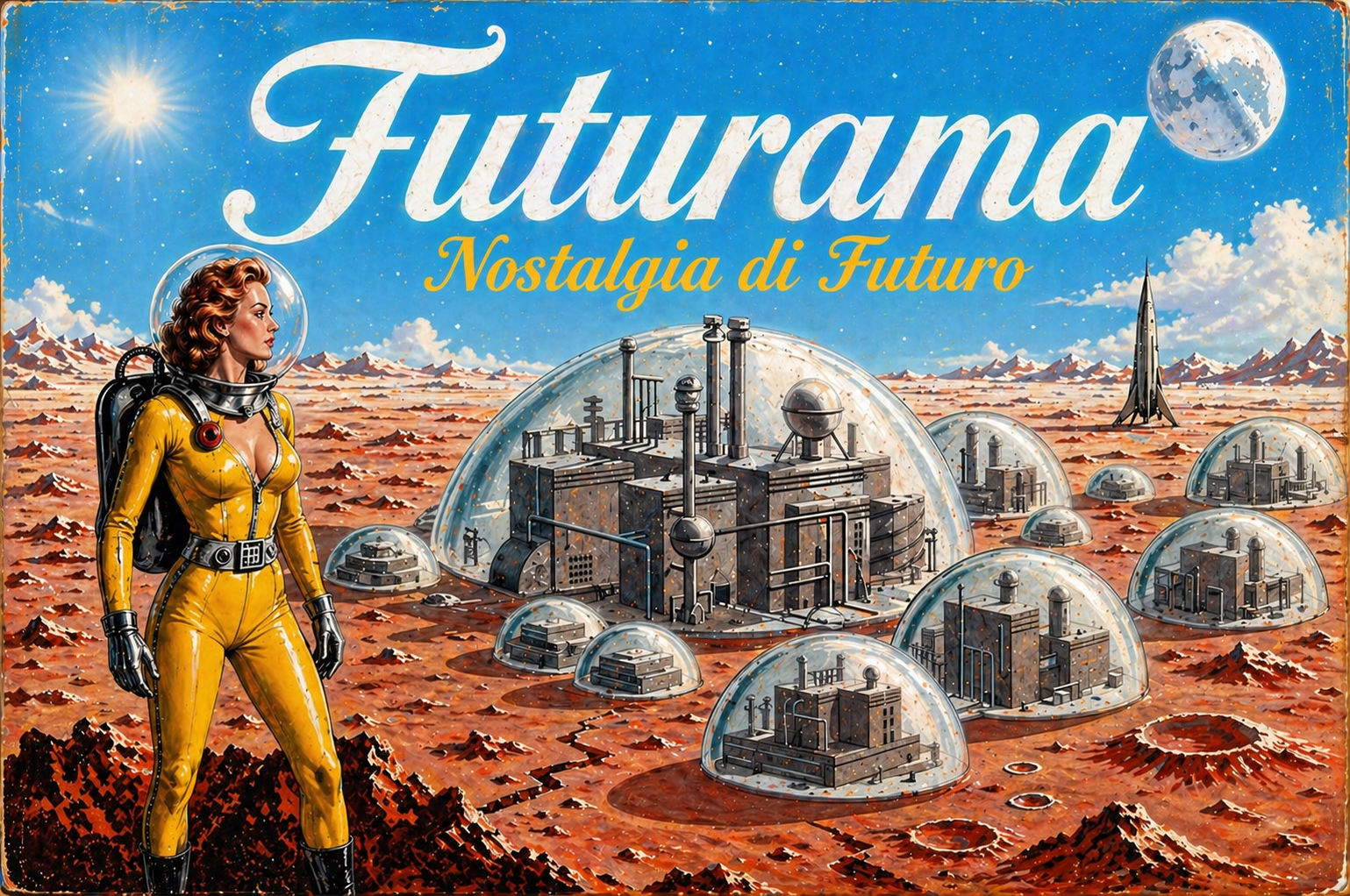
The MAN exhibition builds on that vision to interrogate the historical period when progress seemed inevitable and universally desirable. Indeed, after World War II, economic growth, scientific achievements and technological acceleration fueled a widespread belief in emancipation from material and biological limitations. The space race, industrial automation and the rise of information technology contributed to the formation of a collective imagination based on the idea of a future capable of guaranteeing well-being and development.
According to the exhibition itinerary, that confidence also translated into a widespread aesthetic of the future that ran through art, design, architecture, fashion and popular culture. In art, experimentation involved industrial materials and new conceptions of space. Examples cited include Gino Marotta’s methacrylate bestiary, Giulio Turcato ’s Lunar Surfaces , and Lucio Fontana’s Spatial Concepts. In parallel, design and architecture imagined modular environments and dynamic surfaces, while fashion adopted geometric lines and abstract cuts in dialogue with the artistic research of the period.
The exhibition also includes a section devoted to the design of the 1960s, characterized by shapes and colors that translated the fantastic visions of the time into concrete objects. An additional focus is on fashion, with a section curated by Michela Gattermayer.
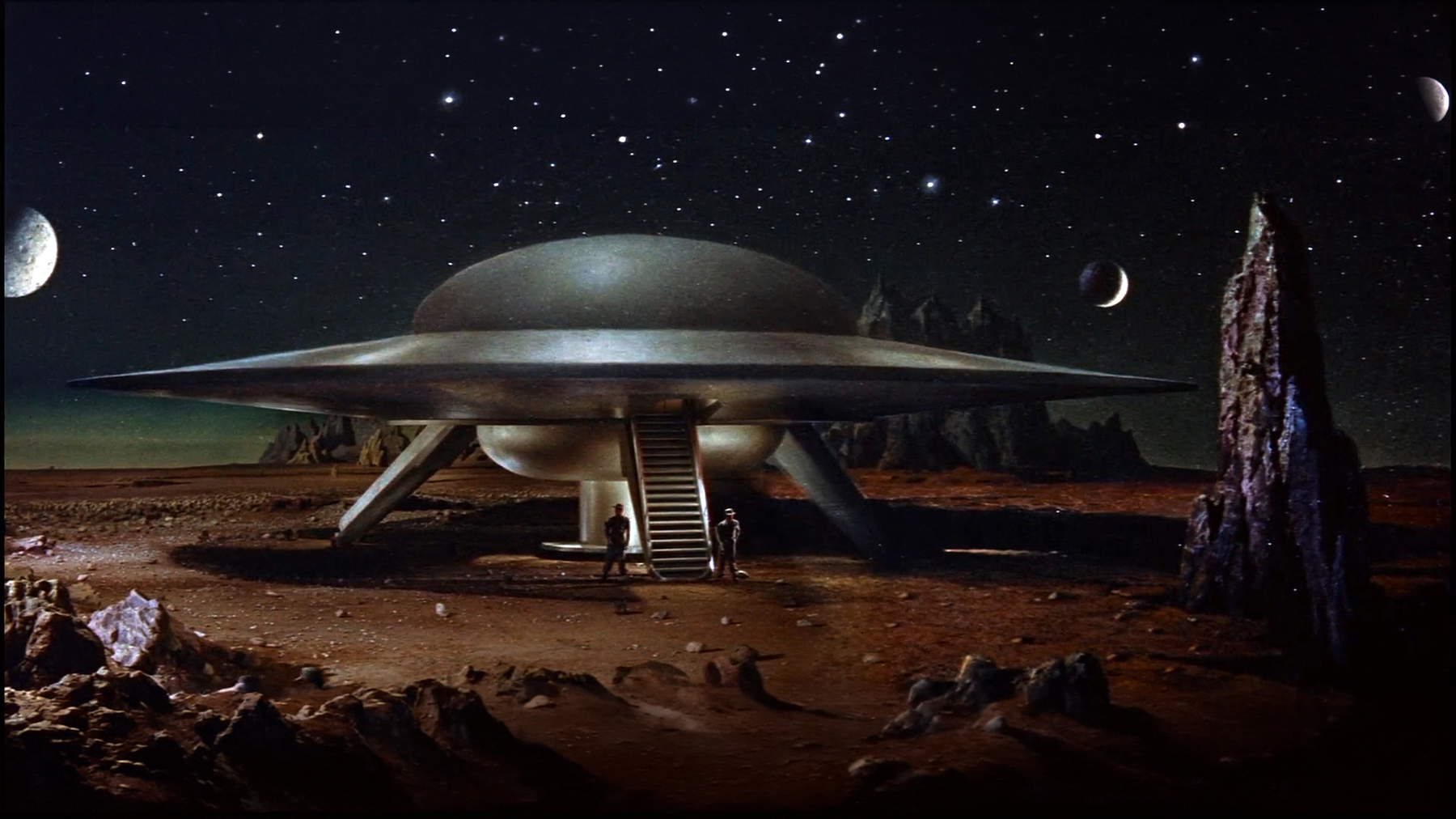
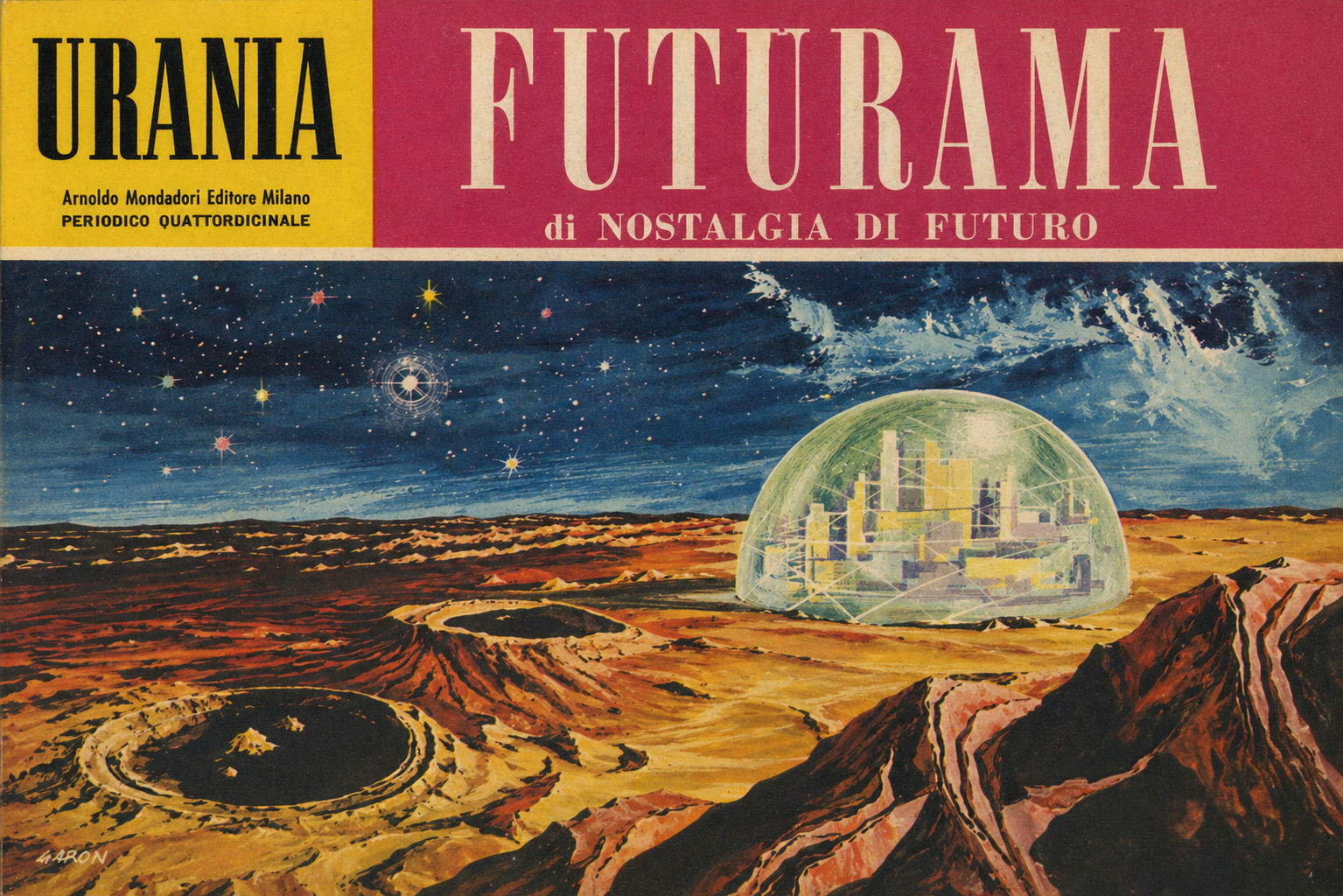
Ample space is also given to science fiction and popular culture, considered central tools in the dissemination of the futuristic imagination of the 20th century. Robots, interplanetary travel and hyper-technological societies entered everyday life through cinema, publishing and toys. The exhibition recalls in particular the early Japanese toy robots of the 1950s, inspired by American science fiction and anticipating the great “super robots” of later animation. In playful form, such objects translated the fascination with the machine seen as an ally of the human being. Another core of the exhibition is devoted to the science fiction series that helped spread the idea of the future as a space of adventure and possibility on a large scale. The exhibition will also feature a selection of Urania volumes from the Arnoldo and Alberto Mondadori Foundation.
Central sections of the itinerary also include video installations devoted to science fiction cinematography related to the space race. In this context, the political confrontation between the United States and the Soviet Union during the Cold War is also analyzed through the audiovisual production of the time, which transferred the geopolitical tensions of the 20th century to space.
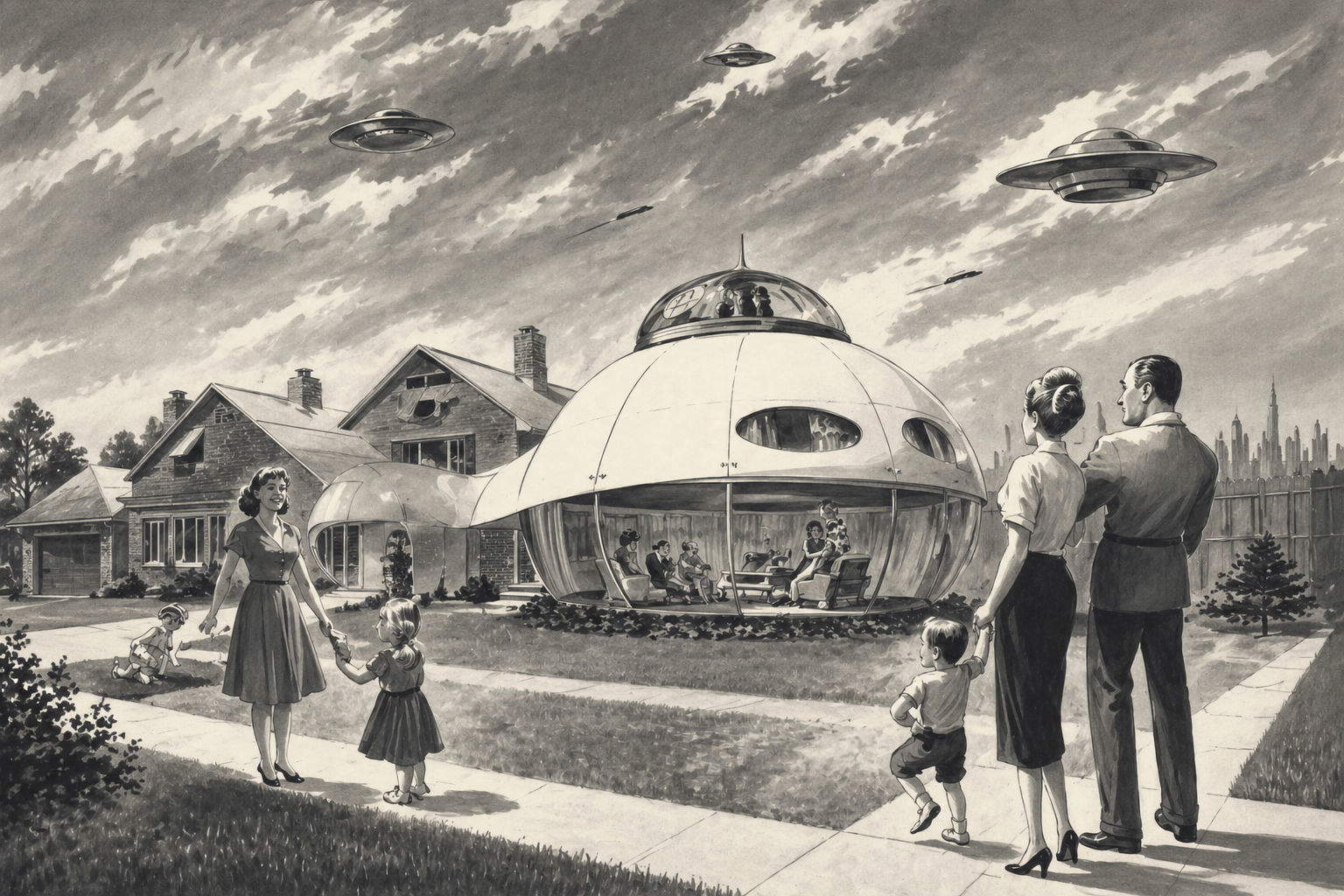
The exhibition thus reconstructs a historical season characterized by a radical faith in progress, interpreted as a true aesthetic utopia. Technology was conceived as an instrument of liberation from labor, hardship and even death. In any case, the path progressively highlights the contradictions generated by the development model itself. The dynamics that fueled modernist optimism also produced new forms of inequality, alienation and ecological fragility. According to the curatorial framework, intensive industrial expansion, uncontrolled urban growth, and total reliance on technology generated environmental and social consequences that the utopia of progress had not foreseen. A number of artists grasped these critical issues early on, including Piero Gilardi, indicated in the itinerary as a figure capable of anticipating the environmental issues that emerged forcefully in the following decades.
With the crisis of the great modernist narratives and the rise of postmodernism, the future gradually ceased to appear as a shared promise. Futuristic representations became increasingly oriented toward dystopian or paradoxical scenarios. In recent decades, additional global events, from financial crises to pandemics, from conflicts to environmental emergencies, have heightened the perceived systemic vulnerability of contemporary societies.
Within this context, Futurama reads the present as an expression of a paradox typical of hypermodernity: an age marked by continuous acceleration, information overload and extremely rapid transformations, capable of generating simultaneous excitement and loss of control. Hence the concept of “future nostalgia,” formulated by the exhibition as an emotional tension toward a better tomorrow in a time marked by uncertainty. It is not, according to the curatorial project, nostalgia for the past, but the loss of the collective belief in change that had spanned much of the 20th century. Through a path that interweaves technological utopias, aesthetics of progress and critical visions of contemporaneity, the exhibition thus proposes a reflection on the possibility of imagining new future scenarios. The stated aim is to reopen a space for discussion on the idea of the future as a collective construction and not only as an abstract or dystopian projection.
Artists in the exhibition include Valerio Adami, Vincenzo Agnetti, Enrico Baj, Agostino Bonalumi, Davide Boriani, Fabrizio Dusi, Mario Schifano,Lucio Fontana, Piero Gilardi, Pietro Gallina, Gianni Colombo, Sergio Lombardo, Gino Marotta, Pino Pascali, Giulio Turcato and Grazia Varisco. The exhibition will be accompanied by a catalog with critical contributions by Carlo Antonelli, Paolo Campiglio and Michela Gattermayer.
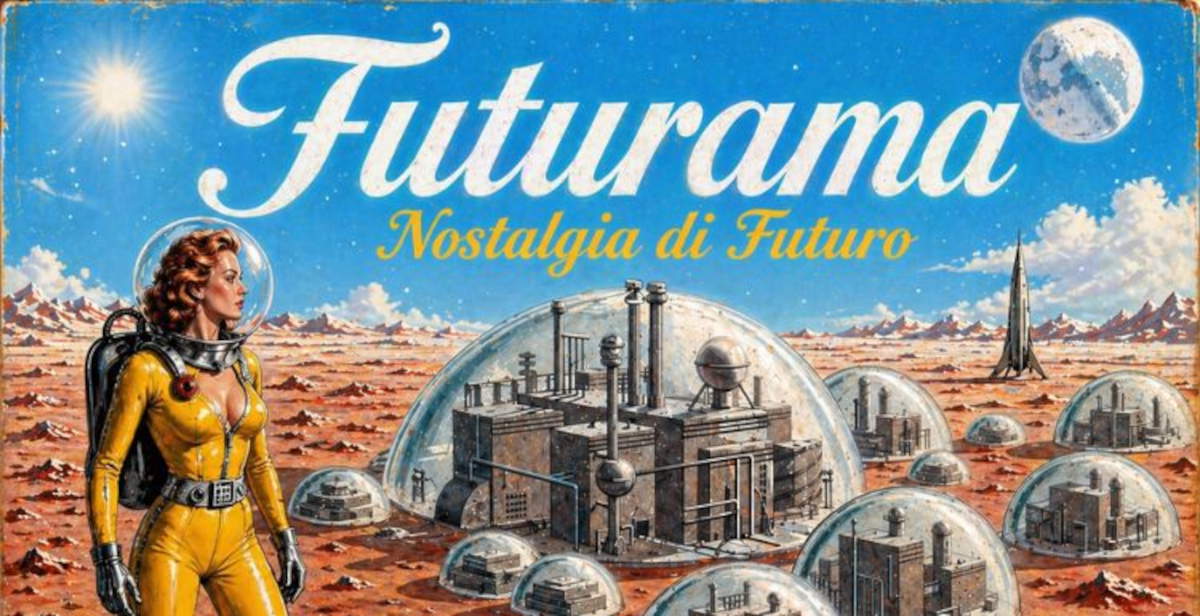 |
| At MAN in Nuoro, Futurama exhibition investigates the future between technological utopia and contemporary crisis |

Warning: the translation into English of the original Italian article was created using automatic tools. We undertake to review all articles, but we do not guarantee the total absence of inaccuracies in the translation due to the program. You can find the original by clicking on the ITA button. If you find any mistake,please contact us.

























 IT
IT FR
FR DE
DE ES
ES CN
CN


