




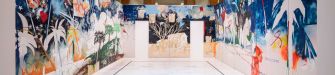
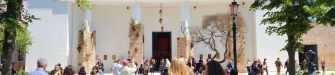
Palazzo Martinengo di Villagana, BPER ’s headquarters in Brescia, once again becomes a place dedicated to contemporary art by hosting a new exhibition proposal signed La Galleria BPER. The exhibition, a solo show by Fabrizio Dusi entitled Fabrizio Dusi. The Words of Others, is curated by Giorgia Ligasacchi. This historic place has been transformed into a space for reflection focused on the theme of language, identity and interpersonal relationships. The Brescia exhibition, which can be visited free of charge until January 11, 2026, is part of a broader conceptual journey initiated by La Galleria BPER. The Brescia initiative, which emphasizes the word understood as voice, is ideally connected to the exhibition The Time of Writing currently underway at the Modena venue, which deals instead with the written word. Both exhibitions share the horizon of paidéia, or the formation of the individual through knowledge, dialogue and beauty. This path, developed through works ranging from the ancient to the contemporary, demonstrates how the topical value of art is maintained in every historical era.
The conceptual focus of the exhibition is a reflection on verbal language, not only as a means of communication, but as an expression of identity and relationship. In an age when individuals are constantly overwhelmed by an excessive flow of stimuli, notifications and messages, a condition of permanent hyper-communication, speech is in danger of losing its essential function of connecting and creating shared meaning. In this apparent overabundance, language has become opaque: rather than sharing, it imposes; rather than expressing, it seduces; rather than listening, it shouts. Words multiply, but listening is reduced, turning communication into mere consumption or an instrument of domination and propaganda.

It is precisely in this situation of crisis that the alternative proposed by Fabrizio Dusi emerges: the choice to listen, to welcome otherness, to question one’s own position. Accepting the multiplicity of points of view is not seen as an obstacle, but as the place where truth can be constructed. In a world that tends toward homogenization and simplification, welcoming the other becomes a revolutionary and deeply political, social and cultural act.
Fabrizio Dusi’s art offers a space to exercise this practice. His works are neither didactic nor imposing; rather, they generate conceptual short circuits and pose questions, demanding an active viewer who does not merely consume the message, but inhabits it. The conscious use of language, according to Dusi, can still represent a “red thread” capable of uniting people, cultures and worldviews. With this in mind, the exhibition is not just an aesthetic journey, but a true ethical experience that emphasizes the responsibility inherent in what is said and defines listening as a political act, suggesting that part of our truth may reside in the words of others.
The very title of the exhibition, The Words of Others, deliberately evokes Florian Henckel von Donnersmarck’s famous film, The Lives of Others (2006). The film explores listening as a transformative gesture, telling the story of a Stasi agent assigned to intercept dissident intellectuals in Berlin. Initially impersonal and instrumental, the attention paid to the speech of others triggers an irreversible change in the agent: silent exposure to the language of others dissolves ideological distance, allowing him to recognize the humanity of those under surveillance. This shift from surveillance to solidarity and from power to support represents the ethical heart of the film and is reflected in the central concept of Dusi’s exhibition.
Along the exhibition route at Palazzo Martinengo di Villagana, Dusi addresses two key archetypal figures in biblical and artistic tradition: the Tower of Babel and theAnnunciation. The artist uses these images, taken from the most reproduced but also among the most misunderstood texts in history, as “devices of meaning” to ground a word-based thought. The Genesis narrative reminds us that creation itself came about through the divine word, not through gesture or thought, establishing language as the origin of meaning and the model of the human condition.
In the Tower of Babel narrative (Genesis 11:1-9), the rupture is consummated. Humanity, united by a single language, attempts to reach the heavens with a boundless construction, a collective but arrogant gesture, animated by hỳbris (the will to assert oneself against the divine). Language, originally an instrument of understanding, is perverted to serve the attainment of power. God intervenes by confusing the languages; communication breaks down, the project fails, and the tower collapses.
Fabrizio Dusi, however, proposes a reinterpretation of this episode, interpreting the divine “punishment” not only as condemnation, but as the beginning of a new condition. In the resulting plurality of languages, in fact, arises the need for listening and the crucial value of translation and confrontation. The word from univocal becomes fragile and multiple, and in this very fragility lies the possibility of building authentic relationships.
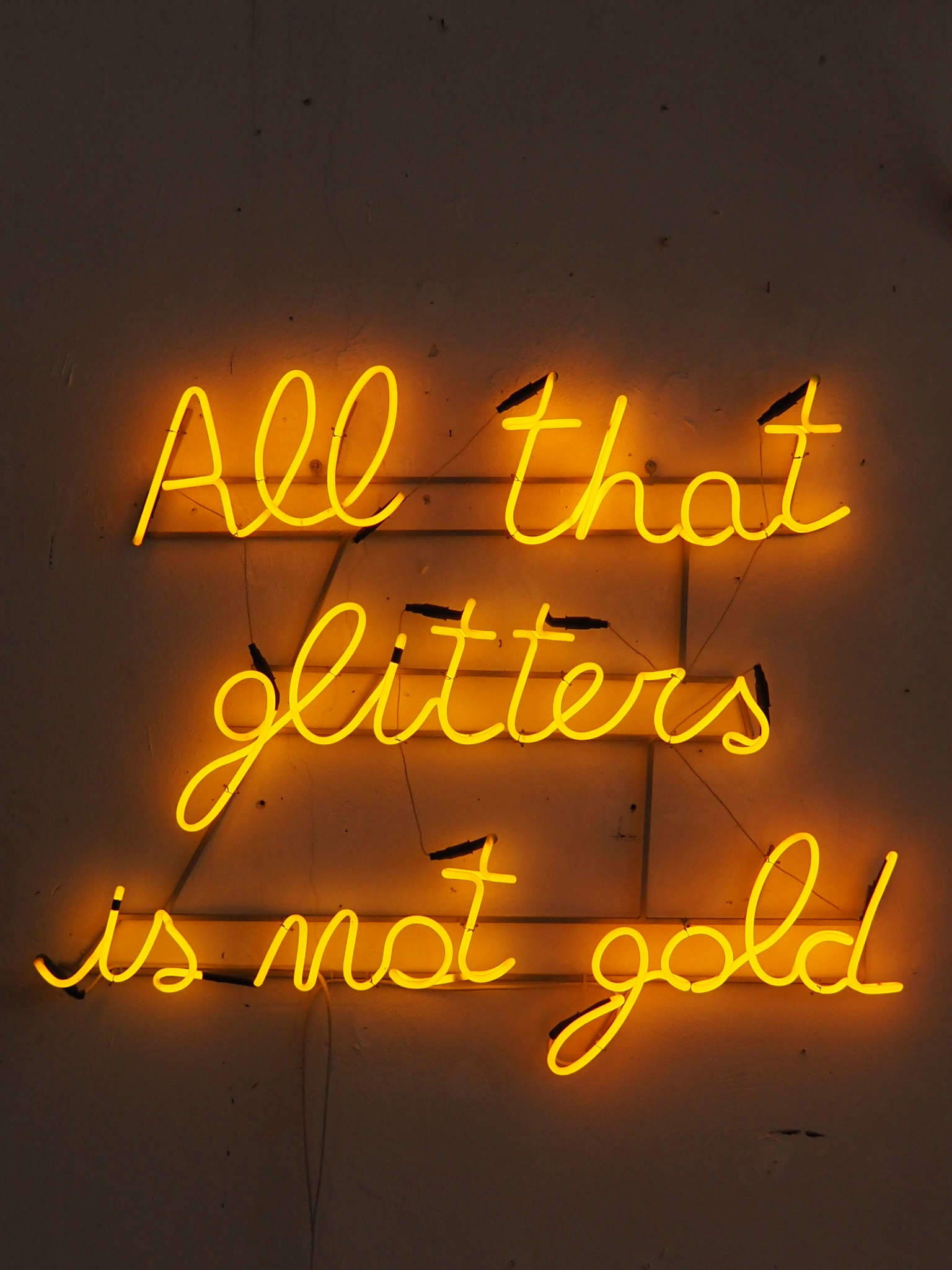
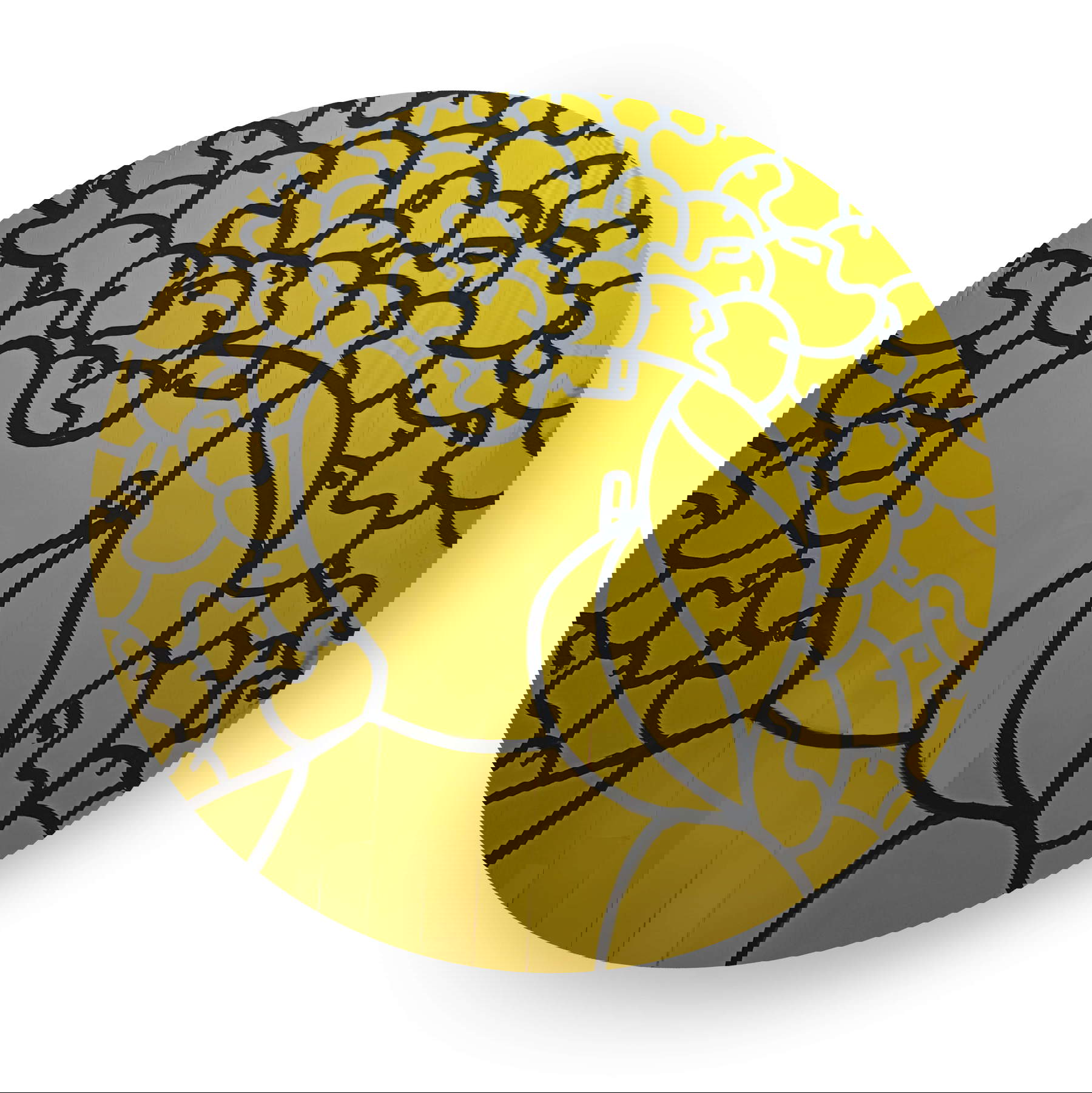

The light installation All that glitters is not gold, positioned at the entrance of the exhibition itinerary (on the grand staircase of the Palace), welcomes the visitor as a warning coming “from above,” in keeping with biblical tradition. This yellow neon phrase, already exhibited in Milan in 2023, warns against the search for a universal and dominant language that does not correspond to authenticity. Linguistic uniformity, while it may appear “golden” or glittering, often hides the loss of dialectical confrontation and nuances of meaning, favoring a superficial and spectacular communication typical of the current era (made of slogans and fake news).
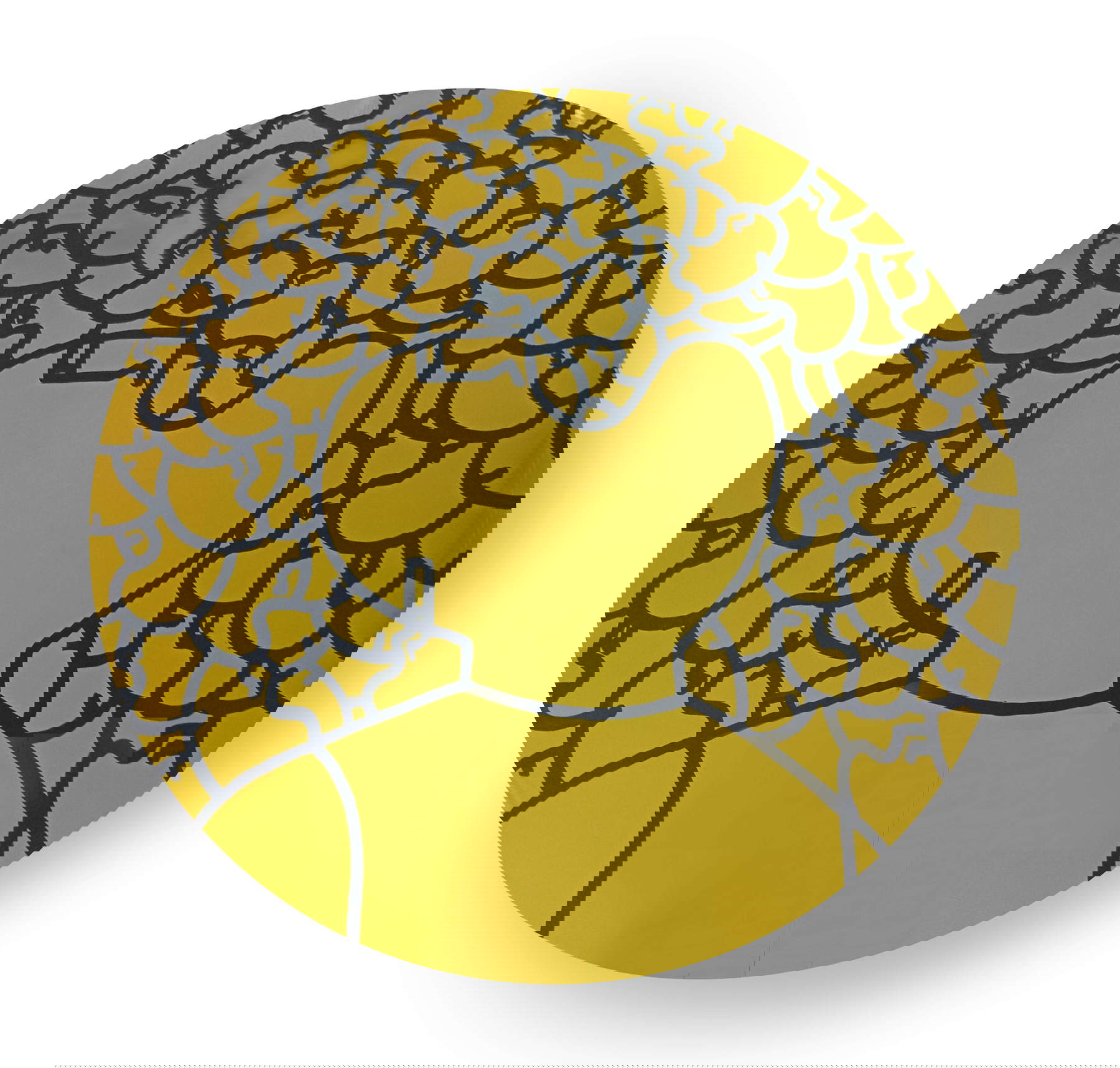
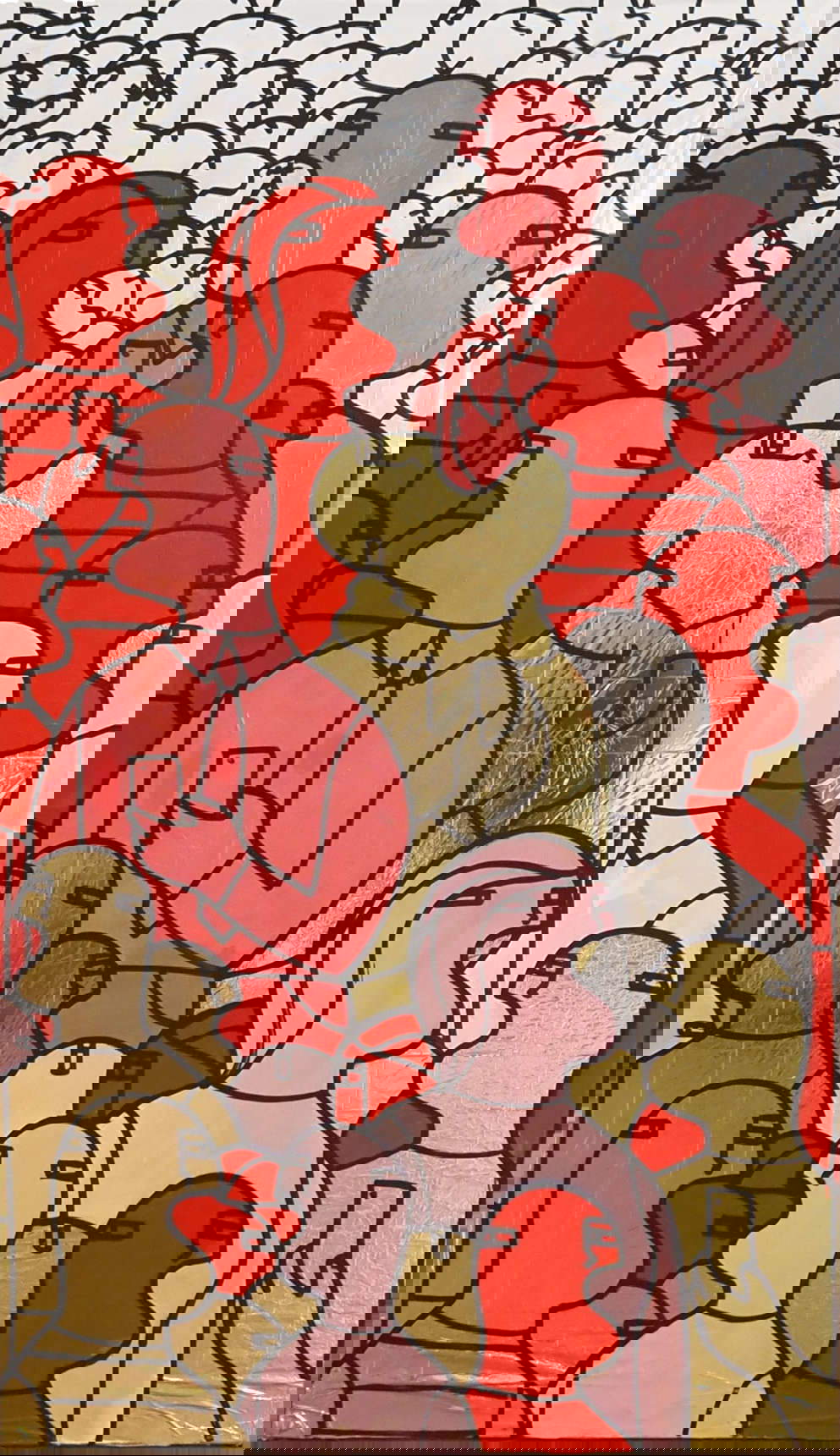
Dusi’s works, made with heterogeneous and symbolic materials such as ceramics, wood, neon and, distinctively, the isothermal blanket, reflect these tensions. In particular, the artist began using the golden isothermal blankets around 2019 to represent the condition of contemporary crisis. This material attracts him not only because of its gold-like visual effect, but more importantly because of its strong symbolic value of emergency and protection, acting almost as a warning sign. The use of the isothermal blanket, an alternative to traditional canvas, reflects an extremely contemporary medium, intimately connected to the present.
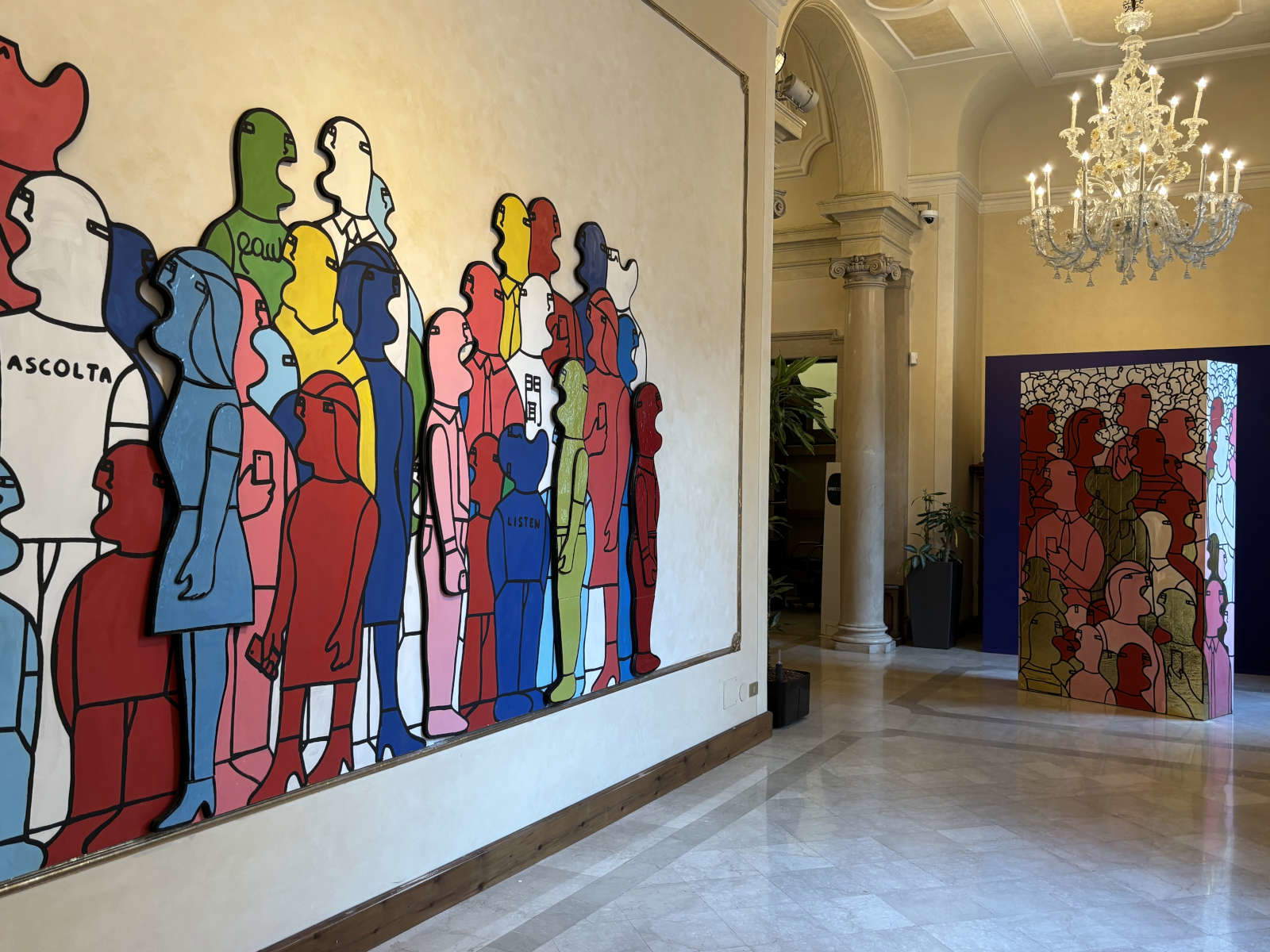
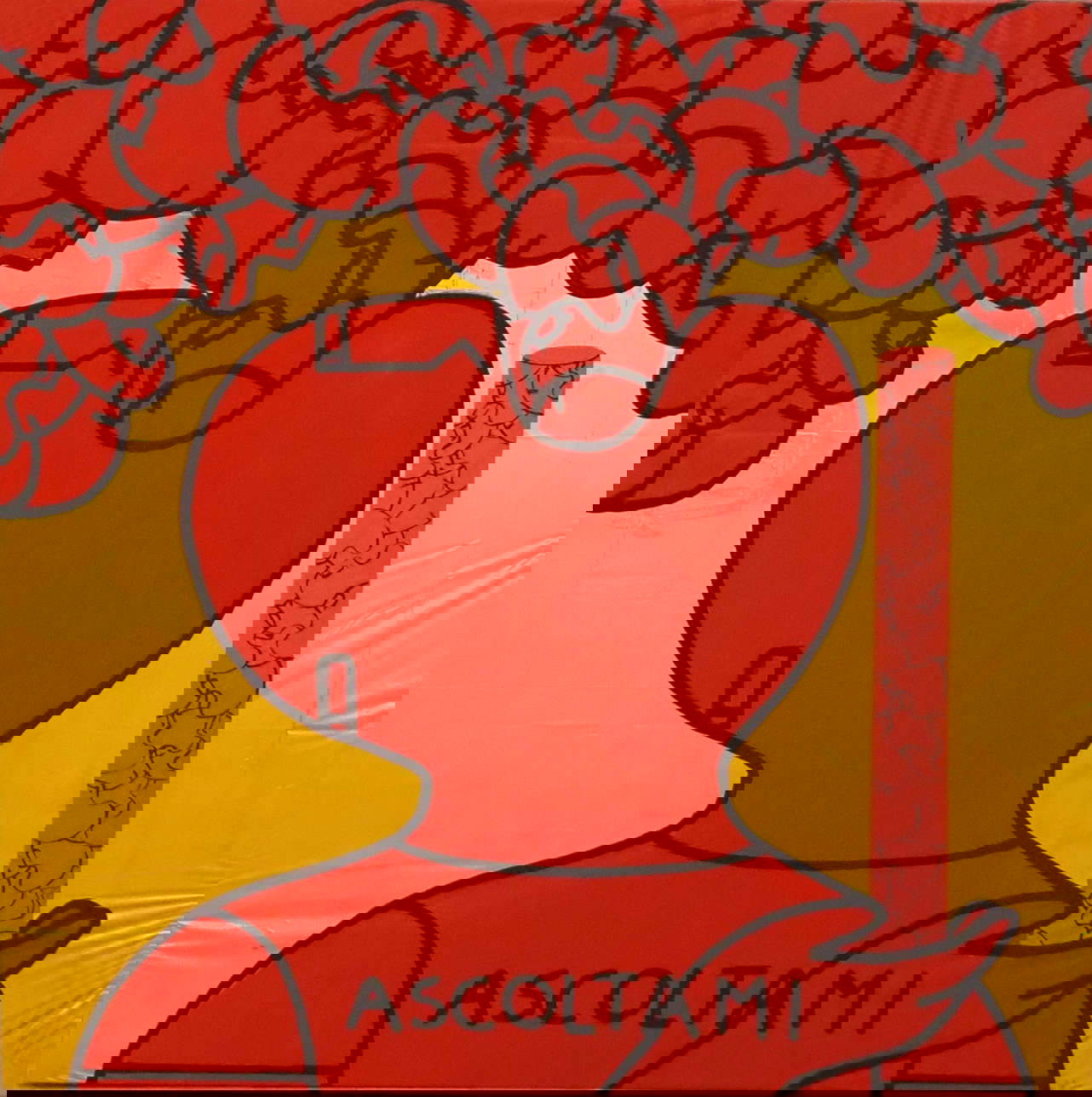
A painting inserted in the foreground, made of painted isothermal blanket, introduces the theme of Babel: the figure portrayed is immersed in a crowd, and on his shirt is visible the words “Listen to me,” almost a muted cry expressing the prevailing need for protection and attention. The elongated, narrow shape of the work provides the first visual reference to the Tower of Babel.
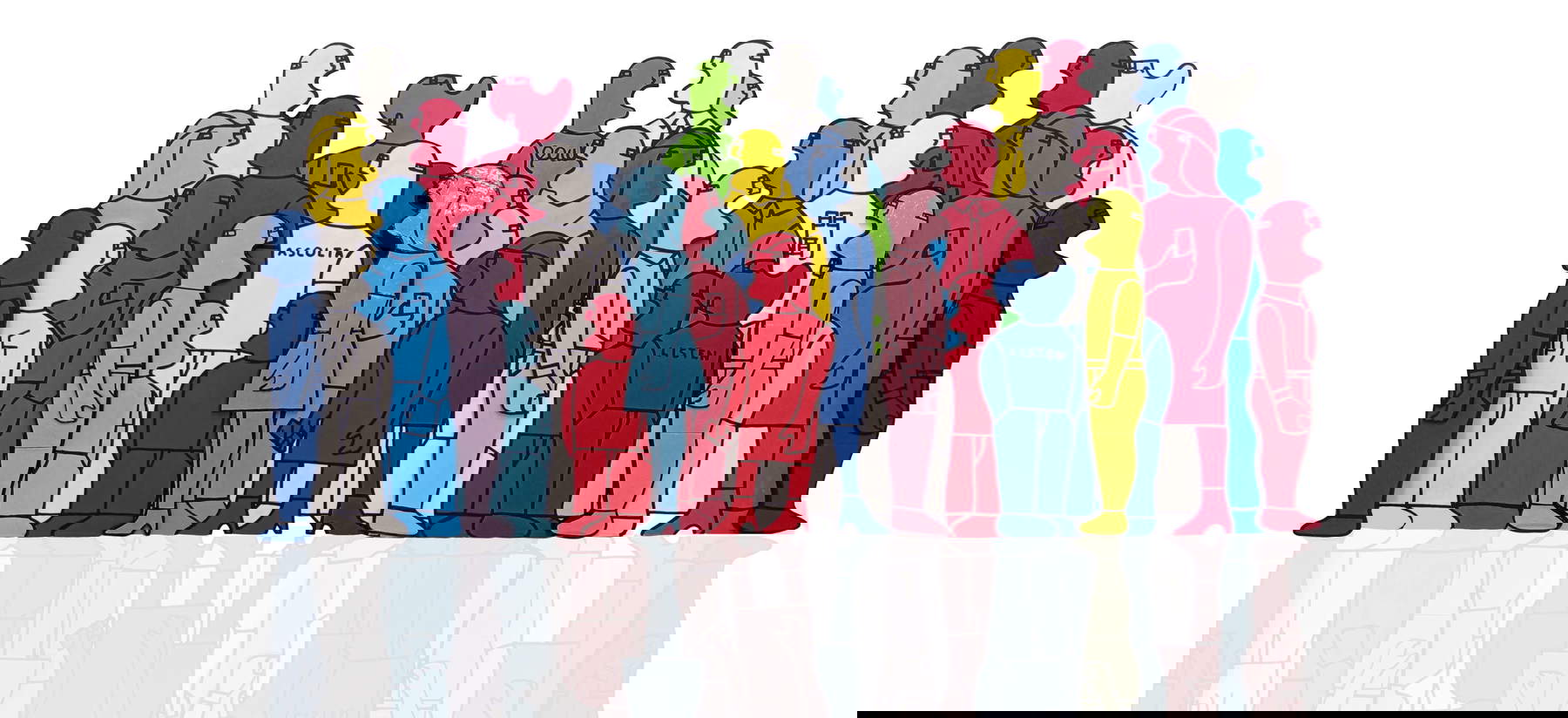
In the main room, a large ceramic installation applied on a wooden support, titled One among the others (The fallen crowd), depicts the bewildered and distressed crowd at the moment of communicative breakdown. These characters, arranged on several levels and bearing inscriptions in different languages on their T-shirts, restore the image of Dusi’s Babelic Crowd. This crowd, while being an image of incommunicability, also symbolizes the moment when the responsibility to communicate takes shape. Linguistic diversity is not an obstacle, but a fertile challenge that invites us to slow down and seek meaning in living together.
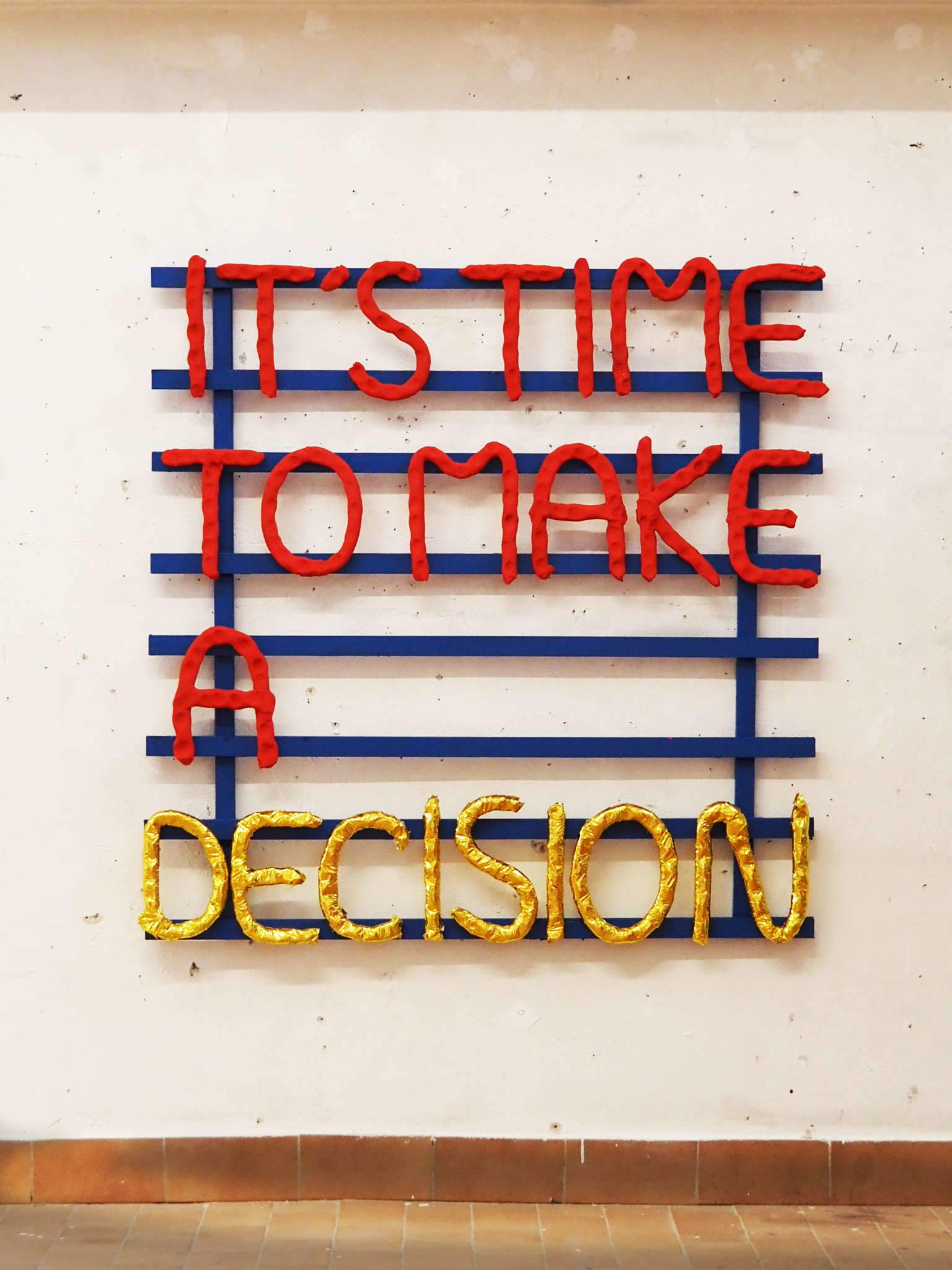
The other archetypal figure explored by Dusi is the Annunciation, which stands in stark contrast to the Babelic confusion. Where Babel represents the shattering of language, the Annunciation embodies dialogue based on authentic listening, the freedom to welcome and the possibility of choice. The work It’s time to make a decision (2025), a red and gold ceramic installation on an iron structure, is a contemporary reinterpretation of the Gospel theme. Contrary to the traditional interpretation of subordination, Dusi and the curators emphasize how Mary of Nazareth does not passively undergo the Archangel Gabriel’s announcement. In the Gospel scene (Luke 1:26-38), the protagonist listens, questions and grasps the mystery. For the first time, a woman is recognized as an active subject in dialogue with the divine. The Announcement is neither a monologue nor a decree, but a request that demands acceptance. Mary, acting in complete freedom and autonomy, consciously decides to answer “yes,” even though she is aware of the grave risk of repudiation or stoning. This is a revolutionary moment, given the limited visibility and decision-making power of women in the era. The play emphasizes that true listening means willingness to be transformed by the other. The request addressed to her does not shine like a slogan. In that silent dialogue, made up of waiting and glances, the word becomes meaningful again and becomes flesh. The past thus offers keys capable of illuminating the present: in contrast to Babelic confusion, the episode proposes a communication based on respect, opening the way to a profound conversation.
The exhibition ideally concludes with the vision of a circle closing. From the rubble of the Tower of Babel rises a “living murmur,” which does not aim to merge voices into a single language, but to make people seek each other out, brush against each other, and recognize each other in a contamination of gestures and phonemes. Listening becomes the true architecture of this new community: an invisible stone capable of holding together what appears distant. Listening generates dialogue, transforming distance into proximity, and in this space of suspension a new collectivity, tenacious if fragile, can be born.
This rebirth is symbolized by Babel reborn, the “Babel that is reborn,” understood as a new, democratic and horizontal city where ideas are discussed and shared and collaboration knows no walls or boundaries. In this context, Babel is no longer seen as a collection of ruins, but as a promise, the threshold of a world that welcomes the word of the other as an authentic force.
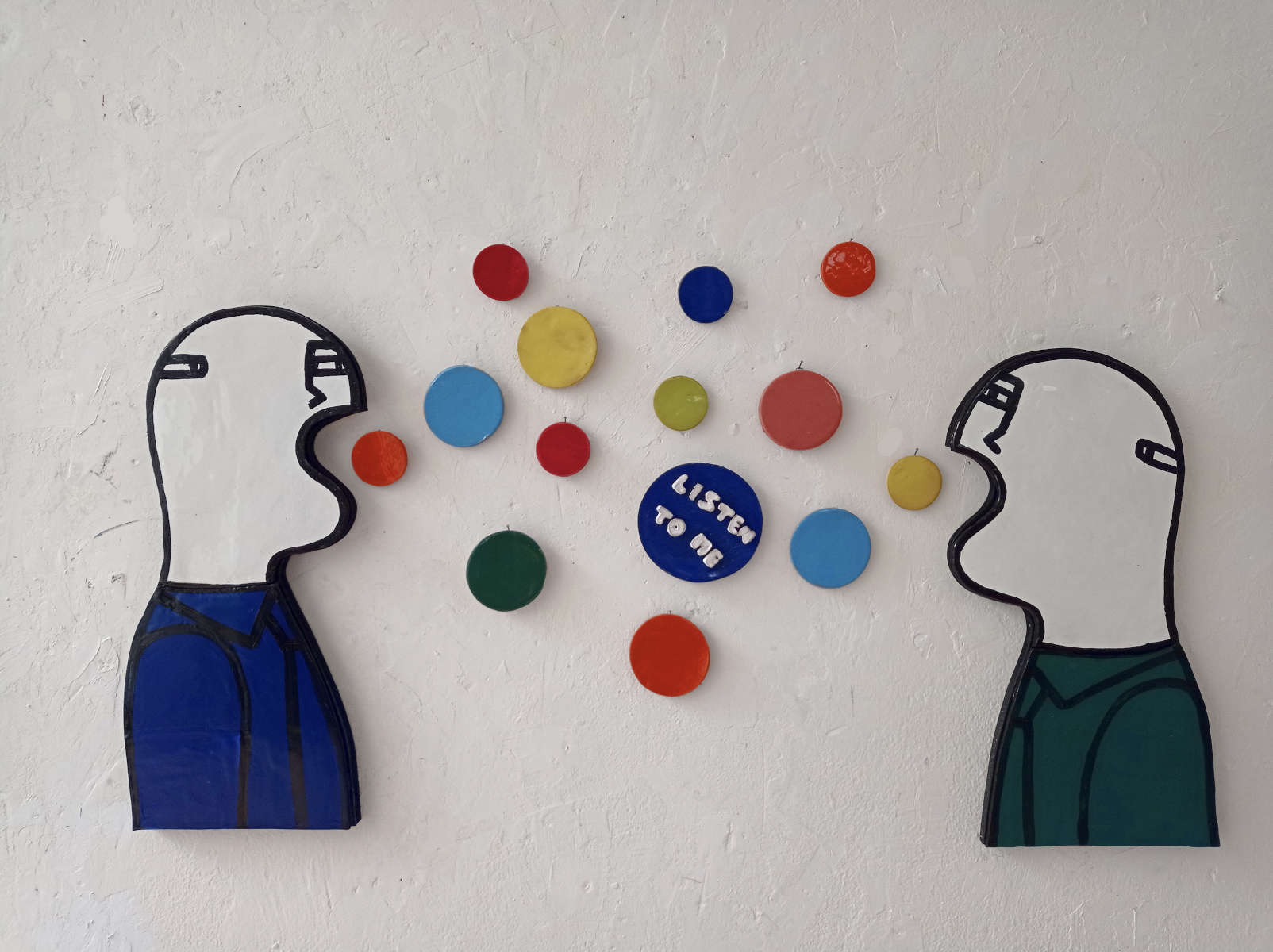
The exhibition journey ends with the encounter of two figures facing each other, wrapped in suspended time. The interstice between them is filled with colored bubbles that create a vibrant space of union: an “I” that opens to the “you,” transforming into a “we.”
The work Classic Family for La Galleria BPER (2023), a ceramic sculpture, was created by the artist to celebrate the union of two historic banking entities. It symbolizes the hope for dialogue and listening between different entities called to work together for a common goal. Its final placement dismisses the audience by projecting them to a horizon of new affective geographies, where ties transcend the boundaries of convention and biology to open up to elective communities. The encounter between these two figures recounts the power of closeness: a harmony that is not a given, but is recreated moment by moment, where identity opens to the movement of encounter.
Through each work, Dusi asks the visitor to open up to the other, a gesture that involves effort, commitment and responsibility. The artist, who has an autobiographical matrix in all his work, universally expresses the personal difficulty in communicating and being heard. If he could “intercept” the words of others, as in the homage to the Stasi film, Dusi would like to hear positive words, but especially with less aggression and shouting, inviting everyone to rediscover kindness and empathy in everyday communication.
Dusi’s exhibition renews the collaboration with La Galleria BPER, which began with the exhibition All that glitters is not gold in Milan in 2023. The Brescia itinerary takes the form of an expansion and continuation of that first project on communication, offering a profound reflection that, in the historic heart of Palazzo Martinengo di Villagana, stimulates the urgency of understanding oneself and the inestimable value of listening.
|
| The words of others: Dusi transforms Palazzo Martinengo in Brescia into a listening workshop |

Warning: the translation into English of the original Italian article was created using automatic tools. We undertake to review all articles, but we do not guarantee the total absence of inaccuracies in the translation due to the program. You can find the original by clicking on the ITA button. If you find any mistake,please contact us.














 IT
IT FR
FR DE
DE ES
ES CN
CN