



by Redazione 31/03/2026



Categories: Exhibitions / Disclaimer
From May 9 to Nov. 22, 2026, Venice hosts The Quiet Source, Jan Fabre's exhibition that compares three new bronze sculptures with Tintoretto's painting cycle, offering a comparison of Renaissance and contemporary art.
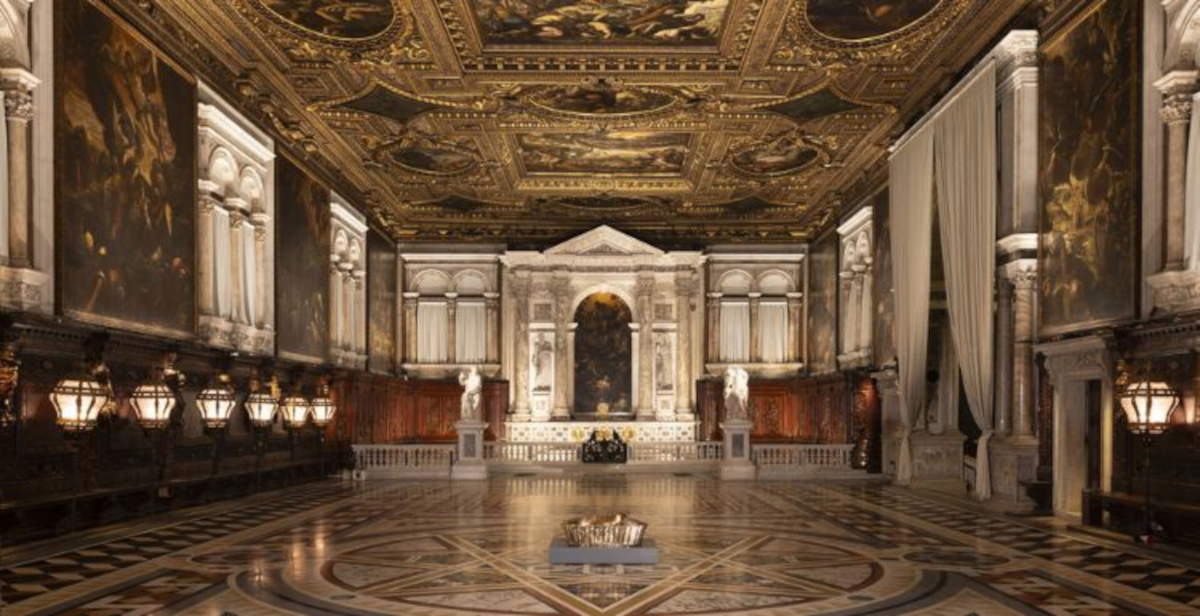
From May 9 to Nov. 22, 2026, the Scuola Grande di San Rocco in Venice hosts The Quiet Source, an exhibition by JanFabre (Antwerp, 1958) presented on the occasion of the 61st Art Biennale. The exhibition, curated by Giacinto Di Pietrantonio and Katerina Koskina, proposes a dialogue between three bronze sculptures and Tintoretto’s famous painting cycle, relating two artistic languages centuries apart but converging in their investigation of light, spirituality and human experience. Fabre is the first living artist invited to intervene in one of the most historically important spaces in Venice, a building that was already the custodian of an exceptionally important Renaissance heritage.
The project is part of the 61st International Art Exhibition - La Biennale di Venezia and is organized by Galleria Gaburro and the Linda and Guy Pieters Foundation. The Flemish artist has for years been developing an interdisciplinary path that includes drawing, sculpture, installation, film and performance. For The Quiet Source, Fabre confronts Tintoretto through sculpture, using silicon bronze, a material that can amplify light and give the works an almost immaterial quality of presence.


The three sculptures, developed over a five-year period, are placed along the central axis of the building, creating a path through the ground and upper floors of the School, almost as if forming a symbolic spine similar to a Tree of Life. The works constitute a trilogy focusing on the themes of family, memory and personal mythology. Although they all incorporate the artist’s body, two of them bear the faces of Fabre’s father Edmond and his brother Emiel, who died before the artist’s birth.


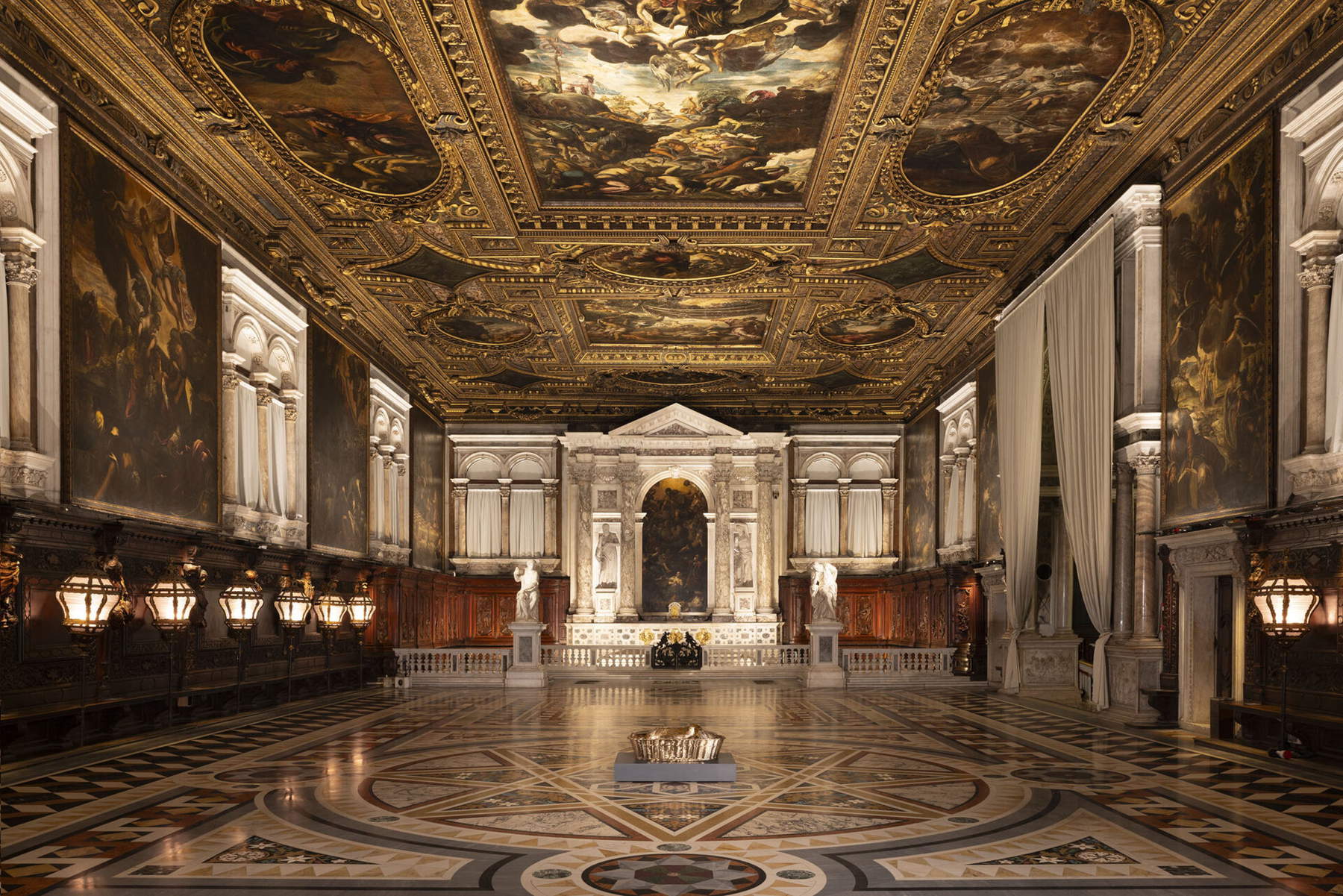
On the ground floor isThe Man Who Holds the Sword (Oath of My Father), depicting Fabre with his father’s face as he raises a sword to the sky in a solemn gesture. The posture recalls the archetypal knight, in a reference to the medieval chivalric tradition and the historical mission of the Scuola Grande di San Rocco, dedicated to protecting the most vulnerable. In the Chapter Room, The Artist as a Stray Dog in His Basket shows the artist in the guise of a stray dog curled up in a basket, with a marmot lying on its back. The animal references Fabre’s wife, Joanna, symbolizing love and protection, while the dog recalls the iconography of St. Roch, patron saint of the School, traditionally depicted with the animal that fed him during his illness.
The last sculpture, The Man Who Cuts the Grass, is placed in the Sala dell’Albergo, below Tintoretto’s Glory of Saint Roch. Fabre appears there on all fours with the face of his brother Emiel, cutting blades of grass with a small pair of scissors. The gesture recalls folk rituals related to protection and purification, introducing a performative dimension: the sculpture is designed for visitors to sit, transforming the relationship with the work and inviting a reflection on the boundaries between contemplation and participation.
In all three cases, light takes a central role. Just as in Tintoretto’s Venetian painting, the dramatic and expressive use of light defines space and emotions, imparting a dynamic depth that spans centuries of art history. The entire project dialogues with existential tensions, between life and death, good and evil, integrating mourning and memory in a meditation on human experience. The exhibition catalog is published by Forma Edizioni, Florence.
Statements
“Jan Fabre is a revolutionary, iconoclastic and subversive artist,” says curator Katerina Koskina. “... In this context, his installations in major museums (Uffizi Gallery, Louvre Museum, Hermitage Museum) or in old palaces and theological schools (New Great School of Santa Maria della Misericordia and today the Great School of San Rocco), monasteries and churches (Abbey of St. Gregory, Chapel of Pio Monte della Misericordia) are anything but accidental. These are ideal contexts for an aesthetic, physical and existential experience activated by history, ’staging’ and memory, which cultivates the dialectical relationship between past and present and emphasizes the timelessness of art.”
“That light is the same light with which Fabre creates connections between different worlds, reflecting on the logic of origin through a strong melancholy,” notes curator Giacinto Di Pietrantonio. “In the exhibition a direct confrontation with Tintoretto is staged, in no way antithetical but cooperative; a threshold is constructed that allows us to observe and compare two extremely similar eras, though obviously uneven.”
Notes on the artist
Jan Fabre is a visual, performance, theater and author artist who is considered among the most versatile figures in contemporary art. Since the late 1970s, while studying at the Institute of Decorative Arts and the Royal Academy of Fine Arts in Antwerp, he has developed an interdisciplinary path focused on the human body and its expressive potential, experimenting with different materials and artistic languages. His deeply performative work is distinguished by a recognizable visual language characterized by recurring forms and motifs that create a constant dialogue between work and audience. Raised in a Catholic context, Fabre has often explored sacred spaces and spiritual themes, integrating biblical symbolism and theological reflections into his practice.
His major exhibitions include the Belgian Pavilion at the Venice Biennale (1984), other international biennials, documenta VIII and IX in Kassel, and projects such as Gaude Succurrere Vitae (SMAK Ghent; GAMeC Bergamo; Musée d’Art Contemporain Lyon; Fundación Miró Barcelona), Homo Faber (KMSKA Antwerp, 2006), From the Cellar to the Attic - From the Feet to the Brain (Kunsthaus Bregenz, 2008; Arsenale Novissimo Venice, 2009), PIETAS(Venice 2011; Antwerp 2012), Hortus/Corpus (Kröller-Müller Museum, 2011) and Stigmata: Actions and Performances 1976-2013 (MAXXI Rome, 2013; M HKA Antwerp, 2015; MAC Lyon, 2016; Leopold Museum Vienna, 2017). Fabre was also the first living artist to exhibit a major solo show at the Louvre Museum(L’Ange de la Métamorphose, 2008) and the State Hermitage Museum in St. Petersburg(Knight of Despair / Warrior of Beauty, 2017).
 |
| Venice, Jan Fabre dialogues with Tintoretto at the Scuola Grande di San Rocco |
Warning: the translation into English of the original Italian article was created using automatic tools. We undertake to review all articles, but we do not guarantee the total absence of inaccuracies in the translation due to the program. You can find the original by clicking on the ITA button. If you find any mistake,please contact us.