




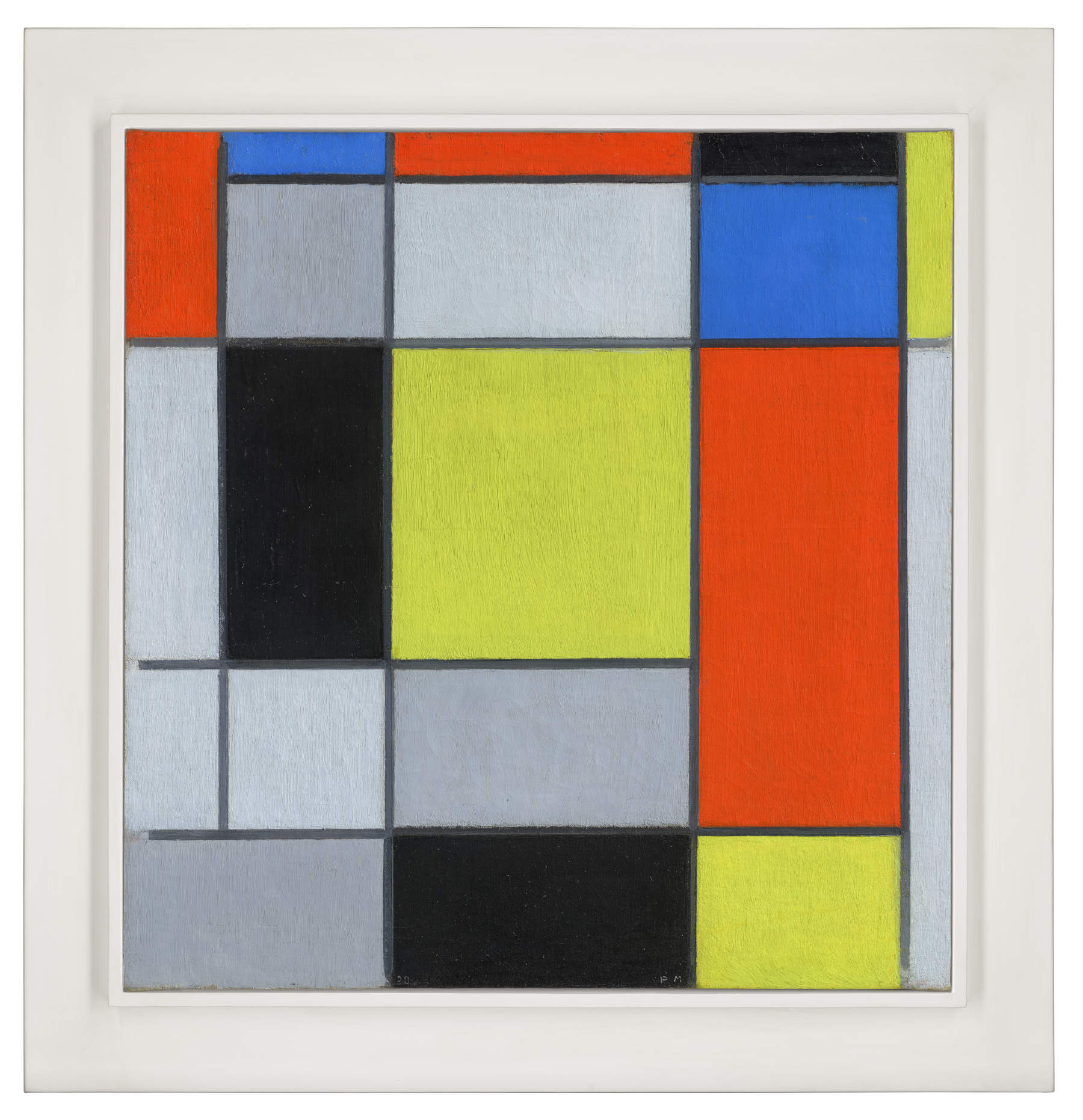
One of the highlights of the London auctions during Frieze Week 2026 will be Piet Mondrian’s *Composition III*, a 1920 masterpiece that Christie’s will present at its *20/21 Century: London Evening Sale* on October 14. The work, estimated at 20–30 million pounds ( approximately 23.3–35 million euros), is appearing on the market for the first time and represents the most significant Mondrian painting offered at auction in Europe since 2009, when *Composition avec bleu, rouge, jaune et noir (1922) and Composition I (1920) were sold by Christie’s in Paris from the collection of Yves Saint Laurent and Pierre Bergé.
Among the painting’s previous owners were Armand P. Bartos, an architect and collector known for his interest in Modernism, and his wife Celeste. It was created at a decisive moment in Mondrian’s artistic development, when the artist produced the first fully realized examples of the abstract language he would later define as Neo-Plasticism.
In 1920, Mondrian created only eight paintings considered fundamental to this transition in his work. Five of these are now part of international museum collections: the Tate in London, the Museum of Modern Art in New York, the Stedelijk Museum in Amsterdam, the National Gallery of Modern and Contemporary Art in Rome, and the Wilhelm-Hack Museum in Ludwigshafen.
*Composition III* was created after the artist’s return to Paris in late 1919, following the years he spent in the Netherlands during World War I. Back in the French capital, Mondrian reestablished ties with the avant-garde scene and embarked on a new phase of his artistic exploration. Throughout 1920, he gradually defined the principles of Neo-Plasticism, developing a visual language based on reducing painting to its essential elements. During the same period, he worked on the essay *Le Néo-Plasticisme: Principe général de l’équivalence plastique*, published the following year as a pamphlet by the publisher Léonce Rosenberg. This marked the first time his theories on art were made available in French.
The works from this period demonstrate the progressive development of this approach. Mondrian focuses his compositions on the interaction of strictly organized geometric shapes and lines, while the surfaces are delineated by graphic marks and a color palette reduced to what he considered fundamental colors. This formal simplification also stemmed from a philosophical conviction: by reducing painting to areas of color and lines, the artist believed it was possible to express an idea of universal harmony and to explore the fundamental laws of the universe.
The creation of his 1920 paintings required a great deal of time and a process of continuous refinement, in which theoretical reflection and intuition proceeded hand in hand. Mondrian could work for months on the same composition, allowing the paint to dry between stages and periodically stepping back from the work to assess the changes. He did not use an easel while painting: he placed the canvas on a table near a window to take advantage of natural light, while the easel was used primarily to view the painting from a distance.
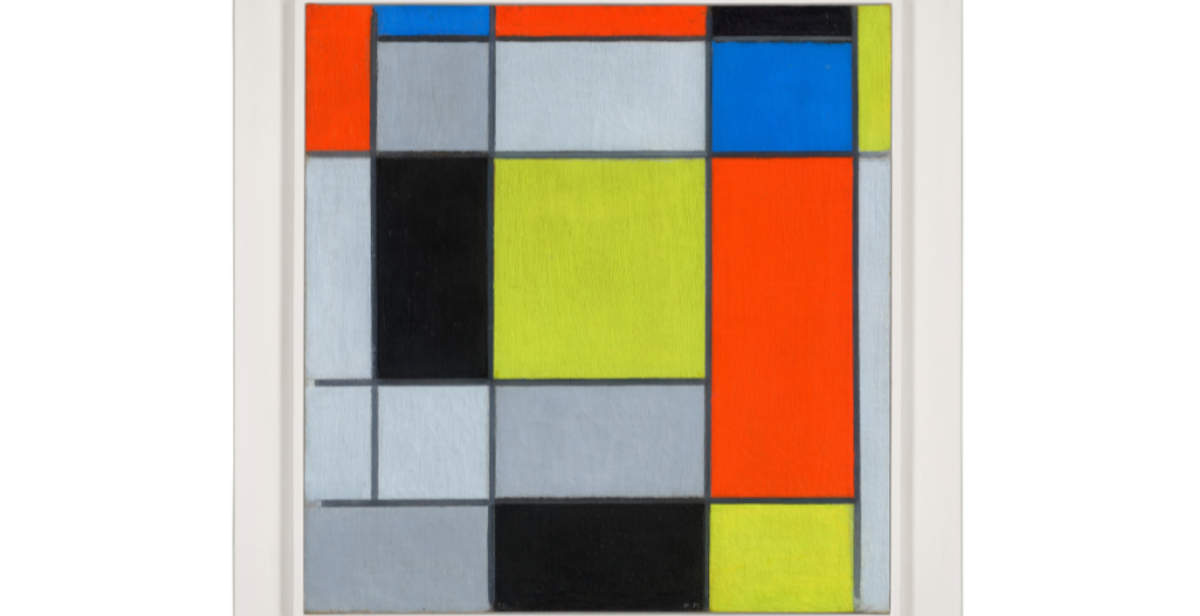
*Composition III* illustrates this method through a structure based exclusively on the colors permitted by the Neo-Plastic system: red, yellow, and blue, alongside black, white, and gray. The color fields are organized into a dynamic grid of lines, whose tone varies slightly as they traverse the surface. The red and blue areas are balanced by fields of bright, almost acid-like yellow and by various shades of gray. The layers of pigment and traces of brushstrokes remain visible, revealing the artist’s hand.
A distinctive feature concerns the black panels, to which Mondrian applied a layer of varnish to increase their saturation and brightness and accentuate the contrast with the other colored surfaces. At the center of the composition, a yellow square positioned on the axis of symmetry introduces a point of visual tension that contributes to the overall balance.
Prior to the London exhibition, scheduled for October 8, 2026, *Composition III* will be presented at Christie’s locations in Zurich from September 2–4, Paris from September 9–12, New York from September 17–20, and Hong Kong from September 25–29. The auction will take place in London on October 14, 2026.
“We are delighted to celebrate Mondrian’s extraordinary legacy and to present his 1920 masterpiece, *Composition III*, alongside another key work from this pivotal year, which is part of the Tate’s collection,” says Keith Gill, Christie’s Vice President for 2020/21.“Composition III dates back to a turning point in Mondrian’s career, when he arrived at a new and radical abstract language that profoundly redefined the landscape of modern art. Appearing at auction for the first time in its history, it ranks among his most important and rare paintings ever to come to market.”
 |
| One of Mondrian's most important works is up for auction at Christie's: estimated at 30 million pounds |
Warning: the translation into English of the original Italian article was created using automatic tools. We undertake to review all articles, but we do not guarantee the total absence of inaccuracies in the translation due to the program. You can find the original by clicking on the ITA button. If you find any mistake,please contact us.

























 IT
IT FR
FR DE
DE ES
ES CN
CN


