




Auctioned by Il Ponte Auction House is the rediscovered manuscript of Princess Ippolita Maria Sforza. On parchment, richly illuminated and still preserved in its original binding, the mid-15th-century codex contains the first decade of Titus Livy ’sAb Urbe condita and was chosen by the young Sforza as part of her dowry on the occasion of her wedding to Alfonso II of Aragon, celebrated in Naples in 1465.
Sold for the sum of 420,000 euros, the manuscript is set in the context of the exceptional humanistic education received by Ippolita, who is considered one of the most erudite women of 15th-century Italy. Trained in Milan by such illustrious masters as Baldo Martorelli and Constantino Lascaris, she had an education equivalent to that of her male siblings, based on Latin, notions of Greek and the reading of the great classical authors. Books constituted the center of his education and a fundamental tool in defining his political and cultural profile.
In 1465, at the time of her marriage to Alfonso II of Aragon, Duke of Calabria, Ippolita arrived in Naples bringing a dowry composed not only of precious objects but also of fourteen manuscripts of extraordinary value, punctually described in the dowry inventory. A large part of these codices went missing with the dissolution of the Aragonese library; the volume that has resurfaced today thus represents a rare and significant testimony to that book heritage.
The inclusion of classical Latin texts alongside devotional books reveals a conception of knowledge intimately linked to the exercise of power. Authors such as Livy and Virgil offered moral and political examples essential to the education of the humanist prince, an ideal shared by Alfonso II himself. The manuscript thus belongs to a cultural tradition that considered the classics not only an intellectual heritage, but tools of government, diplomacy, and dynastic self-representation.
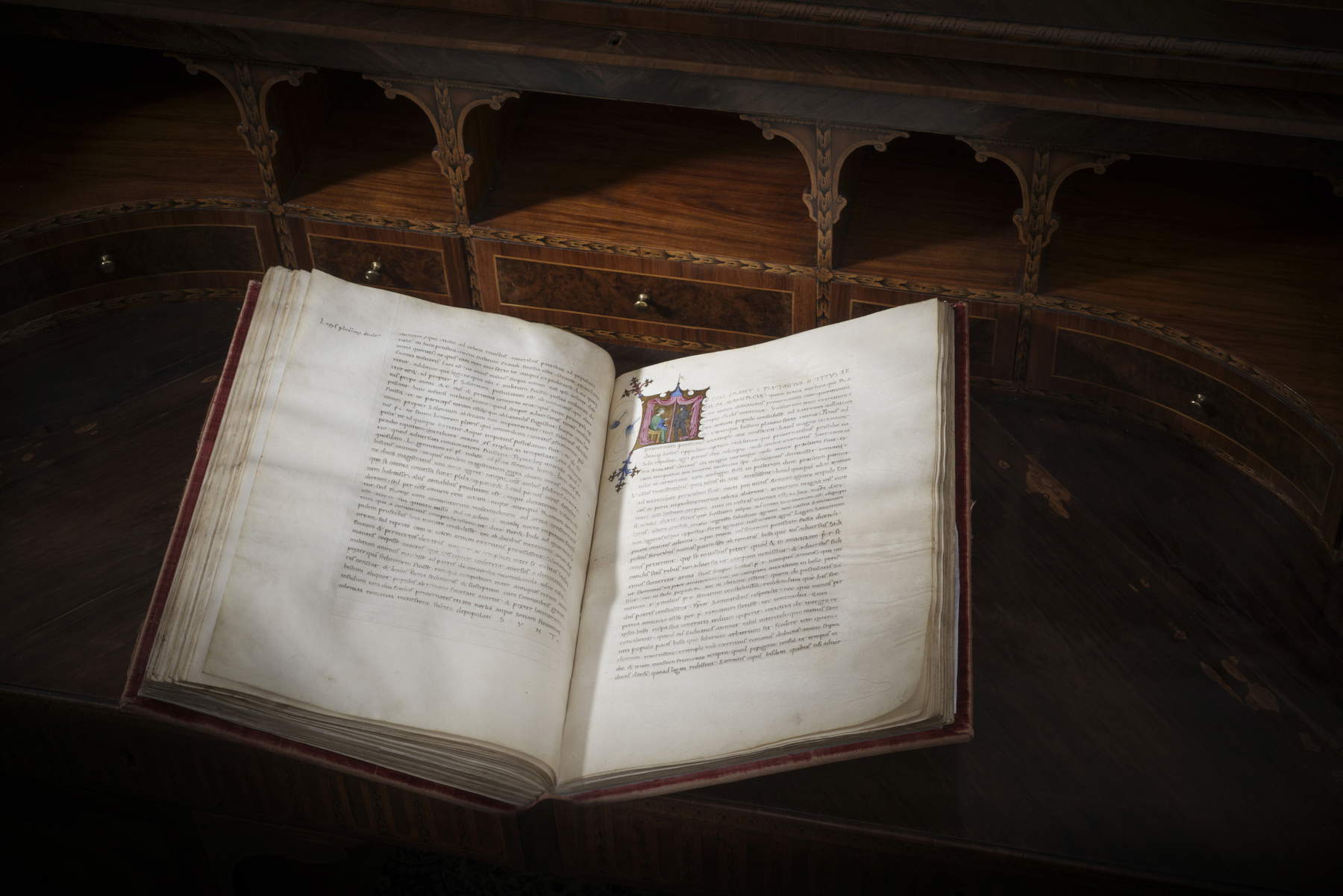
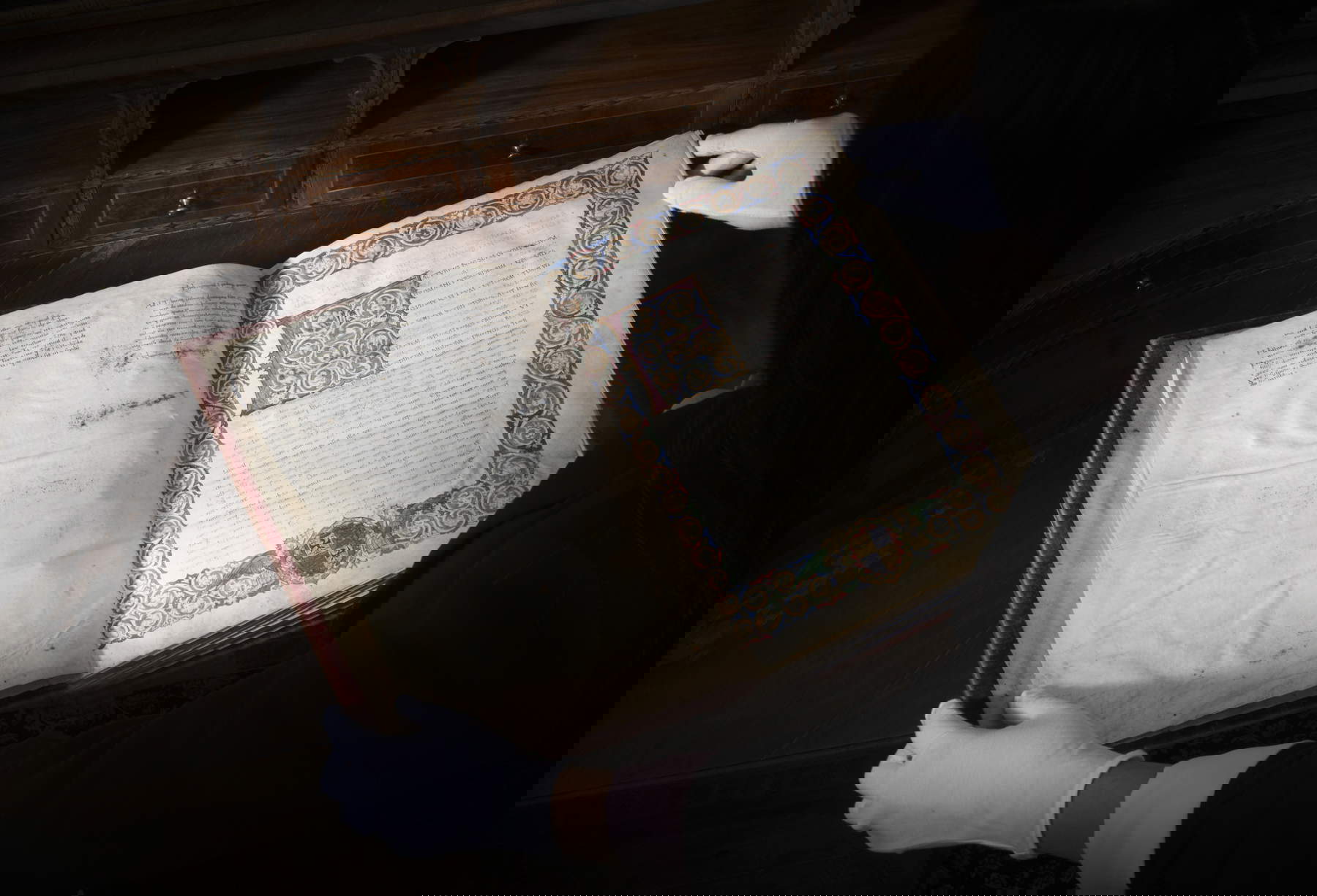
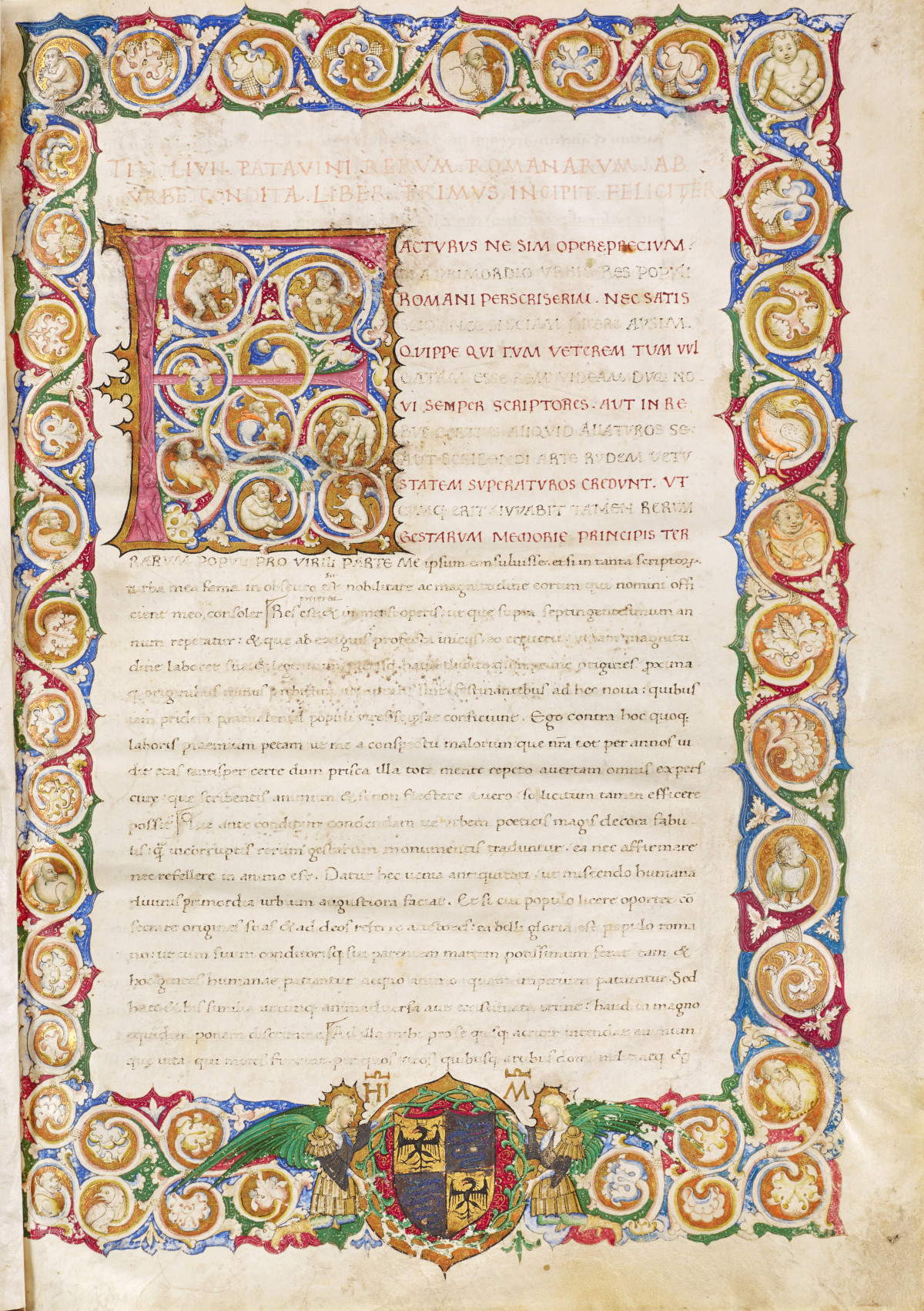
This is a 208-card membranous codex, manuscripted in elegant humanistic handwriting and without cartulation. All the papers feature dry-erase rifling with holes. The first paper is framed by an elaborate decoration of white girari embellished with punched gold, with putti and drôlerie; in the center, at the bottom, stands the Sforza coat of arms supported by two angels and surmounted by the initials “Hi M.” There are nine finely illuminated initials on a gold background, adorned with plant and animal motifs and historical figures. An autograph inscription by Ippolita Maria, dated 1460, appears on the guard leaf, with quotations from Cicero’s De Oratore and St. Jerome’s Prologue to Genesis. The volume also has numerous glosses by different hands, quoting classical authors such as Virgil and Ovid, as well as a schematic representation of the caudine forks. The restored binding is in red silk on wooden boards, with gilt cuts.
“In addition to its historical and bibliographical value, in this find lies the fascination of being able to rediscover and recount a cultured woman, patron and bibliophile, where, for centuries, male dominance was unquestioned,” writes Stefania Pandakovic, director of the Books and Manuscripts Department of Il Ponte Auction House. “In commissioning this monumental work by Titus Livy, Ippolita Sforza revealed her interest in the virtues, diplomacy and good governance that guided her actions in the relations between Milan and Naples and in the events of the Pazzi Conspiracy. A woman of culture and balance, she earned the esteem of Lorenzo de’ Medici and became a symbol of a feminine humanism, at once intellectual and political. Presenting this manuscript today means giving voice again to that legacy, allowing those who love books, history and art to relive-through the pages of Livy-the vision and grace of a princess who made knowledge her highest form of power.”
|
| Sold by Il Ponte Auction House the rediscovered manuscript of Princess Ippolita Maria Sforza |

Warning: the translation into English of the original Italian article was created using automatic tools. We undertake to review all articles, but we do not guarantee the total absence of inaccuracies in the translation due to the program. You can find the original by clicking on the ITA button. If you find any mistake,please contact us.





















 IT
IT FR
FR DE
DE ES
ES CN
CN