





A restoration project involving the Fountain of Lions has been launched at the Buonconsiglio Castle in Trento, with work scheduled between April and July 2026. The operation is part of a historical-artistic heritage enhancement initiative supported by Pellegrini Spa and Villotti Group Srl, in collaboration with the Superintendence for Cultural Heritage of the Province of Trento.
The start of work is set for April 27, 2026, while the activities are expected to be completed by the end of July of the same year. The project includes a first phase dedicated to diagnostic investigations, followed by the actual restoration work. The execution is entrusted to the company Lares Restauri of Venice, under the supervision of the provincial Superintendency.
The initiative is part of a path of interventions that the Pellegrini family has developed over the years in the field of conservation and enhancement of cultural heritage. The company, which has been active in the business sector for more than a century and now operates in the field of office printing & digital transformation, has progressively consolidated an activity of supporting restoration projects. Previous interventions include the restoration of the statue of St. John of Nepomuk on the Grand Canal in Venice, the opening of the Secret Itinerary of the Doge’s Palace, and the recovery of the bust of Teodoro Correr at the Correr Museum in St. Mark’s Square. The deal also represents a moment of consolidation of the group’s business presence in Trentino, where Pellegrini Spa has been active since 2024.
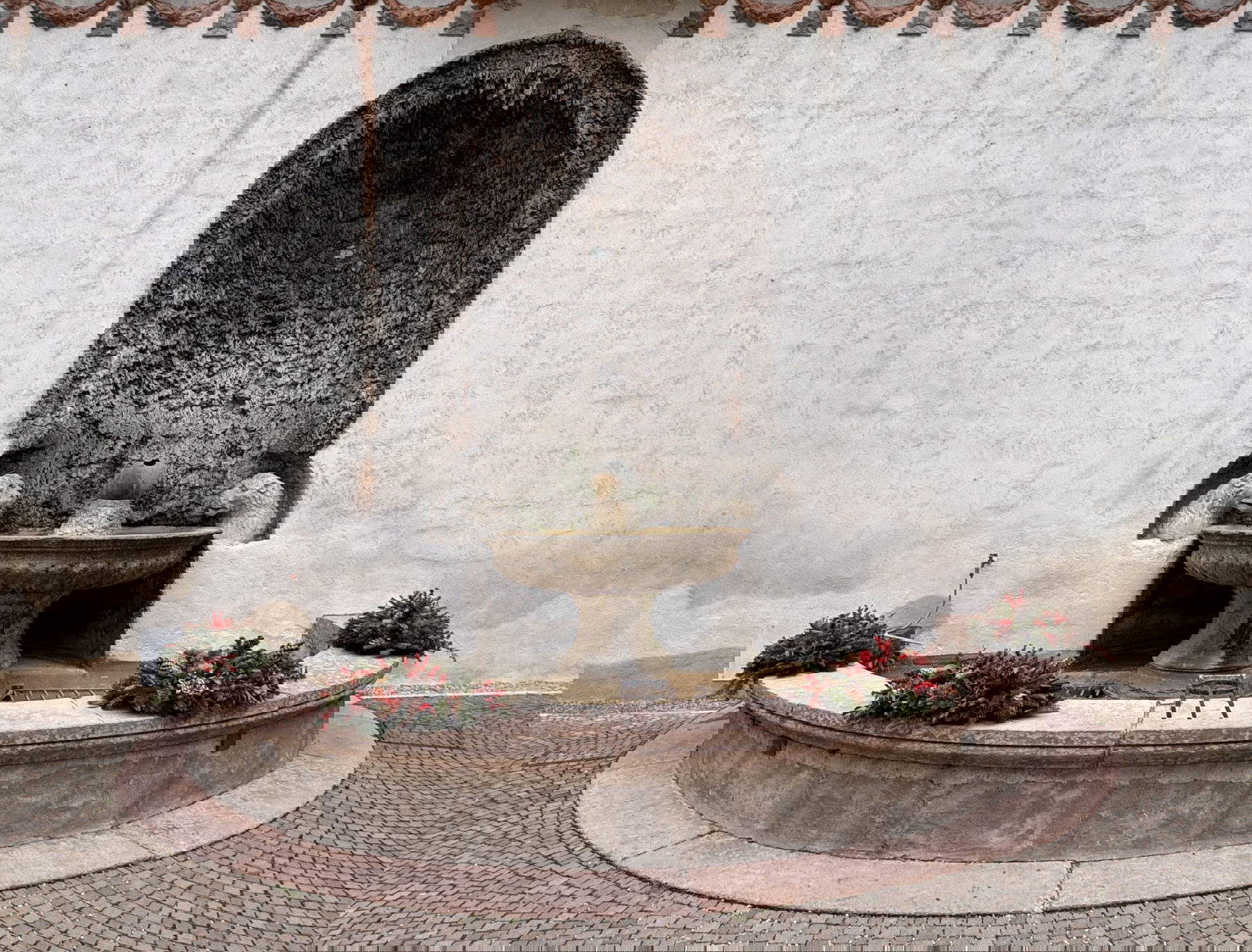
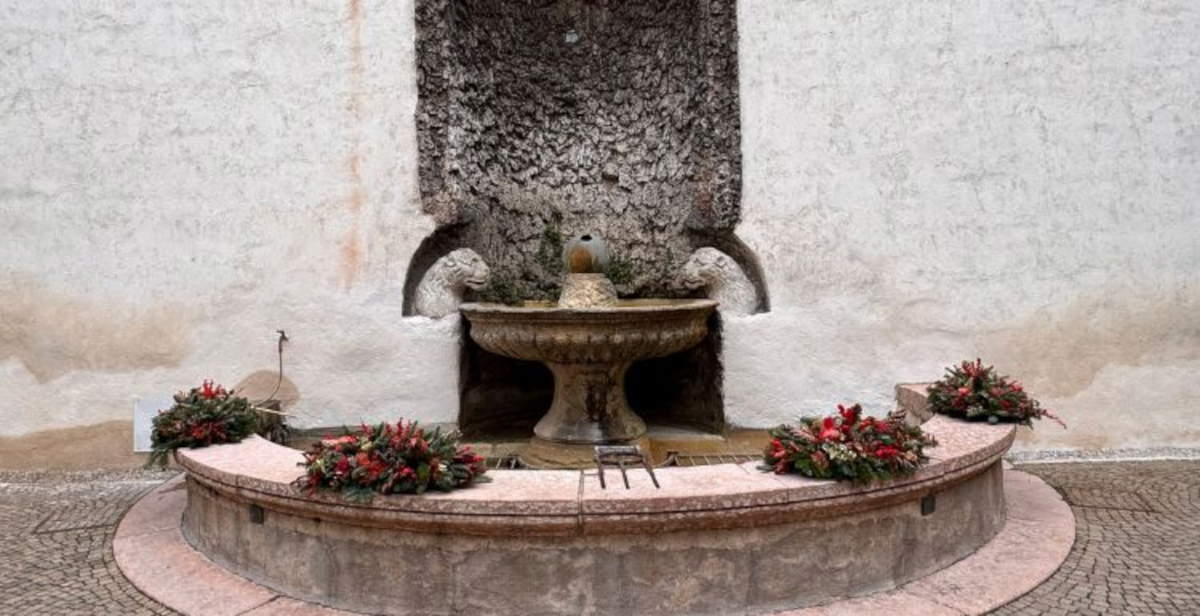
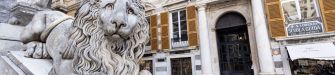
From a technical point of view, the fountain is set against a light-colored plastered wall and features a central niche lined with irregular elements in vacuolar travertine. The niche, in the form of a round arch, is configured as a deeply recessed element characterized by an irregular surface reminiscent of the artificial grottoes typical of fountains of Mannerist matrix. At the base of the niche is a circular basin of carved ammonitic stone, placed on a central pedestal decorated with a bas-relief. In the center of the basin is a metal sphere from which the water jet emerges, an element that constitutes the visual focus of the entire composition. On either side of the basin are two lion heads, presumably made of Istrian stone, recurring elements in historic fountains and associated with symbolic meanings related to strength and protection.
The ensemble is bordered by plastered masonry on which a red Verona marble cover is inserted, with a molded frame defining a continuous semi-circular-shaped seat. The state of conservation of the work shows the presence of inconsistent surface deposits and differentiated degradation phenomena on the different constituent materials. The stone surfaces are affected by limestone stratification, salt efflorescence and pulverization phenomena in some areas. There are also structural fragmentations and discontinuities that require preventive safety interventions.
The planned operations consist of a sequence of technical steps. Controlled removal of inconsistent surface deposits and precautionary preconsolidation of areas affected by pulverization is planned, with interposition of Japanese paper sheets. Larger fragments will be secured, while those in danger of falling will be fixed by punctual microinjections of epoxy resin. For non-removable elements, a treatment with corrosion inhibitors is planned, preceded by brushing and degreasing the surfaces with suitable solvents. This will be followed by cleaning operations of the stone elements affected by coherent deposits and desalination interventions through repeated application of deionized water packs on the areas affected by salt efflorescence.
Calcareous stratifications will be removed by the use of micro-cutters, followed by thorough rinsing of the surfaces with deionized water. Detached fragments will be bonded using two-component epoxy resin, after cleaning and degreasing the contact surfaces. The project also includes the removal of degraded or unsuitable grout and the subsequent repair of cracks and micro-cracks with salt-free lime-based mixes, river sands and marble powders selected to be consistent with the original materials of the work. Surfaces that show disintegration or pulverization will undergo consolidation work. The final stage involves protection of the stone surfaces by application of oligomer siloxane, applied by brush and spray.
 |
| Restoration of the Fountain of Lions at Trento's Buonconsiglio Castle gets underway |

Warning: the translation into English of the original Italian article was created using automatic tools. We undertake to review all articles, but we do not guarantee the total absence of inaccuracies in the translation due to the program. You can find the original by clicking on the ITA button. If you find any mistake,please contact us.



















 IT
IT FR
FR DE
DE ES
ES CN
CN


