





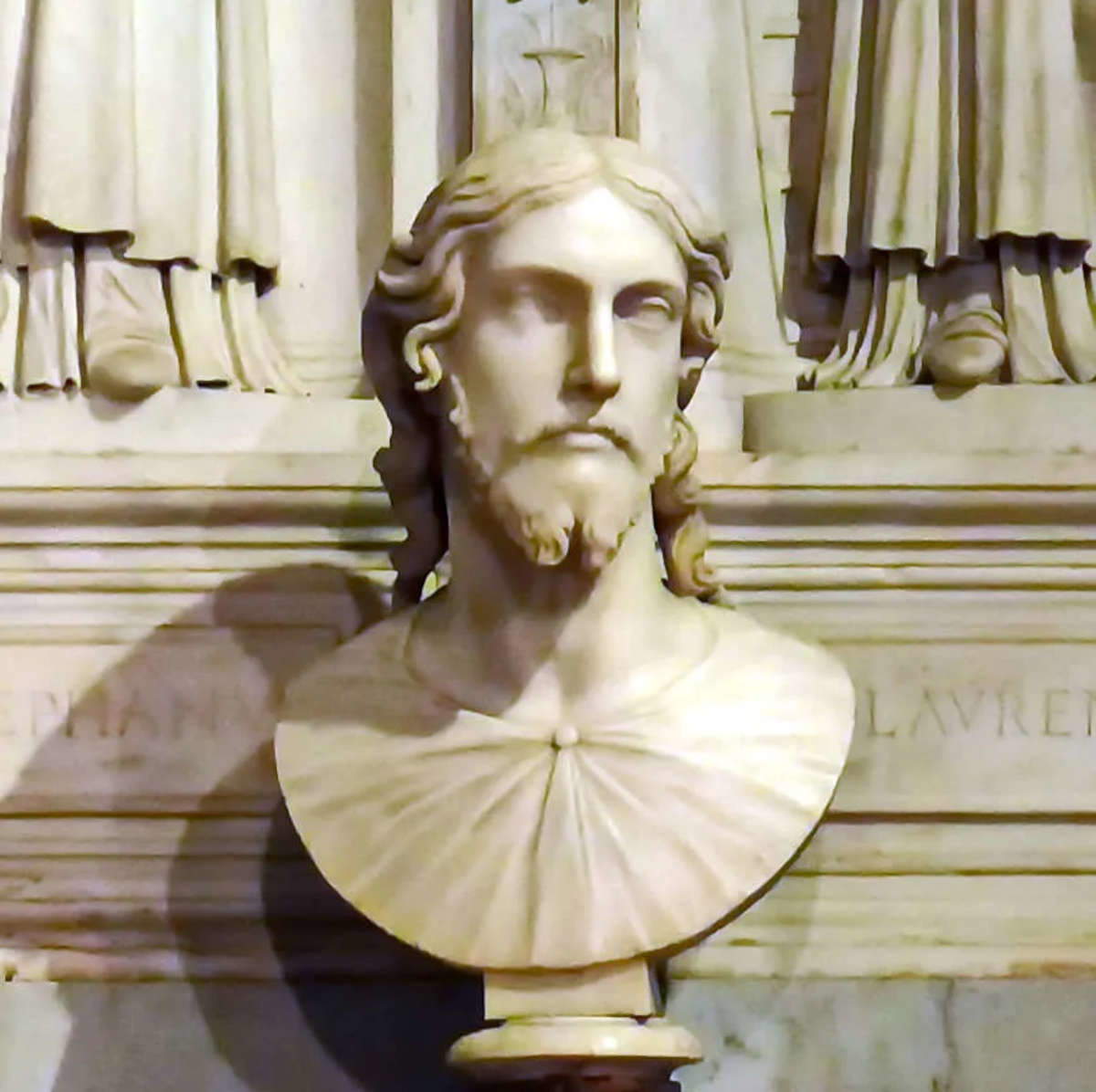
It seems that the only ones still willing to believe in the clumsy, flimsy, improbable attribution to Michelangelo of the poor Christ of Sant’Agnese fuori le Mura are the journalists of Rai’s Tg3: nine days ago, the news program of the third public network aired a report, signed by Cecilia Carpio (moreover relaunched on the Rai News website with the peremptory title “The Christ of Sant’Agnese in Rome is by Michelangelo”), to give an account of certain alleged novelties that, according to Valentina Salerno, i.e., the researcher who proposed the attribution, would confirm her thesis. A minute and a half of service to assert, in essence, that a professor of anatomy at a Brazilian university, having spotted on the neck of Christ the relief of a jugular vein, and having noticed that the same anatomical detail appears in several works by Michelangelo (the David, the Moses, the Brutus, the Christ Justiniani), he signed a study that would support the conclusion, evidently reached by Aristotelian syllogism, that the Christ of St. Agnes may also be the work of Buonarroti.
The report aired on the same day that the researcher sent out a press release to lend luster to her new findings (which, admittedly, only an excess of indulgence would allow one to call by such a noun): the anatomical detail mentioned above, and a mention of the bust in a 1693 source, namely a guide to Rome in which a certain head of Christ is given to Michelangelo. Before going back to restating the obvious, namely, that this poor Christ is a product of Buonarroti’s hand only in the domains of the imagination, one is obliged to question the quality of a public service that should not only scrutinize with the most serious rigor the degree of scientific of a hypothesis, but, being aware, by the very admission of the journalist to whom the piece was entrusted, of the existence of a scientific community entirely skeptical of Valentina Salerno’s conjectures, would also be obliged to make public opinion aware of the contrary position. However, not only did Cecilia Carpio’s report, while hinting at the presence of widespread skepticism, avoided reporting the positions of those in the scientific community who consider Valentina Salerno’s ideas inadmissible, but nine days later, no one at RAI still seems to have felt the duty to offer viewers a report, of equal length, to grant the same space to the opposing arguments. Or so it seems from a search on the Rai News website. And even if an additional service was devoted to the opposing side’s reasons, to date, from an elementary search through the site’s engine (the one, therefore, accessible to most users), nothing appears, beyond Carpio’s service: enough, in short, to note at best an inequality of treatment, at worst the exclusion of the reasons of those who do not believe in the attribution. It is a curious concept of public information: space is given to the at least extravagant reconstructions of those who, certainly with Michelangelo, are trying their hand at it with good zeal but also with somewhat reckless ideas about the methods of research, and they neglect to hear from those who have been working with Michelangelo for a lifetime following scientific canons that are a little more robust. It is then legitimate to wonder whether RAI would have treated with the same superficiality and relaunched with the same aura of seriousness the press note of, let’s say, an amateur astronomer who is convinced that he hashaving discovered a new satellite of the Earth on the basis of finding an archival document that mentions it and because an art history professor noticed that there are five or six paintings depicting two moons in the sky. If this example sounds slightly bizarre, if not completely untenable, to the reporters of Tg3, they should know that it is the same discomfort that experts experience when they see art history treated as if it were the plot of a Dan Brown novel.
Now, one cannot expect an experienced political journalist to be familiar with the methods of art-historical research, nor can one demand, from someone who is not a specialist in the subject, exact knowledge of the dynamics that lead an experienced scholar to consider the idea that Michelangelo’s story can be rewritten on the basis of a 1693 travel guide and an anatomical survey as at least rash. Someone will object that the first press note, that of a month ago, already contained all the most classic warnings that put specialists on their guard: let us, however, practice a supreme exercise of generosity, and grant Tg3 the extenuating circumstance of distraction, levity, failure to verify, failure to consult experts. An exercise of generosity to be repeated a month late and with the community partly already intervened. All permissible, then. And yet, since when does an editorial staff, aware of a scientific position that is skeptical about a certain hypothesis, not deem it necessary to investigate it further? Since when does an editorial staff, even in this climate of festive Michelangeloesque revisionism, not deem it obligatory to make the public aware of the due counterclaim? If tomorrow someone were to send a note to Tg3 warning of an impending alien invasion and at the same time the newsroom was aware that astronomers declared themselves skeptical, wouldn’t the editor-in-chief deem it necessary to also hear from the experts who see no signs of an attack by Martians and convey their position?
It is, in short, a matter of form, even before substance. It is permissible and admissible to give space to a totally unfounded hypothesis that has no solid basis. It is less permissible to present it as a certainty. But that is not even the point. The point is that it is not tolerable for the public service not to give the same space to the opposing position, especially if one is aware that there is widespread skepticism within the expert community. This, of course, does not mean that an outsider cannot measure up to the research. It is not a question of titles: the history of art is filled with embarrassing blunders taken by top specialists, as well as brilliant insights that have come from subjects completely unknown to scientific studies. However, an outsider cannot escape the methods of art-historical investigation. And in this case, even without reasoning about the fact that Valentina Salerno’s research is a self-published article (I believe that no journal in the field, for that matter, could seriously consider it), it can be reiterated that her results are flawed by important methodological blunders, as any specialist can easily see from the letter she herself sent a few weeks ago to the Giornale to support the goodness of her own research: stripping away all the populist trappings (“I feel like a modern Cinderella,” “knowledge cannot be the preserve of a caste,” “dealing with history by going beyond titles”), Salerno is convinced that a document is “the more reliable the closer it is temporally to the author of the work and from a public archive.” So, the whole framework of a research that, again by her own admission, never went into the merits of “technical-stylistic examination” since the field of investigation of the aforementioned “relates to historical reconstruction based on archival documents,” rests on at least two incorrect beliefs. Meanwhile, there is no correlation between reliability of a document and chronological proximity to a fact. In other words: one cannot confuse the existence of a document with the presumed truth of its contents. The archives are full of ancient attributions that turned out to be wrong, for all sorts of reasons: transcription errors, memories that were lost and hastily reconstructed (partly because in ancient times connoisseurship was very rudimentary), gaps, red herrings, simplifications, and so on. And then, the bulk of what is in public archives today was once private, including the documents Salerno used to arrive at his conclusions, but beyond that the ownership of a document has little to do with its reliability anyway.
On this basis, therefore, it is not complex to reject Salerno’s assumptions with conviction, for the reasons already stated on these pages. We can offer a brutal summary, even in light of the two latest “news”. First, Salerno insists that his attribution rests on documentary foundations and not on stylistic analysis. But what is the prince document, the most relevant document, the most inescapable document if not the work itself? And on a stylistic basis, there is not the slightest possibility that the Christ of St. Agnes is by Michelangelo, because that Christ has nothing of the master’s, but seems rather to be a derivation, however well-crafted, of the Giustiniani Christ, a work left unfinished by Michelangelo and finished later by another hand, moreover not yet identified with certainty. Now, if we assume that the completion also involved the face of the sculpture, if we accept Adriano Amendola’s recent, interesting hypothesis that it was Pompeo Ferrucci who finished the work around 1630, and if we believe that the Christ of St. Agnes derives from the Cristo Giustiniani, it will be very difficult to see attestations of the bust appear before the mid-seventeenth century. So much so that, to date, the oldest record of it would date from 1693. If Valentina Salerno had found older, incontrovertible attestations of a link between the Christ and Michelangelo, she would hardly have first insisted so much on a citation from 1776 and now on one from 1693. Second: even if one were to follow the admittedly very naive idea of a correlation between chronology and reliability, the seventeenth-eighteenth-century quotations do not prove anything because they are not only too distant from the time in which Michelangelo lived (which, in any case, would have little meaning), but because they are the result of a time when Buonarroti had already passed from history to myth, and a time when it was not uncommon to confuse works attributable to the artist’s circle, if not copies or derivations tout court, works executed in Michelangelo’s manner, and autograph works. Third, the presence of anatomical detail does not change the issue. We are at the caricature of Morellian criticism: veins on the neck are found in so many of Michelangelo’s contemporaries, from Benvenuto Cellini to Bartolomeo Ammannati, from Bertoldo di Giovanni to Vincenzo de’ Rossi, so on the basis of the same element, taken individually, someone might even hazard a hypothesis of attribution to Vincenzo de’ Rossi, an artist who insisted on the anatomy of the muscles of the neck no less than Michelangelo. But this is not how stylistic investigation works: it is extremely rare, not to say almost impossible, for a detail, taken alone, to reveal the hand of an artist. It is the fruit of a fictional mentality to believe that a given anatomical element is “the signature of artist X,” as certain bad popularization would like to imply. Fourthly, the fact, recalled by Tg3, that the sheet with the study of the Libyan Sibyl that went to auction at Christie’s in February was traced back, by an unconfirmed hypothesis, to the legacy of Daniele da Volterra, and that Valentina Salerno also imagined for the Christ of St. Agnes the same provenance does not serve to ennoble the ideas of the researcher, nor to confirm their goodness. Again, if there is no proof that the poor Christ is sixteenth-century, much less can it be proven that the bust belonged at some time in history to Daniele da Volterra and his heirs: we can very simply demote the whole thing to conjecture (admittedly rather creative, but still conjecture) by Valentina Salerno.
Therefore, if RAI wanted to fulfill its public mission, it could ask for enlightenment from some of the scholars who, in the past weeks, have exposed themselves to return to sender any imaginative hypothesis of attribution to Michelangelo of the poor Christ. We make it easy for the Tg3 editorial staff by listing the names of the art historians who have taken a stand on the bust: Francesco Caglioti, Teodoro De Giorgio, Giacomo Montanari, Vittorio Sgarbi, and Matthias Wivel. Let Rai choose the expert most willing to believe that something more than an eighteenth-century quotation and a carved vein is needed to attribute a work, and revise its granitic certainties about the verbal manners to be used to accompany the boutade on duty.

The author of this article: Federico Giannini
Nato a Massa nel 1986, si è laureato nel 2010 in Informatica Umanistica all’Università di Pisa. Nel 2009 ha iniziato a lavorare nel settore della comunicazione su web, con particolare riferimento alla comunicazione per i beni culturali. Nel 2017 ha fondato con Ilaria Baratta la rivista Finestre sull’Arte. Dalla fondazione è direttore responsabile della rivista. Ha scritto i libri Vero, Falso, Fake. Credenze, errori e falsità nel mondo dell'arte (Giunti editore, 2025) e Immagini del potere. Arte e propaganda da Augusto a Trump (Giunti editore, 2026). Collabora e ha collaborato con diverse riviste, tra cui Art e Dossier e Left, e per la televisione è stato autore del documentario Le mani dell’arte (Rai 5) ed è stato tra i presentatori del programma Dorian – L’arte non invecchia (Rai 5). Al suo attivo anche docenze in materia di giornalismo culturale all'Università di Genova e all'Ordine dei Giornalisti, inoltre partecipa regolarmente come relatore e moderatore su temi di arte e cultura a numerosi convegni (tra gli altri: Lu.Bec. Lucca Beni Culturali, Ro.Me Exhibition, Con-Vivere Festival, TTG Travel Experience).
Warning: the translation into English of the original Italian article was created using automatic tools. We undertake to review all articles, but we do not guarantee the total absence of inaccuracies in the translation due to the program. You can find the original by clicking on the ITA button. If you find any mistake,please contact us.
























 IT
IT FR
FR DE
DE ES
ES CN
CN


