





In the Etruscan world, the divine came through detail. Every anomaly in the sky, every variation in the animal body, every vibration of the earth carried a message. The priest did not pronounce dogma, but he read the world. His gaze flowed over the viscera as if he were on the lines of heaven, and the order of things was revealed to him by contact.
Marigolds, who had emerged from the furrow of the earth, had given men knowledge. Tradition presents him as a seer child who appeared near Tarquinia while a farmer was plowing a deeper furrow. Cicero, in De Divinatione, recounts how the entire Etruscan people flocked to hear the voice of this young being of ancient wisdom, capable of clearly enunciating the precepts of the Aruspicine discipline, later transcribed and preserved in sacred texts. “It is said that a certain Marigold in the territory of Tarquinia suddenly appeared while the earth was being plowed, at the moment when a deeper furrow was impressed, and that he spoke to the one who plowed. As it is written in the books of the Etruscans, this Marigold is said to have had the appearance of a child but the wisdom of an old man. Because the farmer, astonished at his appearance, raised a cry of wonder, many people rushed in and in a short time all Etruria gathered there. Then Tagetes spoke at length before the crowd of listeners, who listened attentively to all his words and put them in writing. His whole discourse was that in which was contained the science of aruspicìna; it then grew with the knowledge of new things that were traced back to those same principles. That we have learned from the Etruscans themselves, those writings they preserve, those they regard as the source of their doctrine.”
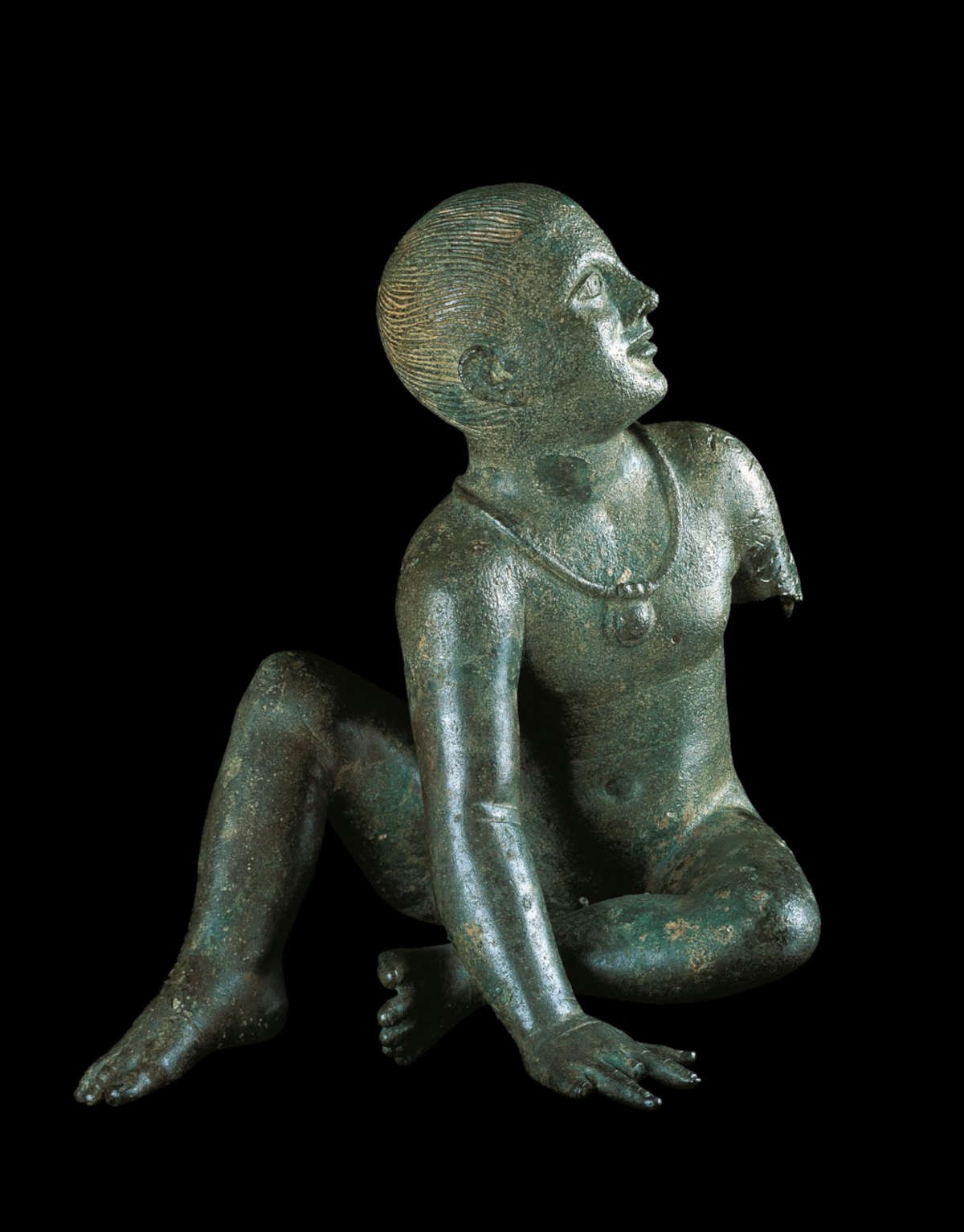
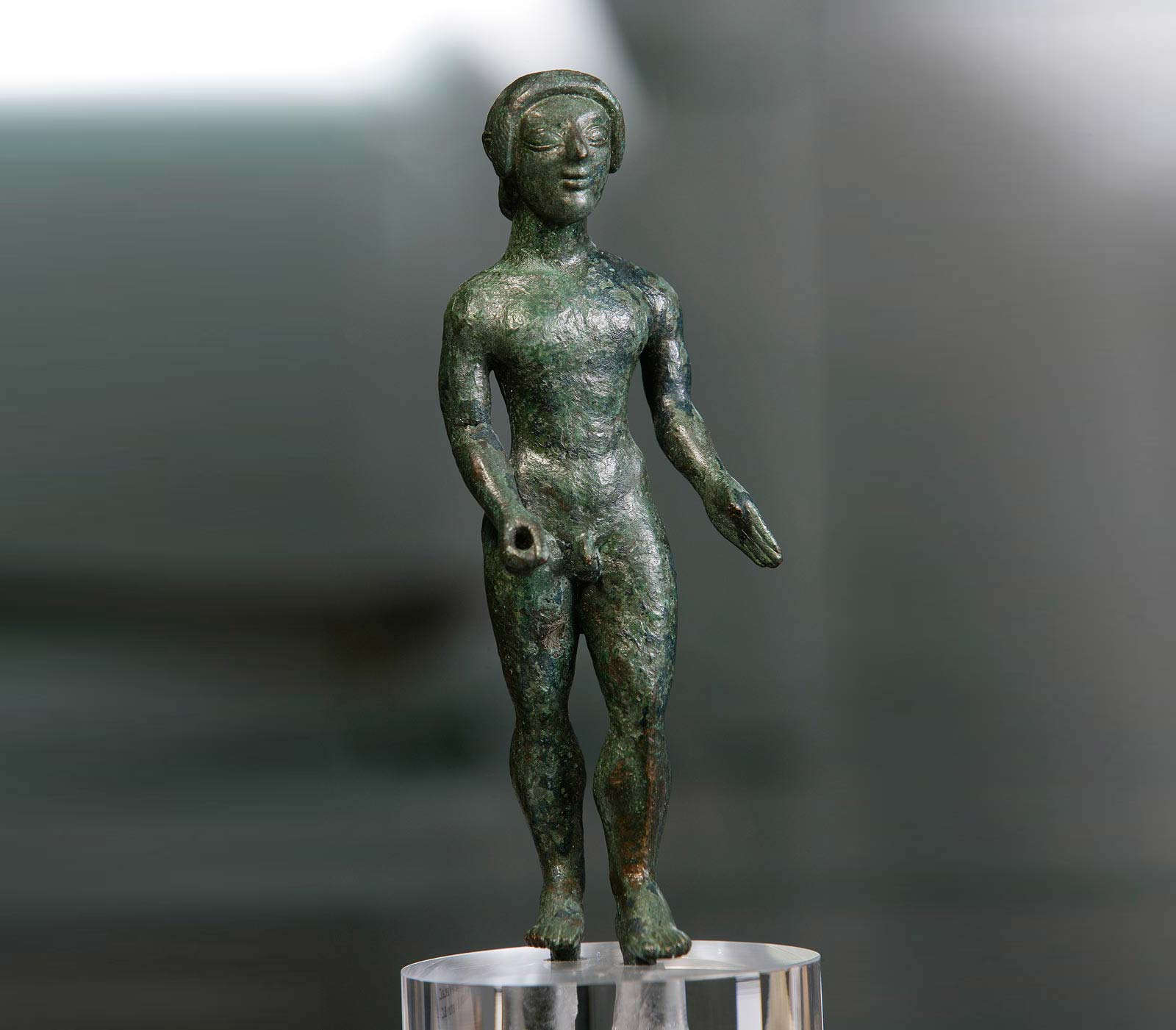
But iconography struggles to flesh him out: one of the most suggestive identifying hypotheses is that of the so-called Putto Carrara, a bronze votive statue from Tarquinia and preserved in the Vatican Museums, in which the child displays features that combine childhood and senescence. White hair, raised gaze, body huddled in an intense, suspended posture in which form takes on ambiguity.
For the Etruscans, Marigolds inaugurates a religion based on the reading of the divine in the real, on the systematic interpretation of signs. Seneca himself, centuries later, in comparing the Roman to the Etruscan posture, recognized the radical difference: where the Romans believed that lightning resulted from the collision of clouds, the Etruscans were persuaded that clouds collided in order for lightning to be produced. Every phenomenon obeyed the need to manifest the higher will, and man was called to grasp and respect those signs. This sacred determinism demanded a rigorous, detailed theology capable of regulating human action in every aspect. It was Marigolds who transmitted this discipline, who traced the grammar of the world. His brief presence was enough to establish a ritual structure that spanned the centuries. Next to him, in the Etruscan tradition, stands the figure of the nymph Vegoia, the revealer of another fundamental branch of the sacred discipline: lightning reading. A luminous and complex figure, Vegoia, also known as Vecu in her most archaic form, is shrouded in an oracular aura. Not only priestess of heaven but also keeper of the law. She is said to have dictated, in a state of divine inspiration, the rules for interpreting space, distinguishing the lawful from the unlawful, drawing the margins between city and forest, between life and the world of the gods. A normative wisdom, which extended beyond liturgical time to embrace political and legal time as well.
Archaeology does not return us a face of her, but her name survives in texts handed down through Roman sources, often with respect and awe. Vegoia was credited with the drafting of boundary tables (the “augural boundaries”) and provisions for land consecration rites. Two registers were welded in her: celestial divination and civil codification. She was both a theologian and a legislator, a conduit between the invisible power and the visible order. Nothing took place that had not first been provided for in her code.
Every part of the visible world coincided with a fragment of the divine design. That world thought of existence as constantly traversed by powers. There was no profane emptiness because every space was already sacred, every body was already in relationship. No wonder Cicero spoke of Etruscan religion as a “revealed discipline,” distinct from the Roman one, which was based on tradition and custom. The Etruscans, on the contrary, did not inherit a religion, but received it by revelation. Aruspicine art, lightning reading, calendar rituals (collected in the Haruspicine Books, Fulgurales, Rituales) constituted a science of the divine, based on analogies between heaven and earth, between macrocosm and microcosm. The vault of heaven was dissected into sixteen regions, each inhabited by a deity and each endowed with a symbolic weight where the animal liver, the hottest organ, closest to the seat of the soul, reproduced the map.
Among the most extraordinary objects that have come down to us of Etruscan spirituality, the Liver of Piacenza surely occupies a central place. Discovered in 1877 , but dating from the 2nd-1st century B.C., it is the tangible remnant of a cosmology. It is a bronze model of a sheep’s liver, made with anatomical precision and engraved with forty inscriptions in the Etruscan language delineating the sixteen outer sectors corresponding to the sixteen regions of the Etruscan sky and a central core representing the deepest part of the organ, perhaps related to the very heart of the omen. Each sector bears the name of a deity, from Tinia to Cel, from Lusa to Selvans, in a distribution that mimics a map of the firmament.
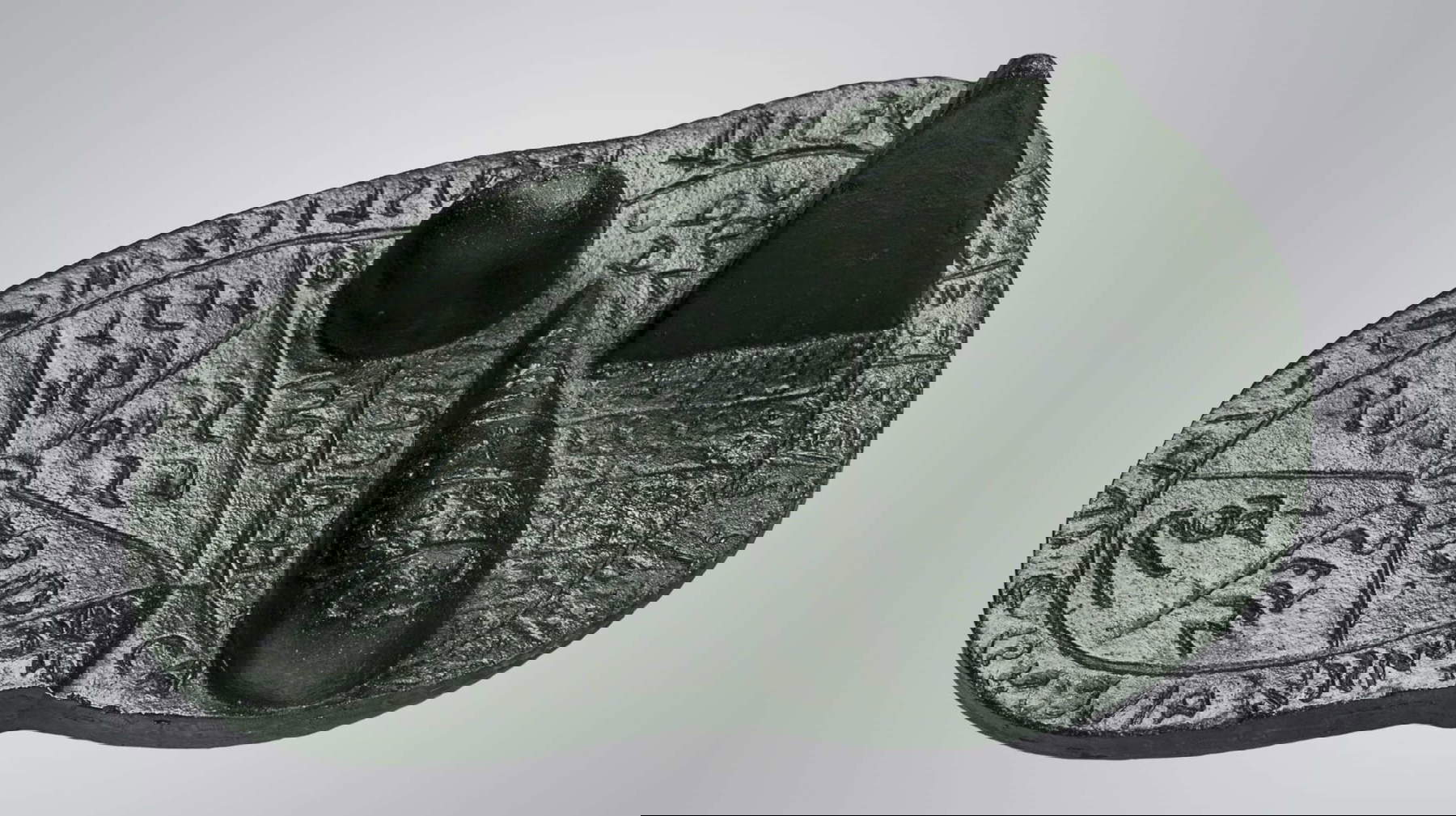
The purpose of this object was twofold: didactic and ritual. It served to instruct the haruspices so that they would learn the correct interpretation of anomalies found in the real liver during sacrifices. Each deformation, spot or prominence of the organ was read as a signal sent by a specific deity, whose location corresponded to one of the sectors engraved on the model. The priest followed a precise grammar: that of a ritual science in which the animal body reflected the body of heaven. The sophistication with which that object was constructed testifies to the depth of Etruscan thought. And through that object, as through a mirror reflecting the invisible, the priest could direct the decisions of a city, found a temple, interrupt an action. Everything in the Etruscan ritual system had to accord with higher harmony. And the Liver of Piacenza, with its sober monumentality, is a compendium of that harmony made visible.
Today, that language is almost indecipherable to us. Our relationship with the world is rarely structured by ritual, and when it is, it is often in an impoverished form, reduced to replication or consumption. The very idea that anything can have meaning (not symbolic, but causal) seems almost suspect. The weakening of gesture, of form, of matter is perhaps what most distances us from the Etruscan posture. In this sense, rereading that system means not only studying it, but questioning our loss of formal meaning. As philosopher Giorgio Agamben has suggested, modernity is constituted precisely at the moment when ritual is emptied and action is emancipated from the sacred context. Technique, then, replaces ritual, and efficiency erases the necessity of gesture.
The ancient Etruscans were celebrated among their contemporaries as a “most religious people” (as the Roman historian Titus Livius called them) for the scrupulous care with which they practiced every rite and interpreted the signs of divine will. Ritual action, for them, was foundational. Every construction had to be preceded by augural ceremonies. Every city had to be inscribed in the sky. The priest was architect, cartographer, exegete. The temple reproduced the firmament, the altar housed its forces, and the sacrifice was not meant to appease but to translate. The reading of the liver, like that of lightning, was a hermeneutic act, aimed at determining the coherence of human gesture with respect to the invisible order.
Etruscan art participated in this system as its living manifestation. Statues placed on the roofs of temples delimited consecrated space. The Apollo of Veio, dated between 510 and 500 BCE, in his taut stride and drapery drawing a restrained movement, embodied a watching entity. Every formal detail was designed to act. Inside the tombs, the painting evoked a time that never ceases to exist. The dancers, the hands offering cups, the set tables built a continuity between worlds. Vanth, with wings spread, showed the way; Charun, armed with a hammer, manned the threshold.
Interestingly, in the Etruscan funerary world, Vanth is a recurring and recognizable presence. A winged female figure, she carries a lighted flashlight, sometimes keys, and accompanies the deceased on their journey to the afterlife. Her image appears in numerous frescoed tombs, beginning in the 4th century BCE, a sign that her role in Etruscan religion was deeply rooted and widespread.
One of his most famous depictions is found in the François Tomb at Vulci from the late 4th century BCE, in which Vanth appears alongside such Greek mythical figures as Achilles and Penthesilea, demonstrating the refined cultural syncretism of the Etruscans. Other significant appearances are in the mid-3rd-century B.C.E. Tomb of the Aninas and the late 4th-early 3rd-century B.C.E. Tomb of the Blue Demons, both in Tarquinia, where she is seen alongside the demon Charun as she escorts souls to the afterlife. In these images Vanth assumes dynamic postures, wings spread and flashlight raised as she lights the way, directs the passage, and participates in the moment of separation without ever conveying hostility.
In the Etruscan universe, in fact, death did not represent a final break, but a route to be taken with the right guides. Vanth, with his flashlight and wings, was the reassuring presence that guaranteed continuity and accompaniment. A keeper of the thresholds, charged with guarding the most fragile moment of existence.
Charun, on the other hand, is a figure who embodies the most brutal and ambivalent face of death. A chthonic demon, present from the 4th century B.C. onward, he does not belong to a consolatory pantheon, but represents the inescapable necessity of passing away, its blind force, its ritual violence. His appearance is among the most disturbing in Etruscan iconography: blue or greenish skin, deformed face, hooked beak-like nose, prominent teeth, equine ears. He carries a huge hammer, which is not just any weapon but the tool with which, according to the most accepted interpretations, he closes the gates to the world of the living forever or punishes unworthy souls.
His figure appears frequently alongside Vanth, in an obvious iconographic dialectic. Where Vanth assists and directs, Charun embodies the dark power of the threshold. His depictions are concentrated in Etruscan tombs of the Hellenistic period, when funerary imagery becomes more dramatic, more dense with fear, more explicitly linked to the need to exorcise the unknown.

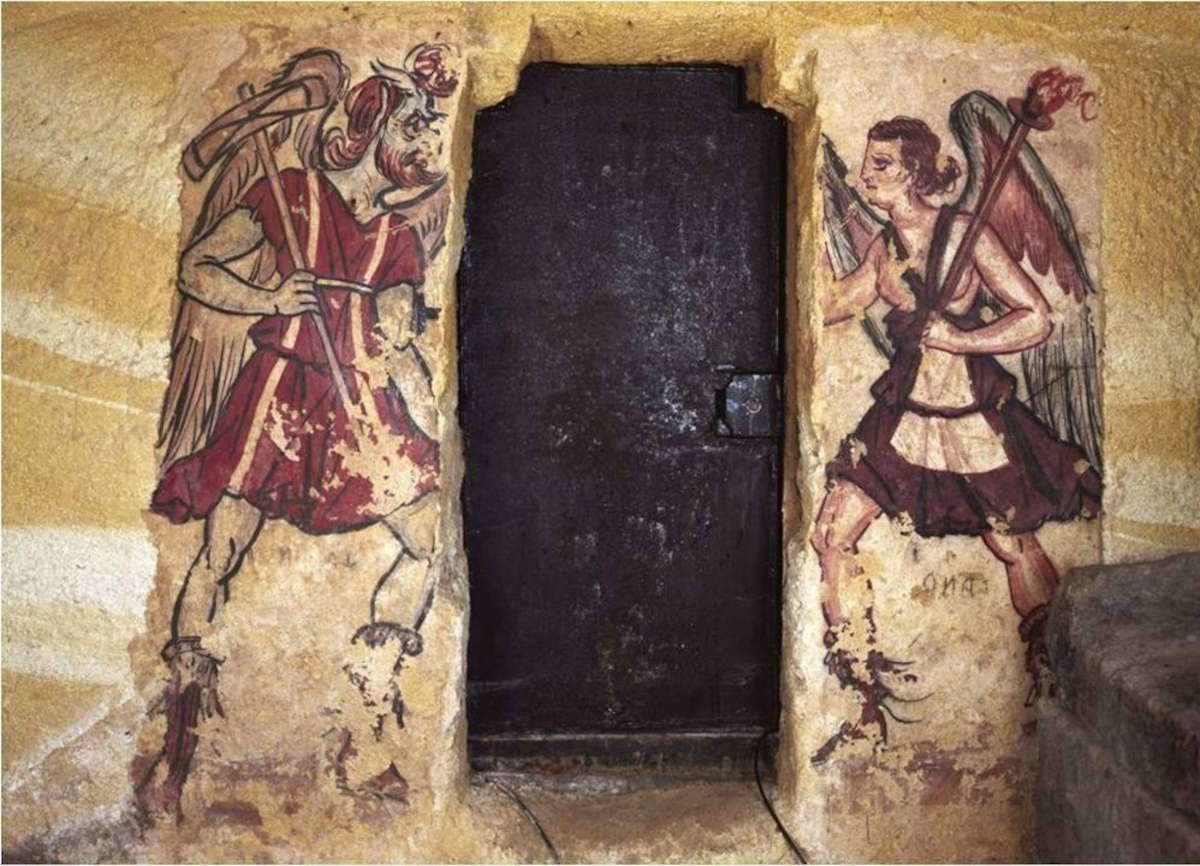

Among his most famous depictions is that of the Tomb of the Blue Demons at Tarquinia. This tomb, unique for its dominant color and the richness of its figures, takes its name precisely from the numerous infernal creatures painted with blue incarnate-a chromatic element that recalls the otherworld, the otherness of the realm of the dead. In the tomb, Charun appears at Vanth’s side: his wings are membranous, his body snappy. He wields a hammer, and moves among the souls and monsters with an eerie, almost theatrical presence.
The entire funeral chamber is conceived as a scene: a funeral procession unfolds along the walls, gradually slipping into an infernal vision. Demons, winged monsters, composite creatures inhabit the space as guardians and as menace. The blue color, spread over bodies and backgrounds, amplifies the feeling of a dense air, of a viscous elsewhere. Charun, in this context, acts as a guarantor of the irrevocable: the passage is accomplished, and he is its guardian.
In other Tarquinia tombs as well, such as the Tomb of the Àuguri or that of the Anina, and in the cinerary urns of Volterra, Charun appears as an isolated figure or in pairs with Vanth. Always with the hammer, always in a controlling attitude. On the inner door of the Tomb of the Anina he is depicted facing Vanth, as two guardians watching over the soul’s exit from the tomb. Despite his monstrous appearance, Charun does not belong in the punishing hell: his presence ensures that the passage takes place, that the dead remain dead, and that the boundary between worlds is not violated. His brutality serves the cosmic order, his strength closes the circle of life. In Etruscan art, it is precisely its deformity that makes it effective: it represents the rupture, the other from itself, the power that nails all life to its destiny.
Etruscan spirituality manifested itself with surprising intensity even in the most minute objects: small bronzes, votive inscriptions, engraved mirrors. In these moving fragments was condensed the same sacred tension that animated the great wall cycles. They were living objects, imbued with meaning and often intended for direct dialogue with the divine. Bronze mirrors, widespread between the 6th and 3rd centuries BCE, are perhaps the finest evidence of this. Mirror-polished on the convex side, they were finely engraved on the back with mythological scenes, heroic episodes and divine presences. The Etruscan woman reflected in them would find Turan, goddess of love, or armed Menrva, or Lasa, winged spirit of fertility, behind her in the morning. The object was not only for facial care but, again, held symbols, protected, evoked.
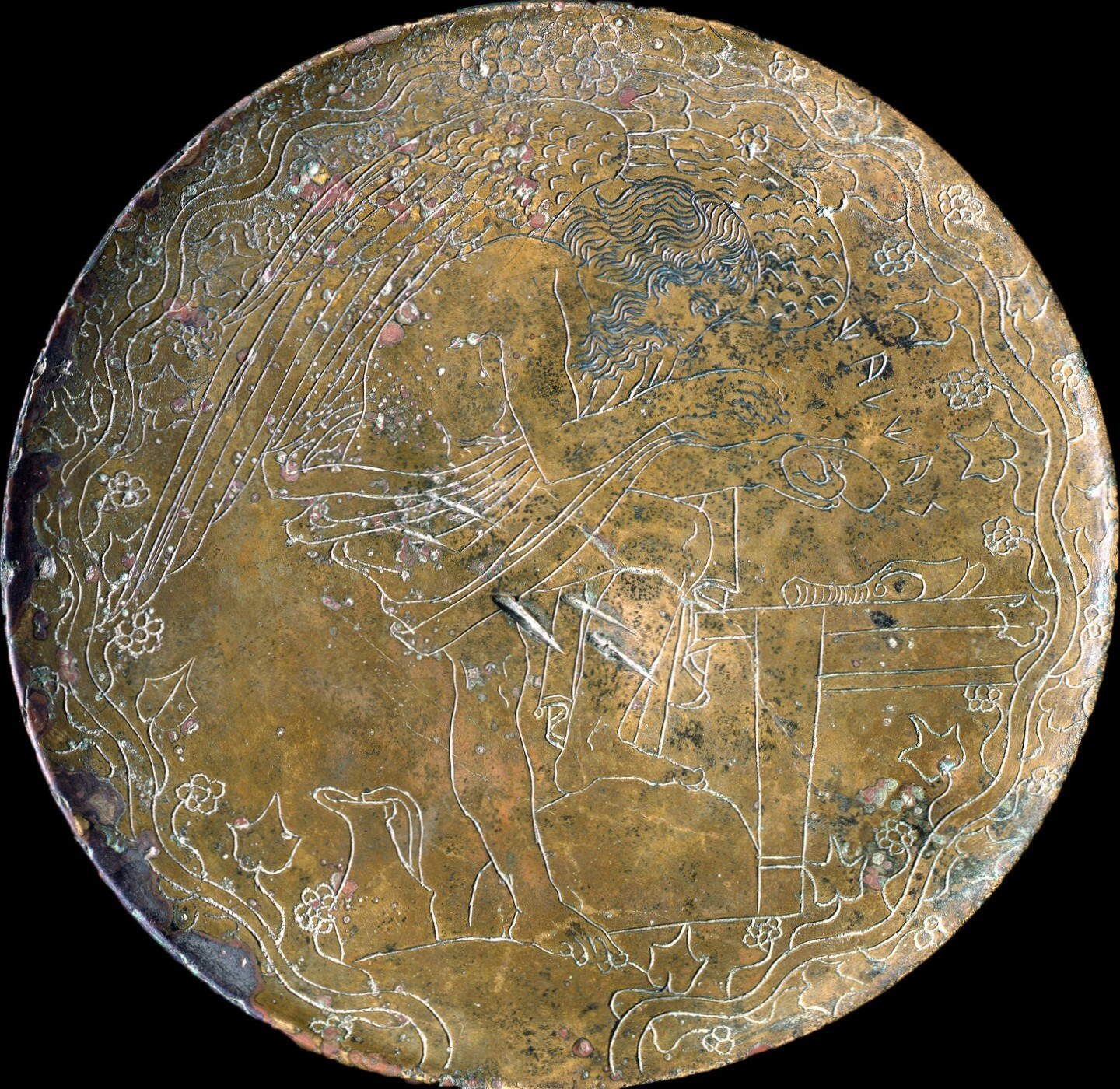
One of the most emblematic examples is the Mirror of Chalcante in which the Greek soothsayer, whom the Etruscans called Chalcante, is depicted in the exact gesture of the haruspicin. The bare foot resting on a rock, in direct contact with the earth, examines an animal liver. The detail is powerful: for the Etruscans, touching the earth was essential to establish a channel with the invisible forces of the chthonic world. The body becomes a conduit, the organ to be read a map. The artist, here, has endowed it with wings to emphasize its function as a medium, its ability to ascend and descend between worlds. In that object, designed perhaps for a cultured and devout woman, divinatory wisdom is intertwined with the desire for contact. But these mirrors were also often part of the grave goods and were laid beside the deceased as talismans. They reflected identity and, perhaps, projected it beyond death. In tomb contexts, the figure on the back became a spiritual guarantor: a god, a heroine, a presence that accompanied the soul in passing.
Alongside mirrors, an equally strong role is given to votive bronzes. As early as the 8th century B.C., the Etruscans produced an abundance of them: praying human figures, sacrificial animals, miniature weapons, symbolic instruments. The gesture of the offerer, with raised arm and open hand, is one of the most widely used in Etruscan culture. Often these artifacts were accompanied by dedicatory inscriptions, engraved with short but solemn formulas: “Mi X turanale,” “I, (name), to Turan,” or “Ramtha Zurask Tini muluvanike,” “(name) gave this to Tinia.”
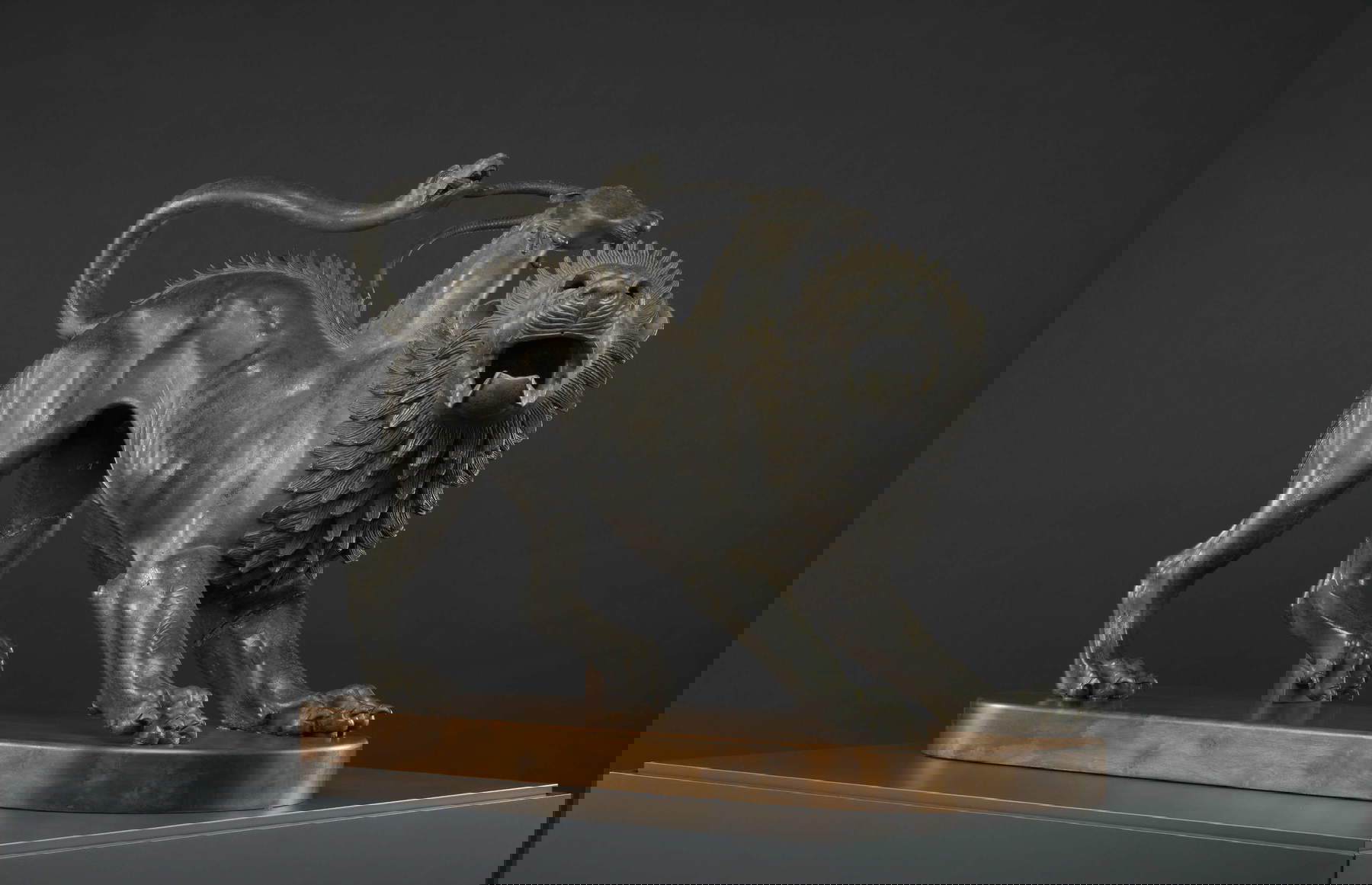
Of all of them, two bronzes deserve a separate place for formal strength and symbolic power. The Chimera of Arezzo, a fifth-century B.C.E. bronze masterpiece, depicts the mythological monster with a lion’s head, feline body, goat’s head on its back, and serpentine tail. The body is engraved with the inscription “TINSCVIL”: “given to Tinia,” the great celestial god. It is a wounded creature, in dramatic twist, almost symbolizing the victory of cosmic order over primordial chaos. His sacrifice is already in place, frozen in bronze.
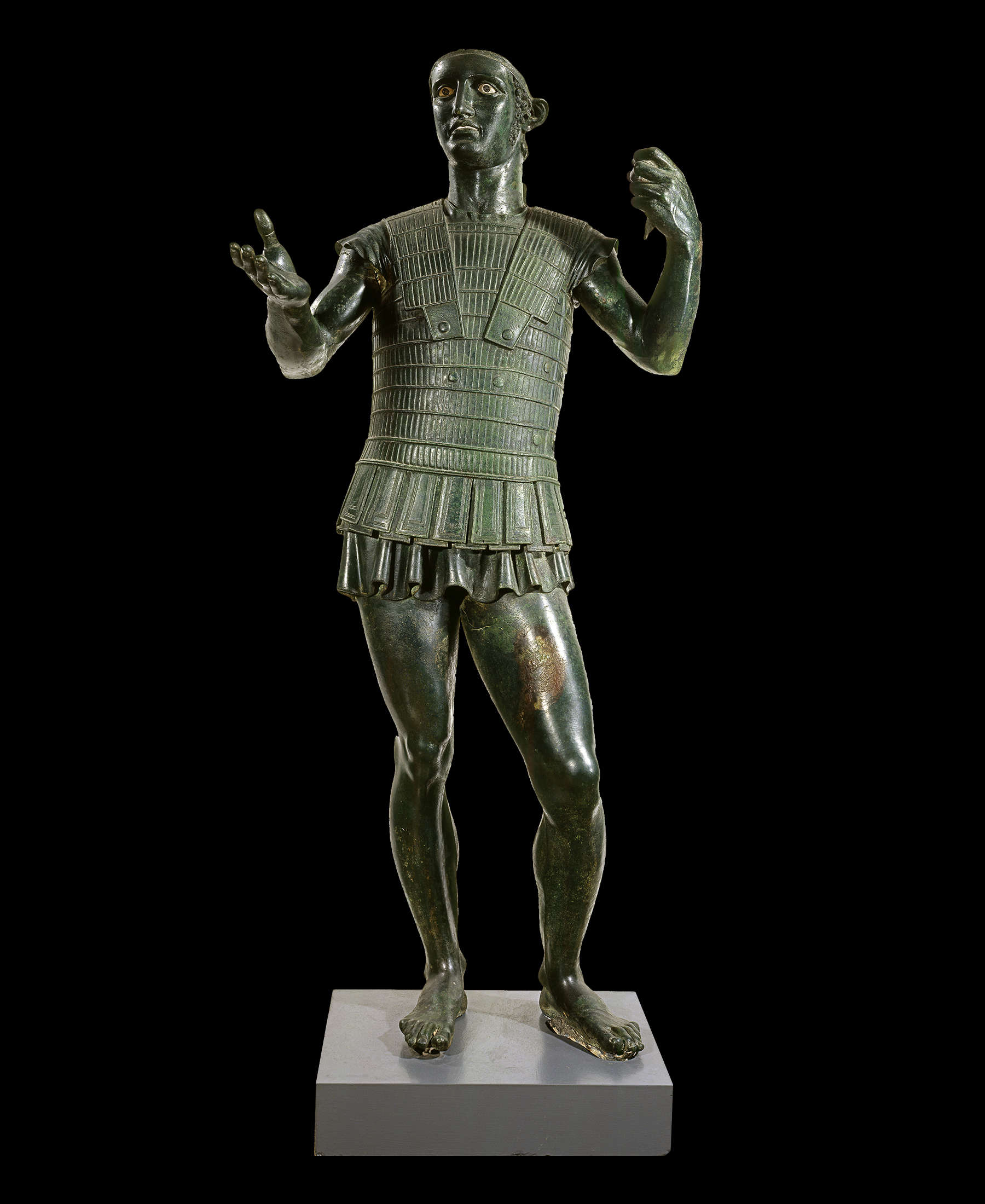
The other example is the Mars of Todi from the late 5th century BC. Found in 1835 near Todi, buried among slabs of travertine (perhaps as a ritual act following a lightning strike) it depicts a young warrior caught in a suspended gesture: libation before battle.
He wears close-fitting armor and a chlamys that enhance his upright, almost hieratic posture. His right arm, stretched forward, solemnly offered a patera, the ritual cup for pouring wine to the gods; his left was resting on a spear, now lost. The whole composition is marked by a severe composure, with clear references to Attic models of the second half of the 5th century, particularly to the sphere of Pheidian sculpture, but with echoes also of polycletic plasticity balanced between idealized realism and sacral force. The inscription engraved on the hem of the tunic, in the Umbrian language but in the southern Etruscan alphabet, reads, “ahal trutitis dunum dede,” or “Ahal Trutitis has donated (this statue).” The name, possibly Celtic, opens up scenarios of cultural intersections between the Umbrian, Etruscan and Trans-Apennine worlds. The act of dedication implies a vow fulfilled and fulfilled: it is an ex voto probably consecrated in a shrine dedicated to Laran, Etruscan god of war, equivalent to the Roman Mars.
The presence of the inscription engraved on the body of the statue itself, not on a base, not on an auxiliary support but on the warrior’s robe, suggests how integral the writing was to the sacred action. The engraved word acted, transformed bronze into gift, gesture into bond, image into ritual offering. This profound relationship between writing and religion is reflected in other evidence, perhaps less spectacular in size but not in theological density.
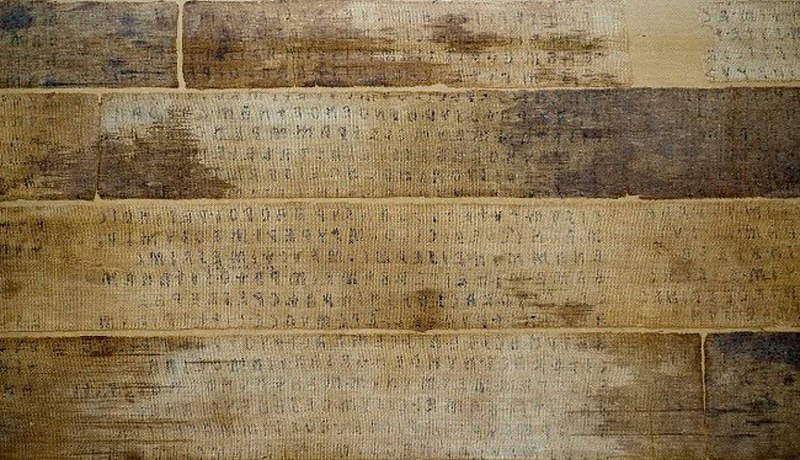
The most enigmatic of these texts is the Liber Linteus from Zagreb, the longest Etruscan text that has come down to us and the only book from antiquity that has survived on linen. It was found wrapped around an Egyptian mummy. It is a liturgical calendar with sequences of ceremonies, prescribed sacrifices and dates to be observed. Each column is a score of rituals. Although the language remains largely opaque, the intention is crystal clear; that is, to write to order, to write to convey. The Etruscan text, more than a thousand words long, was intended for those who could recognize in the sign an act.
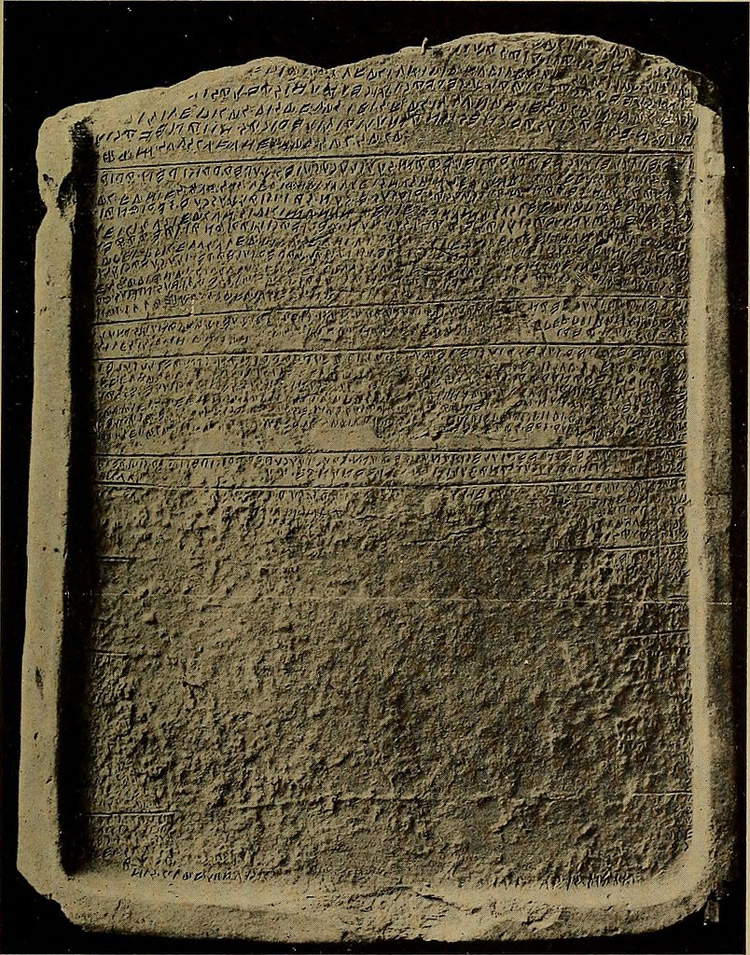
Another key document is the Tabula Capuana, a terracotta tablet found in Santa Maria Capua Vetere and dated to the fifth century BCE. The text, engraved with rigor on a flat surface, alternates between names of deities, dates, and ritual formulas. Perhaps it was placed at the entrance to a sanctuary, or perhaps it served as a guide for an urban liturgy. In any case, it shows a religion practiced through speech, where each syllable has a prescriptive function and each accent establishes a boundary between the licit and the impure.
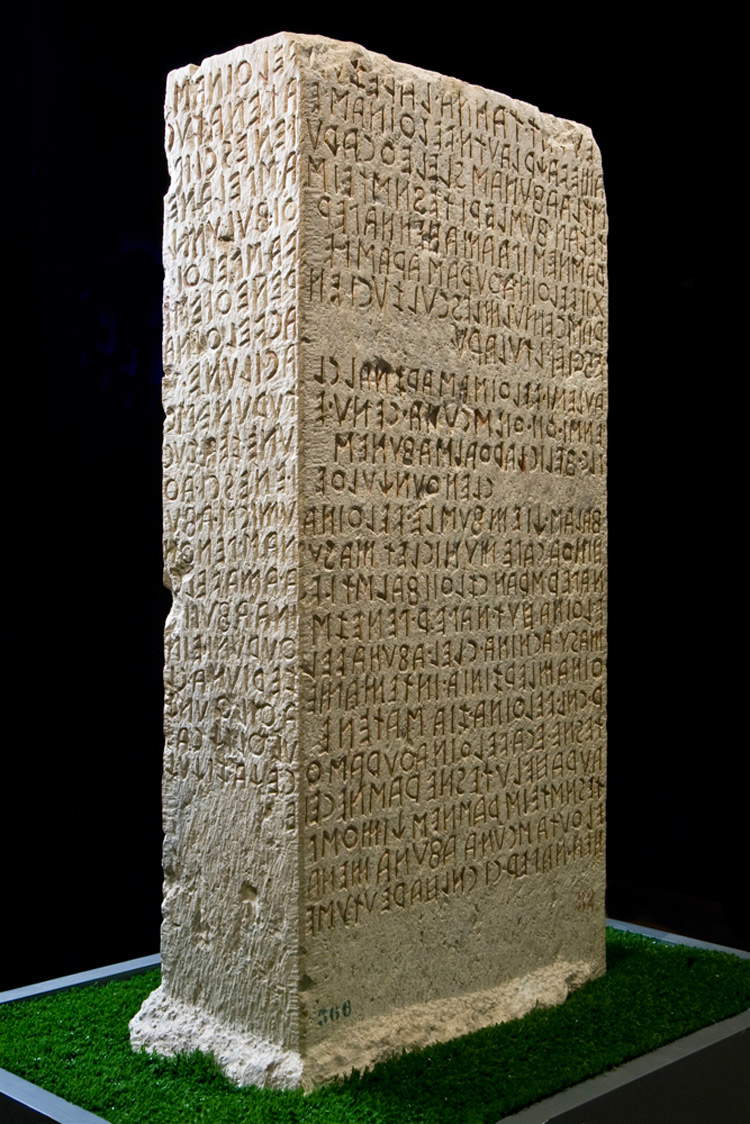
But of all the Etruscan inscriptions, the Cippo of Perugia is perhaps the one that comes closest to a narrative act. Carved on stone in the second century B.C., articulated in 46 lines thickly spaced on two sides, it recounts (one assumes) a boundary pact between two families. It is legal text, but it has a structure and solemnity that brings it closer to ritual. The very fact that Gianni Rodari made it the protagonist of one of his stories, giving it a voice and a memory, testifies to the evocative power of these forms.
Perhaps this is precisely where the deep core of Etruscan spirituality lies: in the belief that form, gesture, word, sound, stone, everything, if accomplished with precision, can still speak to the gods.


The author of this article: Francesca Anita Gigli
Francesca Anita Gigli, nata nel 1995, è giornalista e content creator. Collabora con Finestre sull’Arte dal 2022, realizzando articoli per l’edizione online e cartacea. È autrice e voce di Oltre la tela, podcast realizzato con Cubo Unipol, e di Intelligenza Reale, prodotto da Gli Ascoltabili. Dal 2021 porta avanti Likeitalians, progetto attraverso cui racconta l’arte sui social, collaborando con istituzioni e realtà culturali come Palazzo Martinengo, Silvana Editoriale e Ares Torino. Oltre all’attività online, organizza eventi culturali e laboratori didattici nelle scuole. Ha partecipato come speaker a talk divulgativi per enti pubblici, tra cui il Fermento Festival di Urgnano e più volte all’Università di Foggia. È docente di Social Media Marketing e linguaggi dell’arte contemporanea per la grafica.Warning: the translation into English of the original Italian article was created using automatic tools. We undertake to review all articles, but we do not guarantee the total absence of inaccuracies in the translation due to the program. You can find the original by clicking on the ITA button. If you find any mistake,please contact us.




















 IT
IT FR
FR DE
DE ES
ES CN
CN


