





In May and June 2026 the Monumental Rooms of Palazzo Venezia in Rome will be accessible to the public as part of the project Cantiere aperto. The Monumental Rooms of Palazzo Venezia, an initiative that will allow visitors to take a closer look at one of the most significant restoration projects currently underway in the capital. The restoration involves the Sala del Mappamondo, the Sala delle Battaglie and the Sala Regia and is part of the works for the construction of the Venezia station of the Rome Metro Line C.
The project was presented by Mayor of Rome Roberto Gualtieri, Mobility Councillor Eugenio Patanè, the government’s extraordinary commissioner for Line C Maria Lucia Conti and VIVE - Vittoriano and Palazzo Venezia Director General Edith Gabrielli. The presentation was also attended by Bruno Sed, liquidator of Roma Metropolitane, Andrea Sciotti, technical director of the same company, along with the top management of the General Contractor Metro C S.C.p.A., led by Webuild and Vianini Lavori, with CEO Fabrizio Di Paola and president Franco Cristini.
The initiative will allow the public to follow the progress of the restoration through both digital tools and in-person visits. A diary of the construction site will be published on the institutional website of VIVE on a regular basis, accompanied by video interviews with restorers who will illustrate the different phases of the intervention: from structural consolidation to surface cleaning and the reintegration of pictorial parts.
Alongside the online documentation, twice a month between May and June it will be possible to directly access the scaffolding set up in the rooms and follow the work accompanied by the restorers themselves engaged in the intervention. The initiative will offer citizens and tourists the opportunity to take a close look at the decorations of one of the most important historical buildings in the city and to understand in a direct way the methodologies adopted for conservation.
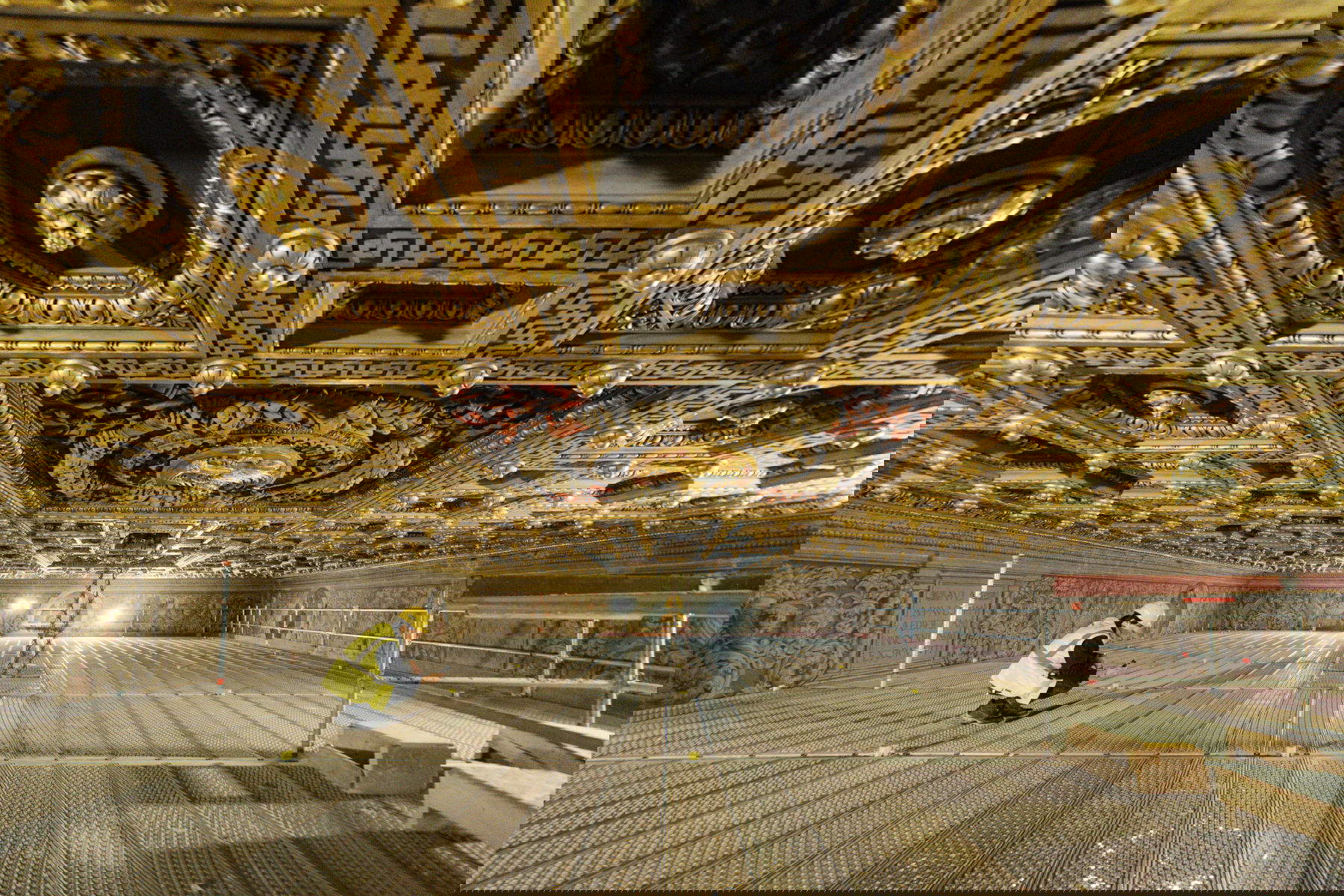
The opening of the construction site is part of the VIVE Cantiere aperto program, developed with the aim of involving the public in the processes of protection and conservation of the Vittoriano and Palazzo Venezia monumental complex. The project was previously tested with the restoration of theAltar of the Fatherland, the sculptures of the Vittoriano’s main elevation and the Barbo Apartment in Palazzo Venezia.
The stated intent is twofold: on the one hand, to prevent the places affected by the restorations, during the suspension of ordinary enhancement activities, from being taken away from the public’s attention; on the other hand, to encourage a more conscious participation of visitors, so that the protection of heritage is perceived as a shared process and not exclusively technical.
In the case of Palazzo Venezia, the project also takes on a symbolic value related to the building’s recent history. For a long time the palace was perceived as a distant and inaccessible space, not least because of the weight of its historical and institutional memory. In recent years, VIVE has embarked on a path of reopening and enhancement that has had one of its most obvious steps in the clearing of cars from the Great Garden, restoring greater usability to the entire complex and bringing it back to the center of international tourist flows and proximity tourism.
The restoration of the Monumental Rooms is also part of the campaign to consolidate Palazzo Venezia and the Vittoriano, which is necessary in view of the construction of the Venezia station of Line C, destined to affect the surrounding area in the coming years. In this context, the Open Yard project aims to show how infrastructural transformations can coexist with the preservation of the historical heritage, offering an image of Rome as a city capable of innovating without interrupting the relationship with its cultural stratification.
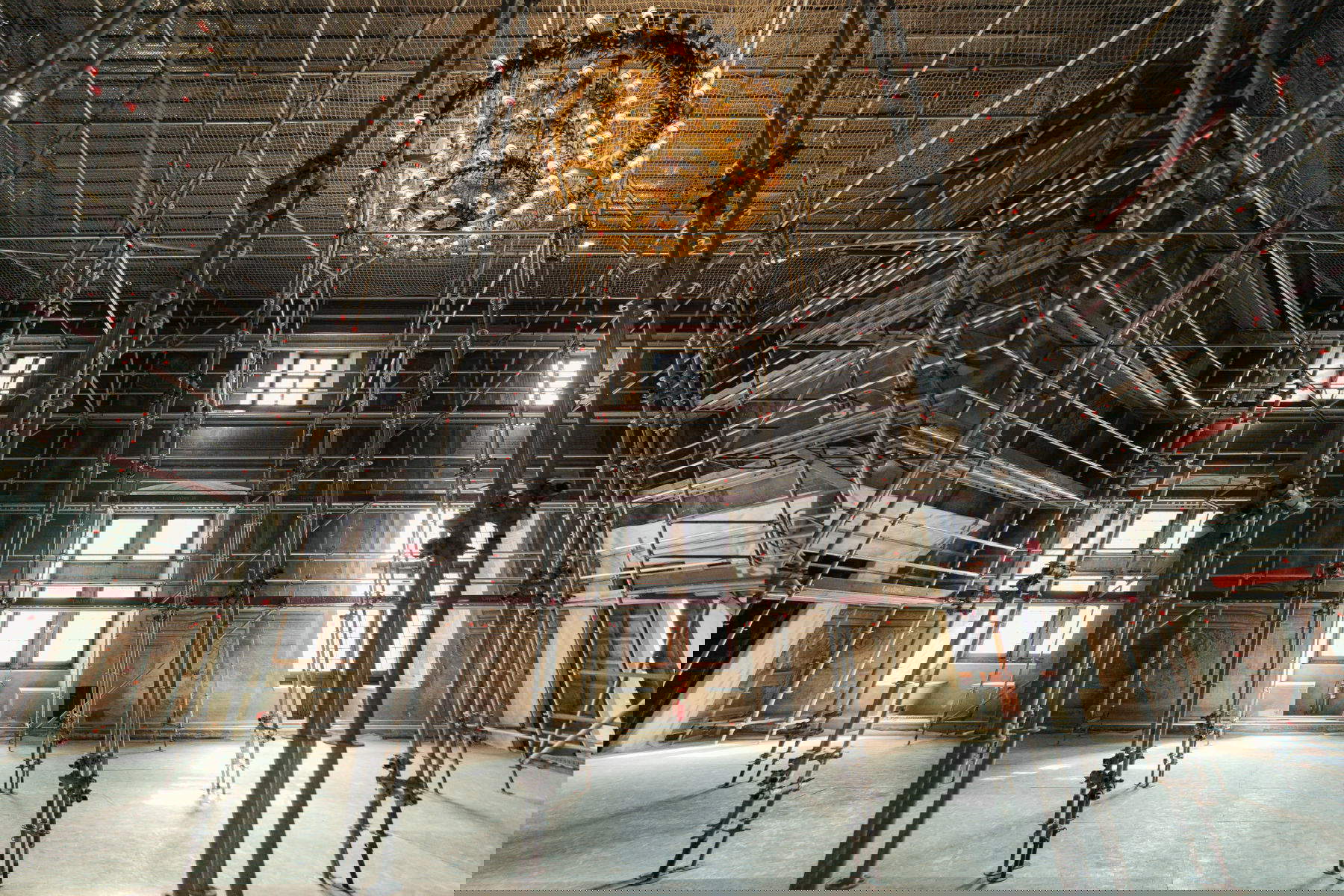
The Monumental Rooms represent one of the most important parts of the palace. They are three large rooms located on the piano nobile, built immediately after 1464, when Cardinal Pietro Barbo, promoter of the original core of the building, became pope under the name of Paul II. Over the centuries the spaces have fulfilled prominent institutional functions: in 1564 they became the seat of the ambassadors of the Venetian Republic, while from 1797 they housed the representatives of the Austro-Hungarian Empire.
In 1916 the palace was claimed by Italy, and the rooms were allocated to the Museum of the Middle Ages and the Renaissance. In 1922 Benito Mussolini transformed them into the representative headquarters of the Fascist government, imparting a new and decisive historical stratification to the rooms. After World War II they housed the permanent collections and, beginning in 1982, were used for temporary exhibitions. At the end of the restoration currently underway, the Monumental Rooms will host a new permanent itinerary designed by Michele De Lucchi and dedicated to Fatto in Italia (Made in Italy), a museographic itinerary designed to tell the story of the peninsula’s artistic and artisan tradition from the Middle Ages to the threshold of Made in Italy.
The complexity of these rooms is evident in their very architectural and decorative configuration. Renaissance elements and twentieth-century interventions coexist in the rooms: fifteenth-century frescoes and sculptural apparatuses, still visible in the jambs and large fireplace of the Sala del Mappamondo, are superimposed by wooden ceilings, chandeliers and wall paintings created five centuries later under the direction of Superintendent Federico Hermanin in the 1920s.
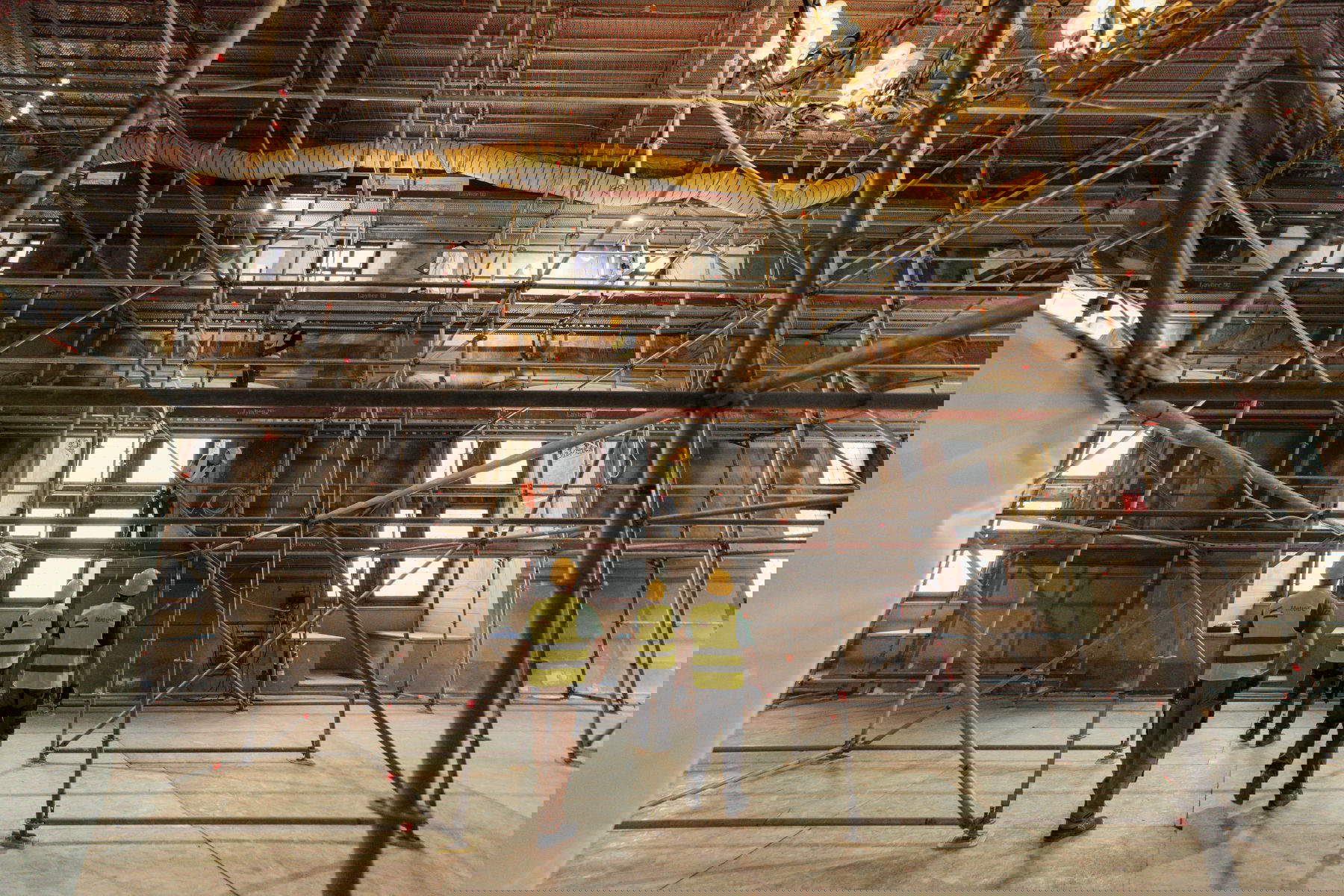
The cultural history of the Monumental Rooms is also particularly dense. Episodes of international significance were recorded here, such as the visit of Erasmus of Rotterdam in 1509, meetings between Pope Paul III Farnese and Emperor Charles V, as well as the conversation with Michelangelo convened to discuss the Last Judgment in the Sistine Chapel. In the same rooms were held the concert of the young Wolfgang Amadeus Mozart and the direction of Gioachino Rossini’s Stabat Mater, up to one of the most dramatic moments of the Italian twentieth century: the announcement of Italy’s entry into World War II.
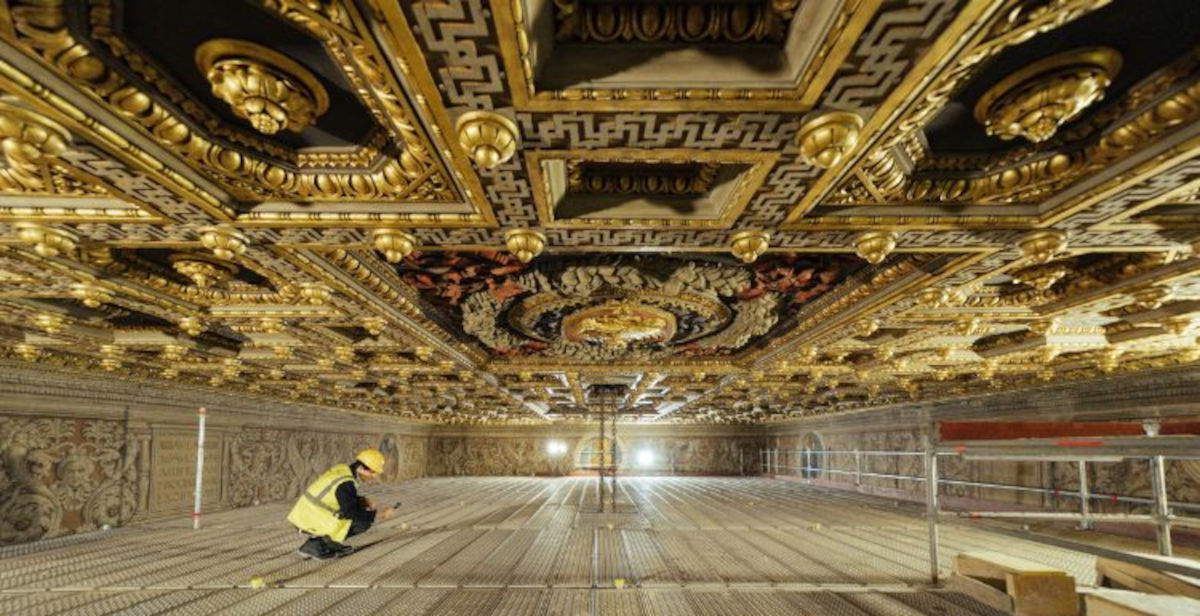
The restoration work currently underway is particularly complex precisely because of the overlapping interventions and transformations that have accumulated over the centuries. The wooden ceilings showed widespread alterations and the gilding was completely obscured by time, water infiltration and layers of oxidized paint. The cleaning operations brought back the original brilliance of the gold, restoring depth and legibility to the decorations. On the walls, the work proves even more articulate. The wall paintings retain traces of numerous successive interventions, which require a careful study of the stratifications before cleaning, plaster consolidation and reintegration of the paint film. The stated goal is to restore a legible whole in accordance with the methodological principles of Italian restoration, while keeping visible the traces of the building’s history.
 |
| Rome, Palazzo Venezia opens construction site to public: tours of monumental rooms under restoration |

Warning: the translation into English of the original Italian article was created using automatic tools. We undertake to review all articles, but we do not guarantee the total absence of inaccuracies in the translation due to the program. You can find the original by clicking on the ITA button. If you find any mistake,please contact us.























 IT
IT FR
FR DE
DE ES
ES CN
CN


