



by Redazione 22/05/2026



Categories: News / Disclaimer
Students from the Galluzzo Comprehensive Institute in Florence have designed and developed an innovative serious game, starring Beato Angelico, to turn Latin into concrete experience. The presentation at the Museum of San Marco on Monday, May 25.

On Monday, May 25 at 9:30 a.m., at the Museum of San Marco in Florence, Ars et Anima, an innovative serious game (a digital game designed specifically for educational, informative and didactic purposes) conceived and developed by the students of the Galluzzo Comprehensive Institute as part of the CIVIS ETICA: certamen culturae inter otium et negotium project, promoted in collaboration with the Franchi Foundation and 3D Academy, will be officially presented.
The launch of the video game, available free of charge to the public, will coincide with the student awards ceremony. The event will be attended by the institute’s school leaders, representatives of the Regional Directorate of National Museums Tuscany of the Ministry of Culture and the Museum of San Marco, the head of the Provincial School Office of Florence, the Councillor for Education of the City of Florence, the vice president of the Franchi Foundation, the developers of the 3D Academy of Pisa and Acer for Education.
The project was born from the collaboration between the Galluzzo Comprehensive Institute and the Regional Directorate National Museums Tuscany, of which the San Marco Museum is part, with the aim of creating innovative educational paths capable of connecting school, artistic heritage and new technologies. Ars et Anima is not configured as a simple video game, but as a serious game: an educational tool that exploits the typical dynamics of the game, such as objectives, challenges, scores and progression, to stimulate learning, deepening and active participation. Thus, at the basis of the project is a precise educational reflection: how to bring Latin closer to children by making it alive? The answer was to transform it into concrete experience, enhancing its legacy through etymologies, proverbs and idioms still present in today’s Italian language.


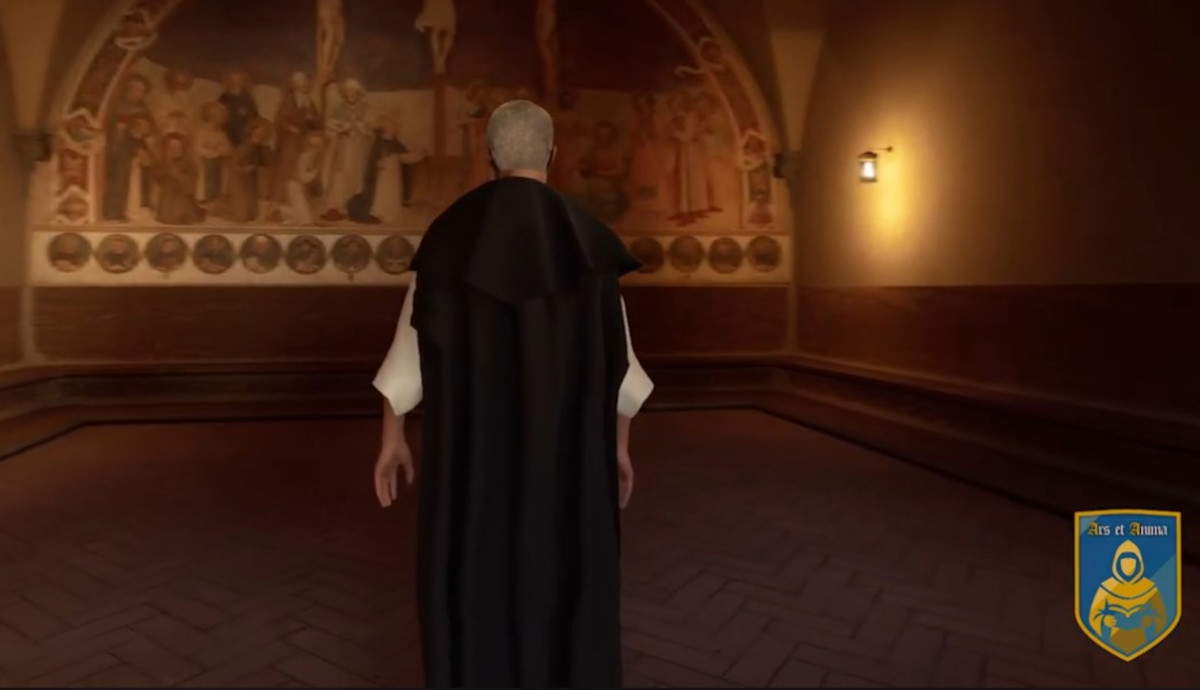
To guide this experience, students chose Beato Angelico, a symbolic figure of the early Florentine Renaissance, as the protagonist. Set in the 15th-century Convent of San Marco, the game sees Blessed Angelico move around the cloister and meet six friars, each an expert in a different discipline (botany, art, astronomy, music, food and mathematics), who ask questions related to Latin culture. Each correct answer allows the protagonist to obtain the colors needed to complete the famous St. Mark’s Altarpiece, which is revealed at the end of the journey.
The video game is also meant to be an opportunity to delve into the history of Florence and the Medici family. In fact, the setting is set in the years following 1436, when, with the bull of Pope Eugene IV and the intervention of Cosimo the Elder and his brother Lorenzo, the Dominicans of the convent of San Domenico di Fiesole obtained a new home in Florence. From 1437 the Medici financed the complete reconstruction of the convent, entrusting its design to the architect Michelozzo. Beato Angelico probably began work as early as 1438 on the frescoes in the convent and, beginning in 1440, on the new altarpiece intended for the church’s high altar, conceived as a celebration of Medici patronage. The work was completed in 1443 with the consecration of the new church and altar dedicated to Saints Cosmas and Damian, protectors of the Medici family, in the presence of Pope Eugene IV.
For the altar, Angelico created the altarpiece depicting the Madonna and Child Enthroned among eight angels and eight saints, commissioned by Cosimo and Lorenzo de’ Medici and described by Vasari as “bella a meraviglia.” The work is one of the highest symbols of Medici patronage and includes a direct reference to Cosimo, portrayed in the guise of Saint Cosmas kneeling before the Virgin with his gaze turned toward the viewer.
Through this device, Cosimo ideally becomes the intermediary between the audience and the sacred scene, symbolically breaking the “fourth wall” and inviting the faithful to divine contemplation. A curious biographical fact also contributes to strengthening the identification between the saint and the Florentine banker: Cosimo in fact had a twin brother named Damiano, who died at an early age, just like the saint who traditionally accompanies Saint Cosmas in Christian iconography. Also appearing in the foreground of the altarpiece is a gilded wooden tabernacle with the Crucifix and mourning figures, almost separate from the rest of the scene. This element acts as a refined illusionistic play, a “painting within a painting” that dialogues directly with the priest during the celebration of Mass, suggesting a symbolic continuity between the birth of Christ depicted in the main panel and the Crucifixion.
The project involved students in an articulated multidisciplinary path that included the study of Beato Angelico’s life and works, educational visits to the exhibition dedicated to the artist at Palazzo Strozzi and the Museum of San Marco, narrative and rules design of the game, historical reconstruction of the convent environments, linguistic research on etymologies, proverbs and specialized vocabulary, and digital development of the final product.
Students actively participated in the creation of the storyboard, the definition of character concepts and the design of gameplay mechanics. Also making the experience even more authentic was their involvement in the dubbing: in fact, the voices featured in the quizzes belong to the same students who took part in the project. From a technological point of view, Ars et Anima was developed in a 3D environment using Unreal Engine 5, one of the most advanced graphics engines in the video game industry. The team took advantage of innovative technologies such as Lumen for real-time dynamic lighting and Metahuman for the creation of high-fidelity digital characters. Professional motion capture systems were also used to enhance the realism of the animations, capable of making the experience more immersive and cinematic. Also crucial was the use of Acer workstations, which provided the performance needed to handle 3D workflows, real-time rendering and advanced graphics processing.
Acer will donate a dedicated computer workstation to the San Marco Museum that will allow visitors, students and schools to directly experience the serious game inside the museum. Ars et Anima is thus proposed as a virtuous example of collaboration between schools, cultural institutions and technological innovation.
The game will be available for free on the STEAM platform, on the Franchi Foundation website and later through the official digital channels of the San Marco Museum and the Galluzzo Comprehensive Institute of Florence.
|
| Florentine students create a serios game to learn Latin, starring Beato Angelico |
Warning: the translation into English of the original Italian article was created using automatic tools. We undertake to review all articles, but we do not guarantee the total absence of inaccuracies in the translation due to the program. You can find the original by clicking on the ITA button. If you find any mistake,please contact us.