





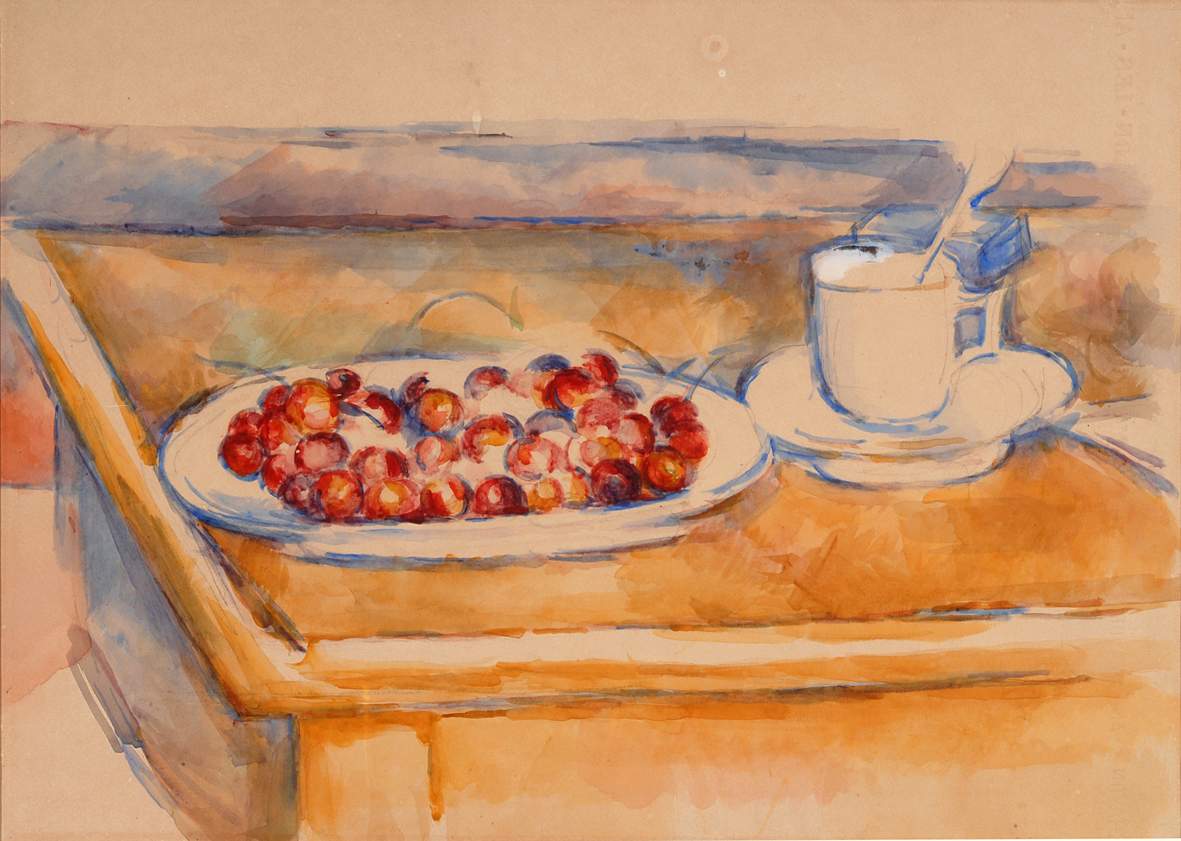
An extraordinarily serious theft has struck one of northern Italy’s most significant cultural centers . At the Magnani Rocca Foundation, in Mamiano di Traversetolo, in the province of Parma, several masterpieces of the highest artistic and economic value belonging to the permanent collection were stolen. Among the stolen works is Les Poissons, an oil on canvas by Pierre-Auguste Renoir created in 1917, one of the rare examples of the Impressionist artist permanently present in a collection open to the public in Italy. According to initial reports beaten out by agencies and confirmed by investigative sources, along with Renoir’s painting, Paul Cézanne’s Still Life with Cherries, a watercolor on paper, and Henri Matisse’sOdalisque on the Terrace, an aquatint, both of which are kept in the villa that houses the foundation, were also reportedly stolen. The theft was reportedly a few days old, but the news was only made public today. These are key artists between Impressionism and the twentieth-century avant-garde, and their presence in an Italian permanent collection is relatively rare. In particular, Renoir and Cézanne(here an in-depth look at Still Life with Cherries), are poorly represented permanently in Italian museums: this makes the loss extremely significant.
According to initial reconstructions, a gang of thieves managed to break into Villa Magnani, home of the collection, taking advantage of circumstances still under investigation by investigators. The thieves, hooded, allegedly acted quickly, managing to steal the painting without leaving immediate traces. The theft occurred a few days ago, but the news was only released today.
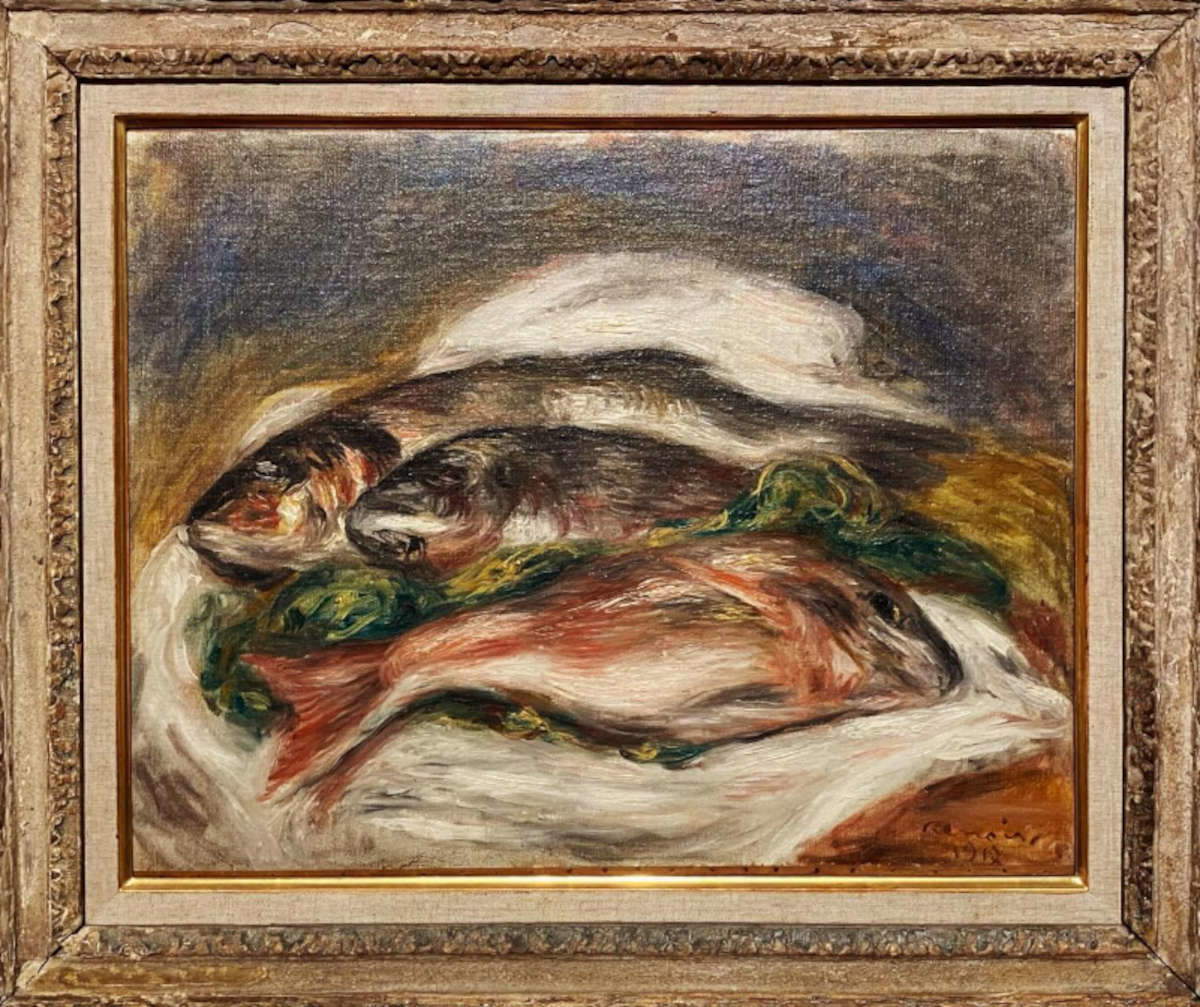
The blow has struck one of Emilia-Romagna’s most relevant cultural hubs. Indeed, the foundation holds a collection of works of great importance, with masterpieces spanning different periods and artistic currents. Les Poissons, a 1917 canvas, represented one of the most significant pieces for the presence of Impressionism in the collection, along with another painting by the same author, Paysage de Cagnes, also an expression of the late phase of Renoir’s production. They are among the few Renoir works visible in a collection open to the public in Italy. The stolen painting belongs to the French artist’s mature period, characterized by a freer and more vibrant painting, in which nature takes a central role and forms tend to dissolve into colors.
Even more relevant, for uniqueness in the Italian context, is the nucleus of works by Paul Cézanne kept at the foundation. Still Life with Cherries, made around 1890 with pencil and watercolor on white paper, measures 38 by 49 centimeters and depicts a simple interior: a table on which a cup and a plate of cherries are arranged. It is a significant example of the research conducted by the Aix-en-Provence artist throughout his career, in which still life takes a central role in reflecting on the relationship between object, perception and pictorial construction. Cézanne’s still lifes have been the subject of important analysis by art historian Meyer Shapiro, who has emphasized their profoundly innovative character. In his interpretation, the artist’s ability to depict both still life and landscape testifies to a radical need to paint that which is external to man. In this sense, still life is not simply a representation of objects, but becomes an extension of man’s relationship with reality, in which the choice of elements and their compositional balance reflect an aesthetic and contemplative attitude.
In the specific case of the subtracted work, the balance between the cold and warm tones, between the reds of the cherries, the ochre of the table, and the white and blue of the plate and cup, contributes to an image of particular charm. This is further accentuated by the sense of airiness resulting from the watercolor technique, with the alternation between painted areas and spaces left free, circumscribed only by the brush stroke. For Cézanne, painting meant recording his own colored sensations, and in the watercolors this perceptual dimension emerges clearly.
The modalities of the theft are now the focus of the investigation conducted by the Carabinieri, particularly the specialized nucleus for the protection of cultural heritage. Investigators are reconstructing the dynamics of the incident, analyzing the villa’s security systems and checking for any flaws that may have facilitated the thieves’ actions. The heist was most likely carefully planned, given the value of the works and their recognition on the international market. In fact, thefts of this kind pose difficulties even in the next stage, related to the possible fencing or clandestine export of the asset.
The theft of works by Renoir, Cézanne and Matisse temporarily deprives the Italian public of one of the few artist’s works permanently visible in the country. This is a significant absence, affecting not only the Magnani Rocca Foundation but the entire national cultural heritage. Investigations are continuing to identify those responsible and attempt to recover the painting, with the goal of returning a work of great artistic and symbolic value to the community.
|
| Sensational theft at Magnani-Rocca Foundation (Parma): stolen Renoir, Cézanne, Matisse |

Warning: the translation into English of the original Italian article was created using automatic tools. We undertake to review all articles, but we do not guarantee the total absence of inaccuracies in the translation due to the program. You can find the original by clicking on the ITA button. If you find any mistake,please contact us.
























 IT
IT FR
FR DE
DE ES
ES CN
CN


