





At Art Basel in June, there’s always someone selling something important even before the fair opens. Not during the preview hours, which are already reserved for those who have proven they deserve access—such as collectors with a track record, a deep pocket, and the right number saved in the right phone. Even earlier, during those thirty or forty minutes when the booths are technically still closed but the right people are already circulating, with their badges dangling from their chests and the air of someone who isn’t looking for anything in particular because they already know what’s coming their way.
It’s a spectacle that has something reassuring about it in its candor. No one pretends to be there for anything else; no one talks about research, inner need, or dialogue with history. People buy and sell, and they do so with a certain elegance—which is probably the best one could ask of a market. The problem isn’t Art Basel because Art Basel works very well, and those who work there know it. The problem is what happened to the rest of the system the moment Art Basel—and art fairs in general— stopped being an event and became an institution. The moment when the contemporary art calendar began to organize itself around art fairs rather than in spite of them. That moment passed fairly quietly, as is typical of changes that no one has any interest in openly acknowledging. And now we’re on the other side, and it’s worth taking a look at what’s here.
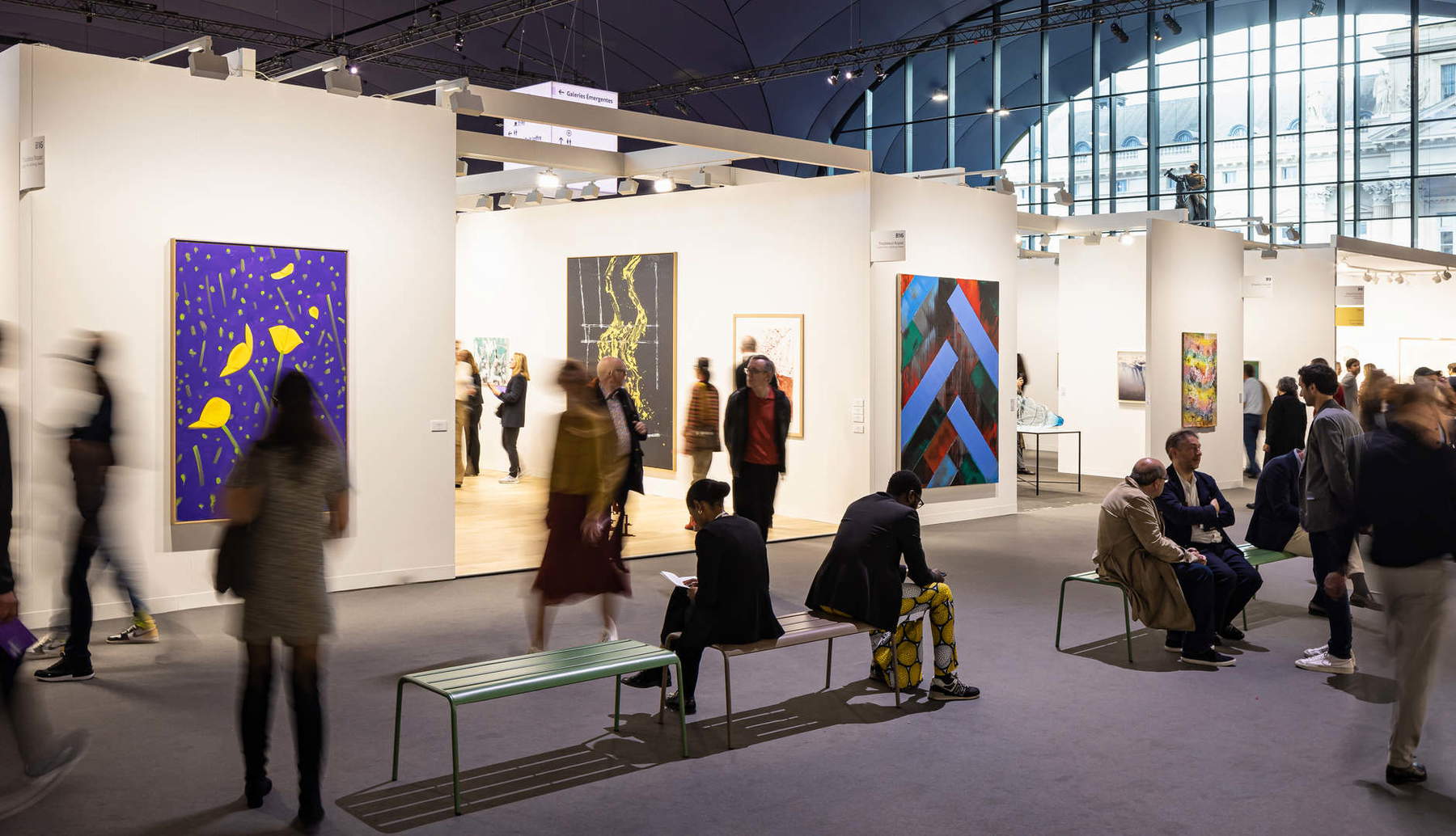
Art fairs have existed for decades: Art Basel dates back to 1970, FIAC to 1974, and Arco in Madrid to 1982. For most of their history, they were exactly what their names suggested: fairs. Places where galleries brought their artists, collectors came to see what was new, things were bought and sold, and then everyone went home. The heart of the system remained elsewhere: in studios, galleries, institutions, and magazines that were still read in print. The art fair was a moment, not an identity. Then, in the early 2000s, something shifted. Art fairs grew in number, size, and symbolic weight. They began to feature curated sections, public programs, and satellite exhibitions. They hired curators, editors, and artistic directors. They began to resemble temporary institutions more and more, with the fundamental difference that a temporary institution that lasts five days and generates more sales than a museum does in a year has a much clearer agenda than any museum. And in the meantime, galleries have begun to face the music—not metaphorically, but in real terms—with alarming figures. The rent for fair booths has risen every year, production and transportation costs have risen every year, and the number of fairs one had to participate in to remain visible has risen every year. And collectors—those collectors who once came to the gallery, who built a relationship with the space, with the program, with the curatorial vision—have begun to look forward to the art fairs.
Why visit twelve galleries in twelve cities when you can go to Basel once and see everything all at once? It’s a reasonable question, but it’s also the question that changed everything. Not in the negative sense of the term—or not only that—but in a structural sense. A simple and obvious example: the supermarket gives you everything in one place, saves you time, and lets you compare items without having to go from store to store. It’s efficient; it’s convenient. And gradually, inevitably, your relationship with what you buy changes. You no longer go to the baker because you have a relationship with the baker, because you know his story, because you trust his judgment about the flour. You go to the supermarket because the bread is in aisle three, next to the cookies.
The collector who buys at an art fair isn’t a worse collector than the one who buys at a gallery: they’re often better informed, more up-to-date, and more exposed to different geographical contexts. But their relationship with the artwork they buy is fundamentally different. They didn’t see that exhibition, didn’t read that critical essay, didn’t have that conversation with the gallerist at six in the evening when the space was empty and they could really talk. They saw the work at a forty-square-meter booth, among twenty other works, with a salesperson engaged in another conversation two meters away and their eyes fixed on the entrance to see if someone more important was arriving. A moral judgment? Not exactly: it’s a description of context. And context, in art, is never neutral.
What’s happening is that galleries are closing. Not in a dramatic way, not with newspaper announcements: simply, at some point, they decide not to renew their lease. Or they downsize or change their business model: no more permanent location, just art fairs and art weeks, because keeping a gallery open fifty-two weeks a year for three exhibitions that each draw three hundred people has become economically unsustainable.
This phenomenon doesn’t affect the big players—those with multimillion-dollar budgets and locations on four continents—nor the very small ones, those that survive on a handful of loyal artists and minimal costs. It affects the middle tier—the one that has historically done the most interesting work, that discovered artists before they became famous, and that built programs with a long-term vision. That tier is disappearing, and it is precisely the tier that produced the bulk of the experimental work.
Anyone working in the art world knows the names of the most recent closures: Air de Paris, after more than thirty years of operation and a roster of artists who are now part of art history; Dépendance in Brussels, which for twenty years had supported artists like Ed Atkins and Haegue Yang, and which closed simply by saying that the time had come; Templon, which closed its New York location because the rent had reached a figure that no fair sales could cover anymore.
What is almost never mentioned, however, is that these closures are not only a symptom of an economic crisis but also a symptom of a crisis in collecting. The Italian—and not just Italian—lower-middle and middle classes who used to buy art haven’t disappeared for mysterious reasons: they’ve been progressively excluded by a system that has driven up prices, shifted transactions to art fairs, and made the direct relationship between those who create art and those who buy it to live with it increasingly complicated. Filling that void are the “flippers”—buyers who treat artworks like stocks, buying today to resell at auction in six months. Galleries try not to sell anything to them, and they’re only partially successful. The void remains.
There is one consequence of all this that is discussed even less—perhaps because it is uncomfortable in different ways for almost everyone involved in the system: the pressure from art fairs has begun to alter the way artists work through the most powerful mechanism that exists in any market— the prize. The art fair has specific aesthetic needs, even if it never articulates them. It needs works that can be appreciated from a distance, in a crowded booth, within the average amount of time a visitor spends on each work before deciding whether to approach it or move on. It needs works that photograph well, because the art fair markets itself primarily through social media. It needs works with a story that can be told in a few lines: the Syrian artist who works with fragments of bombed-out houses, the photographer who documents indigenous communities in Alaska. Not that these stories are false, but when the distribution system rewards a certain type of work, then artists—not out of cynicism but out of necessity—begin to produce that type of work. And the works that don’t fit into that category begin to disappear from the booths, then from the galleries, and then, little by little, from the conversation.
Art fairs have also colonized time. The contemporary art calendar is now structured around fairs: Art Basel in June, Frieze and Art Basel Paris in October, Artissima in November, Art Basel Miami in December, Arte Fiera in February, Arco in March, Miart in April, and then all the satellite art weeks that have multiplied like franchises of an original idea. The result is that the rhythm of the system is no longer determined by artists’ production, curators’ research, or institutional programming. It is determined by the dates of the art fairs; works are produced for the fairs, openings are timed around the fairs, and budgets are planned according to the fairs. And everything that doesn’t fit into this timeframe—such as an exhibition requiring two years of preparation, a site-specific project that can’t be transported, or research that hasn’t yet yielded visible results—struggles to find space, attention, and resources.
There is no simple solution, and it would be dishonest to pretend otherwise. Art fairs exist because they meet real needs for visibility, for the market, and for bringing together people who otherwise would not meet. And none of them will disappear—nor would that be desirable. But there is a question worth asking aloud, even knowing it will likely remain unanswered: What would happen if the system decided to invest a fraction of the resources that flow into art fairs (into booths, transportation, hotels, and opening-night dinners that cost as much as an entire exhibition) instead into the medium-sized independent galleries that are closing down? Not as an act of charity, but as an act of collective intelligence: recognizing that those galleries produce the raw material that art fairs then sell, and that without that raw material, in a few years, the fairs will have nothing interesting left to offer.
An American gallery owner who closed her doors after twenty years in business said something simple in an interview: it only takes one art fair that goes badly to sink a gallery. It’s not a dramatic statement, but a description of balance—a balance so precarious that what’s astonishing isn’t how often it breaks, but how long it has held up. Over the past twenty years, the art world has demonstrated a remarkable ability to ignore the long term. There’s no reason to believe it will stop now, but every now and then it’s worth pointing out anyway—if only because of the annoyance it causes.


The author of this article: Federica Schneck
Federica Schneck, classe 1996, è una giornalista specializzata in arte contemporanea. Laureata in Storia dell'arte contemporanea presso l'Università di Pisa, il suo lavoro nasce da una profonda fascinazione per il modo in cui le pratiche artistiche operano all’interno, e in contrapposizione, alle strutture sociali e politiche del nostro tempo. Si occupa delle trasformazioni del sistema dell'arte contemporanea, del dialogo tra ricerche emergenti e patrimonio culturale, del mercato, delle istituzioni e delle fiere internazionali. Alla scrittura giornalistica affianca quella critica, con testi per artisti, gallerie e collezioni private.Warning: the translation into English of the original Italian article was created using automatic tools. We undertake to review all articles, but we do not guarantee the total absence of inaccuracies in the translation due to the program. You can find the original by clicking on the ITA button. If you find any mistake,please contact us.





















 IT
IT FR
FR DE
DE ES
ES CN
CN


