





Alex Da Corte was born in Camden, New Jersey, one of the poorest cities in the United States, and grew up in New Jersey, Pittsburgh, and Caracas. This biographical detail is not merely incidental: it is the center of gravity of his entire body of work. Da Corte does not viewAmerica from the inside or the outside, but from that unstable vantage point of someone who knows it as one knows something that has shaped you without fully belonging to you. The America of Saturday-morning cartoons, of Heinz ketchup, of Mister Rogers, of Eminem, of the red devil from cartoons, of Frankenstein, of Popeye, of the Wicked Witch of the West. Not America as political critique, not America as nostalgia, but America as a mother tongue learned and mangled, as a system of symbols that never cease to signify even when you no longer know exactly what they mean.
Da Corte scours supermarkets, street corners, and IKEA showrooms in search of materials for his installations and videos, which use everything from food to hardware. But this is not the archaeology of the everyday in the usual sense: there is no documentary intent, no desire to catalog reality. Instead, there is something more precise and harder to name, which Da Corte has summarized as follows: seeking something unknown in the face of the familiar, surprising with what is already known, extracting the unnoticed from the interstitial spaces of everyday experience.
That interstitial space is his territory. Not the commodity itself, but what the commodity leaves behind once consumption is over. Not the symbol in its intact form, but the symbol slightly displaced, repeated to the point of hallucination, clad in something it shouldn’t be wearing. Da Corte does not limit himself to depicting the world of consumerism and the media through seductive icons, as Pop artists did before him: the artist reifies that world by transforming it into pure space, where every element is intended to convey something elusive and immaterial—something we always seem to recognize through a screen but that appears unable to exist outside a luminous surface. This is the difference that matters—the one that sets Da Corte apart from citationist postmodernism and Pop Art as a gesture of ironic detachment: in his works, there is no distance. There is immersion, and immersion is always also a risk.
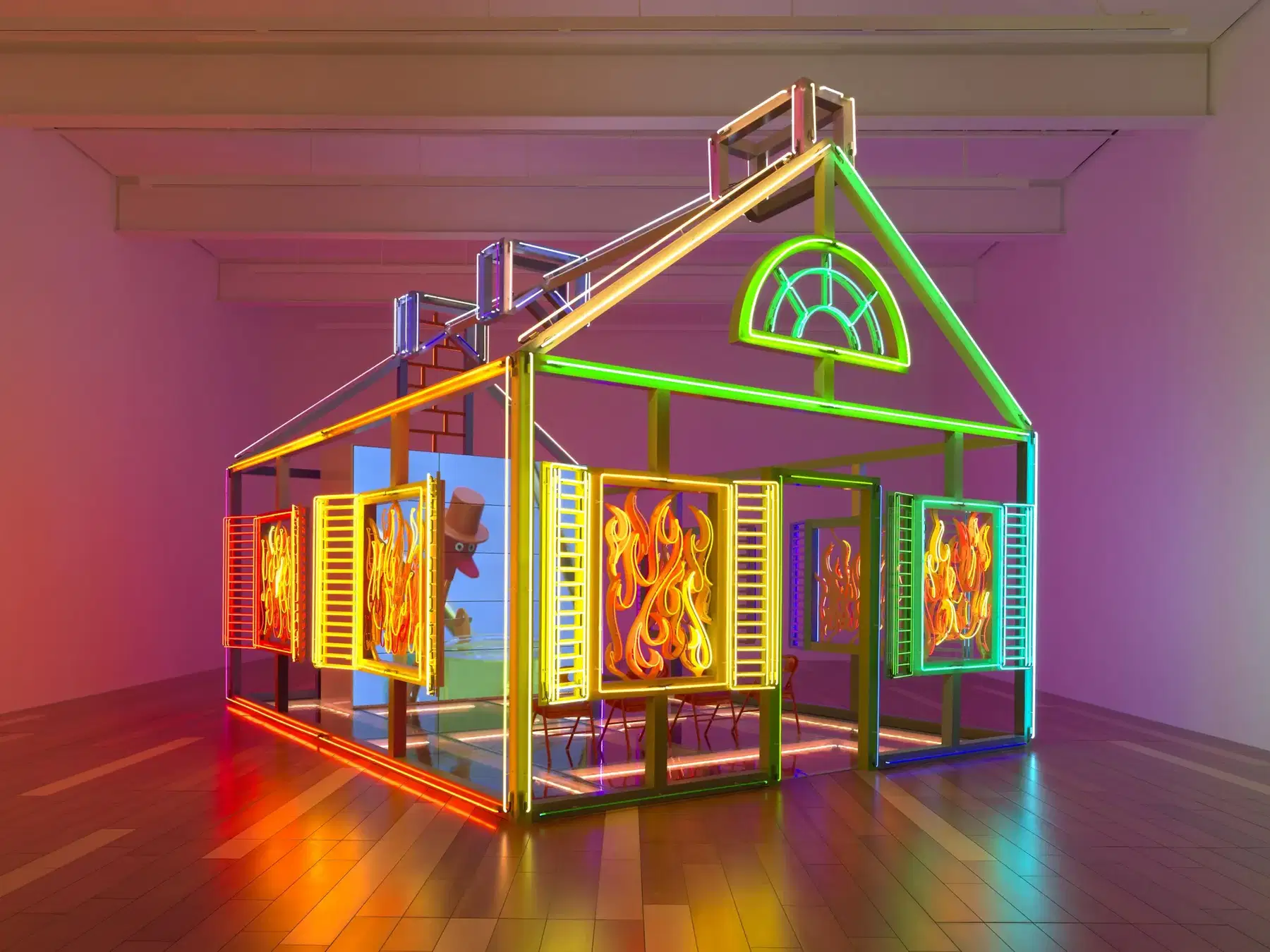
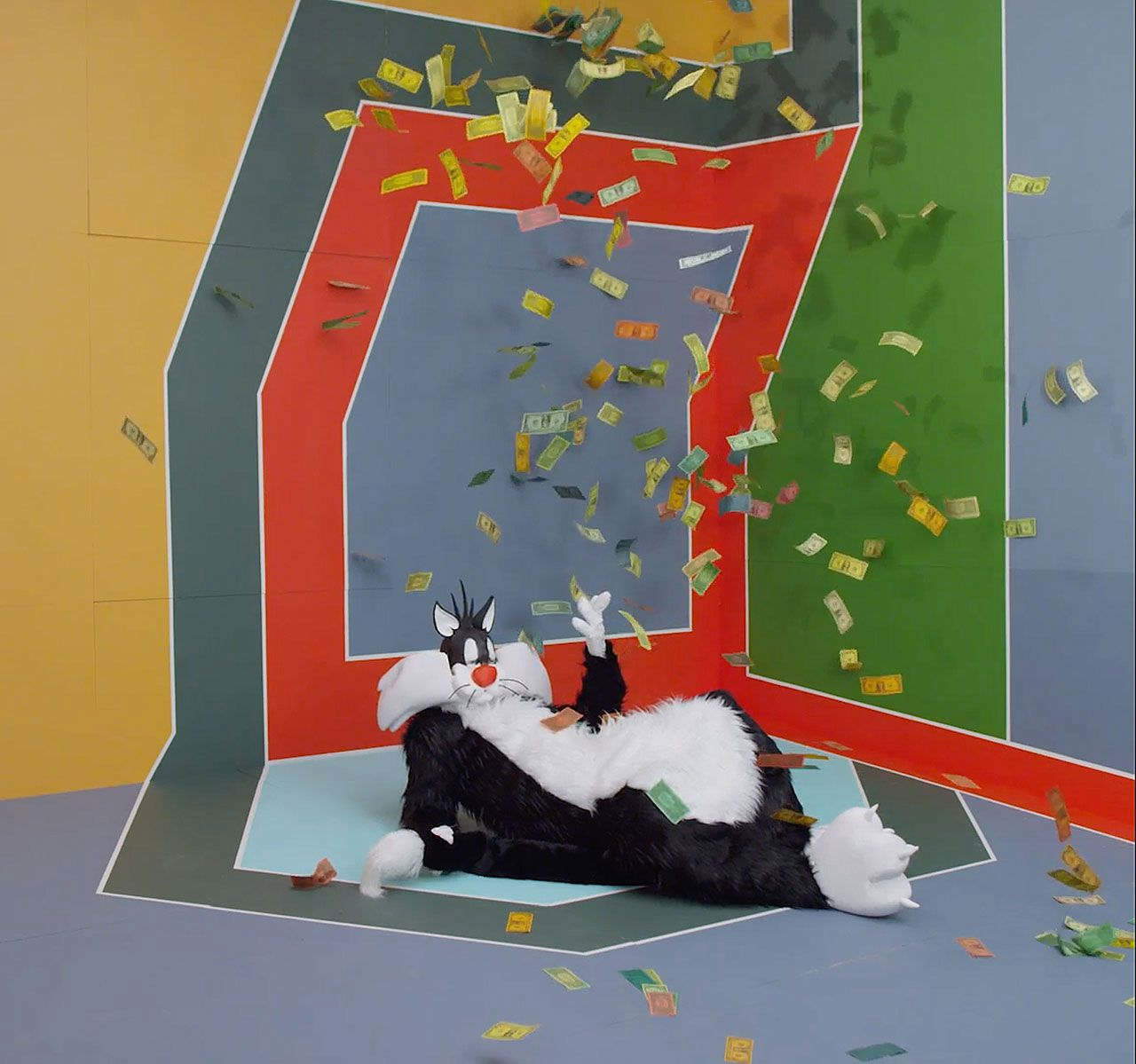
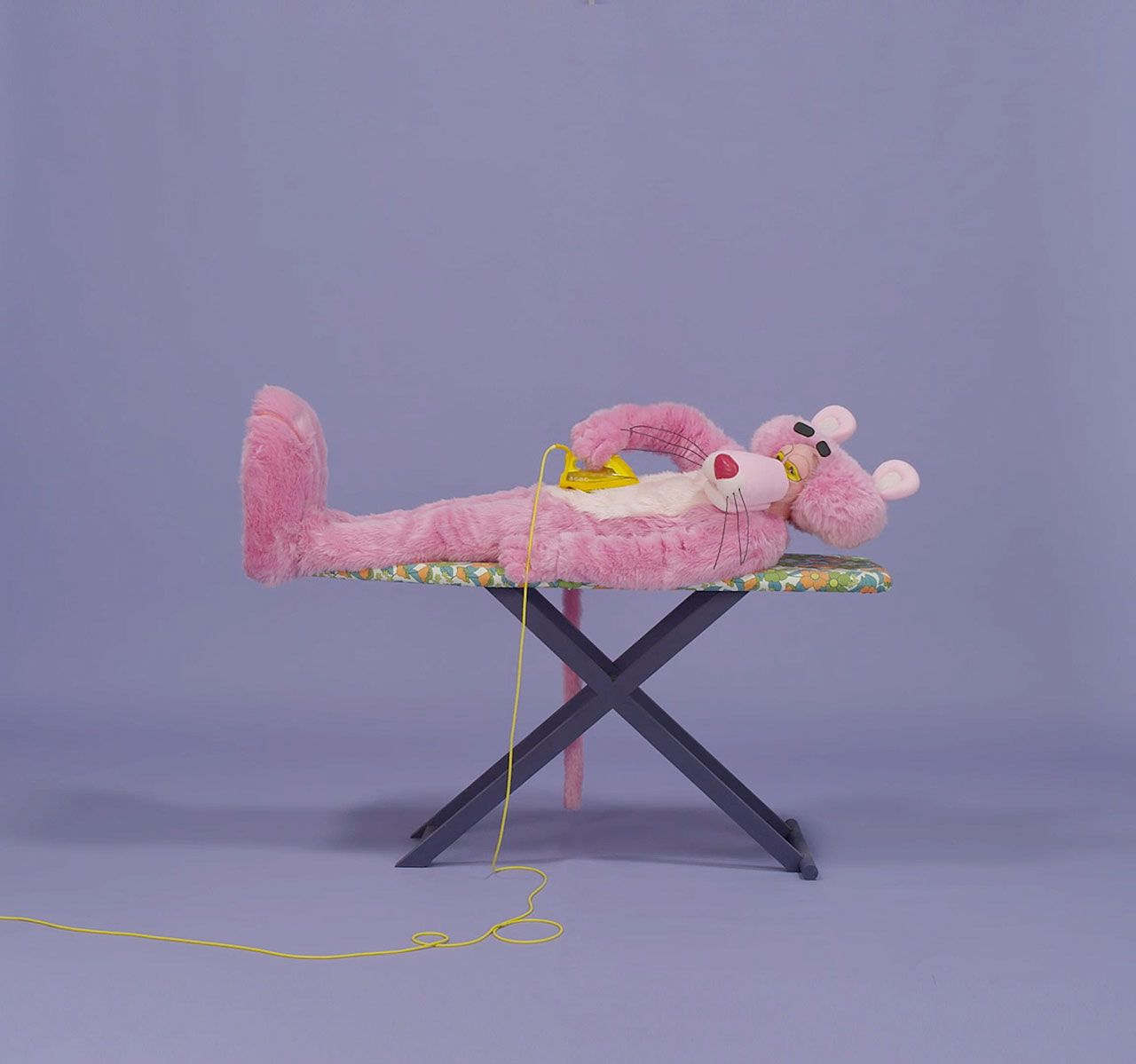
The work that, more than any other, has built his international reputation—and which continues to generate new versions and installations years after its initial appearance—is *Rubber Pencil Devil*, a 2018 video consisting of fifty-seven episodes. The number is no coincidence: Da Corte derived it from the fact that the Heinz brand—headquartered in Pittsburgh, where the 57th Carnegie International, for which the work was conceived, was held—is known for its Heinz 57. Fifty-seven episodes like fifty-seven varieties of ketchup, like fifty-seven fragments of American television spilling over into itself, like a never-ending Saturday morning of cartoons. Da Corte plays the two main characters after hours of prosthetic makeup: Mr. Rogers, the uncomplicated hero of American childhood, in a bright blue sweater, who takes off and puts on his shoes in a purgatorial loop, and the devil, painted bright red, who obscenely waves the giant eraser pencil from the title. The two never meet, never clash, yet they inhabit the same visual universe, the same hypnotic world of events that unfold without a climax or resolution. Time slows down; one expects a crescendo that doesn’t always come. Sometimes that is precisely the point.
In 2022, Glenstone commissioned Da Corte to create *Rubber Pencil Devil (Hell House)*, a five-and-a-half-meter-tall house covered in neon that houses the original video—a structure that appears to be ablaze and transforms the viewing device into architecture, into a landscape, into something one inhabits even before looking at it. The total work in the Wagnerian sense of *Gesamtkunstwerk* —not as a rhetorical ambition but as a necessity: the image alone is not enough; one needs the space that generates it, the color of the walls, the quality of the light, and sometimes even the scent.
Da Corte always acts as a performer in his own videos, and this is not a technical detail but a poetic statement. He has embodied Mister Rogers, Frankenstein’s monster, the Wicked Witch of the West, Popeye, among others: figures from the American collective imagination whom he inhabits with prosthetic makeup so precise as to border on a lookalike, yet at the same time with a minimal but perceptible shift that renders them unrecognizable within their very recognizability. There is no hierarchy among these references: the rapper and the children’s television host stand on the same level as the work of art, the fictional character, and the consumer object. American culture as an infinite repertoire in which everything is already an image even before it becomes an experience.
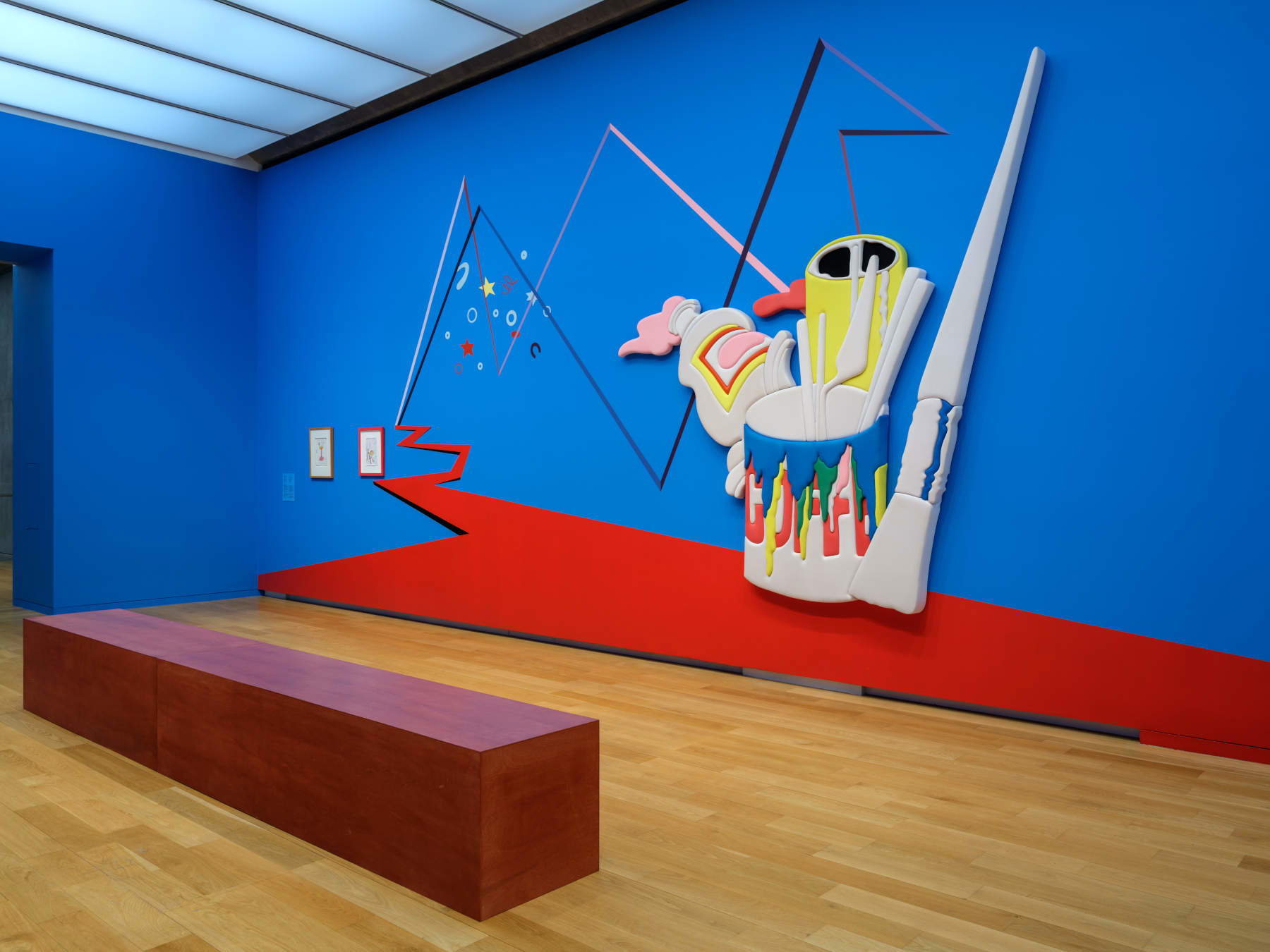
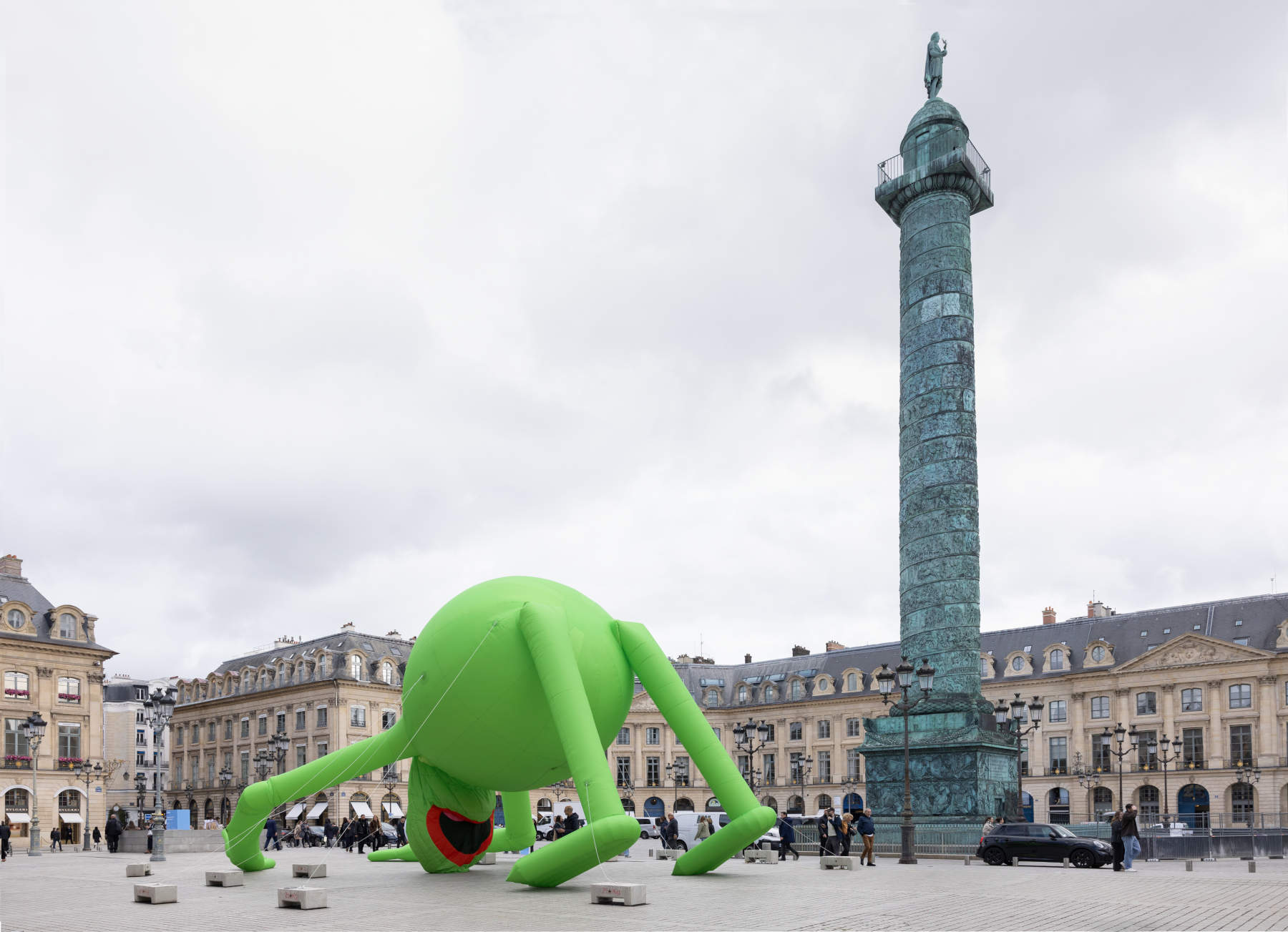
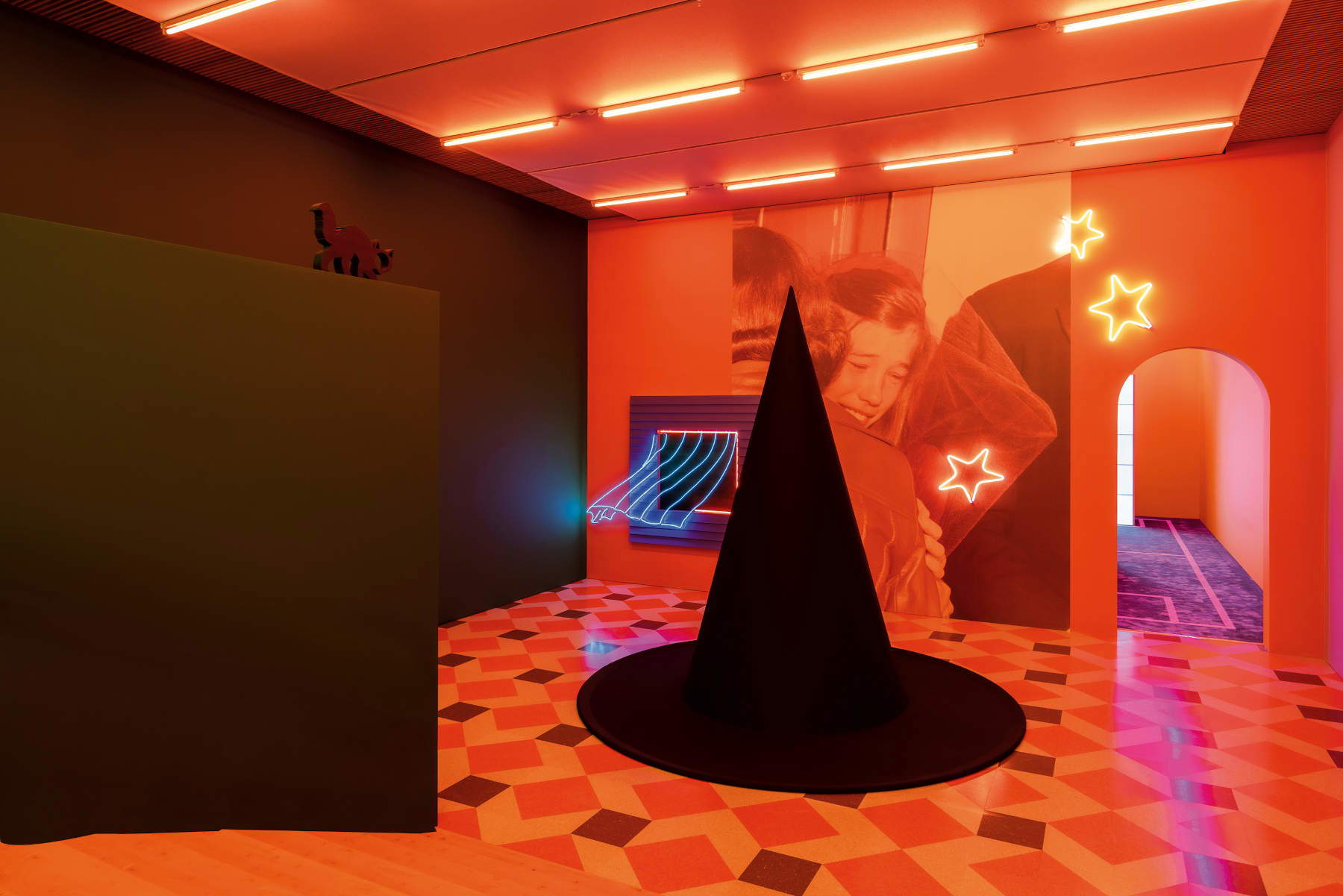
The 2025 exhibition *The Whale* at the Modern Art Museum in Fort Worth—the first dedicated entirely to his relationship with painting—structured its narrative around the Jungian reference to the journey of self-discovery in which one emerges from the belly of a whale, a cavity of ghosts and stories, as one’s true self. A whale that, however, in Da Corte’s work is never a place of dramatic danger: it is a TV room, a domestic interior saturated with color, an IKEA showroom where something is slightly out of place.
At this precise moment in history, while the contemporary art world debates artificial intelligence, immateriality, and the dematerialization of the object, Da Corte does something that appears to go against the grain: she constructs total physical environments, using the body, makeup, costumes, and the most concrete and least conceptual materials that exist—neon, rubber, paint, vinyl, and fur. A physicality that transforms the way the present is filtered through a consciousness that refuses to separate her aesthetic formation from her personal history.
There is something deeply coherent that connects his origins to the artistic path he has taken: Da Corte emerges as an artist who began by applying color to others’ surfaces, managing to build an entire career by applying color to others’ symbols, coating them with something they were not, transforming them into something not entirely recognizable.
Da Corte’s work is not meant to be decoded but rather experienced, even if only for the duration of a few-minute-long episode, even if only for the time it takes to understand why Mister Rogers taking off his shoes in an endless loop is both the most reassuring and the most unsettling gesture the American imagination has ever produced. The works possess a duality of extraordinary melancholy and sadness, yet at the same time something very effortless, playful, and lighthearted. That duality is never resolved. Da Corte keeps it in tension, and in that tension lies his precision.


The author of this article: Federica Schneck
Federica Schneck, classe 1996, è una giornalista specializzata in arte contemporanea. Laureata in Storia dell'arte contemporanea presso l'Università di Pisa, il suo lavoro nasce da una profonda fascinazione per il modo in cui le pratiche artistiche operano all’interno, e in contrapposizione, alle strutture sociali e politiche del nostro tempo. Si occupa delle trasformazioni del sistema dell'arte contemporanea, del dialogo tra ricerche emergenti e patrimonio culturale, del mercato, delle istituzioni e delle fiere internazionali. Alla scrittura giornalistica affianca quella critica, con testi per artisti, gallerie e collezioni private.Warning: the translation into English of the original Italian article was created using automatic tools. We undertake to review all articles, but we do not guarantee the total absence of inaccuracies in the translation due to the program. You can find the original by clicking on the ITA button. If you find any mistake,please contact us.





















 IT
IT FR
FR DE
DE ES
ES CN
CN


