





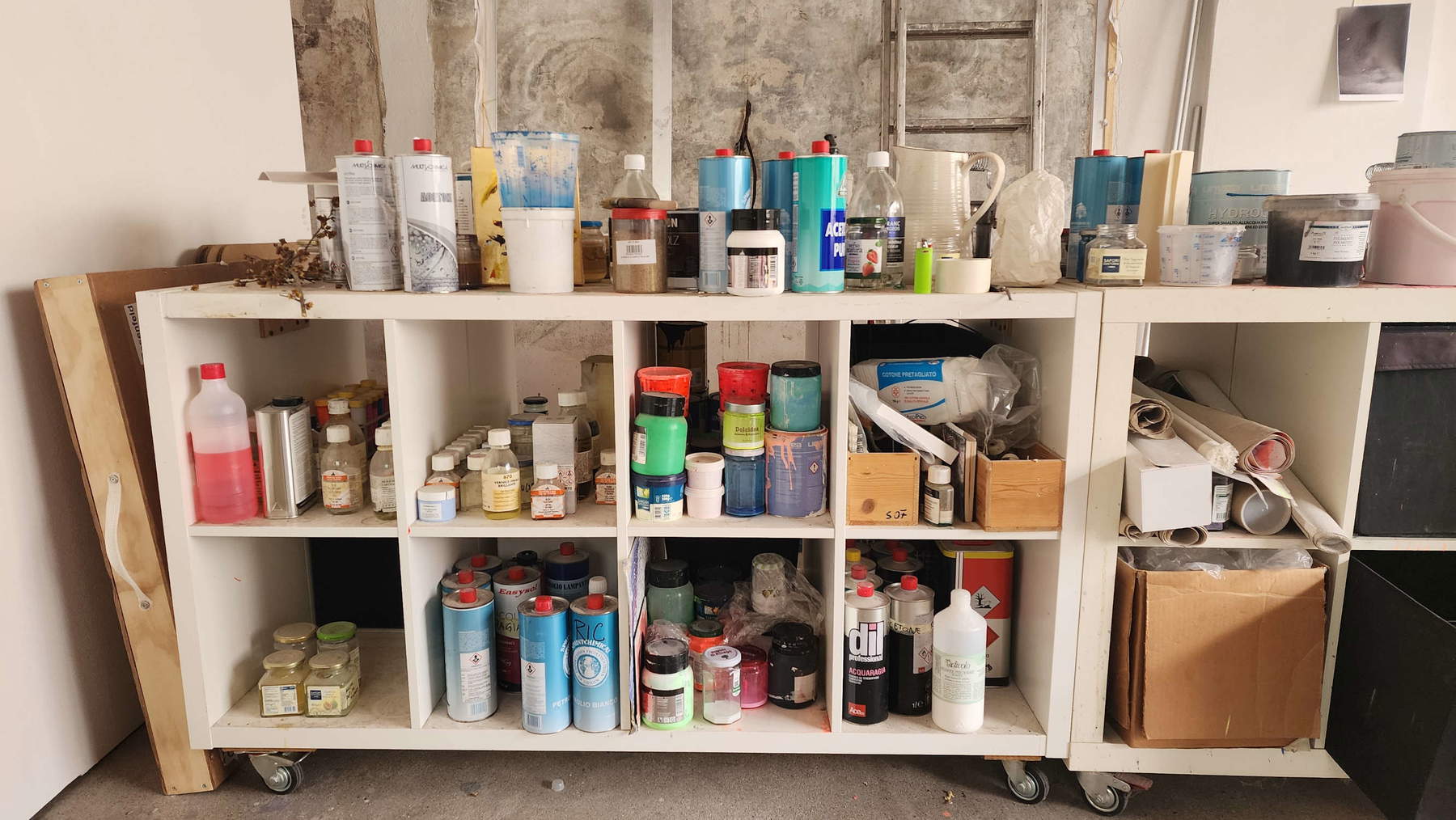
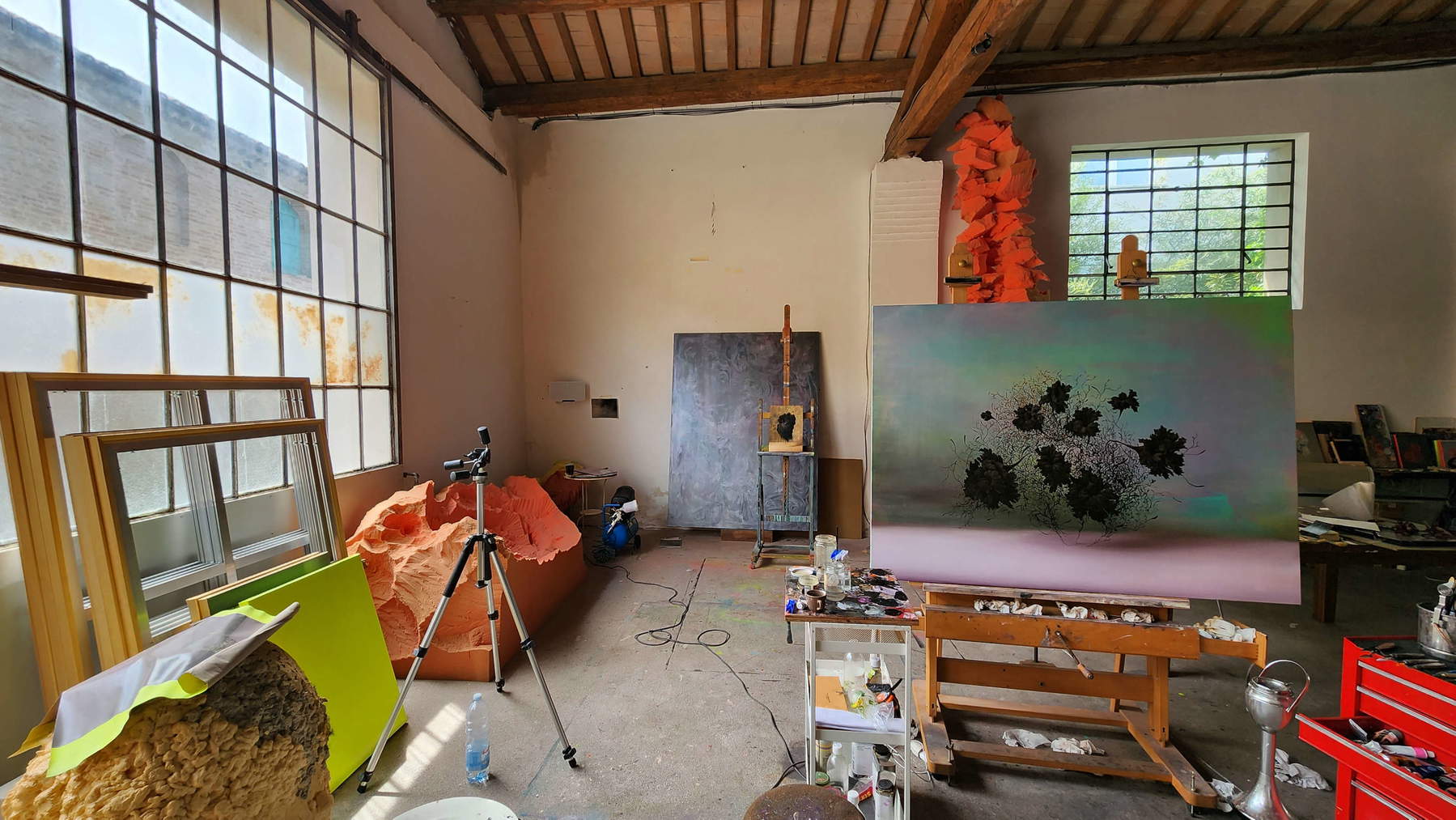
Enrico Minguzzi’s cabinet of curiosities is a humble and shy little doodle, a shrine half a meter or so high, with a lock that struggles to close, a glass cabinet hidden in the white half-light of an antechamber of his house in Bagnacavallo. A house that pretends to be a dwelling but is also a kind of hermitage, a physical garden and a mental garden, an industrious workshop, a small museum of naturalia and artificialia, a warm and luminous studio carved out of the first floor of a building in the historic center that was once a warehouse. Behind the cabinet’s crystals, Minguzzi has amassed whatever interesting things he can find during his walks through the countryside, the most curious gems from his rural, mountain, and maritime wanderings. There are quartz, tiny fossils, the skeleton of a small snake, a few entomological specimens, shells, minerals, fragments of stones, of rocks, of who knows what. Like everyone else, he has a favorite place for idleness and contemplation. He tells me about the Pialassa della Baiona, a lagoon just outside Ravenna, where the saltiness mingles with the fumes of chemical plants, where you happen to see flamingos flying near the big road on which the trucks rattle past refineries, cement factories, steel mills, and oil depots. The road that breaks off from the Via Romea and threads its way through the brackish water basins of the Baiona could be a kind of allegory of Minguzzi’s painting, were it not for the fact that human beings often prefer fractures and have divided with the firmest sharpness, with the most bureaucratic precision the natural from the artificial. Thus, if you go toward Marina Romea, if you turn left you will see the weary waters of the lagoon, the cormorants diving for fish, the fishermen’s scales, the signs pointing to the hut where Garibaldi took refuge (it is still there: just walk about ten minutes from the main road). On the right, however, he will see the smokestacks of the industrial zone, the towers of the petrochemical plant, the silos, the storage facilities. In Minguzzi’s painting, the clash between natural and artificial is resolved with a more ambiguous, persuasive articulation, with an evanescent, subdued doubleness, with a restlessness governed by a perennial sense of vital, stubborn, necessary precariousness.
In the cabinet there are also scraps of landscape gathered in that lagoon. Where others seek rest, he continues to exercise his feverish, brisk, imaginative intelligence. And the exercise necessarily starts from this collection of that which offers itself to those who can recognize it, from the fruit of this absorbed vigilance. “This vitrine represents me,” he says. “It is, in showcase form, my way of working.” Not all is as it appears: he shows me a rock and explains that it is a fossil of some primordial bacterial forms. Then he shows me what has all the appearance of being a bone, perhaps from an animal: it has the texture, the appearance, the color, to the touch it looks as if it should be crumbling. She tells me that it is actually a piece of porcelain: a friend of hers made it by soaking and then baking a piece of kitchen sponge. It would therefore come to think that this cabinet is really a synthesis of Enrico Minguzzi’s research, a compendium of his work, or even better, the autobiography for objects of an artist who every day, with his work, continues to probe the boundary between what is born and what is made, a tension where there is neither reconciliation nor conflict but where the natural seems to want to tend to form and the artificial to life. What is born naturally becomes artificial.
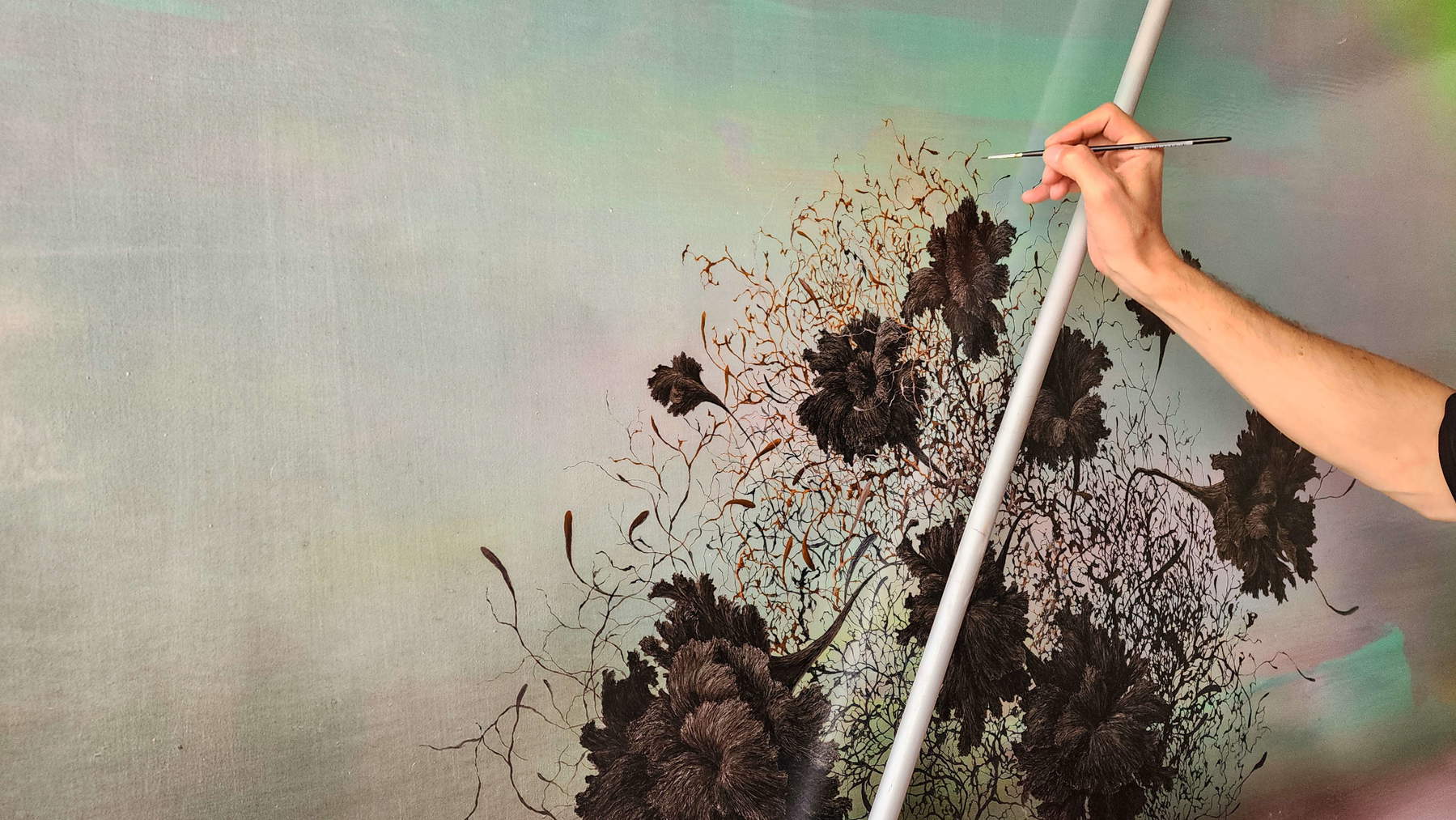

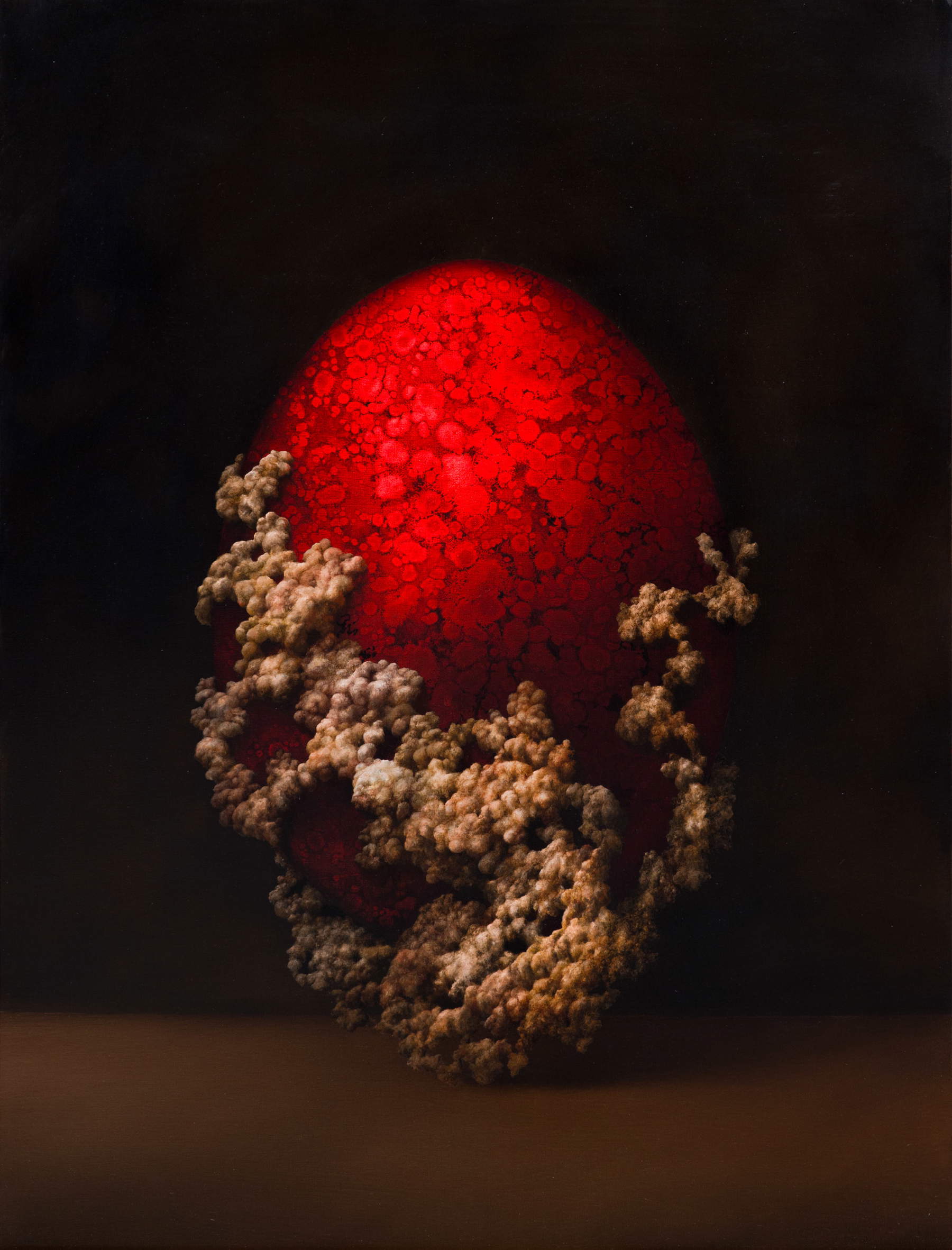
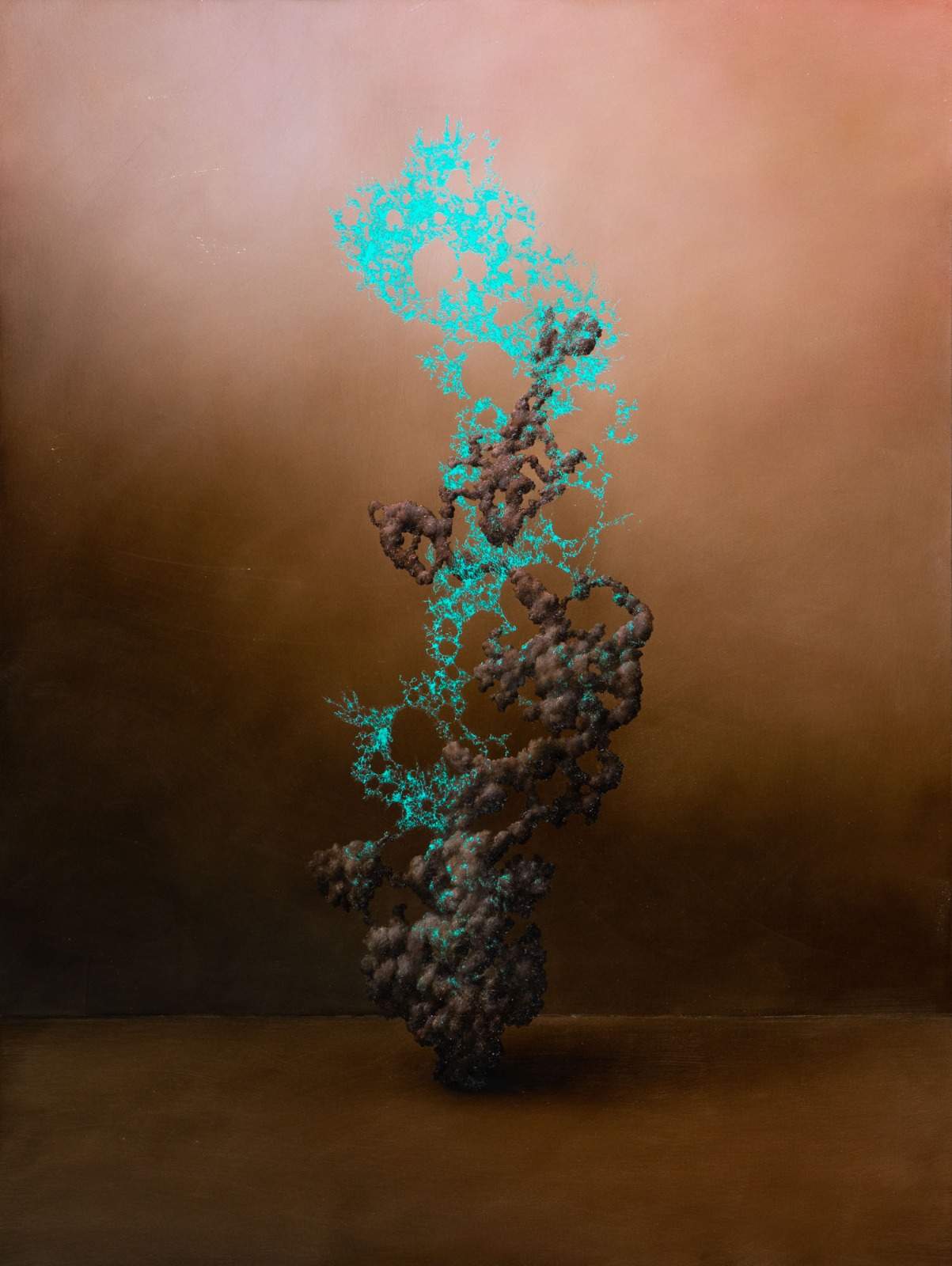
One then feels some form of embarrassment when trying to classify Enrico Minguzzi’s recent production, which began roughly five or six years ago, after the exhibition Antinomie in which he exhibited a series of views, of landscapes that were founded, wrote Daniele Torcellini in the catalog, on a profound “perceptual dissonance” which opposed to open spaces (in some cases, still, those of the Baiona), to woods, brushwood, prairies, clear skies, a whole overthrow of saturated surfaces, flat color layering, fluorescent alterations, pigments bound to epoxy resins “painted emphasizing the chemical artificiality of the pictorial matter.” It is difficult, however, to support the possible idea that Minguzzi abandoned landscape painting: it is more likely, if anything, that painting changed form, but without arriving at an arrangement, a norm, the semblance of an order, that it became something else. Consequently, it is equally likely that landscape for Minguzzi is not only a view, a scenery, a backdrop, but is also a biological process. At first glance, one would say that Minguzzi paints natural movements, an incessant swarming of intrusive and disjointed life forms, aggregates of beings living in relationship, a movement of viscous, lumpy, threadlike, phytomorphic creatures, resembling now a sponge, now an anemone, now a mold, now a flower arrangement, now an eerie agglomeration of unknown, alien biological entities. And it is a movement that always alludes to something that seems to be living, seems to be expanding, seems to have to transcend the boundaries of the work. They have branches, they have tentacles, they have legs, septa, mouths, laminae, stems, leaves, cells, walls, filaments, mycelia, spores. Creatures on the move. They seem to have just been born but they seem to have been here for centuries. They live in a state of perpetual transformation, or at least they live in a state of potential transformation. It is almost spontaneous to imagine them as a kind of visual translation of Lynn Margulis’ theory of symbiogenesis: organisms that are born as a result of a process of symbiotic cooperation. Minguzzi’s creatures seem the allegory of an evolutionary force that continues to invent new and increasingly complex forms, that knows no boundaries of time or space, that escapes any control, any prediction. Organisms that overturn the perspective of a self-sufficient subject. Chthonic creatures, to use Donna Haraway’s expression, that “wallow in the multispecies humus,” that challenge the exceptionalism of the human being because they want nothing to do withhomo “standing there scanning the sky.” A network of relationships in perpetual transformation.
These are not “still lifes”: it would be reductive to reduce these works to the still life genre. Saverio Verini, curator in 2022 of a major exhibition of Minguzzi’s work, La piena dell’occhio, which was held at the Museo delle Cappuccine in Bagnacavallo, had swirled a fascinating whirlpool of adjectives to try to define these works: “hyper-irreal, almost still life, painted nature.” He was starting from the assumption that Minguzzi’s subjects are not immediately recognizable. Perhaps they are not recognizable tout court. And the unrecognizability implies an unpeaceful relationship with nature, “almost as if it were the observation of a mutation that has taken place.” The interest in nature is a drive that the Romagna artist feels as spontaneous, yet he would not feel like calling his paintings “natures,” because they are neither nature nor accomplished artifice. They are an uncertain mixture, a hybrid that keeps itself on the threshold, suspended, neither here nor there, inhabiting a limbo of forms hesitant about how to define itself. “Hybrid natures,” one might call them. “Expanding natures.” “Organisms on the threshold,” which is perhaps even better. Something like that.
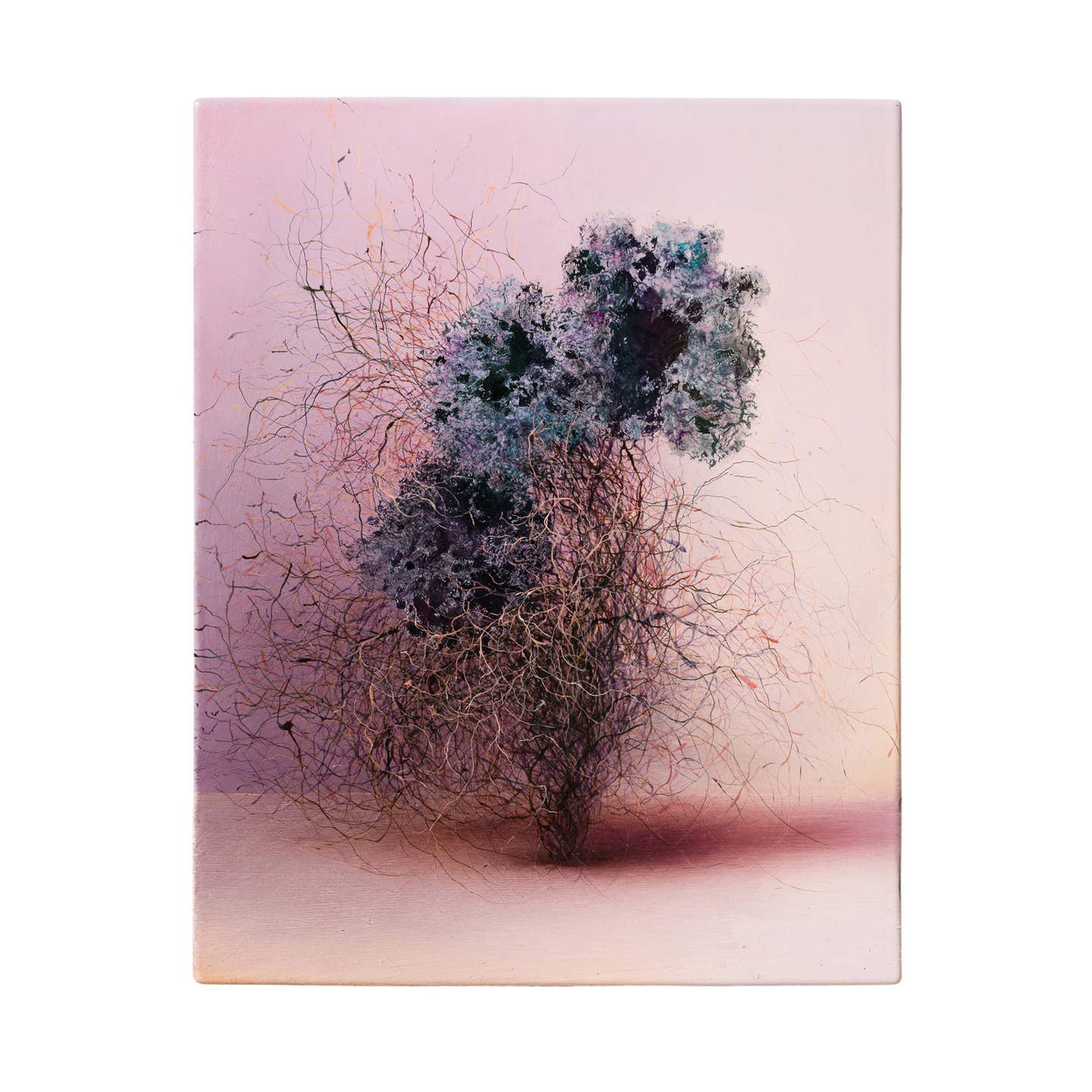
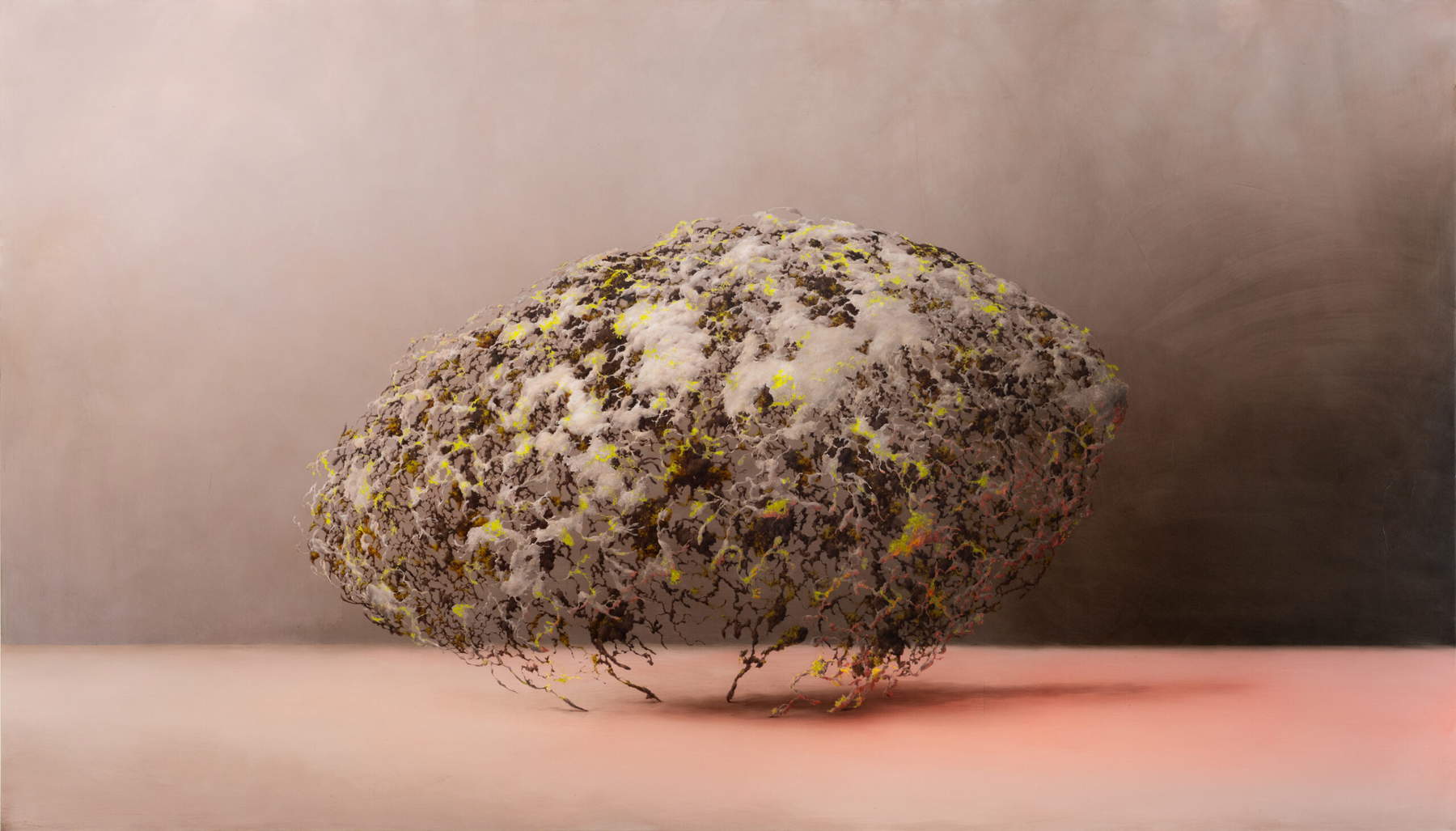
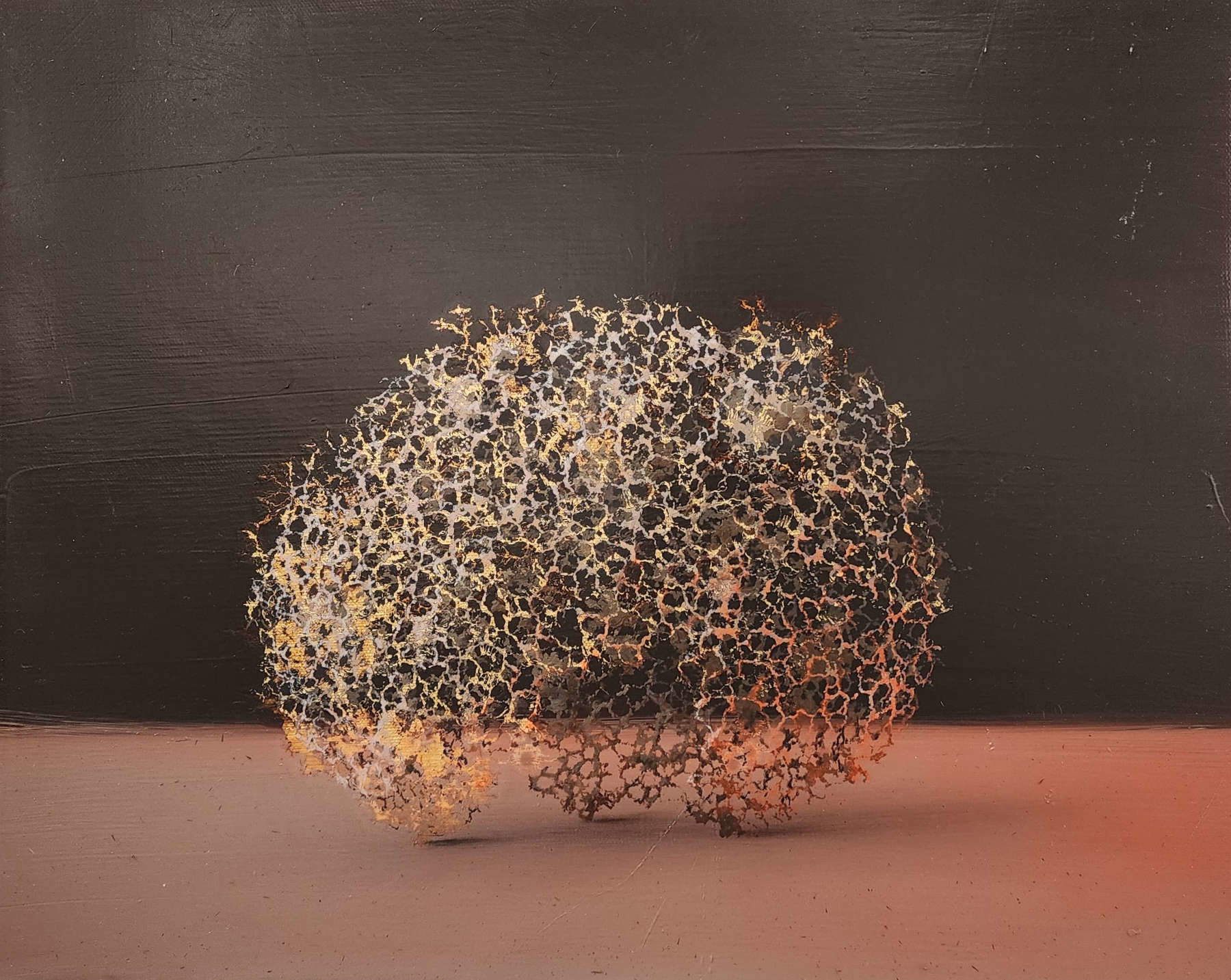
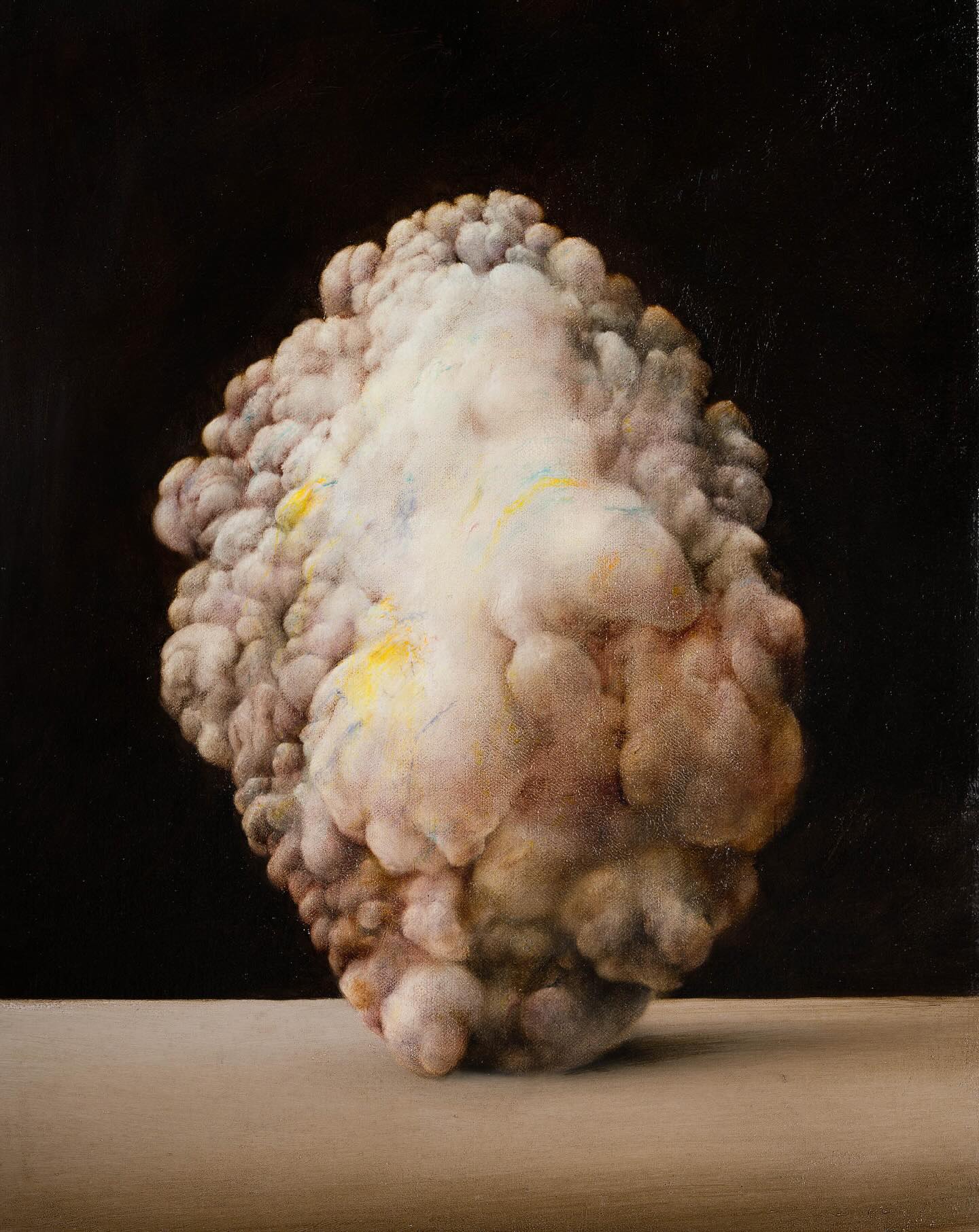
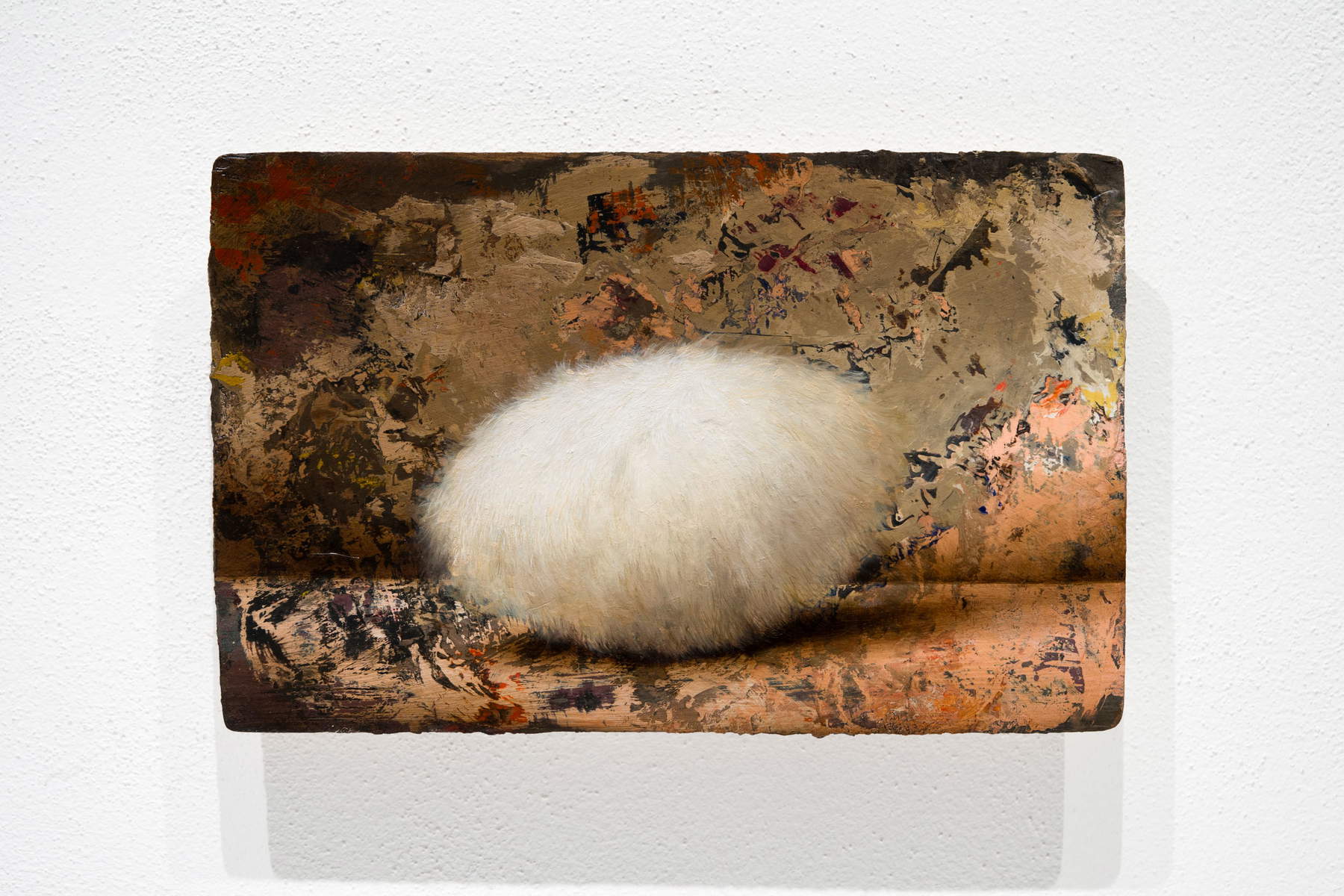
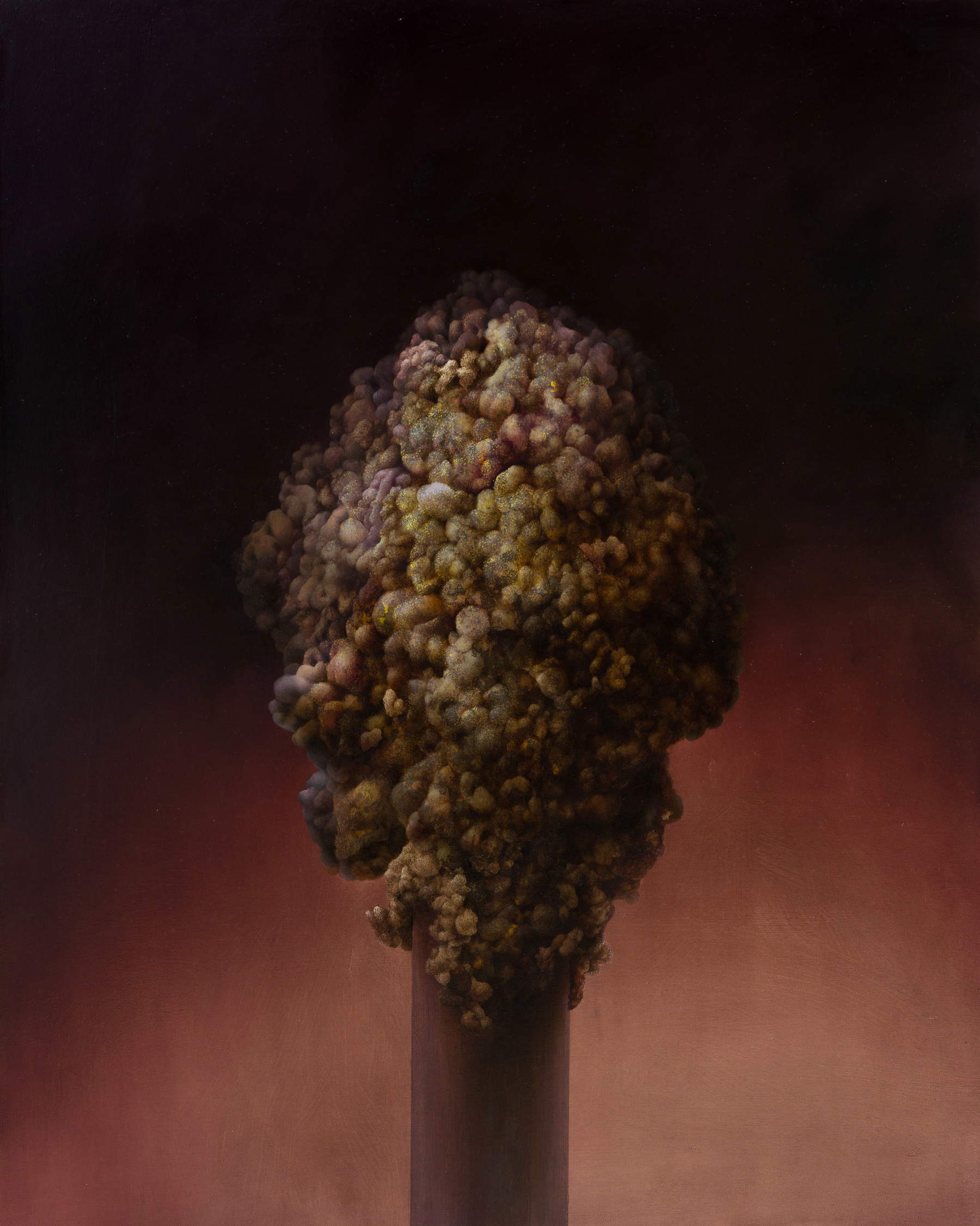
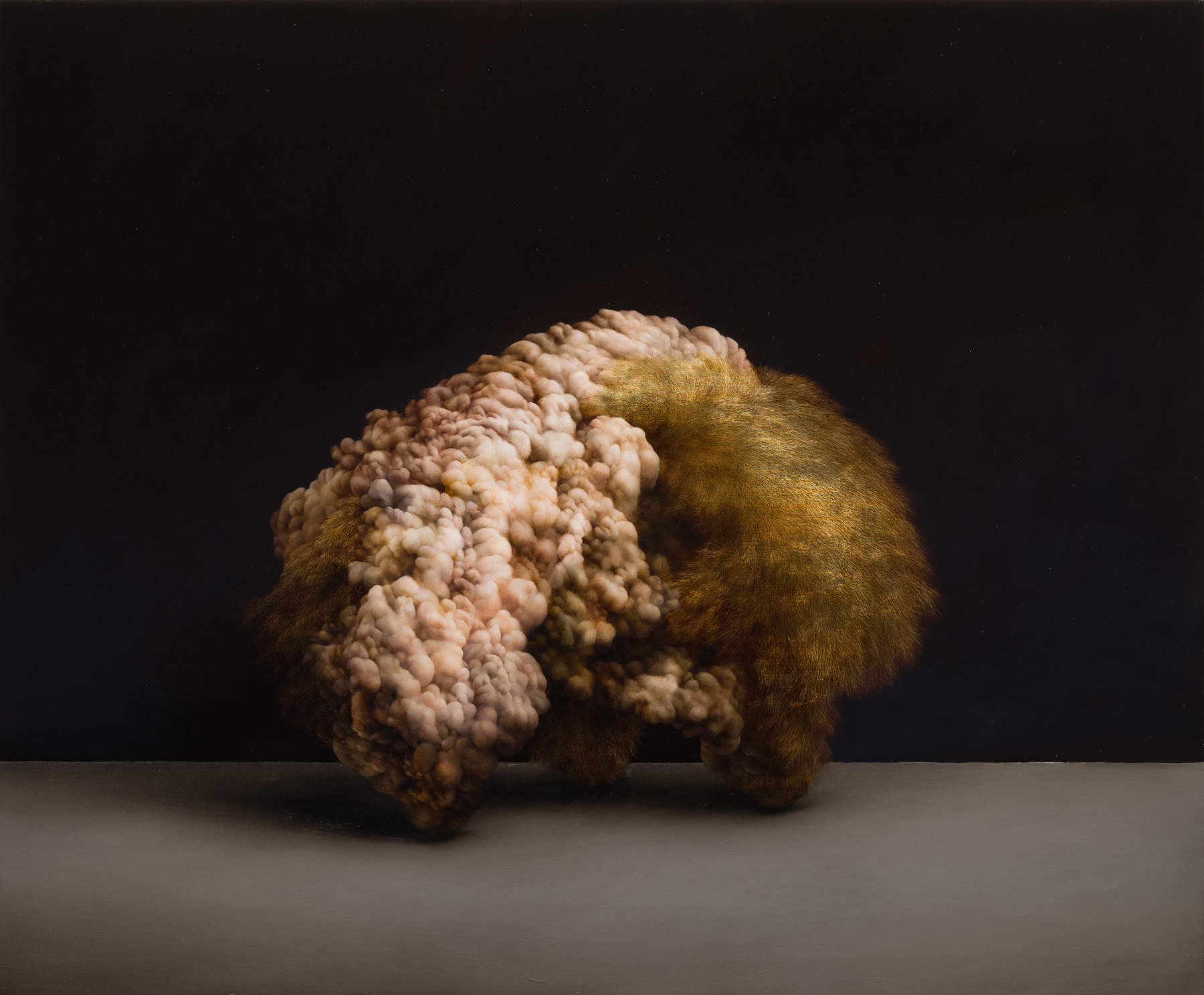
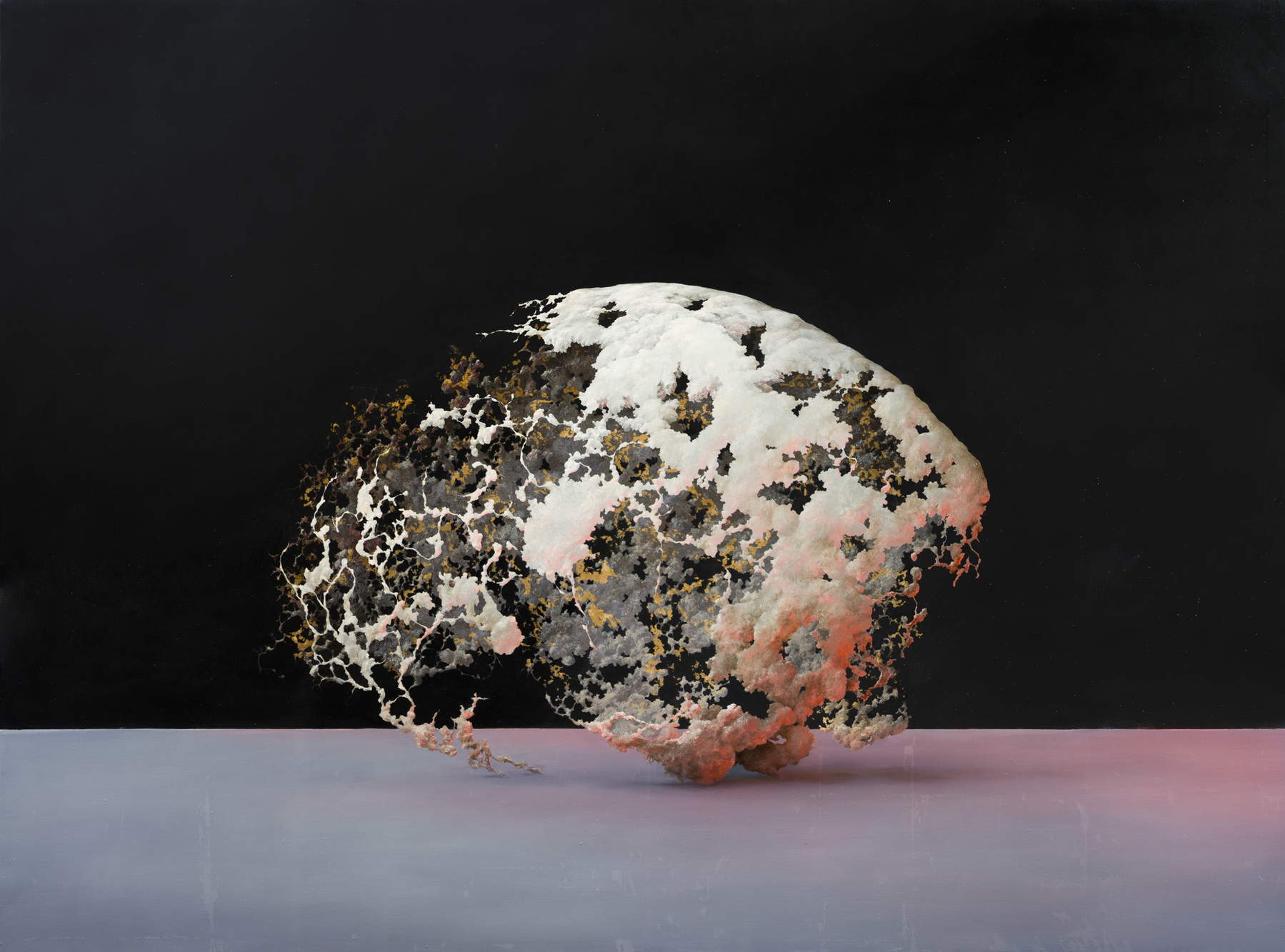
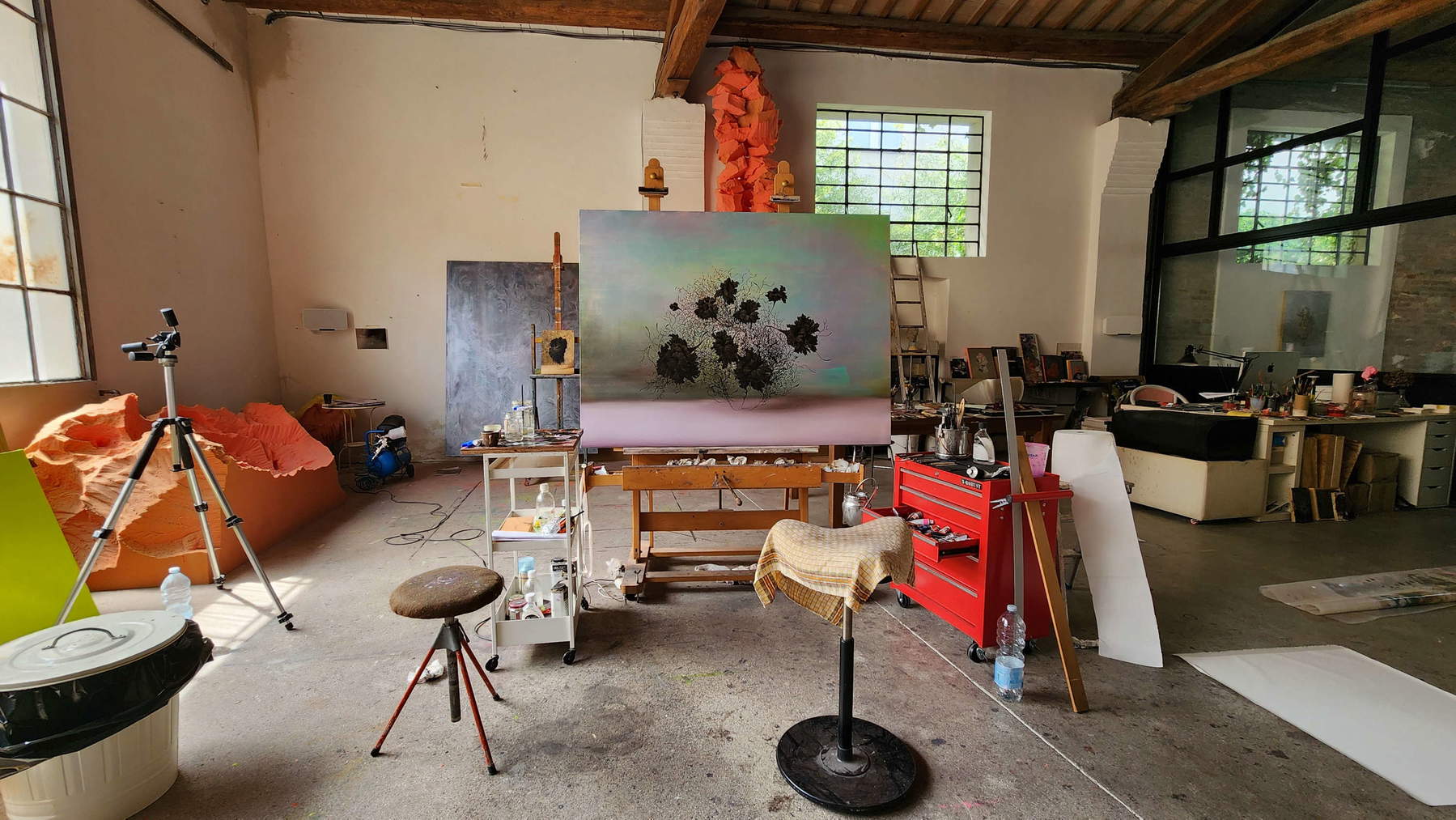
It is a painting that always springs from a discovery, even if, beyond all appearances, there are no ties that bind the work to the phenomenal datum. Even any idea of death, any nocturnal laceration, any cadaverous image, any grim and pensive sign that seems to surface on the surface of the works (but it would still be narrow-minded to avoid considering how, in Enrico Minguzzi’s studio, s’accumulate bouquets of dried flowers, fragments of bones, fossils, forms of life crystallized within colored concretions) must surrender before the evidence that the natures on Minguzzi’s threshold seem intent on a perpetual struggle, engaged in a continuous cause against dissolution, sustained by a provisional, revocable, fragile, precarious equilibrium: and yet, this very instability seems to be the only possible form of the necessity of this balance. One could imagine a game, and try to count how many of Enrico Minguzzi’s fragile creatures are capable of standing stable on sturdy supports, capable of holding firm every vertical development, capable of assuring an energetic and firm sustenance to that vitalism that fills the artist’s eyes, and how many, rather, are the masses that entrust all their weight to a shred, a splinter, a twig, a stem, a filament. The count would certainly lean toward the latter. Cristallo, for example, one of the most recent works, exhibited last year at Minguzzi’s solo show organized by Giovanni Bonelli, is a structure that resembles a coral, a strange, burnt, living coral in shades of gold, pale pink, apricot pink, a structure that rests barely on three stalks. Fragment of Stars is an accumulation of organic material clinging stubbornly to a piece of column, but the bulk of this creature is all up in the air. On the easel at the time I visit the studio, there is a sort of disproportionate plant barely holding on to three or four stems that sooner or later will have to give way under the weight of that mass of branches, leaves, flowers, shoots. Another recent work, Candido, is perhaps an egg, or an embryo, or a lump of wool, or the bleached fruit of a posidonia, so light that it looks as if it must be blown away, at any moment, from the bottom on which it rests. And the background is nothing more than an accumulation of color, a palette: the reuse of palettes is common practice in Minguzzi’s painting, which on the palette finds gestures that are not functional to representation, but are functional to something mechanical, to collect the color, to unload the brush, and thus preserve an instinctive trace of the artist’s doing that is not found elsewhere in his practice.
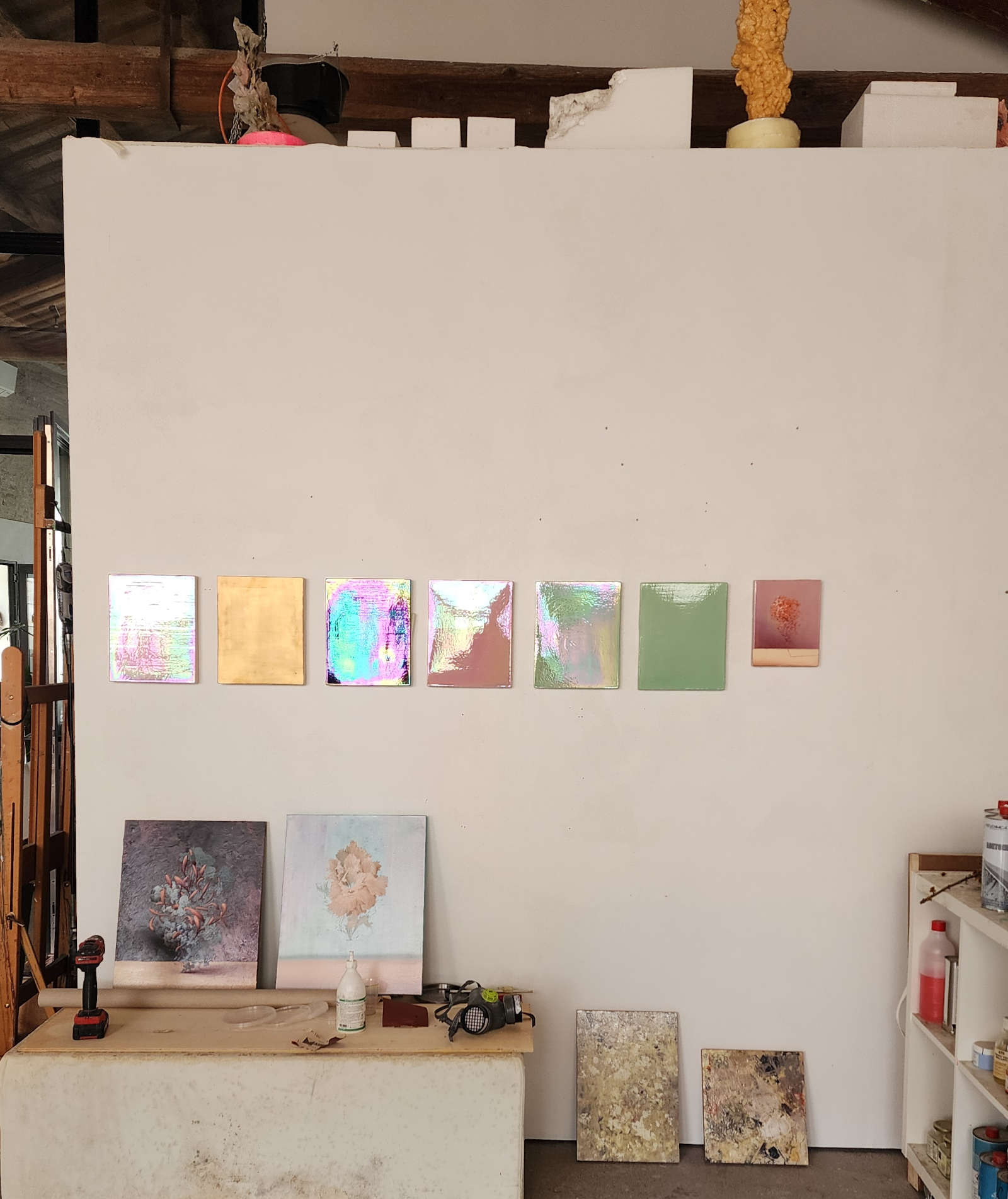
One would be making a mistake, however, if one were to be led to think that the encounter between the palette, between this zone of irreducible involuntariness, and those creatures that seem natural but are the result of an impeccable welding of craft, talent and visionary spirit, are the only epiphany that illuminates and inflames Enrico Minguzzi’s painting. Anyone who comes across these organisms on the threshold cannot escape the impression of recognizing in them shadows, references, reminiscences of certain art history. Not the still lifes of the Flemish or the Dutch, which more often than not convey a sense of opulence that is completely foreign to Minguzzi’s painting (if one really has to find a Nordic ancestor in him, then perhaps one should look more to certain painters of flora and fauna, such as Otto Marseus van Schrieck or Elias van den Broeck): one would be inclined to think, if anything, on the one hand of the inquisitive curiosity of a Jacopo Ligozzi, and on the other of the metaphysical austerity of the Spanish bodegones , of those meager juxtapositions of poor objects that already seem to contain a bare declaration of vivid immobility, a metaphysical fever snuffed out by a sharp light, imaginative but copied from life. All comparisons, however, are tenuous: Enrico Minguzzi reaffirms the originality of his research not only in the updating of a genre and in the reduction to the minimum terms of his subjects (subjects that do not find their reason forto be in an improbable surreal, but live, if anything, in a paradoxical metaphysics of the hyperreal that has nothing to do with dreams, visions, assorted dreamlike fantasies), but also in an extreme economy of pictorial means, in a discipline of removing that’is already in itself a form of invention, in the treatment of the backgrounds that are never such but rather seem to be zones of suspension, in that minimalism that is not poverty but a choice of subtraction of the world, in the technical finesse of a strongly illusionistic painting that lives, however, in the paradox of imitating reality without ever wanting to imitate it seriously, for real. There is, then, a profound research on materials. Enrico Minguzzi is used to suddenly revolutionizing his habits, and if until recently he worked mainly on fluorescent monochrome backgrounds, obtained by painting the canvas with strong colors and then covering it with an epoxy resin spread in a very thin film, which ended up plasticizing the canvas opening up technical possibilities unattainable in other ways, now he has ended up painting on polychrome ceramic surfaces, on which the paint clings as on resin. In his studio, he shows me some of his newest and most original works: he has just finished preparing third-fire green glazed ceramics, a process that Minguzzi introduced into his work because it made him discover the possibility of giving his grounds mother-of-pearl finishes that insinuate an additional principle of instability. So much so that he then decided to reproduce this effect of ceramics on the canvas: here then, again, what was born as a result of a combination of natural elements (fire, earth, the minerals contained in the pigments) becomes artificial, here the painting ends up imitating itself. Entirely consistent with an artist who appears interested more in processes than in final states, more in transformation than in result. And one feels a sincere and strange wonder when one lingers on the backgrounds of Minguzzi’s works, when one lingers to contemplate the surfaces that are clothed in those glazed hues, those translucent iridescences, those precious chromatics that give his paintings the paradoxical impression of a fluctuating, rich persistence, a persistence that has not renounced movement. One looks at those backgrounds, and one senses that behind Minguzzi’s creatures there is an infinite space, an eternal space.
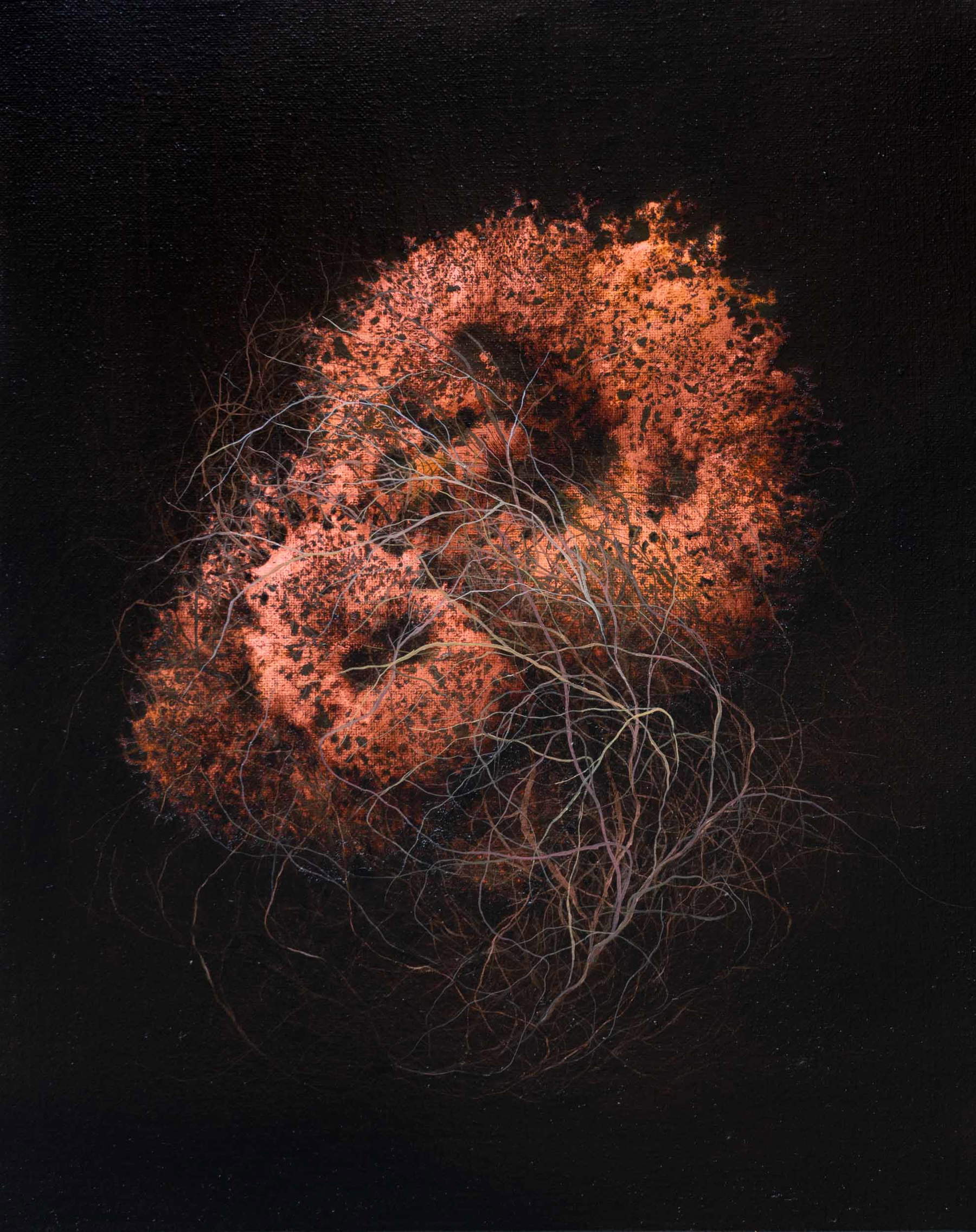
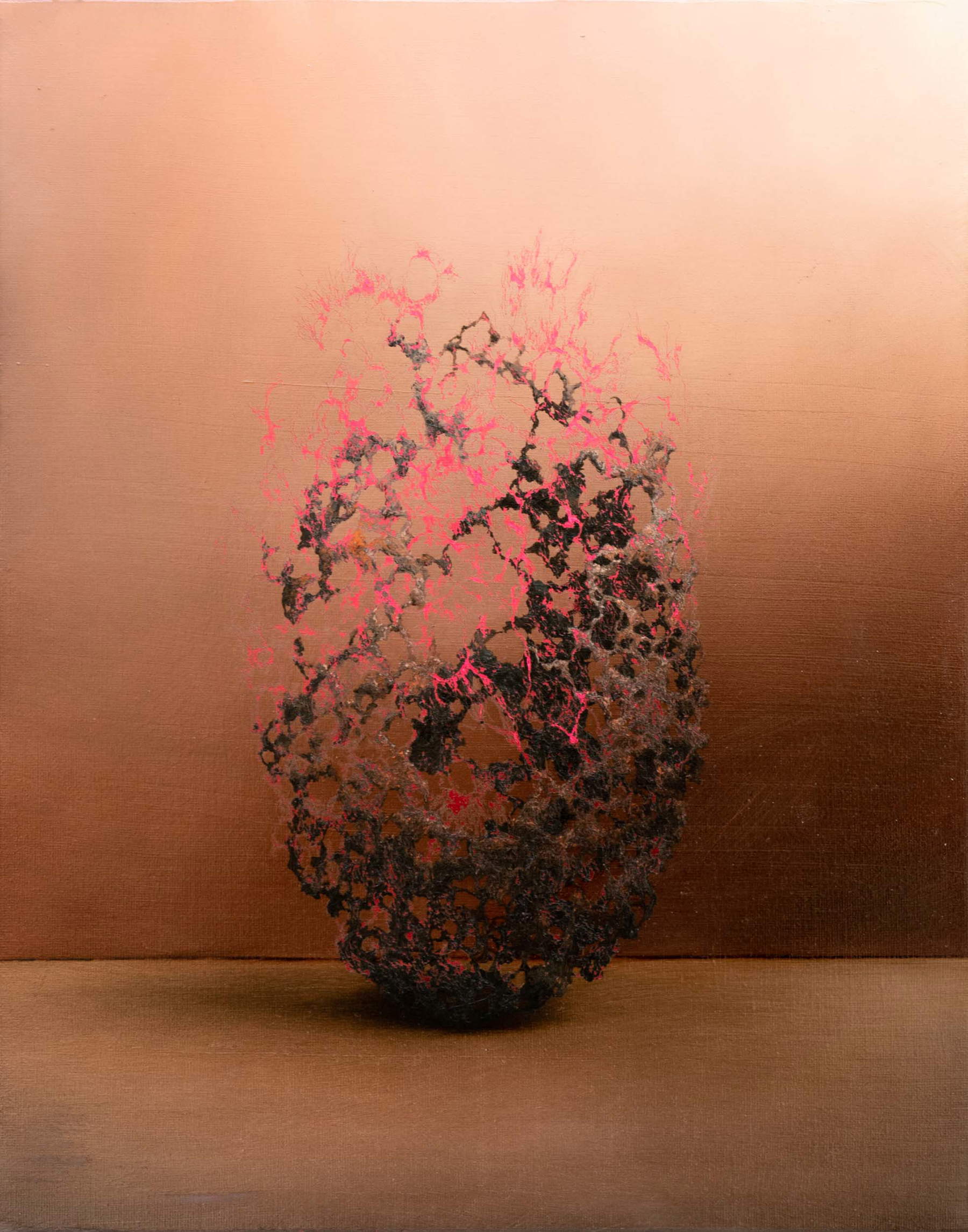
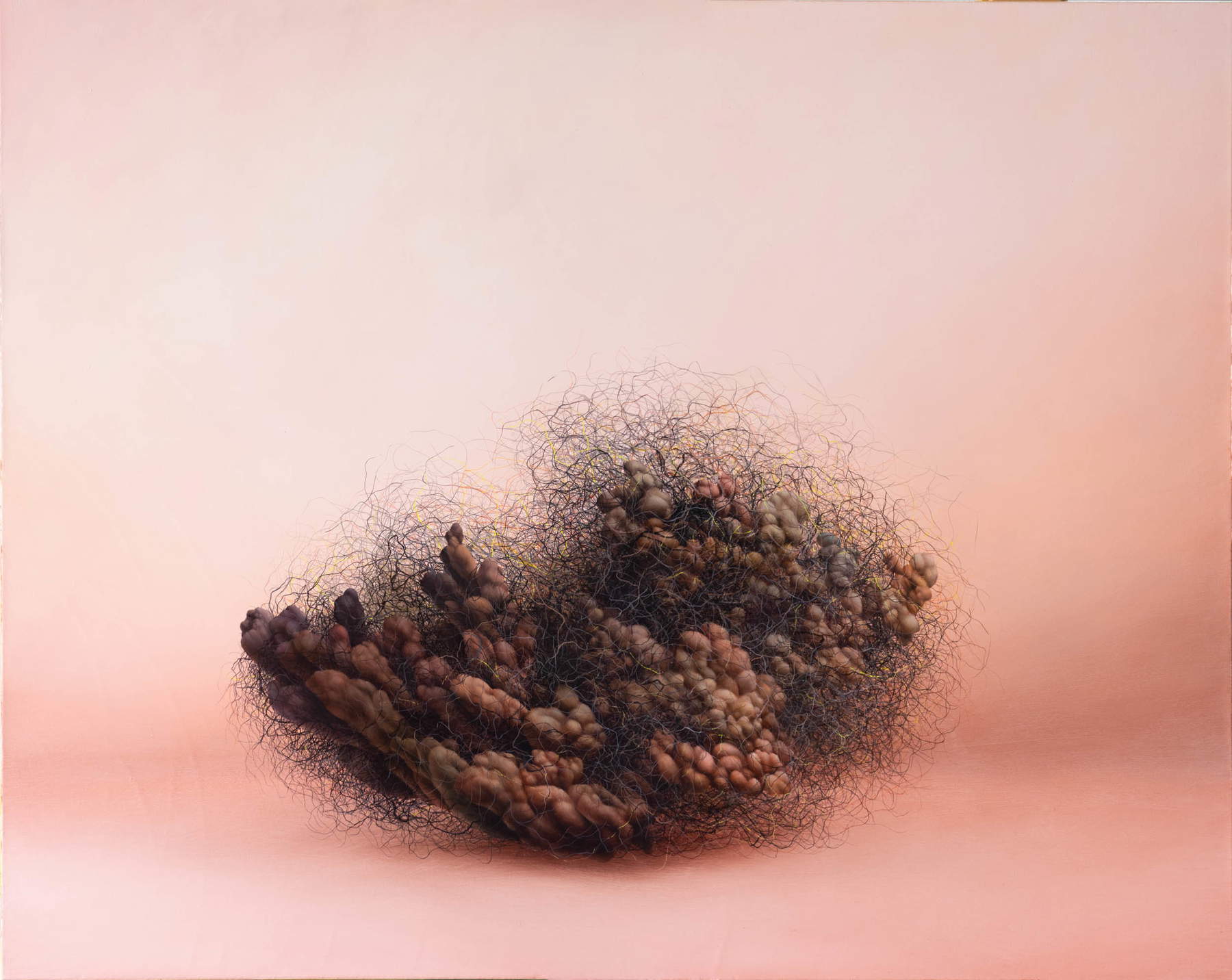
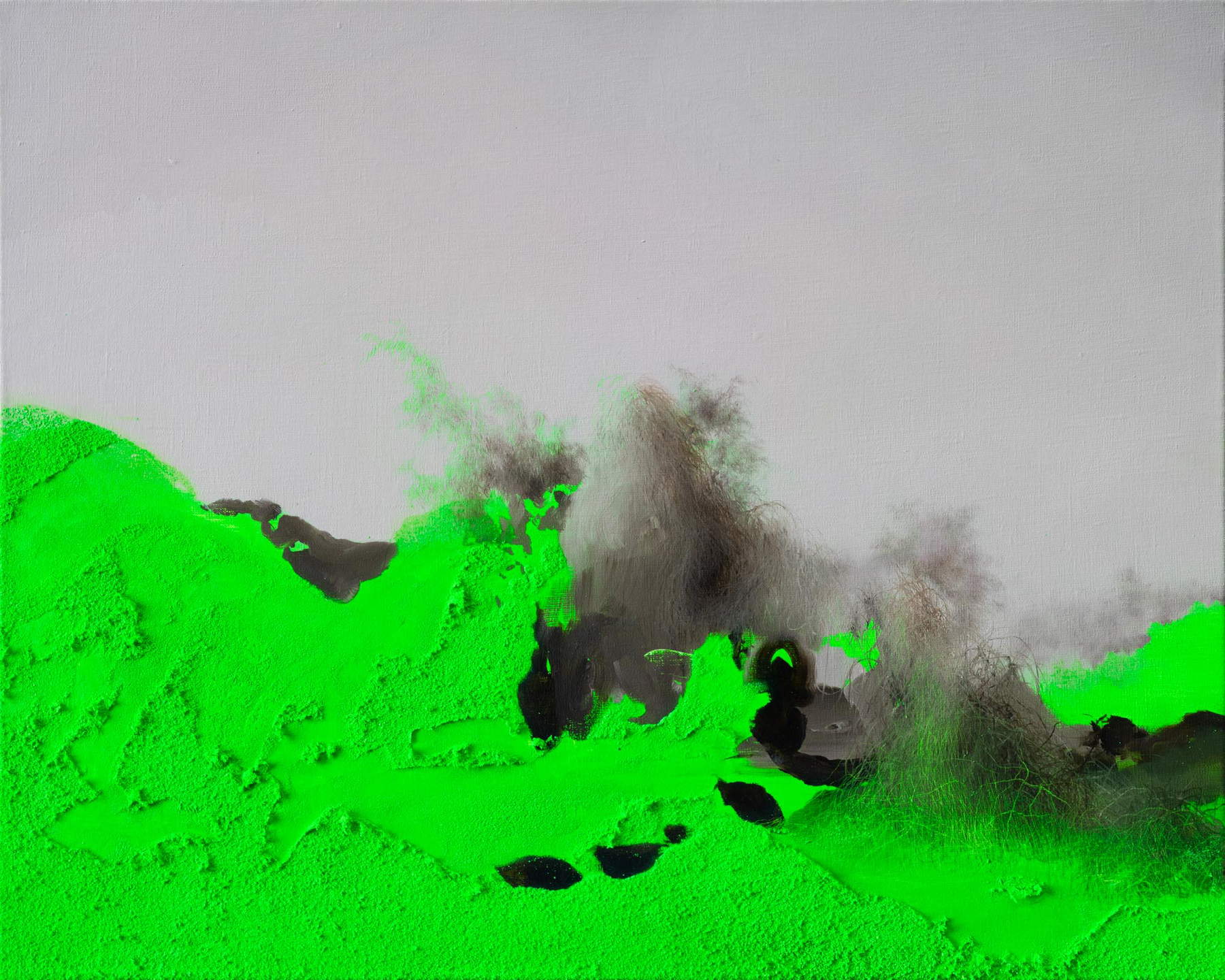
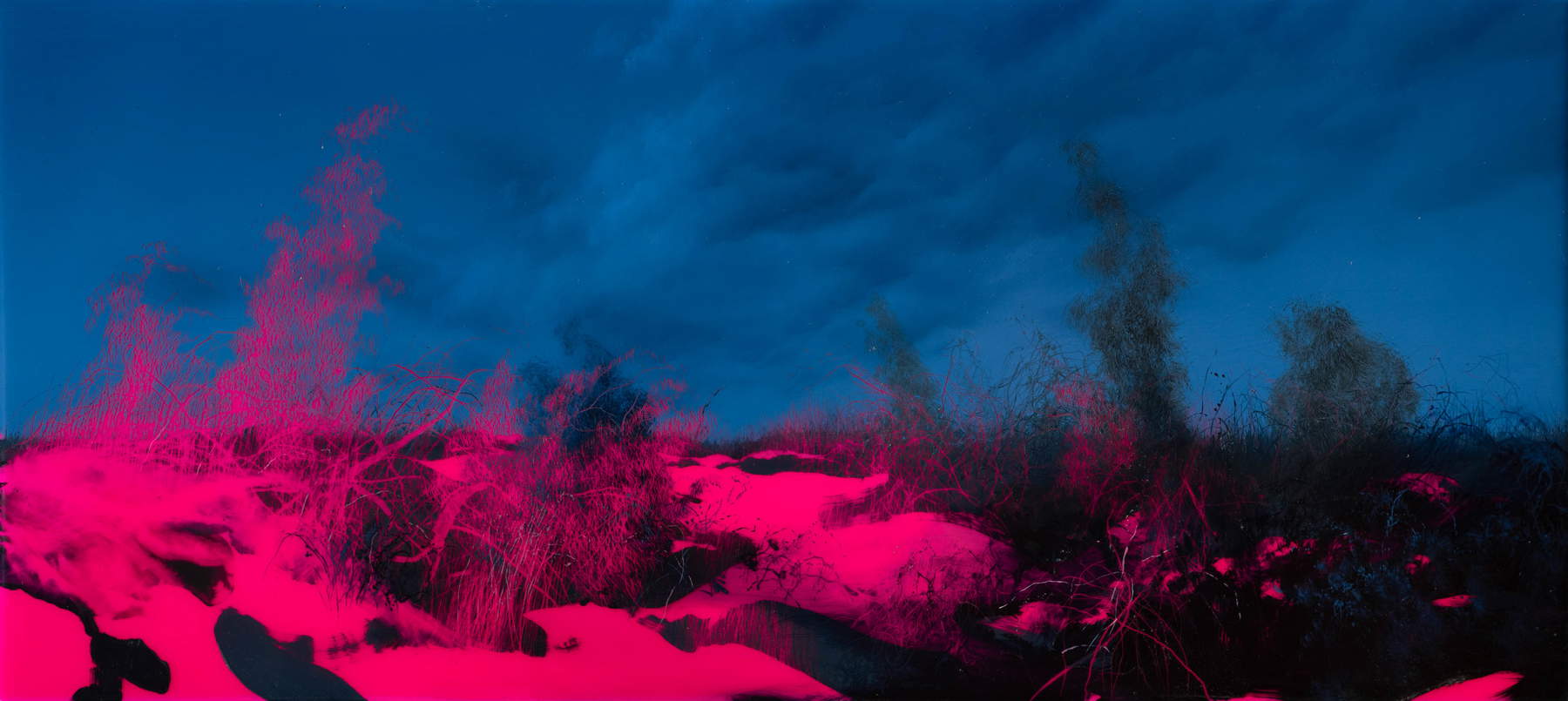
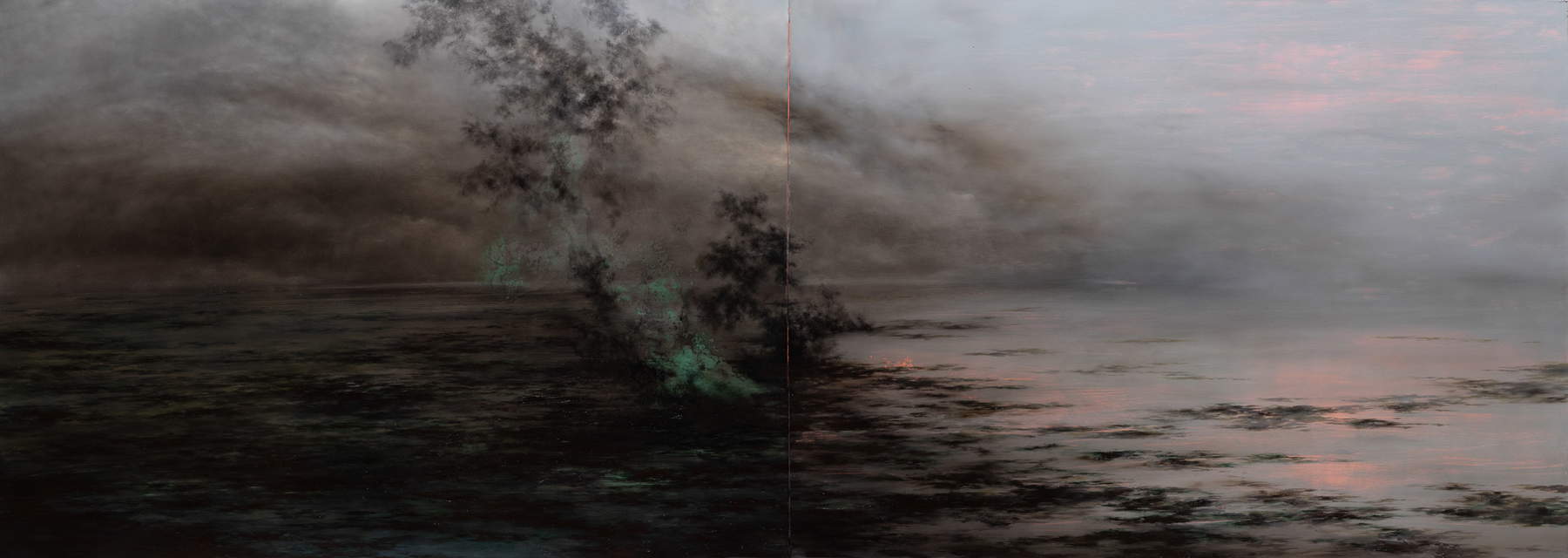
Observing Enrico Minguzzi’s works, one might wonder if it is possible to catch a posthuman germ in his reflection, either in that “primitively dehumanized landscape” (so Davide Caroli) of his earlier works or, above all, in the research of recent years. However, it is difficult to imagine Enrico Minguzzi as a painter of posthumanism, and for an extremely precise reason: that is, observing his works, and even seeing him at work, it seems almost as if, in the end, the center of his work is the very act of painting, which for him, he explains to me, is a gesture, a choice irreducible to an external theoretical logic, an experience that is not completely controllable but which is made up of continuous adjustments and immediate reactions. It is significant that his works are born without any planning: Minguzzi is an artist who draws little, so he hardly translates an idea that is born on paper. His creatures are born, grow, thrive in the territories of imagination: the subjects may evoke posthuman sceneries, yet the pictorial gesture remains profoundly human because it is situated, because it is a physical, free, spontaneous gesture, because it belongs to a painter who thinks of his work as a form of communication that is not reducible to a calculation, a model, a simulation. The pictorial surface itself is for him a living organism, an organism to be listened to, which is able to respond, to reveal, even to oppose, an organism on which it is the images themselves that manifest themselves.
There remains, at any rate, a tension, perhaps unresolvable, between what this painting evokes and what this painting is. A tension between its subjects in perpetual metamorphosis, between those organisms that inhabit boundaries and interstizî, between those images that exclude all human presence, and a sincere claim to humanity, to empathy, a position that is almost anti-technological in its rejection of any mechanicism, although it recognizes that the evolution of our species, in the more or less near future, will transit through the hybridization between the natural and the technological (and it is also for this reason that artifice becomes an extension of nature). A tension between a painting that seems to belong to an area of organic, biomorphic abstractionism, founded on an idea of life as a form that grows and expands, and the persistence of a dream of beauty to which painting itself, unable to renounce it on condition of losing all its sincerity, always tries to cling. It is, however, this contradiction, a fruitful paradox: perhaps it is precisely this tension that makes these hybrids so original, these organisms on the threshold, this painting so unstable, so alive, a painting that overcomes all flattery of immobility, a painting that inhabits the border with the freedom and spontaneity of a gesture that remains stubbornly and profoundly human, but which lasts just long enough to produce a figure, a trace, a shadow, and then ends up dissolving. And what remains is living matter.

The author of this article: Federico Giannini
Nato a Massa nel 1986, si è laureato nel 2010 in Informatica Umanistica all’Università di Pisa. Nel 2009 ha iniziato a lavorare nel settore della comunicazione su web, con particolare riferimento alla comunicazione per i beni culturali. Nel 2017 ha fondato con Ilaria Baratta la rivista Finestre sull’Arte. Dalla fondazione è direttore responsabile della rivista. Nel 2025 ha scritto il libro Vero, Falso, Fake. Credenze, errori e falsità nel mondo dell'arte (Giunti editore). Collabora e ha collaborato con diverse riviste, tra cui Art e Dossier e Left, e per la televisione è stato autore del documentario Le mani dell’arte (Rai 5) ed è stato tra i presentatori del programma Dorian – L’arte non invecchia (Rai 5). Al suo attivo anche docenze in materia di giornalismo culturale all'Università di Genova e all'Ordine dei Giornalisti, inoltre partecipa regolarmente come relatore e moderatore su temi di arte e cultura a numerosi convegni (tra gli altri: Lu.Bec. Lucca Beni Culturali, Ro.Me Exhibition, Con-Vivere Festival, TTG Travel Experience).
Warning: the translation into English of the original Italian article was created using automatic tools. We undertake to review all articles, but we do not guarantee the total absence of inaccuracies in the translation due to the program. You can find the original by clicking on the ITA button. If you find any mistake,please contact us.

















 IT
IT FR
FR DE
DE ES
ES CN
CN


