





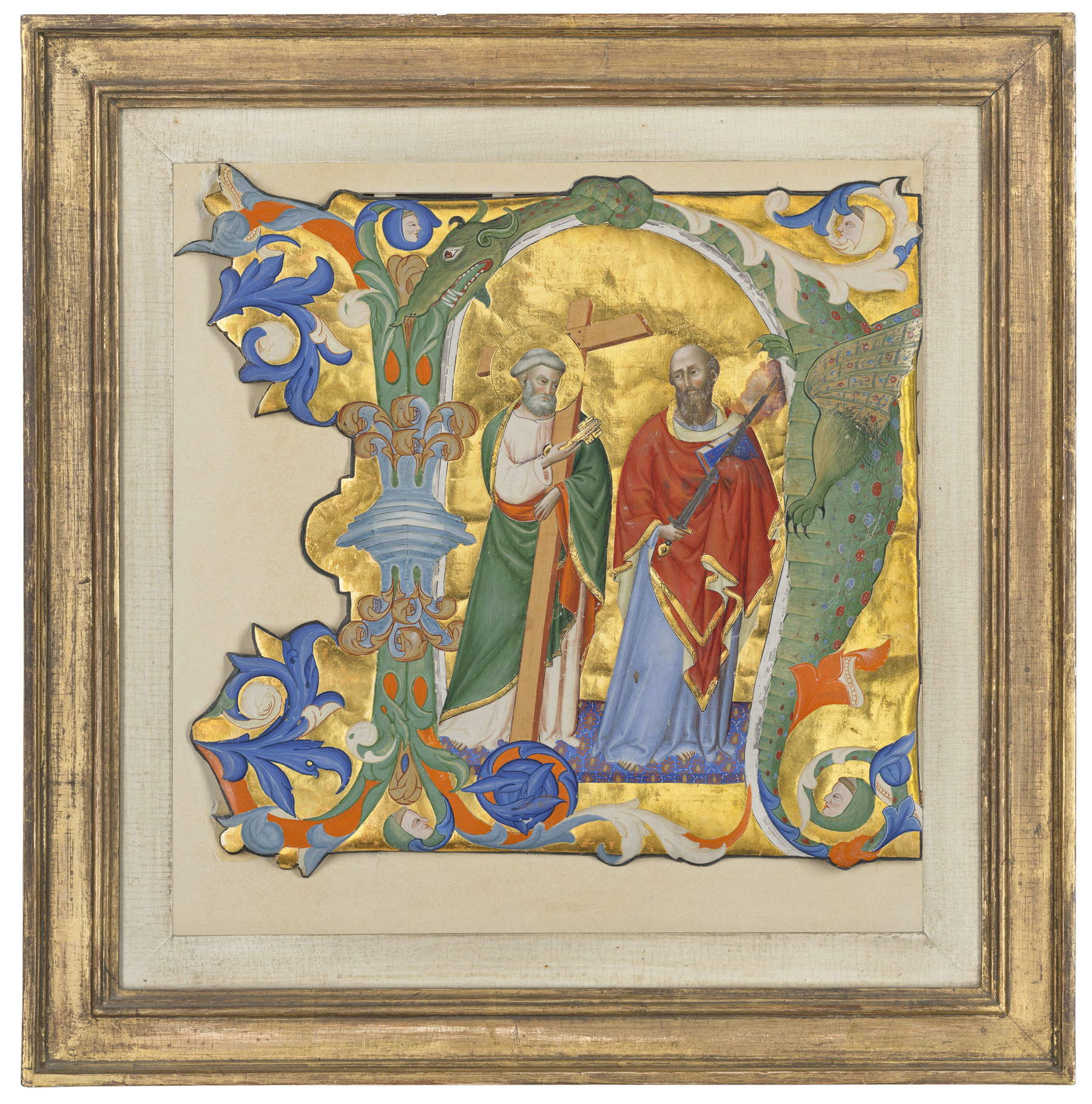
One of the most important Italian miniatures to appear on the market in recent years will be the highlight of the “Valuable Books and Manuscripts including Cartography” auction, scheduled for July 8 at Christie’s. It is a monumental illuminated initial created by Silvestro dei Gherarducci (Florence, 1339 – 1399), one of the leading illuminators of 14th-century Florence, with an estimate of 150,000 to 200,000 pounds (175,000–233,000 euros). The work, a large initial “N” depicting Saints Peter and Paul, is a surviving fragment of an illuminated choir book created between 1371 and 1374 for the Florentine monastery of Santa Maria degli Angeli. Cut from the manuscript at an unknown date, likely between the late 18th and early 19th centuries, the miniature has passed through over two centuries of international collecting before reappearing on the antiquities market today.
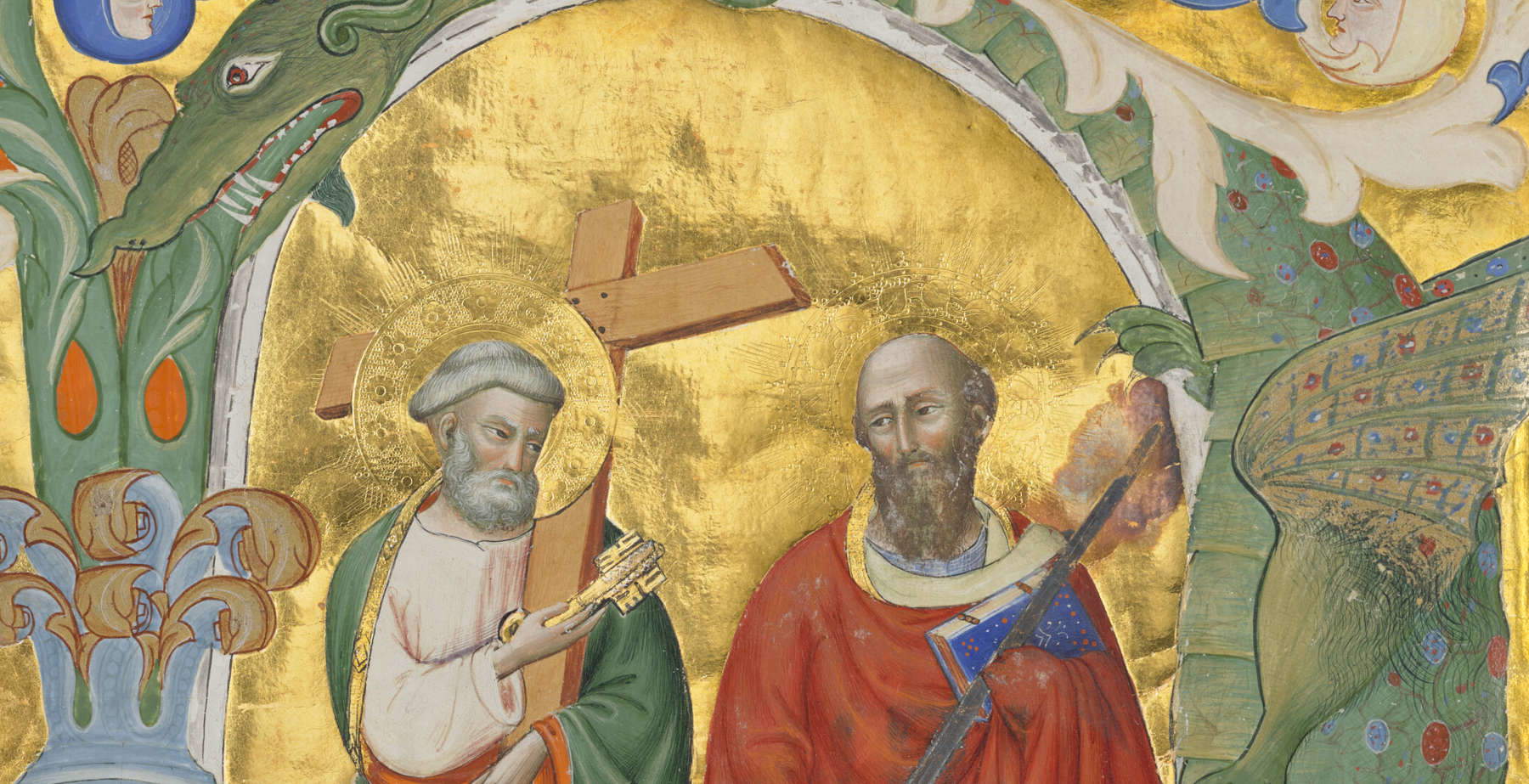
The sheet, measuring approximately 30 centimeters on each side, depicts Saint Peter with the keys and the cross—a symbol of martyrdom —and Saint Paul with a sword and a book, set within a sumptuous zoomorphic initial in which the letter takes the form of a richly decorated dragon. On the reverse, four partial lines of liturgical text remain, along with musical notation on a red tetragram, a rubric, and a decorated initial—evidence of its original inclusion in a choral codex. According to Christie’s, the miniature is in “exceptionally good” condition. The only reported imperfections are a small defect at the tip of St. Paul’s sword, a slight brown stain on the saint’s robe, and minimal loss of pigment and burnished gilding. Overall, the state of preservation is described as close to its original condition.
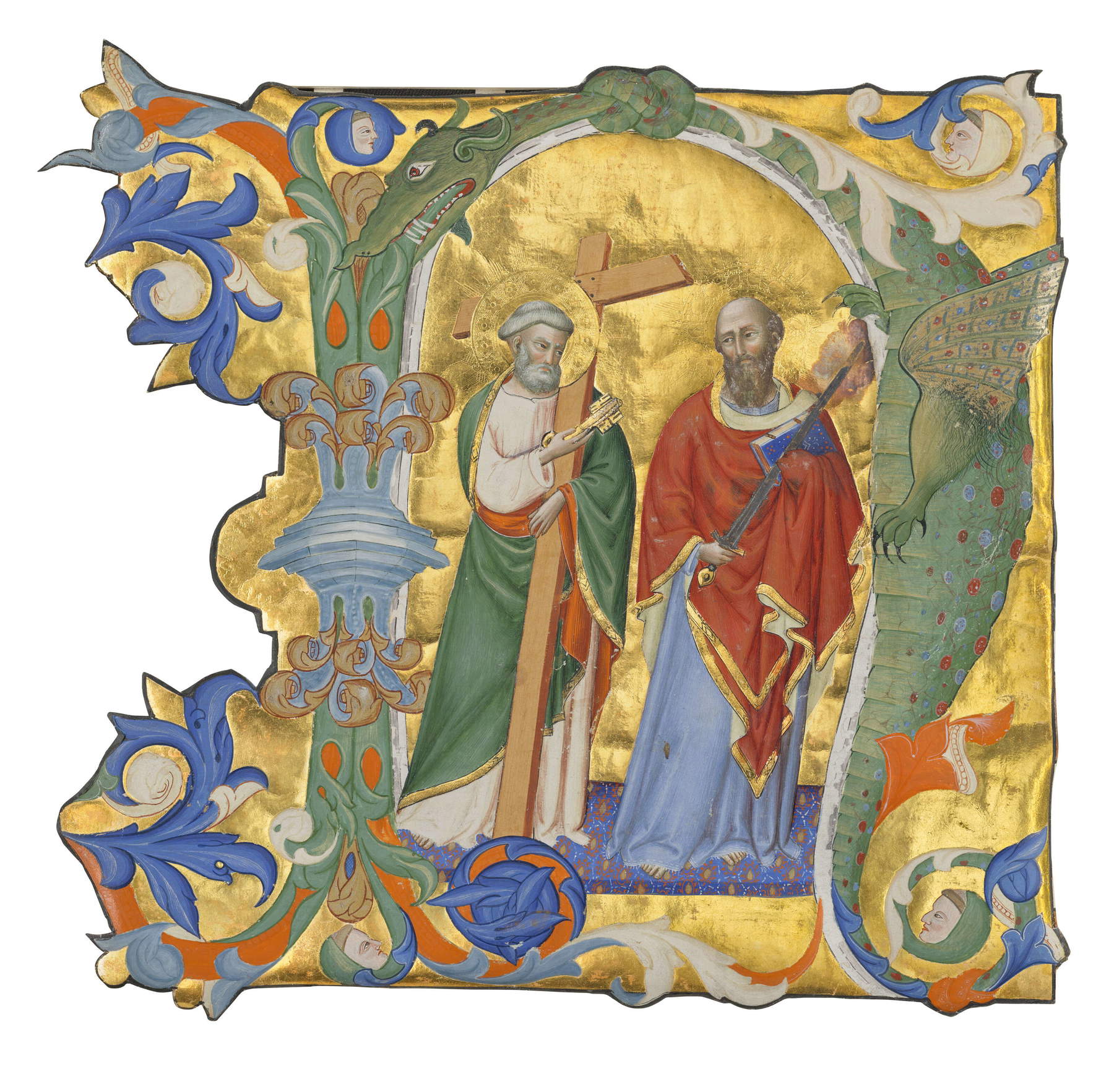
The initial originally belonged to folio 104 of the so-called Choral Book 2 of the Camaldolese monastery of Santa Maria degli Angeli, now preserved at the Biblioteca Medicea Laurenziana in Florence. The manuscript is considered one of the absolute masterpieces of Silvestro dei Gherarducci’s work and represents the most ambitious of the illuminated manuscripts created for the monastery. The choirbook is also of particular importance because it is the artist’s only illuminated manuscript to bear a precise date. In fact, inscriptions in the volume document the completion of the text in 1371, while scholars believe that the illuminated decoration was completed around 1375. A significant bequest helped finance the creation of the new liturgical book: contemporary records indicate that part of the donation was allocated to the purchase of a new missal, as well as to the creation of an altar frontal, a lectern, and other projects for the church of Santa Maria degli Angeli.
Silvestro dei Gherarducci, born in 1339 and died in 1399, entered the monastery in 1348 and became its prior in the 1390s. He was the leading figure in the monastic scriptorium, where the next generation of illuminators was trained, including Lorenzo Monaco, who was destined to become one of the central figures of late-Gothic Florentine painting.
Scholars consider Choral Book 2 to be one of the high points of his work. According to art historian Gaudenz Freuler, the miniatures created between 1371 and 1374 demonstrate full artistic maturity, characterized by greater compositional spontaneity and a freedom of expression that marks his move beyond the influences of Orcagna, still evident in the artist’s early works.
In the fragment offered by Christie’s, Don Silvestro’s painterly qualities emerge clearly. The two saints occupy almost the entire space of the initial letter, standing on an elegant decorated floor, while their richly draped robes, the richness of the colors, and the use of gold lend the composition a monumentality unusual for a miniature intended for a liturgical book. Particularly original is the construction of the letter “N,” transformed into a fantastical dragon figure that seamlessly integrates the ornamentation with the figurative scene. According to Freuler, it is precisely this skillful use of color that represents one of the distinctive elements of Don Silvestro’s style, capable of creating visual unity between decoration and image through sophisticated chromatic harmonies.
Giorgio Vasari himself expressed great admiration for the illuminator’s work. In his *Lives*, the Arezzo-born biographer recalled having personally examined the illuminated books by Don Silvestro, declaring himself amazed by the precision of the drawing and the quality of the execution. The modern history of the miniature is equally significant. The fragment was in fact detached from the manuscript before 1809, when Choral Book 2—already stripped of numerous miniatures—entered the collections of the Laurentian Library along with the other codices from Santa Maria degli Angeli.
The volume was dismembered during the Napoleonic period, when numerous illuminated manuscripts were dismantled to supply the European antiquities market. The decorated pages were in fact cut out and sold individually as standalone works—a practice now considered severely detrimental to the integrity of medieval manuscripts.
According to the reconstruction proposed by Christie’s, at least twelve of the twenty miniatures removed from Choral Book 2 found their way into the collection of William Young Ottley, a discerning British collector, one of the earliest scholars of Italian Renaissance art, and future head of the Department of Prints and Drawings at the British Museum. Scholars believe that Ottley may have purchased the entire group of illuminated leaves around 1800.
After the collector’s death, the miniature appeared at auction at Sotheby’s in May 1838, described simply as a depiction of Saints Peter and Paul. It was purchased for two pounds and eleven shillings, likely on behalf of John Rushout, the second Lord Northwick, a renowned collector who assembled one of Britain’s most important art collections at his Northwick Park estate. Upon the death of the second Lord Northwick, the miniature passed to his nephew George Rushout, the third Lord Northwick. With the extinction of the title, the inheritance passed to the Spencer-Churchill family through Edward Spencer Churchill, father of Edward George Spencer-Churchill. The work then reappeared on the market in November 1925, again at Sotheby’s, during the sale of the Northwick Park collection. On that occasion, it was described as a magnificent initial attributed to the Sienese school and fetched the considerable sum of 200 pounds, being purchased by the antiquarian bookseller Maggs.
Subsequently, the fragment entered the prestigious collection of David Alexander Robert Lindsay, the 28th Earl of Crawford and 11th Earl of Balcarres, one of the most influential figures in 20th-century British cultural life. Lindsay served as president of the National Trust and as a trustee of the Tate Gallery, the National Gallery, and the British Museum, in addition to holding the position of First Peer of Scotland. According to Christie’s, he acquired the miniature through the renowned antiquarian bookseller Martin Breslauer. The work thus remained in the Lindsay family collection, belonging to Patrick and Lady Amabel Lindsay, until this recent sale.
The return of this initial to the market is therefore a particularly significant event for the international collecting world, both because of the rarity of works of such quality still in private hands and because of the historical value of the fragment, which preserves the memory of one of the most important illuminated choir books of fourteenth-century Florence. With its estimated value, the miniature of Don Silvestro dei Gherarducci stands as one of the most important lots in the London auction dedicated to rare books and manuscripts (it is fifth in terms of estimated value; the top lot is the extremely rare Clermont-Tonnerre Grail), and will offer collectors the opportunity to acquire a masterpiece of Italian Gothic miniature art, from one of the most prestigious liturgical codices produced in 14th-century Florence.
 |
| A precious and rare miniature by Silvestro dei Gherarducci resurfaces at a Christie’s auction |

Warning: the translation into English of the original Italian article was created using automatic tools. We undertake to review all articles, but we do not guarantee the total absence of inaccuracies in the translation due to the program. You can find the original by clicking on the ITA button. If you find any mistake,please contact us.



















 IT
IT FR
FR DE
DE ES
ES CN
CN


