





Agostino Beltrano ’s Eucharistic Triptych from Pozzuoli Cathedral will undergo a major restoration and recomposition. The two canvases currently under restoration were identified in 2022 within the Capodimonte deposits by Professor Giuseppe Porzio of theUniversity of Naples L’Orientale, thanks to a careful combination of stylistic analysis and the study of documentary sources. Recorded only in the inventory initiated around 1970 by then superintendent Raffaello Causa, they depict respectively the priest Melchizedek in the act of offering bread and wine (Genesis 14:18-20) and King David seated on a throne.
The discovery of Agostino Beltrano’s signature on the first canvas made it possible to attribute both works to a pictorial cycle with a Eucharistic theme, centered on theLast Supper signed by the same Neapolitan artist. This cycle was commissioned by Fray Martín de León y Cárdenas, bishop of Pozzuoli between 1631 and 1650, for the chapel of the Blessed Sacrament in Pozzuoli Cathedral. The earliest documentary evidence of the pictorial complex dates back to a December 1649 report made on the occasion of the prelate’s pastoral visit.
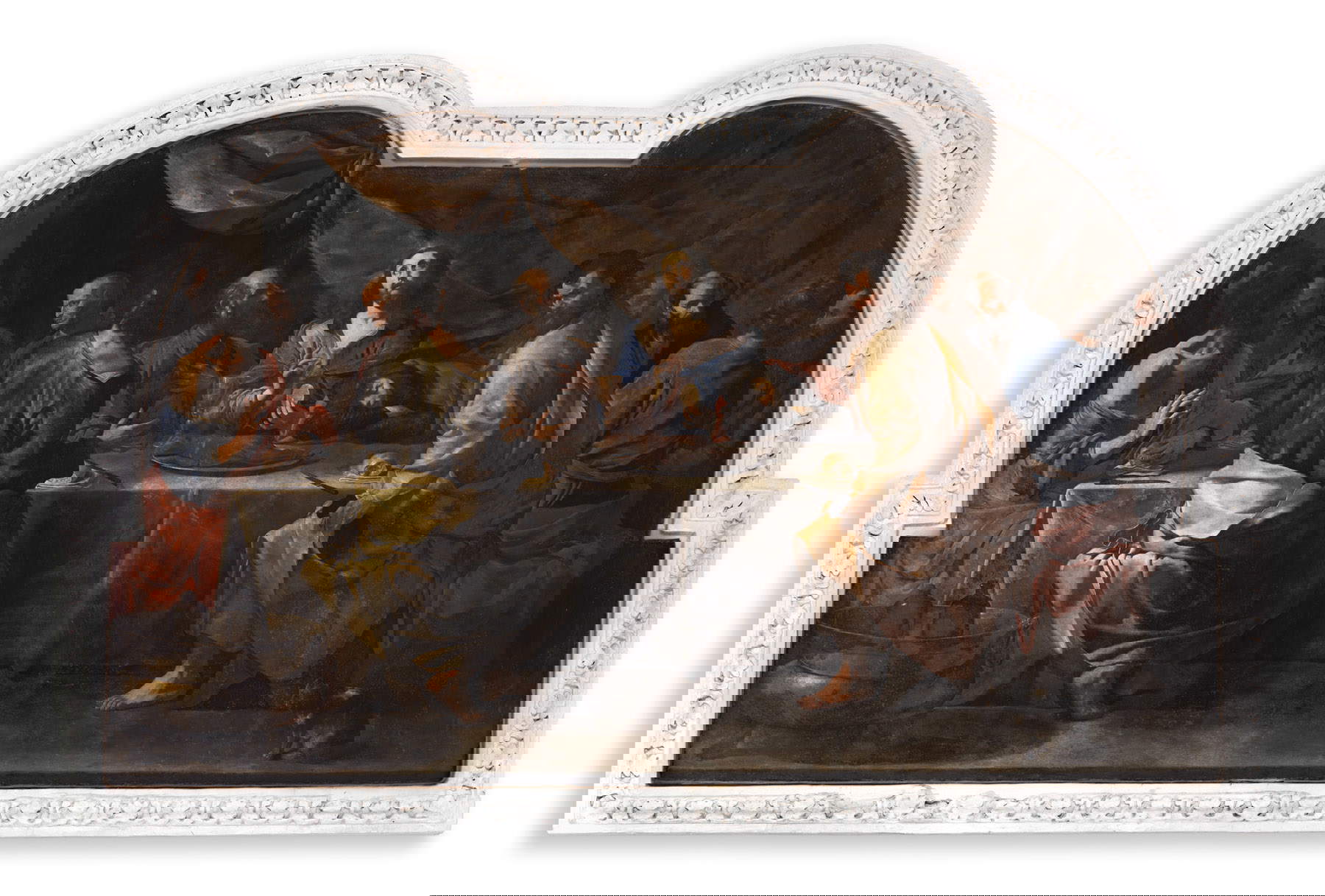
Today, only the large canvas of theLast Supper is preserved in Pozzuoli Cathedral of the Eucharistic triptych, although it has been transferred and adapted in the sacristy. This work represents a fundamental reference point for understanding Beltrano’s artistic journey.
It still remains to be clarified, through further archival research, the circumstances that brought the two works to the Capodimonte deposits: in fact, it is not certain whether the transfer took place before or after the fire that hit Pozzuoli Cathedral in 1964. Parallel to these investigations, the Museum and the Diocese, with the scientific support of L’Orientale University, share the goal of recomposing a fracture in the history of local cultural heritage. The identification marked the beginning of a path of recovery, both critical and conservative, of one of the most significant artistic episodes of the Puteolian cathedral, alongside the works of Massimo Stanzione, with whom Beltrano, husband of painter Diana Di Rosa, collaborated closely, Artemisia Gentileschi and Giovanni Lanfranco.
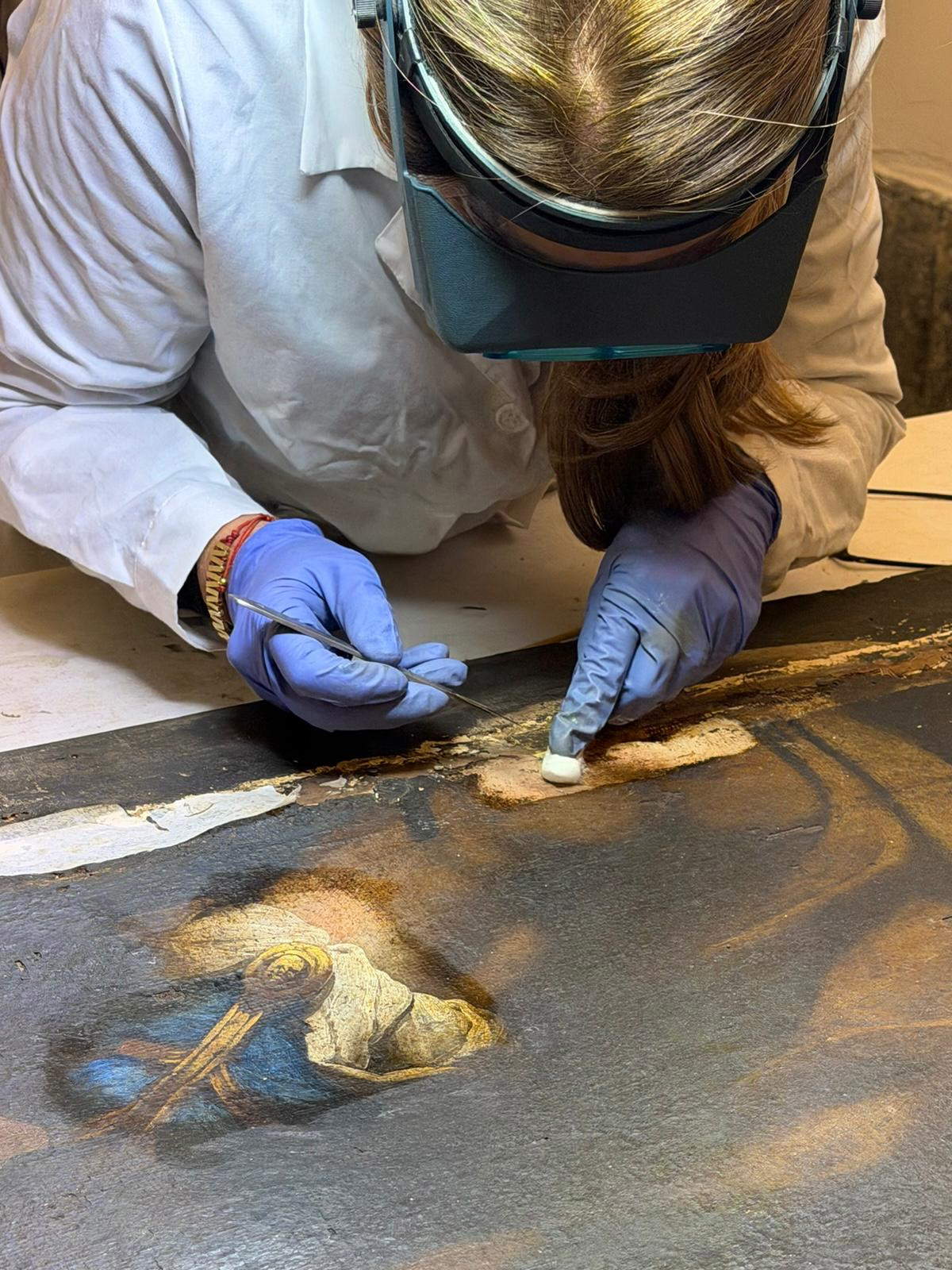
Currently, both canvases are in problematic conservation conditions, compromising their legibility both stylistically and chromatically. In fact, widespread accumulations of dirt, oxidized varnishes and extensive repainting are evident, probably due to very old restoration work. In spite of this, the parts that are still visible reveal a strong naturalistic imprint and a physiognomic rendering consistent with the artist’s best works.
An articulated restoration project is underway, supported by the Diocese of Pozzuoli thanks to a significant contribution from the 8xMille funds to the Catholic Church, and carried out at Iriana Suprina’s Studio Ermes workshop in Naples. This work will make it possible to recover a more authentic reading of the original painting. Starting in May, theLast Supper will also be restored, and the final stages of the intervention will affect all three canvases simultaneously.
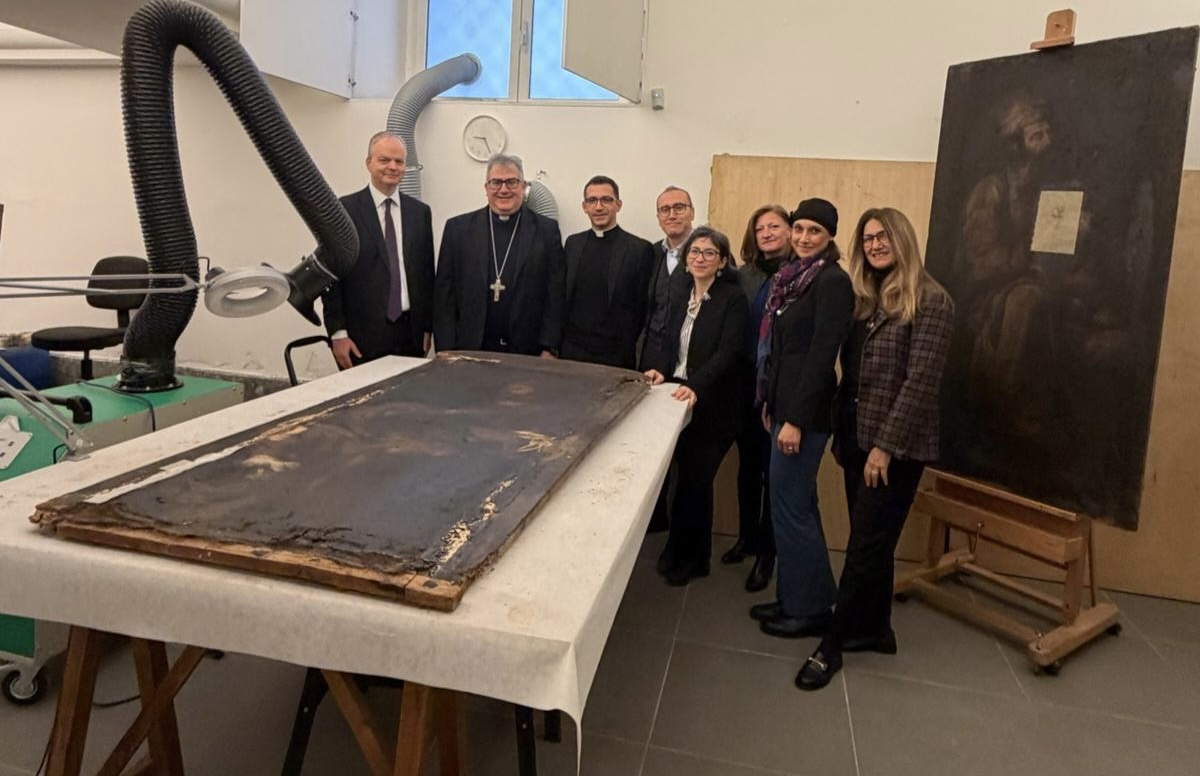
“Capodimonte, the main picture gallery in the south of Italy, second in importance after the Uffizi, wants to dialogue more and more with the territory in particular by contributing with the heritage of its deposits to write the history of art in Campania through, restorations, restitutions and exhibitions, even long term ones,” announced Eike Schmidt, Director of the Capodimonte Museum and Real Bosco. “Particularly significant, as it relates to the enhancement of the Phlegrean territory, is the first collaboration of this new program, which we will call ’Capodimonte diffuso,’ with the Diocese of Pozzuoli for the historic remounting of Agostino Beltrano’s Eucharistic triptych.”
“We will carefully and attentively follow the entire restoration process of the original triptych, which will restore a pictorial richness that is now no longer legible,” said Paola Ricciardi, Soprintendente Archeologia Belle Arti e Paesaggio for the Metropolitan Area of Naples. “Already from the first pieces it is clear that this is a work with a lot of color and detail. For the Phlegrean community, this recomposition will be a very important step: restorations of works of this level, however, have a spin-off far beyond the territory, for all Italian cultural heritage, Beltrame being a leading figure in seventeenth-century art. This is a virtuous operation that sees together the Ministry of Culture in its various articulations and the Diocese.”
“This recovery constitutes a sign of hope for our Phlegrean territory, which despite the bradyseism, wishes to regain its life, always and again starting from the beauty of its places and its history. Moreover, returning to the Eucharist through Beltrano’s artistic expression will be an opportunity for every visitor to rethink that sign that announces God’s presence in history, his becoming flesh, his giving himself out of love as the life of the world. As the tradition of the Church sings, the Eucharist is the sign of unity, the bond of charity, the memorial of the Lord’s death and resurrection, the medicine of immortality. A wish also for the upcoming Easter festivities,” said Bishop Carlo Villano, bishop of Pozzuoli and Ischia. “The collaboration with the Capodimonte Museum, the ABAP Superintendency of the metropolitan area of Naples and the University of Naples l’Orientale is proof that by joining forces, great things can be accomplished, which not only promote the good of society, but also give witness to how one becomes a community.”
|
| Agostino Beltrano's Eucharistic Triptych from Pozzuoli Cathedral will be restored and reassembled |

Warning: the translation into English of the original Italian article was created using automatic tools. We undertake to review all articles, but we do not guarantee the total absence of inaccuracies in the translation due to the program. You can find the original by clicking on the ITA button. If you find any mistake,please contact us.






















 IT
IT FR
FR DE
DE ES
ES CN
CN


