





Founding a city means making decisions about the distribution of space, resources, defense, and the form of government. These are the premises of ELEA. A CITY TO BE FOUNDED., the video game presented on Monday, October 12, 2026, at 10 a.m., at the Velia Archaeological Park. Sponsored by the Archaeological Parks of Paestum and Velia and produced in collaboration with AMONG S.r.l. Società Benefit, the project translates the history of ancient Elea and the philosophy of Parmenides into an interactive experience, in which players’ choices determine the balance of the community. Available in digital and board game versions, it also includes an online version designed for high schools.
The initiative was carried out with funds from the National Recovery and Resilience Plan (PNRR), financed by the European Union—NextGenerationEU—as part of Mission 1 “Digitalization, Innovation, Competitiveness, and Culture,” Component 3 “Tourism and Culture 4.0,” Measure 1 “Cultural Heritage for the Next Generation.” The project is part of Investment 1.2, dedicated to removing physical and cognitive barriers in museums, libraries, and archives to expand access to and participation in culture, under Action Line 7 “Training of Cultural Professionals” and initiatives to promote and enhance the accessibility of cultural heritage through innovative technologies and gamification methodologies.
The starting point is the story of the Focei, who, fleeing the Persian advance, crossed the Mediterranean and reached the coast of Cilento, where they founded Elea in the 6th century B.C. Participants are invited to adopt the perspective of that community at a time when the city’s future was still to be determined. Historical understanding thus unfolds through the challenges its inhabitants had to face: organizing settlements, securing resources, establishing relationships with neighboring communities, and building a sustainable social and political system.
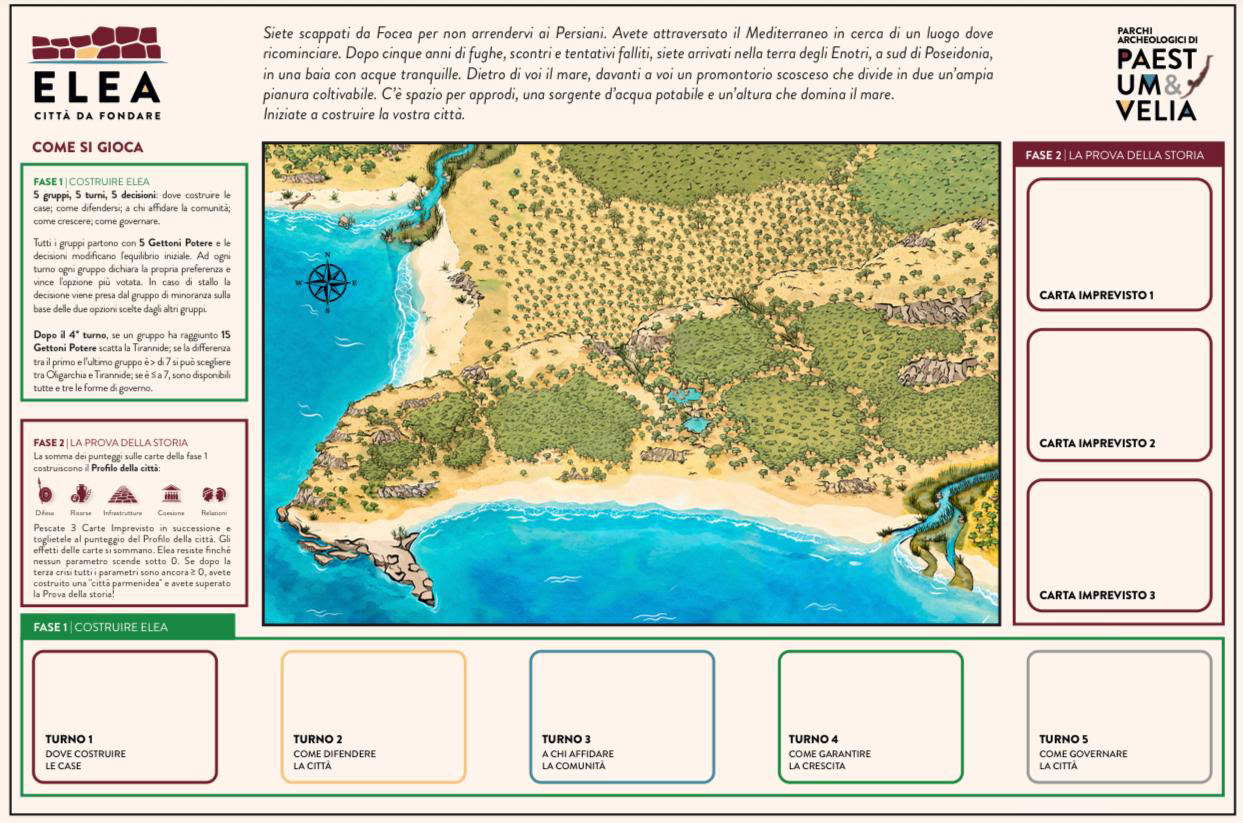
The game unfolds over five rounds, dedicated to placing dwellings, defense, public works and common spaces, growth strategies, and the form of government. Players represent five social groups—priests, warriors, builders, farmers, and merchants—each with specific needs but bound to the fate of the polis itself. Proposals are discussed, justified, and voted on, affecting available resources, infrastructure, defense, the city’s relationships and cohesion, as well as the balance of power among the groups.
In the final phase, called the “Test of History,” unforeseen events subject the community to crises, conflicts, and new opportunities. This part allows players to test the resilience of the decisions made and to observe the fragilities of the system they have built, by relating collective choices to circumstances that cannot be controlled. In fact, every decision entails different benefits, costs, and consequences.
Parmenides’ philosophy forms the conceptual basis of the game mechanics. Choices unfold according to two perspectives: Doxa, associated with the benefit of individual groups, and Aletheia, oriented toward the benefit of the city. Any decision-making deadlocks are resolved by the Grammateus through a special “Parmenidean algorithm.” In the digital version, the app takes on the role of the Grammateus, guiding players and illustrating the effects of their decisions.
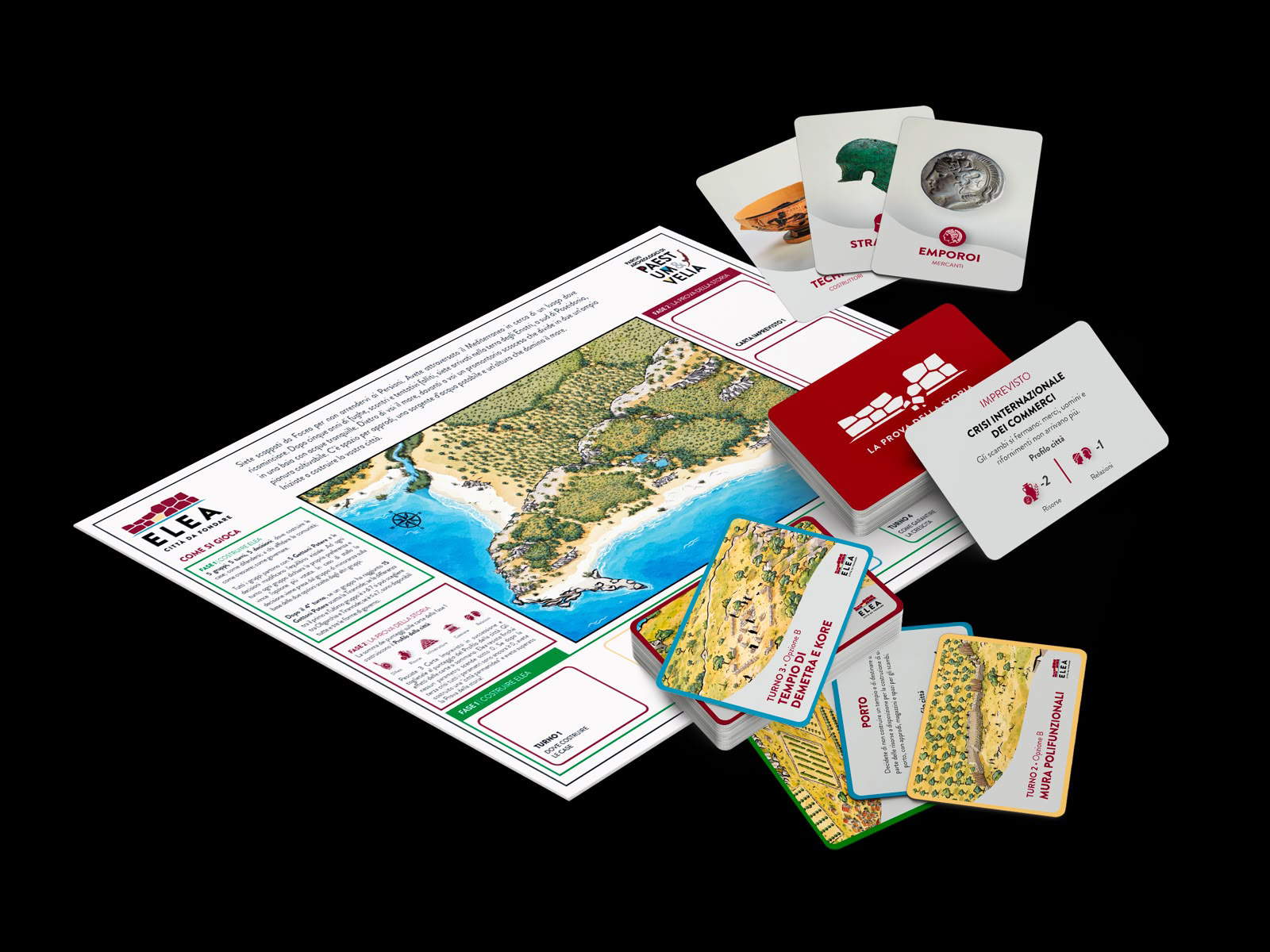
Technology is thus used as a tool for cultural mediation, capable of making historical, archaeological, and philosophical content accessible through concrete scenarios. Taking on a role, discussing alternatives, voting, and assessing the consequences of one’s choices allows players to compare different perspectives and understand the relationships between various aspects of urban life. The digital version also allows the game to be used in the classroom and outside of a visit to the Park, expanding opportunities to engage with the history of Elea.
The experience also offers a framework for interpreting the archaeological heritage. Dwellings, fortifications, sanctuaries, landing sites, and the surrounding territory are linked to the functions they served in community life and to the relationships that connected these different spaces. The physical remains can thus be interpreted in light of the needs, relationships, and decisions that helped shape the ancient city. The project received support from the Italian Philosophical Society as part of the Memorandum of Understanding signed with the Archaeological Parks of Paestum and Velia and the related Implementation Agreement, dedicated to testing and promoting the game in schools. The presentation also served as an opportunity to share the educational perspectives of the initiative and strengthen the dialogue between cultural institutions, the scientific community, and the world of education.
ELEA. A CITY TO BE FOUNDED. was created with the support of the General Directorate of Museums, as part of the gaming-related initiatives outlined in the Communication Plan for the PNRR investment in accessibility at cultural sites. The initiative is part of the strategy of the Archaeological Parks of Paestum and Velia to experiment with innovative tools for heritage education, broaden participation, and promote a more inclusive experience. The history of the polis and Parmenides’ philosophy thus become the starting point for an experience that bridges research and innovation, aimed at younger generations and a broader audience.
“The PNRR investment dedicated to accessibility at cultural sites, coordinated by the General Directorate of Museums,” emphasizes Roberto Vannata, Director of Service II of the General Directorate of Museums, “has represented an extraordinary opportunity to enhance the quality of the visitor experience through site-specific interventions, staff training, communication, and experimentation with new forms of expression. In this context, the Communication Plan also included a call for proposals dedicated to gaming, recognizing games as a tool capable of expanding forms of participation and bringing new audiences closer to cultural heritage. “Elea. A City to Be Founded.” effectively conveys this vision: it brings together research, archaeology, philosophy, and participation, offering a new lens through which to view the history of the ancient city. Experiences of this kind contribute to the growth of the National Museum System and expand museums’ ability to build relationships with diverse audiences.”
“ELEA. A City to Be Founded. stems from this perspective and from the collaboration between institutions, research, and diverse professional expertise,” states Tiziana D’Angelo, Director of the Archaeological Parks of Paestum and Velia. “A project that strengthens the Park’s role as a place of knowledge and education, offering schools and visitors new opportunities to explore the city’s history and its philosophical tradition. Through participation and discussion, the game invites players to understand the complexity of life in an ancient community and the value of the decisions that shape its future. It’s a different and engaging way to tell the story of Elea, focused on fostering civic values. Innovation thus becomes a tool in service of the Parks’ educational mission, promoting a deeper understanding of our heritage and strengthening the bond between new generations and cultural sites.”
“The challenge was to create a simple and accessible game without sacrificing the richness of the experience,” says Annamaria Gimigliano, creator and co-author of the video game. “The solution was to incorporate Parmenides’ philosophy into the game mechanics and offer historically plausible alternatives that allow players to build dozens of different cities.”
 |
| In Velia (Salerno), the founding of Elea is turned into a video game inspired by Parmenides |

Warning: the translation into English of the original Italian article was created using automatic tools. We undertake to review all articles, but we do not guarantee the total absence of inaccuracies in the translation due to the program. You can find the original by clicking on the ITA button. If you find any mistake,please contact us.


















 IT
IT FR
FR DE
DE ES
ES CN
CN


