





The archaeological excavations currently underway in front of the San Giusto Cathedral Bell Tower in Trieste were initiated as part of the water network upgrading works promoted by AcegasApsAmga SpA. Significant archaeological evidence preserved below the current level of Piazza Cattedrale emerged from the earliest stages of operations, leading to the decision to expand the area of investigation from the initial trench excavation, so as to allow for a more complete documentation of the evidence uncovered. The excavation activities were carried out by the company ArcheoTest Srl, with the support of Rosso Srl, under the scientific direction of the Soprintendenza Archeologia, Belle Arti e Paesaggio del Friuli Venezia Giulia.
The data collected so far, which are still being studied, confirm the value of archaeological protection and monitoring activities associated with public works involving the subsoil. Indeed, such interventions represent an important opportunity to expand knowledge about one of the most significant but still little known areas of Roman Trieste.
The excavations have unearthed masonry and monumental structures that had already been partially identified in the 1920s and 1930s during the remaking of Piazza Cattedrale. At that time, however, these findings had been documented only through photographs and cursory surveys, preserved largely in unpublished documentation and lacking sufficient elements for a correct functional interpretation of the context.
In contrast, the current investigation, conducted according to the criteria of modern stratigraphic methodology and supported by advanced surveying technologies, including preliminary georadar surveys, has made it possible to more precisely define the dating and function of the structures that have emerged. The most relevant evidence includes powerful wall alignments and substructure works that can be traced back to the perimeter of the plateau that, in Roman times, occupied the top of San Giusto Hill. This complex, already identified in the 1930s as the city’s forensic complex, is associated with archaeological layers that are returning ceramic and metal artifacts datable to the first century B.C., including numerous pegs belonging to the footwear of Roman soldiers. Residual materials from the Protohistoric period have also been found in these same layers.
These are testimonies of exceptional historical interest, already identified in other areas of the square since a first discovery made in 2021 during a previous intervention by AcegasApsAmga SpA. These discoveries were followed by further archaeological surveys promoted by the Superintendence and the Municipality of Trieste in view of the area’s redevelopment project.
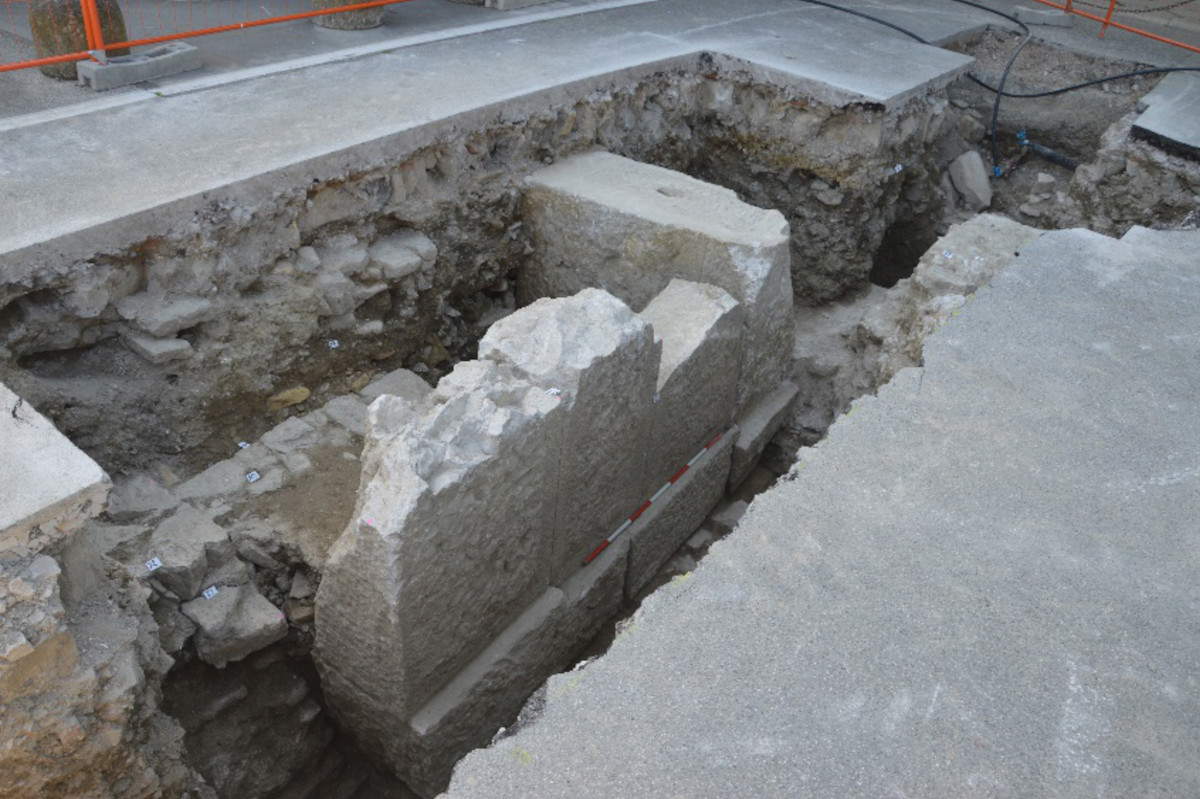
A monumental building, perhaps the base of an arch or a portal, made of large squared blocks of limestone, decorated on the external face and characterized by the presence of the traces of the impost of a pillar, was identified above the 1st century B.C. structures. The building is most probably related to the Propylaeum complex, the spectacular colonnade with access function to the Roman Capitolium, well preserved within the perimeter walls of the Campanile and datable to the 1st century AD, which has also been affected in recent years by stratigraphic verifications, in connection with a significant restoration and enhancement intervention. In front of the monument, to the south, a surface of sandstone paving stones was isolated, smoothed at the head, possibly referable to a roadway.
The investigation also uncovered an imposing wall structure from the Late Antique period, built by incorporating part of the Roman monument. The wall runs along the northern side of the Propylaeum and is interpreted as part of the defensive system referable to the Byzantine Castrum of Tergeste. According to scholars, the Propylaeum was reused as a defensive tower, following a practice already documented in other parts of the city.
More recent phases of the archaeological sequence, on the other hand, are represented by deposits containing human bone remains collected within masonry ossuaries. These materials testify to the transformations undergone over time by the necropolis developed around the Cathedral of San Giusto.
 |
| Trieste, new findings near San Giusto Cathedral on Roman and late antique Tergeste |

Warning: the translation into English of the original Italian article was created using automatic tools. We undertake to review all articles, but we do not guarantee the total absence of inaccuracies in the translation due to the program. You can find the original by clicking on the ITA button. If you find any mistake,please contact us.






























 IT
IT FR
FR DE
DE ES
ES CN
CN


