




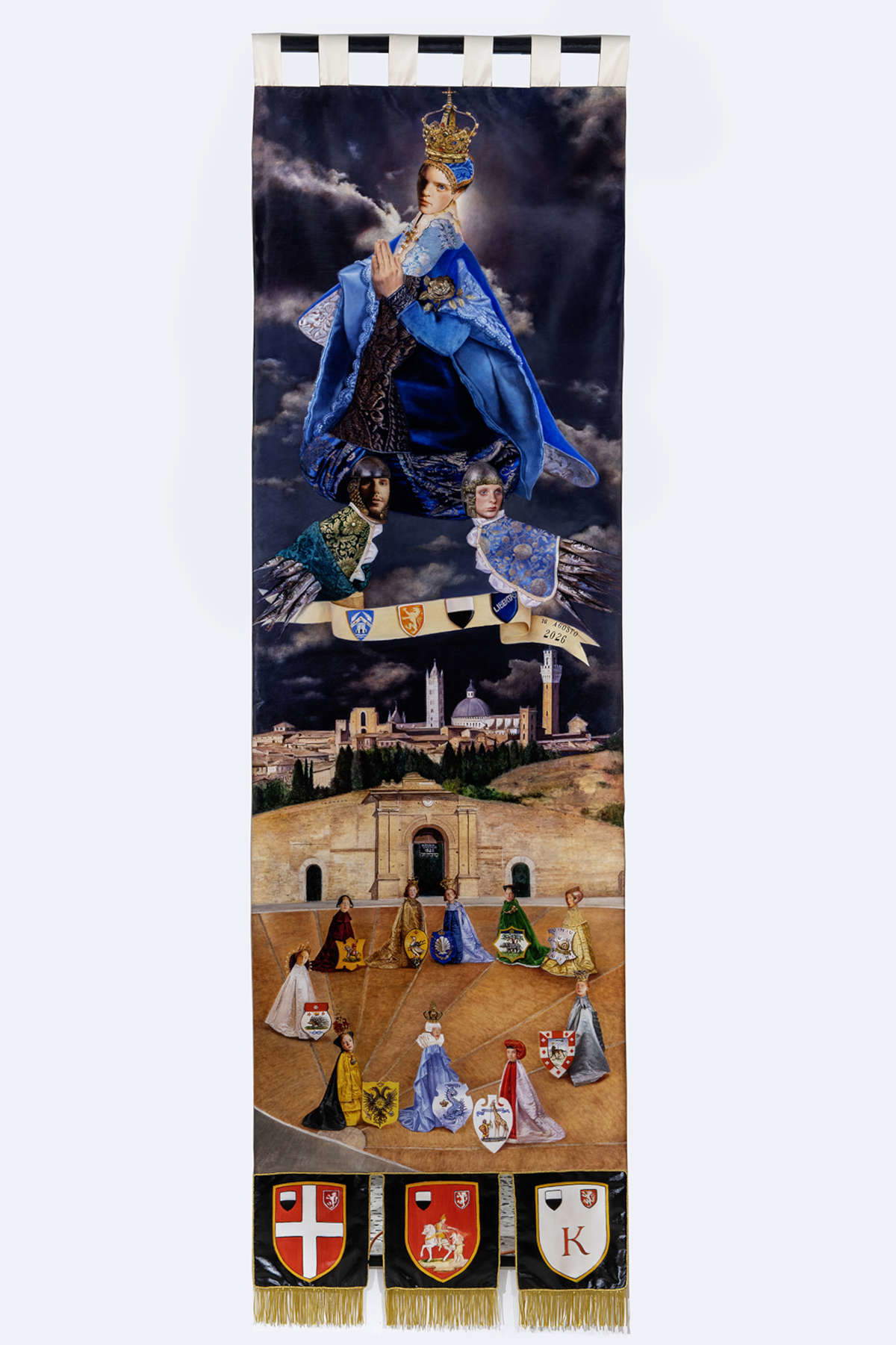
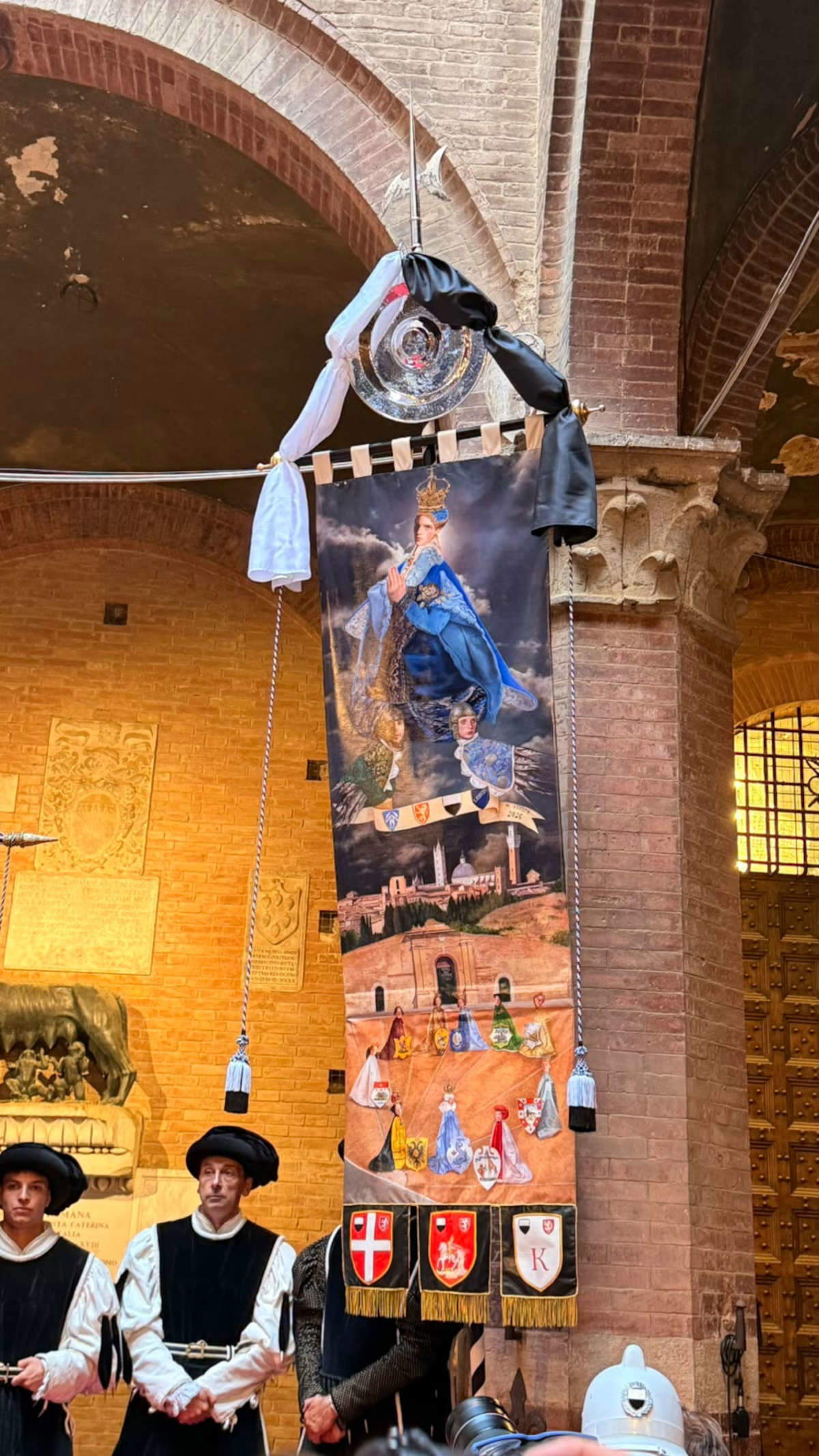
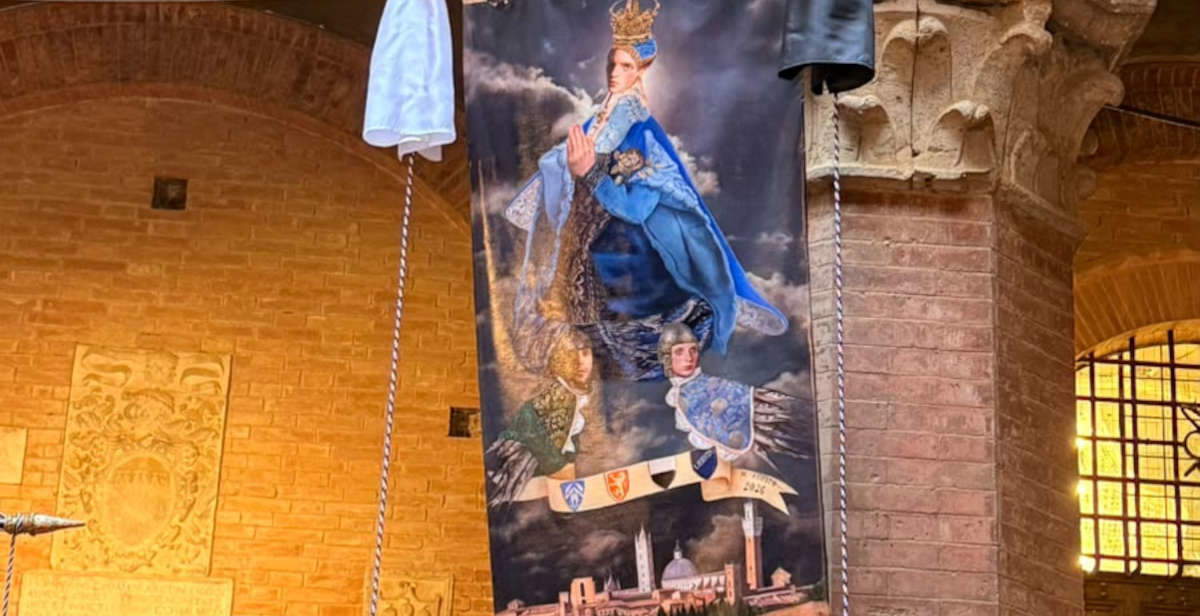
The Drappellone for the Contrada that will win the Carriera on August 16, 2026, was unveiled in Siena. As is customary, the Palio di Siena commissions an artist to create the prize for the winners, and the work for the upcoming race was created by Romanian painter Teodora Axente. It was presented on the afternoon of Monday, August 10, in the Cortile del Podestà of the Palazzo Pubblico, following the sounding of the Palazzo’s trumpets and an introduction by Siena’s mayor, Nicoletta Fabio. The Palio is dedicated to Our Lady of the Assumption, and this year marks the 500th anniversary of the Battle of Camollia, fought on July 25, 1526—one of the most significant events in Sienese history. The Drappellone will become part of the heritage of the Contrada that wins the Carriera and is presented as a work woven from a dense interplay of references to the city’s artistic and spiritual traditions. At the center of the composition is the figure of the Virgin, placed at the apex of a pyramidal structure and depicted protecting the Golden Rose, the precious gift that Pope Pius II bestowed upon the city of Siena. The compositional choice draws directly on the great tradition of Sienese painting and, in particular, establishes an ideal dialogue with the masterpieces of Simone Martini.
The Madonna stands out for the gentleness of her face and, at the same time, for the expressive power of her gaze. Her large blue mantle spreads out like a protective shield over the city and its inhabitants, taking on a symbolic function that links the religious dimension of the festival to Siena’s history and collective identity. At the Virgin’s feet appear two cherubs, whose figures merge with those of the fish through the metamorphic language characteristic of Axente’s painting. The cherubs hold the coats of arms of Siena, while the fish—an ancient Christian symbol—also serves in the painting as a metaphor for the Sienese community.
It is precisely in the Palio, in fact, that this community finds one of the most powerful expressions of its collective identity. Religious and civic symbolism thus overlap within the image, while Axente’s painting constructs a scene in which tradition is reinterpreted through a contemporary sensibility.
One of the most striking elements of the Drappellone is the contrast between light and shadow: light thus serves not only a formal function but also contributes to the construction of the work’s meaning. In particular, the radiance emanating from the Virgin contrasts with the storm clouds gathering in the background. Those clouds evoke the Battle of Camollia in 1526, won by the Sienese against the Florentines, and to which the Carriera on August 16 is dedicated on the occasion of the 500th anniversary. The threatening sky thus serves as a reference to a moment of conflict in Siena’s history, while the light emanating from the Madonna transforms the very scene into a symbol of hope and rebirth. At the center of the painting is Siena, recognizable by a monumental silhouette that brings together the Palazzo Pubblico, the Torre del Mangia, and the Duomo. The city appears as a single entity, immediately identifiable by its iconic buildings. The Virgin’s light also reaches Piazza del Campo, where Axente has depicted the seventeen Contrade.
The Contrade are depicted as solemn figures, each accompanied by its own historical coat of arms. The arrangement of the figures echoes the bas-reliefs of Jacopo della Quercia’s Fonte Gaia and, more generally, the structure of the great Sienese polyptychs of the 14th and 15th centuries. Just as in medieval and late medieval polyptychs each figure contributes to the overall harmony, so too in the Drappellone the seventeen Contrade become parts of a single representation of the city’s community. Through a painting rich in symbols, details, and references to local art history, Teodora Axente has thus created a tribute to Siena and to the spiritual and cultural heritage that the Palio continues to preserve and, at the same time, to renew. Tradition is not simply reproduced literally, but becomes the subject of a contemporary painting in which the past engages in dialogue with the present.
The mayor of Siena, Nicoletta Fabio, emphasized the significance of the work during her remarks at the presentation. “Starting tonight,” she said, “Siena dons the colors of its Contrade and takes on a transcendent quality, capable of uniting the sacred and the earthly, spirituality and popular passion, the material and the dream. It is the garment of our identity, of our history, of our belonging to the Contrade and to Siena. This elegance, this interweaving of beauty, memory, and emotion that has for centuries formed the soul of our city, we find it in the Drappellone painted by Teodora Axente. In her work, metamorphosis becomes the very heart of the Palio’s narrative. The artist interprets the festival as a moment of collective transformation, in which elegance and the dreamlike intertwine in a timeless dialogue. And we Sienese know this transformation well. During the days of the Palio, everything changes: the streets, the palaces, the squares, the sounds, the everyday gestures, the way we move through the city, look at it, and feel it. Every place takes on a different meaning; every detail becomes part of an ancient and ever-living ritual. Siena dons a new guise, just as its inhabitants do, called upon to fully embrace their roles, their symbols, and their sense of belonging. Every person becomes part of the Festival. The work we are presenting today also embodies another metamorphosis: the one through which history becomes living memory and continues to speak to the present. Five hundred years ago, on July 25, 1526, Siena wrote one of the most significant chapters in its history. The Battle of Camollia was not merely a military victory: it was the moment when an entire community demonstrated its ability to unite in defense of its freedom, its autonomy, and its identity. In that trial, the city found a new sense of self. A people torn by divisions and conflicts were able to come together in the face of something greater: the defense of the common good.”
For Teodora Axente, engaging with centuries of Sienese tradition has meant taking on a particularly important responsibility, but also enjoying a rare privilege. The artist belongs to the Cluj School, one of the most influential artistic movements of the 21st century, which has introduced the international scene to artists such as Adrian Ghenie and Victor Man—whose works are featured in major international collections and have been the subject of significant investments. Curator Riccardo Freddo, who presented the painting, highlighted this point. “Teodora stands out as one of the few women of her generation to have achieved such recognition, with a personal artistic language that blends classical painting with a contemporary sensibility. She is a surrealist who engages with the past, echoing figures such as Frida Kahlo and Leonora Carrington. In recent years, Siena has become an integral part of Teodora’s artistic journey. First came the major exhibition at Santa Maria della Scala, then the Rosa d’Oro award, and finally the exhibition at Palazzo Pubblico, alongside Ambrogio Lorenzetti’s Allegory of Good and Bad Government. This Drappellone is not an isolated work. It is the natural culmination of a dialogue the artist has built with the city, its history, and her own painting. Siena has not merely been the place that welcomed Teodora; it has become part of her artistic practice. To understand the Drappellone featuring the Madonna of the Assumption painted by Teodora, we must go back in time. We must return to a little girl in a small village in Romania, Şura Mare. Teodora grew up with her grandparents, who took her to church every Sunday. She recalls that during Mass she would gaze at the tall, solemn figures of the saints painted in the Byzantine style. They were shrouded in candlelight, which made them seem even more mysterious. That vision has never left her. At the age of ten, she painted a Madonna and Child on glass. Her grandmother donated it to the village church, and the priest placed it on the altar. Teodora always recalls with emotion that every Sunday, during Mass, she would see her painting on the altar, and that this was undoubtedly her first real exhibition. Perhaps it was precisely at that moment that the almost spiritual bond that today ties her to the image of the Madonna was born. And it is no coincidence that she herself is at the heart of this Drappellone.”
“I’d like to thank the Mayor of Siena, Michela Eremita, and Riccardo Freddo for their trust, support, and for accompanying me on this journey,” concluded Teodora Axente, “but above all, I want to thank Siena. Over the past few months, I’ve had the opportunity to gain a deeper understanding of its history, its art, and its spirituality. I’ve felt a special connection to the Sienese tradition and to that sacred dimension that is also part of my own roots. Thank you, Siena, for welcoming me and for allowing me to become—even if only for a moment—part of your history.”
 |
| Palio di Siena: Teodora Axente’s Drappellone Unveiled for the Race on August 16 |

Warning: the translation into English of the original Italian article was created using automatic tools. We undertake to review all articles, but we do not guarantee the total absence of inaccuracies in the translation due to the program. You can find the original by clicking on the ITA button. If you find any mistake,please contact us.



















 IT
IT FR
FR DE
DE ES
ES CN
CN


