



by Redazione 16/04/2026



Categories: Exhibitions / Disclaimer
The Metropolitan Museum of Art in New York presents "Giacometti in the Temple of Dendur" from June 12 to September 8, 2026. Works by the Swiss sculptor dialogue with the Egyptian temple of Dendur, highlighting the relationship between modern art and the ancient world.

From June 12 to Sept. 8, 2026, the Metropolitan Museum of Art in New York will host Giacometti in the Temple of Dendur, an exhibition project that relates the sculptures of Alberto Giacometti (1901-1966) to one of the museum’s most emblematic spaces: the Temple of Dendur. The exhibition is curated by Stephanie D’Alessandro, Curator of Modern Art “Leonard A. Lauder” and Senior Research Coordinator of the Met’s Department of Modern and Contemporary Art; Aude Semat, Associate Curator of the Met’s Department of Egyptian Art; and Emilie Bouvard, Curator of the Giacometti Foundation in Paris. The exhibition is co-organized by the Metropolitan Museum of Art and the Fondation Giacometti in Paris.

The initiative, co-organized with Fondation Giacometti, will take place in Gallery 131 at Met Fifth Avenue and offers a direct comparison between some of the Swiss sculptor’s works and the monumental architecture of Egyptian origin now located inside the museum.
The exhibition features a total of seventeen sculptures: fourteen bronze and plaster figures from the Fondation Giacometti, including some rarely exhibited polychrome plaster casts, and three works from the Metropolitan Museum’s collections. The works will be installed both in and around the Temple of Dendur, with the aim of highlighting the relationship between Giacometti’s plastic research and theformal and symbolic legacy of ancient Egyptian art.


The project focuses on one of the constants of the sculptor’s research: the representation of the human figure as a fragile, isolated and at the same time persistent presence in space. Giacometti, throughout his career, continuously investigated the possibility of sculpture to restore the existential condition of man, suspended between solitude and resistance. In this perspective, ancient Egyptian art represented a fundamental reference for him, especially for its ability to synthesize the human form into essential structures charged with spiritual intensity.
Giacometti’s interest in ancient Egypt developed early, beginning with stays in Italy between 1920 and 1921, when the sculptor came into contact with Egyptian works in Florence and Rome. The formal characteristics of those sculptures, particularly the rigid frontality and motionless composure, made a lasting impression on him. Later, having moved to Paris in 1922, he assiduously frequented the Egyptian collections of the Louvre, where he deepened his study of the proportion and structure of the human figure, gradually refining his own artistic language.
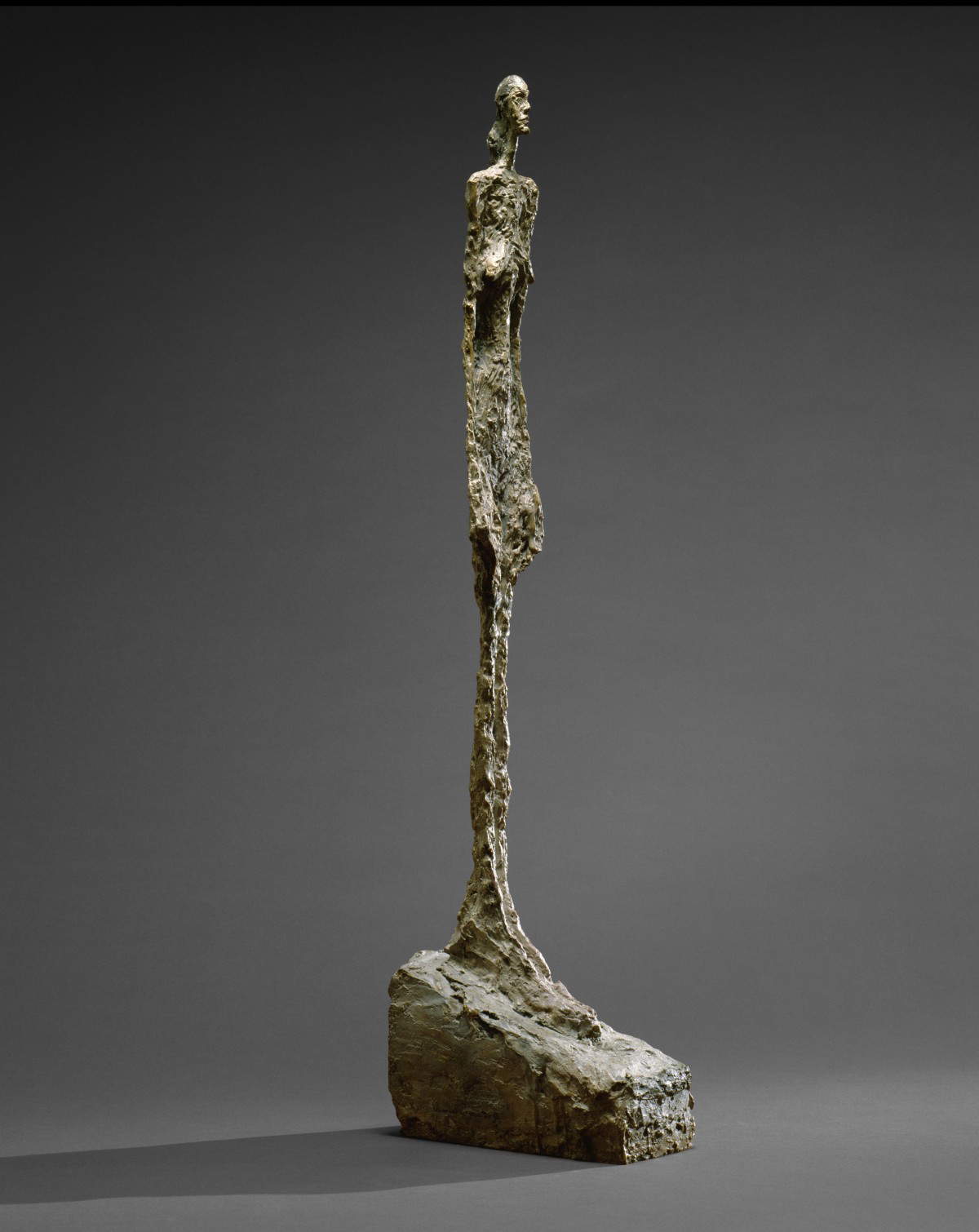
This interest is also accompanied by a theoretical and bibliographical dimension. In 1920 Giacometti acquired Hedwig Fechheimer’s volume Egyptian Sculpture (1914), a text that helped define his vision of ancient art as a form endowed with an almost ritual and symbolic presence. Later, he also confronted Egypt and Western AsiadiLudwig Curtius (1923), using the reproductions in the volume as tools for study and formal reworking. His notebooks of the 1920s and 1930s directly document this assimilation, showing how Egyptian figures become a starting point for the progressive reduction of the human figure to essential elements.
Also within this path is the development of works such as Woman Walking (I) of 1932, in which the figure, elongated and suspended, translates into sculptural form a tension between movement and immobility. The work reflects a conception of human presence understood as unstable equilibrium, in which the body seems to traverse space without ever fully stabilizing. The Temple of Dendur, completed around 10 B.C. and dedicated to the goddess Isis and the deified brothers Pedesi and Pihor, is itself a central element of the exhibition project. Originally a place of worship and mediation between the human and divine dimensions, the temple was donated by Egypt to the United States in 1965 and assigned to the Metropolitan Museum in 1967. Since 1978 it has been permanently installed in the museum, where it has become one of the most recognizable and visited spaces.
The decision to place Giacometti’s sculptures inside and in direct relation to the temple aims to re-propose, in a contemporary key, the relationship between sacred space and visitor perception. In ancient times, the temple was a place of passage and ritual access, where the divine presence was manifested through architectural and ceremonial devices. Similarly, Giacometti’s research has often focused on the relationship between figure and observer, between distance and proximity, between visibility and subtraction.
The arrangement of the works within the temple follows this spatial logic. Woman Walking (I) is placed in the offering hall, in a position reminiscent of the placement of divine statues in Egyptian sanctuaries, before their display to the ritual public. Other figures are arranged in isolation or in small groups on the raised platform of the temple, recalling the terraces of Egyptian temple complexes, spaces of intermittent access to the sacred dimension during festivals. In this context, Giacometti’s works assume a direct relationship with the dynamics of distance and access that characterize both Egyptian architecture and his sculptural research. Female figures, including post-World War II works such as Woman of Venice of 1956, help to reinforce the choral dimension of the presentation, while evoking ritual processions and formal aggregations recurrent in the artist’s work.
The entire project also fits into the Metropolitan Museum’s curatorial strategy of offering cross-readings across eras and cultures. The initiative also anticipates the lines of development of the future Tang Wing for Modern and Contemporary Art, which aims to situate modernity within a global and ongoing historical perspective. The Metropolitan Museum has announced that public programs and collateral activities will be organized during the duration of the installation, details of which will be announced at a later date.
Statements
“The Met is not only a collection of extraordinary works, but also a set of exceptional venues for the exhibition of seminal masterpieces. By placing Giacometti’s work in dialogue with the Temple of Dendur, this installation underscores how profoundly the ancient world has shaped modern artistic expression,” said Max Hollein, Director “Marina Kellen French” and Managing Director of the Met. "Giacometti in the Temple of Dendur reflects the Met’s unique ability to offer new perspectives by bringing works of art from different eras and cultures into conversation-an approach that also inspires the vision for the Museum’s Tang Wing for Modern and Contemporary Art, which will open in 2030."
“Giacometti constantly returned to the dilemma of how to infuse his works with the experience of being human,” said Stephanie D’Alessandro, “Leonard A. Lauder” Curator of Modern Art and Senior Research Coordinator of the Met’s Department of Modern and Contemporary Art. “His ongoing engagement with ancient Egyptian art offered him not only formal clarity, but a model of how the figure could embody both stillness and intensity. Viewed in and around the Temple of Dendur, his sculptures refine our understanding of his decades-long effort to distill human presence into its most essential form.”
“Ancient Egyptian temples were conceived as sacred abodes for the gods, where encounters between divine images and the public took place outside the sanctuary on terraces and ceremonial spaces,” explained Aude Semat, Associate Curator of the Met’s Department of Egyptian Art. “Placing Giacometti’s sculptures around and inside the Temple of Dendur invites us to reconsider the monument not only as an extraordinary work of ancient architecture, but as a living sacred environment. The installation foregrounds the original spatial and symbolic functions of the temple, while opening a dialogue across the millennia on how sculpture mediates between presence and faith.”
“From a young age, Alberto Giacometti was deeply fascinated by ancient Egyptian art, encountering it in collections throughout Europe-from Florence and Turin to the Louvre Museum-as well as through books,” said Emilie Bouvard, Curator of the Giacometti Foundation. “At once naturalistic and highly symbolic, Egyptian art resonated with his perennial quest for monumentality and humanity. The opportunity to present his work in a context of such profound historical and architectural significance offers a rare and engaging perspective on his entire oeuvre.”
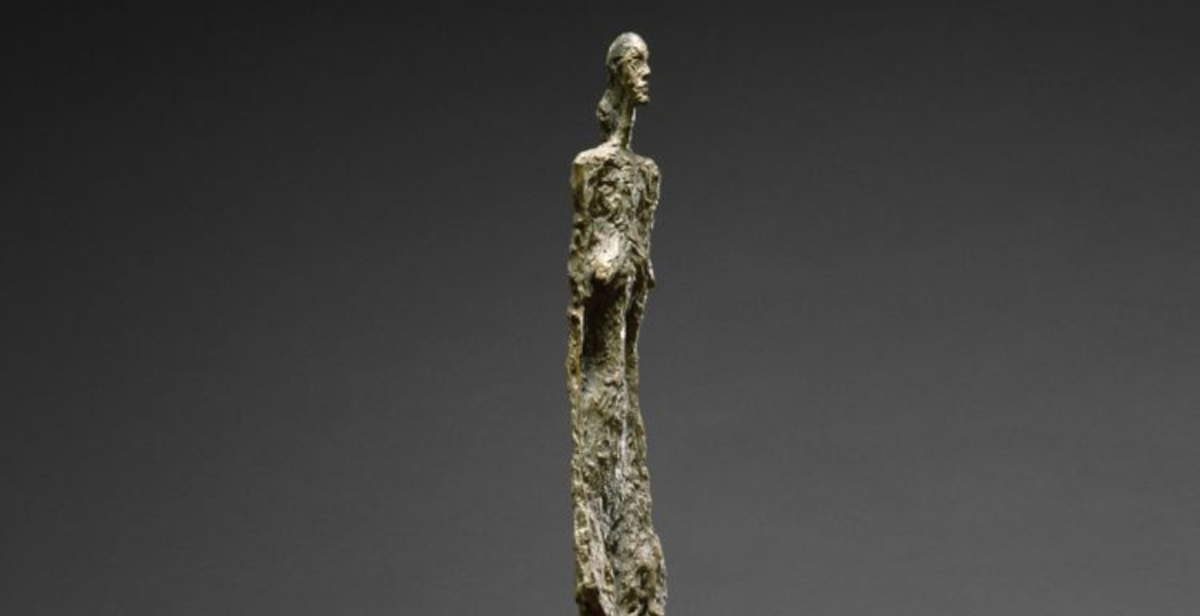 |
| Alberto Giacometti at the Met: the sculptures in the Temple of Dendur in New York. |
Warning: the translation into English of the original Italian article was created using automatic tools. We undertake to review all articles, but we do not guarantee the total absence of inaccuracies in the translation due to the program. You can find the original by clicking on the ITA button. If you find any mistake,please contact us.