





The Museion in Bolzano has opened an extensive institutional exhibition dedicated to Franco Vaccari (Modena, 1936 - 2025), entitled Feedback. The Environments of Franco Vaccari, curated by Frida Carazzato and Luca Panaro, which will remain open to the public from March 28 to September 13, 2026. This initiative assumes significance as it falls in the 90th year since the birth of the Modenese artist and represents the first organic presentation of his work since his passing in December 2025. The exhibition project focuses specifically and in an unprecedented way on environments, which are considered to be the supporting and foundational elements of his entire artistic production. Through a rich selection of photographic works, films, artist’s books and archival documents, the exhibition aims to restore the complexity of a figure who profoundly influenced post-World War II Italian art and international conceptual research.
Franco Vaccari, born in Modena in 1936, maintained a very close bond with his hometown throughout his life, despite a career with a global scope. His scientific training, culminating in a degree in physics from the Milan Polytechnic, provided the logical basis for an approach to art that eschews emotionalism to focus on the processes and structures underlying reality. His entry into the art world came in the late 1960s through visual poetry and verbo-visual research, collaborating with figures such as Adriano Spatola and participating in collective events such as Parole sui Muri in Fiumalbo. However, it was in 1969 that Vaccari defined what would become his theoretical and practical trademark: theReal Time Exposition. This concept sanctions the overcoming of the work of art as a static and finished object, to transform it into a device that is activated and takes shape only through the direct participation of the visitor, who thus becomes an active agent and producer of meaning.
Vaccari’s theory finds a fundamental systematization in two essays published in the late 1970s, Duchamp and the Concealment of Work and Photography and the Technological Unconscious. In these writings, the artist reflects on the need to do away with the manuality of the maker in favor of the idea and the process, a position that brings him closer to Marcel Duchamp and John Cage. The term technological unconscious describes the ability of technological tools, such as the camera, to record reality independently of human will and visual conditioning, revealing aspects of existence that would otherwise remain unknown. This vision transforms photography from a simple tool of mimetic representation to physical evidence of presence, a trace of being that characterizes the artist’s entire journey.
The exhibition itinerary at the Museion, carefully designed by Fosbury Architecture, does not follow a chronological order but develops by thematic nuclei through the third and fourth floors of the building. The layout aims to make each room feel like a living situation to be experienced rather than a mere historical documentation, using salvaged materials and temporary architecture. Already upon entering the museum, the visitor encounters Real Time Exhibit No. 38, Biomass, a 2007 work that consists of a platform connected to a terminal. Instead of counting the number of people, this device measures the total weight of the organic mass entering the museum, transforming the audience into a collective biological datum and making the physical presence of the participants visible from the very first moment.
On the third floor of the structure, the path focuses on a more intimate, individual and perceptual dimension, often linked to the exploration of darkness as a sensory and psychological condition. Among the most significant works repurposed is The Dark Sculpture from 1968, where visitors are invited to immerse themselves in a room completely devoid of light. In this condition of sensory deprivation, perception shifts from sight to touch and hearing, forcing a slowed-down, inward experience of one’s body. Then as now, visitors may wrap themselves in foam rubber before entering to protect themselves from possible impact with air-filled plastic bags suspended inside, experiencing disorientation that stimulates new modes of awareness. Similar themes return in Ambiente grigio multiuso of 1987, a freestanding structure originally designed for the Palazzina dei Giardini in Modena. This work aims to expand the visitor’s sensory capacity through unusual instruments such as a Geiger counter for cosmic rays, a laser for spatial measurements, a pinhole, and a one-way mirror for looking without being seen.
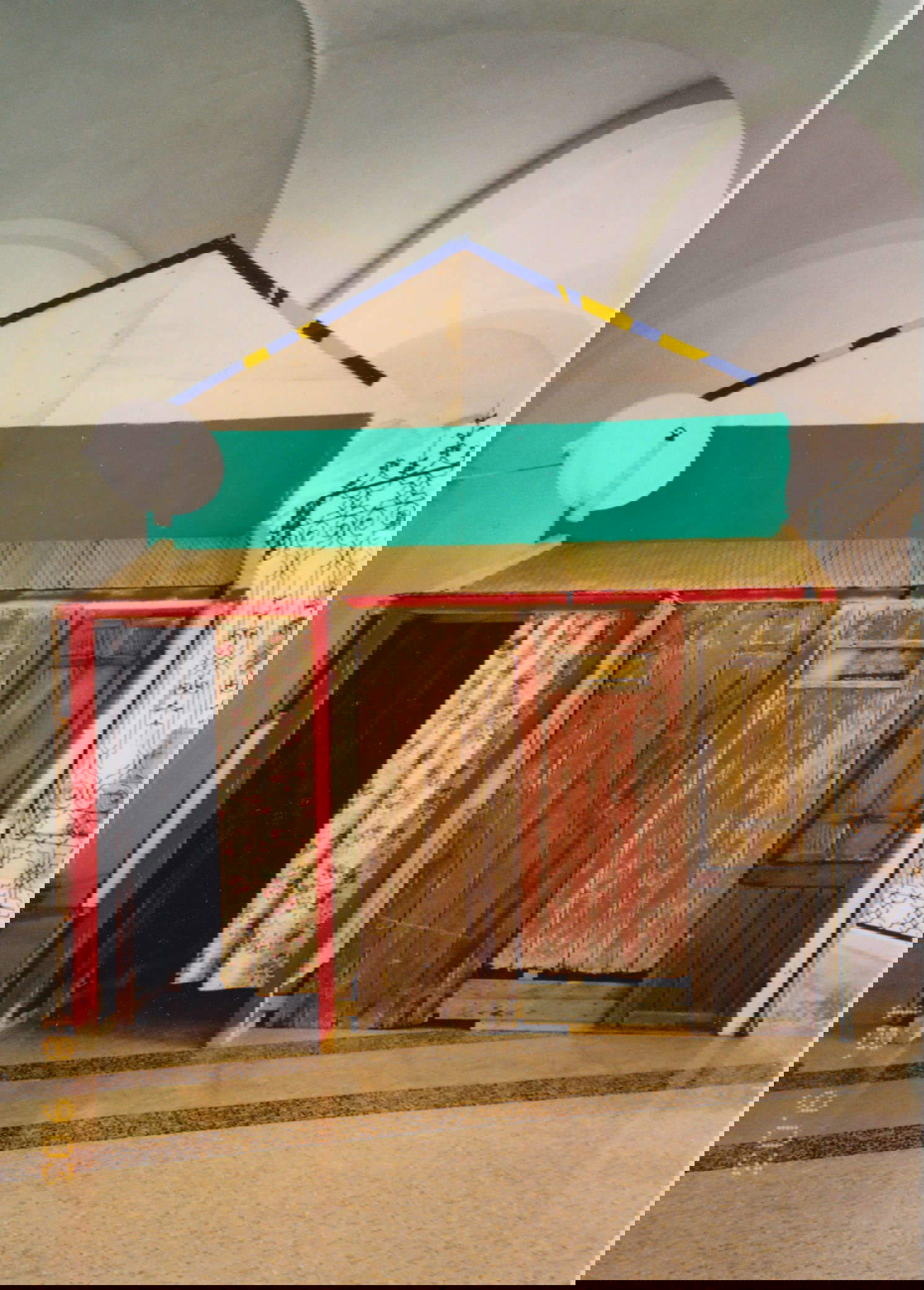
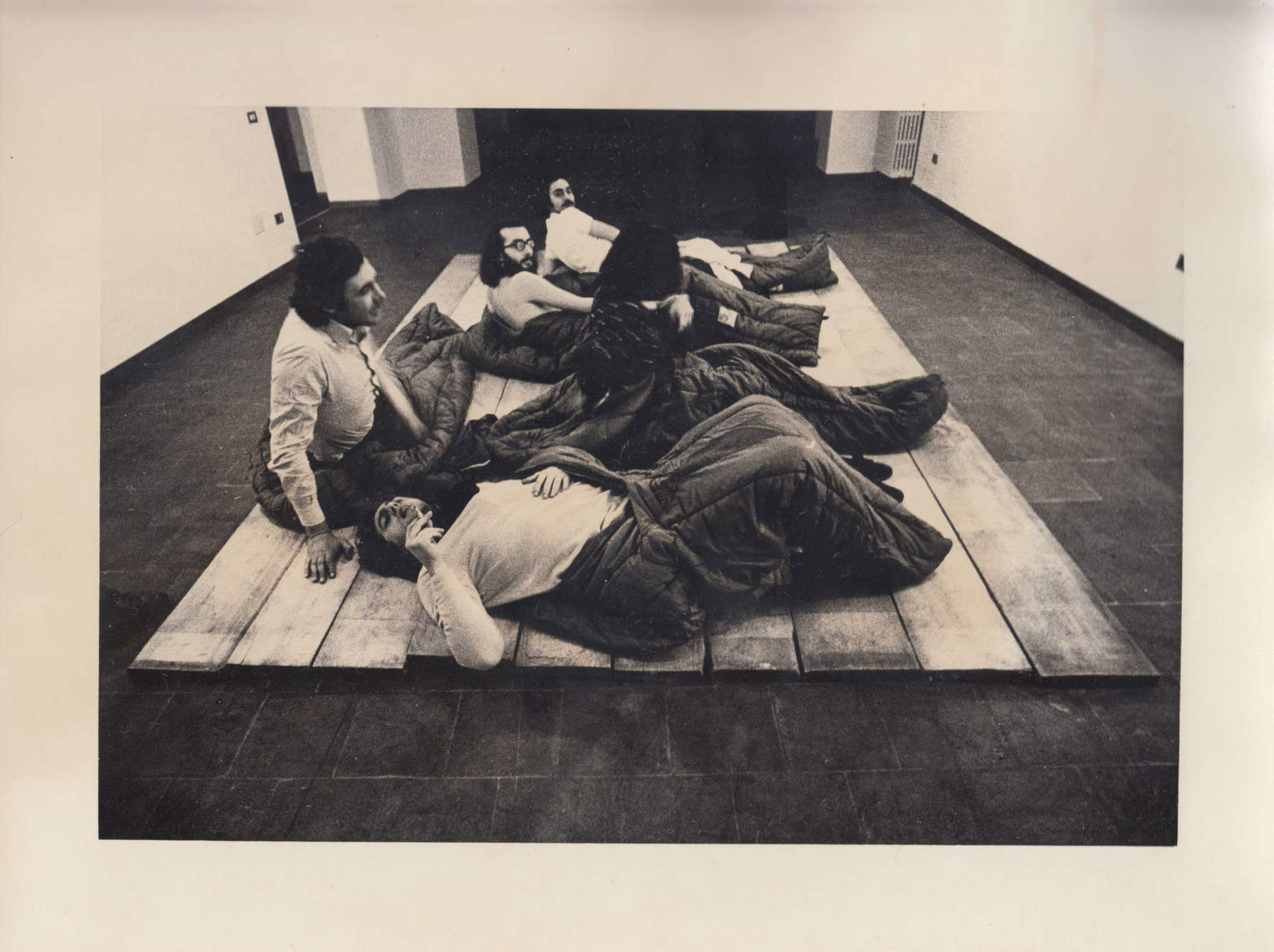
Vaccari’s interest in the dream world is evidenced by Sogni No. 1, a 1975 intervention originally made in Brescia at Galleria Cavellini. The environment, consisting of a darkened room with sleeping bags arranged on a wooden platform, invited people to spend the night in the exhibition space. Upon waking, dreams were transcribed and became an integral part of the work, in a dialogue between reality and the subconscious. The exhibition at Museion reactivates this dynamic, once again offering the public the chance to sleep in the museum and contribute their own accounts of their night visions, creating a temporal bridge with the dreamers of 1975. Other works in this section investigate spontaneous creativity, such as the 1966-67 video In the Underground, which documents writing and graffiti in public restrooms as forms of found poetry, evidence of the human need to leave a trace of oneself against social repression.
A central aspect of Vaccari’s poetics is the concept of minimal travel, illustrated by works that value the experience of displacement over the final destination. In 1971, with Viaggio per un trattamento completo at the Albergo Diurno Cobianchi, the artist collected tickets for various beauty and hygiene treatments received in Milan. Other actions include photographic documentation of the backs of trucks during a trip to Graz or the walking route from Carpi to Ferrara, during which Vaccari sent Polaroid postcards to the exhibition venue. These operations demonstrate how everyday life and movement in space can be transformed into works in real time. This section also includes the 1973 Homages , in which Vaccari described famous artists to an artisan maker of mechanical orchestras so that he could reproduce their likenesses. The experiment aimed to observe how a person’s image changes when filtered through the unconscious of someone from a different cultural sphere.
Moving up to the fourth floor, Vaccari’s investigation shifts to social interaction, collective behaviors and the occupation of public space. Here is a reconstruction of theartist’s most famous work, presented at the 1972 Venice Biennale: Real Time Exhibition No. 4, Leave on these walls a photographic trace of your passage. On that occasion, Vaccari installed a photo booth and an invitation in four languages to take a portrait and post it on the walls of the hall. By the end of the event, the walls were covered with more than six thousand photo strips, creating an immense archive of human presences and demonstrating the power of technological automatism as a tool for democratic participation. At the Museion, a booth of the same type from that time remains present as a monument and memory of that process, although by the artist’s will it is no longer active.
The theme of photography as a virtual and destabilizing alter ego is further explored in Instant Myth of 1974. In this dual environment, the visitor is first photographed with a Polaroid camera and then, in the next room, comes face to face with his own magnified and projected image. This encounter generates a sense of disorientation, as the image captured by the camera often diverges from everyone’s internal and idealized perception of themselves. Italy’s Photomatic project, developed between 1972 and 1974, extended this research on a national scale, using more than seven hundred photo booths scattered throughout Italy. Posting posters seeking new faces for a film, Vaccari collected thousands of spontaneous portraits, composing a sociological panorama of Italy in those years, marked by the desire for self-expression and the explosion of mass culture.
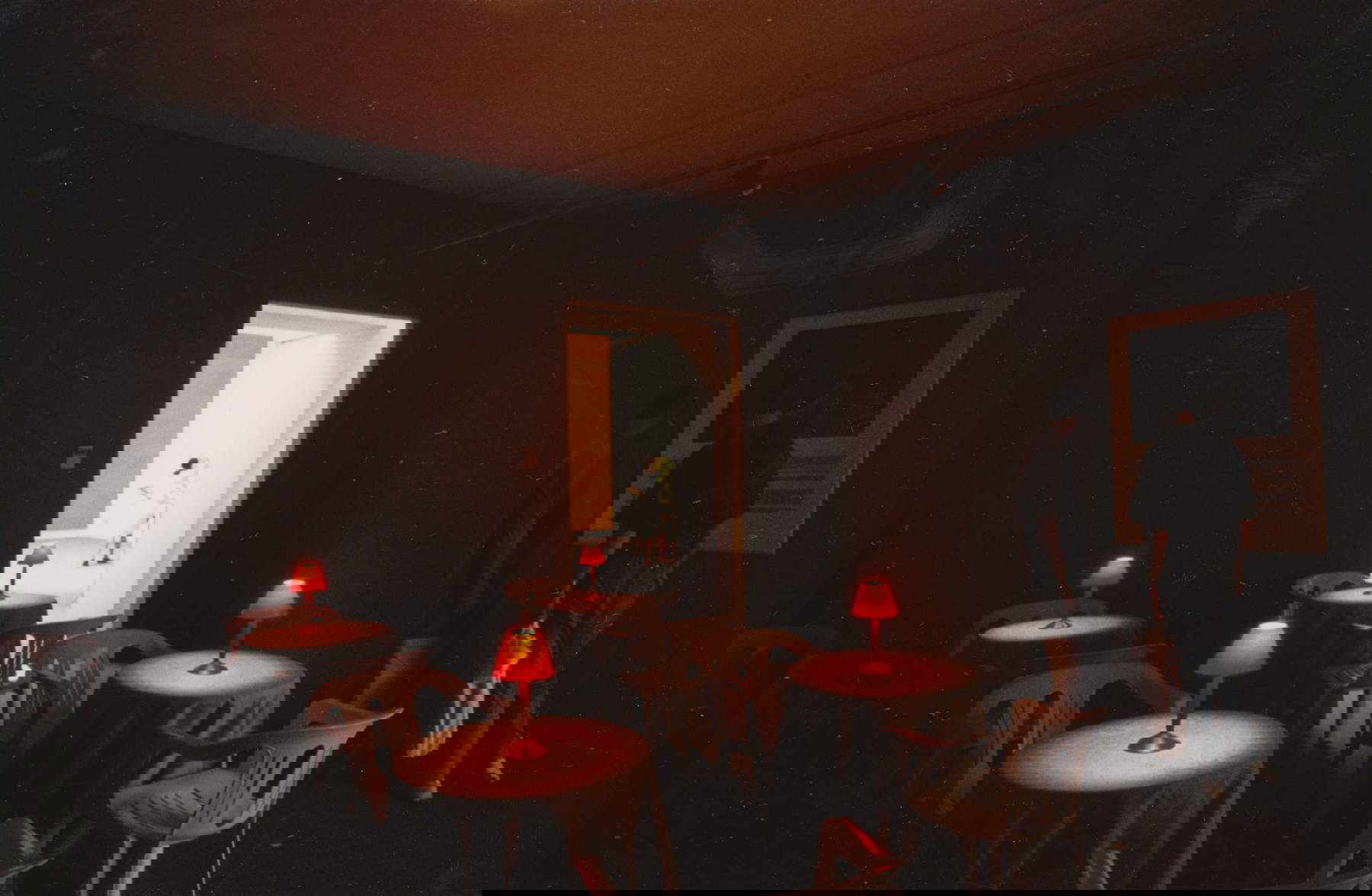
Another environment of great political and social impact is Bar Code - Code Bar, originally made for the 1993 Venice Biennale. The artist recreated a real working bar where the public could sit and have a coffee, but the space was littered with references to the story of activist Silvia Baraldini, who was imprisoned in the United States at the time on a 43-year sentence. Visitors were invited to sign a petition for her release, transforming an informal resting place into a space for civic engagement and discussion. The title played on the double meaning of the term bar, understood both as a meeting place and as a prison bar or line of a code of social control. The exhibition also documents visual experiments aimed at unhinging human perceptual conventions, such as Modena seen at dog level, where Vaccari photographs the city from a very low perspective to free himself from the automatism of human height, or the series taken at the Isle of Wight festival, where framing is entrusted to a spatial automatism instead of the aesthetic choice of a subject.
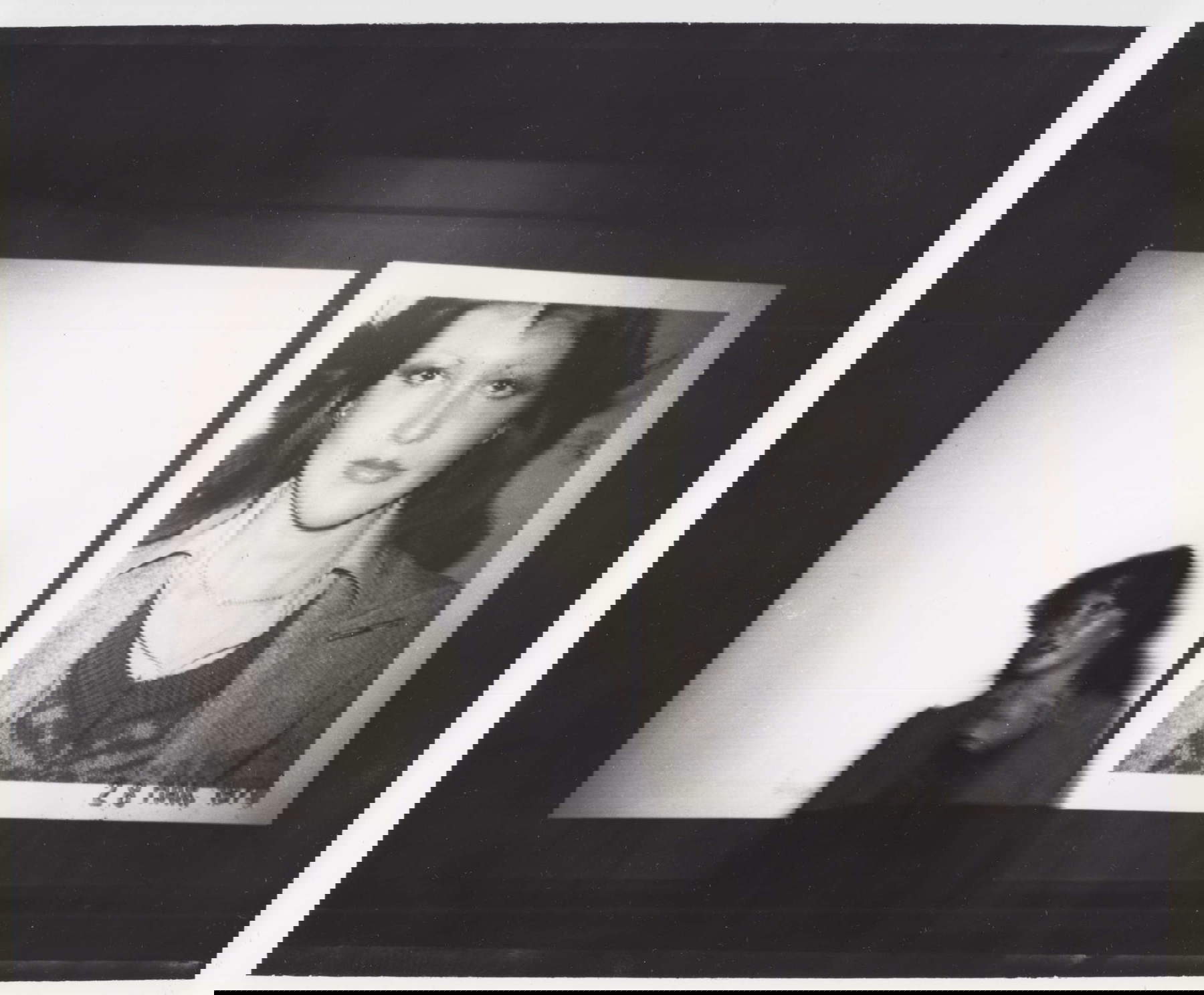
Franco Vaccari’s work proves surprisingly topical today, anticipating themes that would become central to artistic practices in the 1990s, such as relational aesthetics. Museion director Bart van der Heide points out how Vaccari’s work has been a necessary precursor for such world-renowned contemporary artists as Tino Sehgal or Anri Sala, while sometimes remaining in the shadows of international critical debate. “When I look at Franco Vaccari’s work,” he declares, “I inevitably think of artists and artists like Tino Sehgal, Alicia Framis or Anri Sala. What is extraordinary is not only the clarity with which his works anticipate their themes, but the fact that he articulated these ideas as early as the 1960s. Despite this, Vaccari remains relatively unrecognized within the international critical discourse-especially in relation to some recent reevaluations of contemporary postwar art history. This project attempts to fill that void, emphasizing how his works are both fundamental and urgently relevant today.” He is echoed by curator Frida Carazzato: "To confront Vaccari’s long career and approach today is to draw attention to the present and the consequent confusion generated by the overproduction and overexposure of the ego, to promote an art that paves the way for the ’short-circuiting of the ego.’
Through Vaccari’s environments, understood as temporary architectures and activators of consciousness, the Emilian artist has redefined the relationship between the individual and collective space, leaving a legacy that invites not passive contemplation, but action and responsibility for one’s being in the world. With this project, the Museion, which holds about twenty of the artist’s works in its collection, confirms its commitment to enhancing contemporary heritage and promoting critical thinking through the direct involvement of the community.
|
| Franco Vaccari, the great anthology of environments on display in Bolzano |

Warning: the translation into English of the original Italian article was created using automatic tools. We undertake to review all articles, but we do not guarantee the total absence of inaccuracies in the translation due to the program. You can find the original by clicking on the ITA button. If you find any mistake,please contact us.

























 IT
IT FR
FR DE
DE ES
ES CN
CN


