





Christian Stein Gallery dedicates the solo exhibition In studio (now as then), which can be visited with an opening on Thursday, June 4, 2026 from 6 to 9 p.m. in its spaces on Corso Monforte in Milan. The exhibition is part of the long-standing relationship between artist Giulio Paolini (Genoa, 1940) and the gallery, which began in 1967 in Turin and continued over nearly sixty years of collaborations, up to the Milan solo show in 2023.
The exhibition project is organized around nine total works, six of which were made especially for the occasion, flanked by collages and preparatory studies. The title of the exhibition derives from one of the works presented and refers directly to the conceptual core of the entire path: the studio as a privileged place of elaboration of the work, a space separated from the world and at the same time the theater of its construction. Paolini defines it as an environment in which the tools of artistic work take on a decisive role, from pencils to squares and compasses, until they become elements of a staging that oscillates between order and simulation of disorder. In this context, the atelier is configured as aHortus Clausus, a closed space suspended in time, inhabited by the artist or his stand-in, in dialogue with figures and images from different eras.
Located on the back wall is Mnemosyne (Les Charmes de la Vie/8), made between 1981 and 1990 and belonging to a cycle of six episodes. The work is based on a reworking of details from Jean-Antoine Watteau’s painting Les Charmes de la Vie of 1717-1718. In the work exhibited, the eighth detail of the painting is associated with eight frames and a prepared canvas, on which a pencil drawing suggests eight elements arranged around a center, configuring a structure that recalls a system of rotation around a fulcrum.
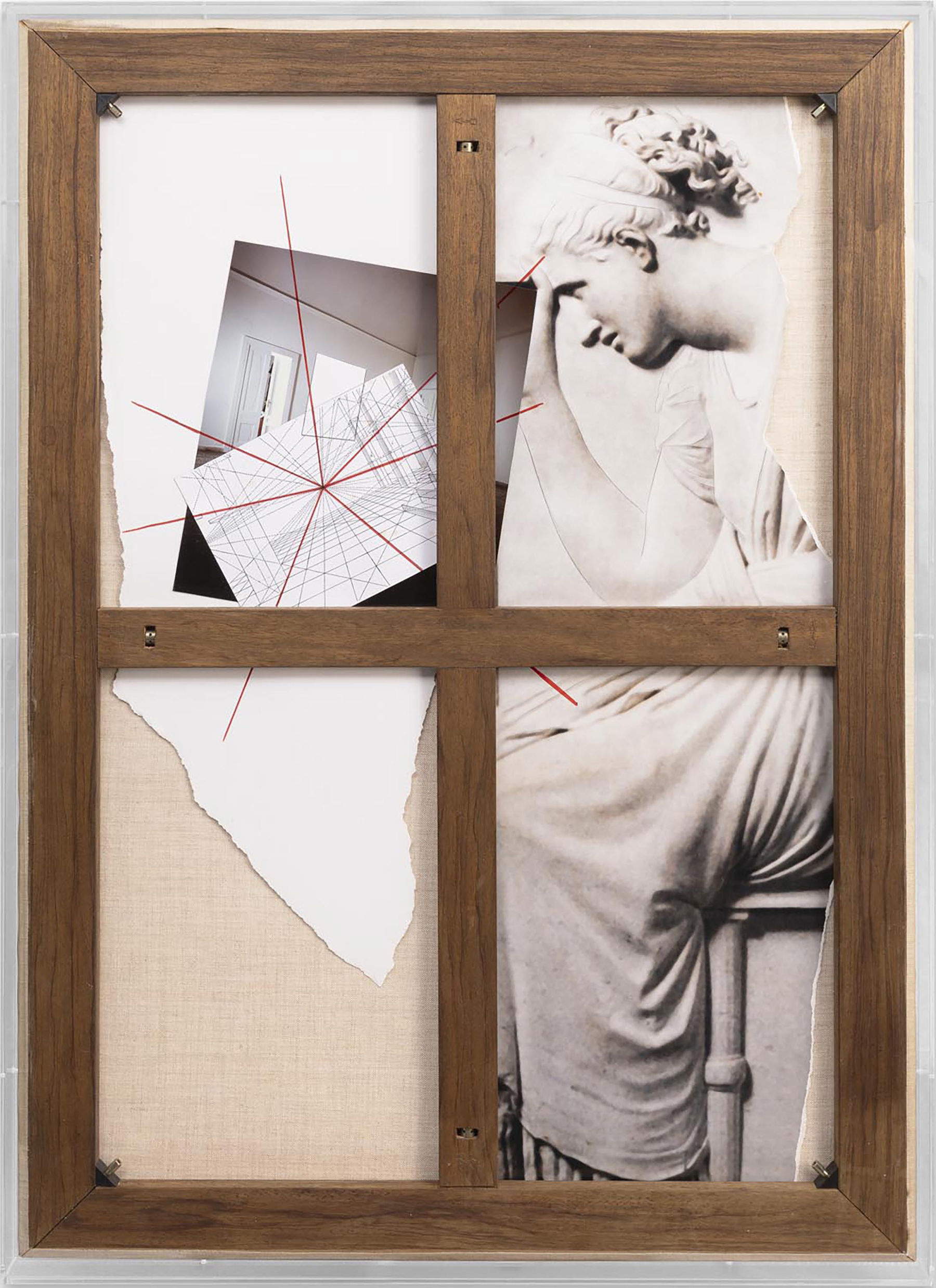
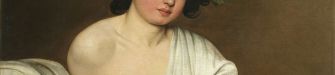
On the right wall is Ariadne, 2025. The work is built on an inverted canvas that houses the torn image of the female figure taken from Antonio Canova’s Funeral Stele of Giovanni Falier. The figure’s gaze is superimposed on a red linear tracing arranged in a radial pattern, intersecting two staggered perspective images. The canvas is placed on an easel placed in front of a French window, while a fabric drape depicting the sky seems to ideally extend the figure itself. The whole is constructed as a visual threshold that introduces one to a condition of waiting. Paolini himself links the title to a reflection on Giorgio de Chirico’s metaphysical paintings, in which the figure of Ariadne recurs as a suspended presence, associated with a condition of permanent waiting for the image.
On the wall opposite the entrance is Sottosopra, 2005. The work consists of a canvas and two music stands inserted into each other with opposing orientations, positioned close to the pictorial surface. Two of the artist’s handwritten texts, reported on white paper and music stand, are torn and scattered on the canvas and wall, configuring a fragmentary fall. The composition is organized on a box traced in pencil with internal diagonals that define a geometry of reference with respect to the disorder of the whole. The texts refer to the theme of the autonomy of the work with respect to the figure of the author, through two historical examples: the handover between Verrocchio and Leonardo and the one between Rossini and Wagner, both interpreted as moments of awareness of generational overcoming.
“Is the voice of the author silent if it does not echo the work that Time, from time to time, assigns to writers, artists, musicians ... to its trusted and devoted ’insiders’?” declares Paolini.
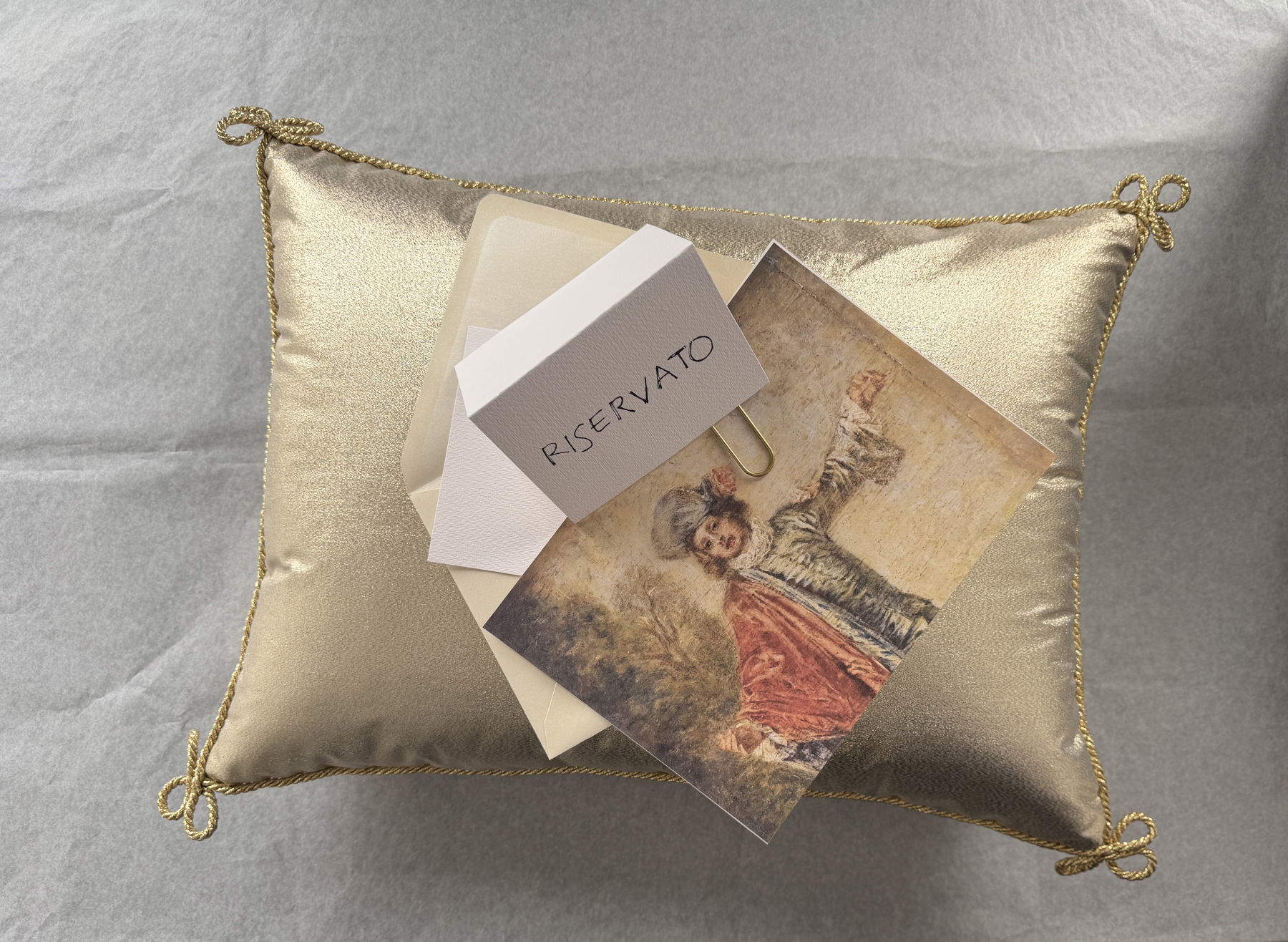
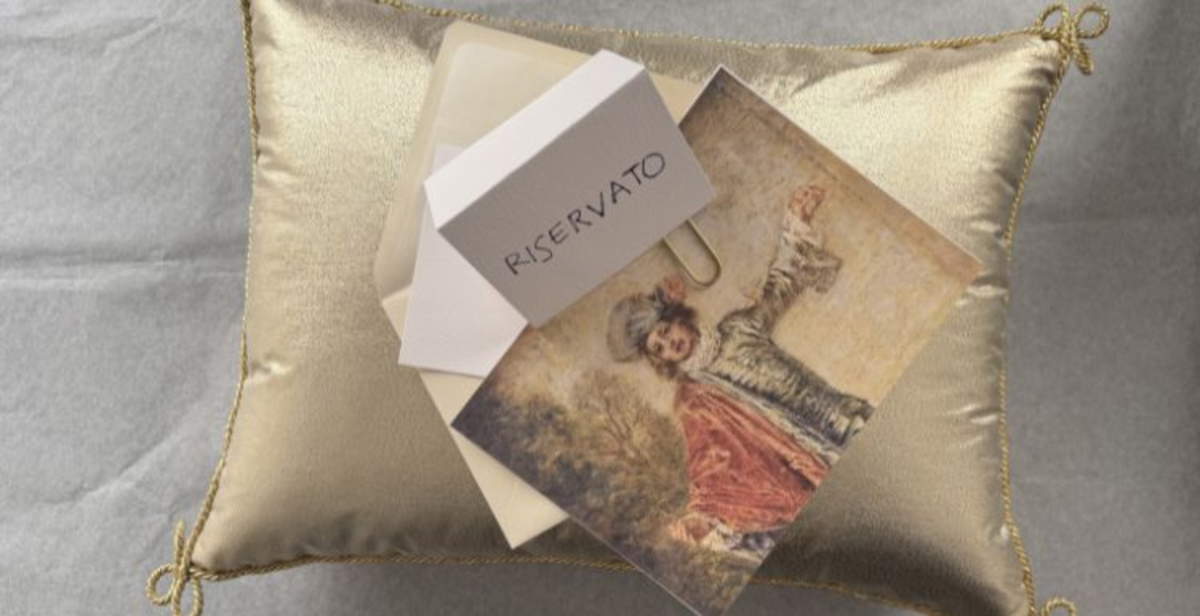
Opposite the window is placed Reserved, 2025. The work stands on a base supporting a gilded cushion on which are arranged a letter envelope, a portrait of an eighteenth-century valet, a gilded paper clip, and a handwritten sheet bearing the word “reserved.” The term takes on a double meaning, referring both to the delimitation of a physical space and to a condition of intimacy and discretion. The set of objects builds a relationship between past and present, in which the figure of the valet seems to take on a function of counterpart or possible alter ego of the artist.
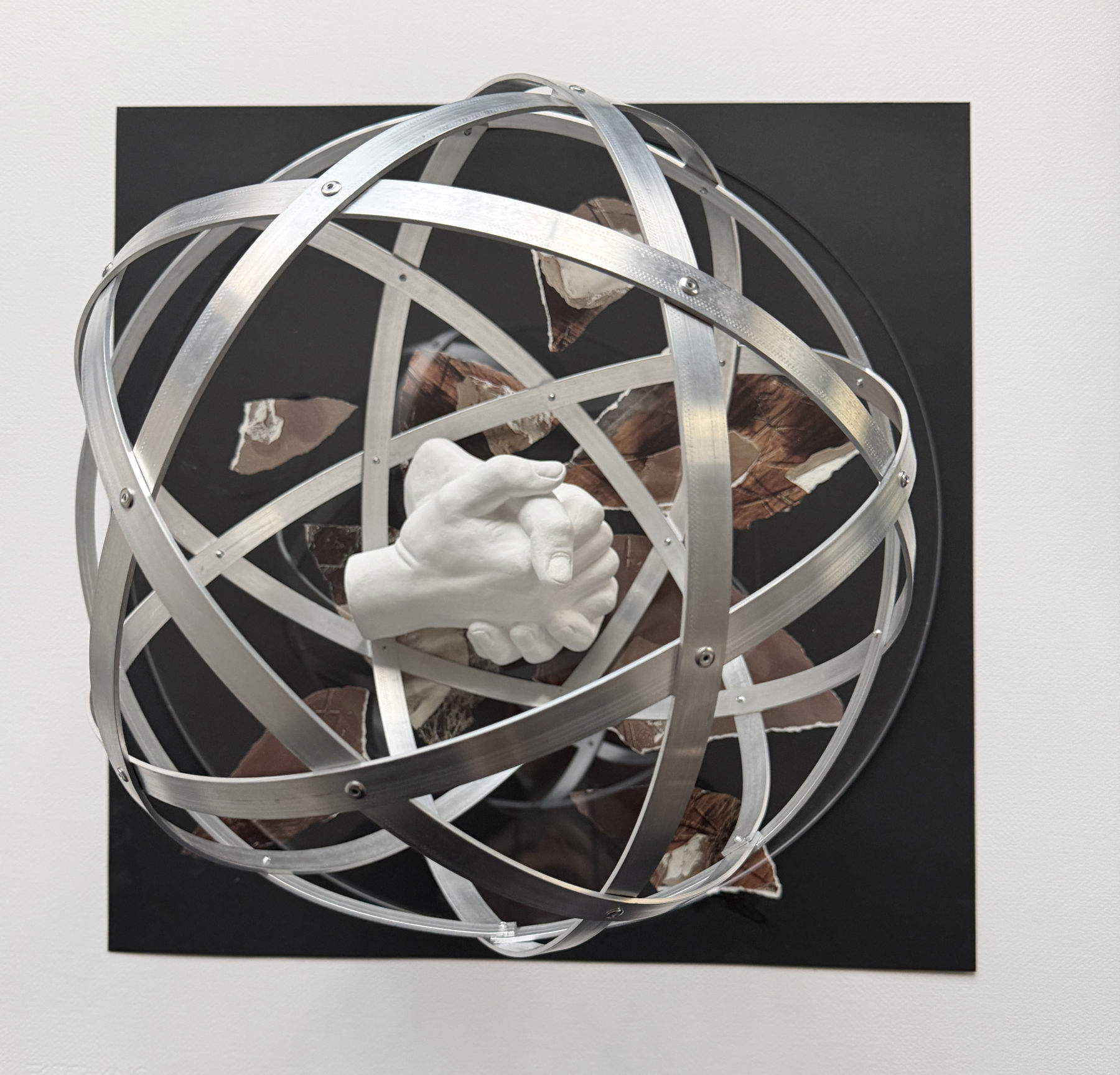
At the center of the exhibition space is a constellation of works on base. Among them is Yes and No, 2025, consisting of a plaster cast of two joined male hands placed inside a Genesa Crystal, a geometric structure composed of intertwined circles of symbolic origin. The object rests on a collage of paper fragments that in turn refer back to fragments of plaster. The work relates the human dimension of the hands to a structure that recalls a universal form.
In Copy and Original, 2026 a plaster cast of a fist-clenched hand and a mother-of-pearl shell are arranged on a mirror plate. The relationship between the two objects highlights a dynamic of formal similarity and ontological difference: the plaster cast refers to the logic of copying, while the shell is configured as a natural element and therefore original.
Out of time, 2020 constructs a sequence of objects and images that refer to a suspended condition of time in the studio. The palette is described as an element foreign to the contemporary, while the hourglass introduces a reference to the timeless dimension of the work. The whole suggests a nonlinear temporality, linked to artistic practice as an autonomous space with respect to the present.
In As Is / As If, 2025 black and white surfaces alternate, constructing a relationship between real presence and appearance. The elements appear staggered and unreconciled, while the photographic images and physical objects establish an unstable relationship of correspondence. The photo frame appears as an image of an absent original, while the real objects find meaning only in the relationship with their representation. The work focuses on the relationship between being and appearing as the central node of representation.
The central work, In studio (now as then), 2025, which gives the title to the entire exhibition, synthesizes the theme of the studio as an operational and conceptual device. An easel divides the space into two sections, recto and verso, both occupied by heterogeneous objects arranged in a controlled balance. These include an hourglass, magnifying glasses, a sphere, mirrors and a black stone. A model Thonet chair, canvases with pencil tracings and photographic reproductions appear on the opposite side. The whole is dominated by the structure of the easel, which also supports a pair of eyeglasses and two photographs of the same studio, one on each side. The work constructs a self-reflexive reflection on the work’s production space and its internal representation.
The exhibition transforms the Corso Monforte space into a closed and analytical configuration, in which the studio is not only represented but rethought as a theoretical device. Approaching the age of 86, the artist continues a line of research characterized by analytical rigor and thematic continuity, in which reflection on the work and its operational context remains the core of the practice.
 |
| Giulio Paolini in Milan: the studio becomes the scene of the work at the Christian Stein Gallery |

Warning: the translation into English of the original Italian article was created using automatic tools. We undertake to review all articles, but we do not guarantee the total absence of inaccuracies in the translation due to the program. You can find the original by clicking on the ITA button. If you find any mistake,please contact us.
























 IT
IT FR
FR DE
DE ES
ES CN
CN


