



by Redazione 27/05/2026



Categories: Exhibitions / Disclaimer
At the Magnani-Rocca Foundation, in Mamiano di Traversetolo (Parma), an exhibition traces the entire output of Man Ray on the 50th anniversary of his death: photography, painting, objects, film and design for more than 250 works that redefine the perimeter of his research.

At the Magnani-Rocca Foundation, on the grounds of the Villa dei Capolavori in Mamiano di Traversetolo, in the province of Parma, the exhibition Man Ray: Everything, dedicated to Man Ray on the 50th anniversary of his death in Paris on Nov. 18, 1976, will be open from Sept. 12 to Dec. 13, 2026. The exhibition, curated by Walter Guadagnini, Mauro Carrera and Stefano Roffi, features more than 250 works including photographs, paintings, sculptures, objects, graphics, books and films.
The exhibition project is set in the spaces of the Villa dei Capolavori, home of the Magnani-Rocca Foundation, located near Parma and historically characterized by the presence of a collection that includes works by Titian, Dürer, Van Dyck, Goya, Canova, Renoir, Monet, Cézanne, de Chirico, Morandi and Burri. In this context, the exhibition relates Man Ray’s production to the villa’s heritage, without setting up a hierarchical comparison but rather a coexistence of historical and modern languages.
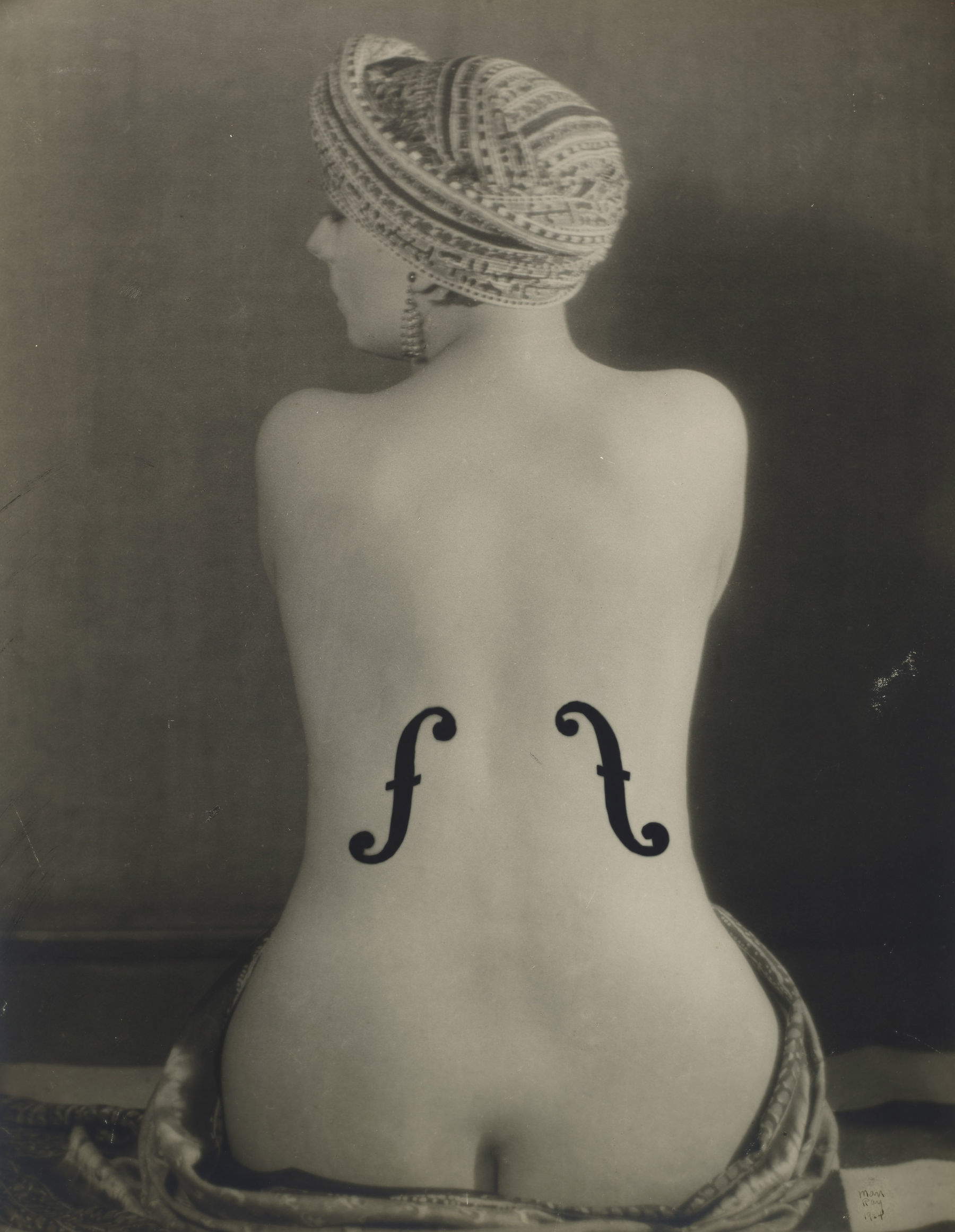
The breadth of the path allows the artist’s entire activity to be traversed without privileging a single discipline. Photography, painting, sculpture, design, graphic design, publishing and film are presented with equal dignity, in continuity with the interdisciplinary nature of his research. The nucleus of works includes works such as Le Violon d’Ingres from 1924, a photographic portrait of Kiki de Montparnasse with violin effigies on her back, along with Tears, The Prayer, Anatomy, Noire et Blanche and several portraits dedicated to Lee Miller and Nusch Éluard.


The exhibition itinerary reconstructs the stages of Man Ray’s career beginning with his American years, marked by his adherence to Dadaism and his discovery of photography, a medium that would become central to his production. This phase includes early sculptures such as By Itself of 1918, presented in the exhibition in its 1966 bronze version, and Obstruction of 1920, composed of 63 suspended wooden hangers, conceived as a multiplication of an everyday object transformed into an installation.
The decisive turning point came with the move to Paris in 1921. His meeting with Marcel Duchamp marked the beginning of an intellectual and personal relationship destined to last, with outcomes also documented in the exhibition. Inserted in the context of the Parisian avant-garde, Man Ray became a central figure on the international art scene, also establishing himself as a photographer of choice for portraits of artists, writers and leading cultural figures of the period.
Alongside his commissioned work in the field of fashion, the artist developed an autonomous research that included experiments with rayographs and solarization, considered among the most representative images of Dada and Surrealism. This also includes the Électricité portfolio of 1931, made with Lee Miller, an American photographer who was initially an assistant and model, then a collaborator and companion, then an independent artist.
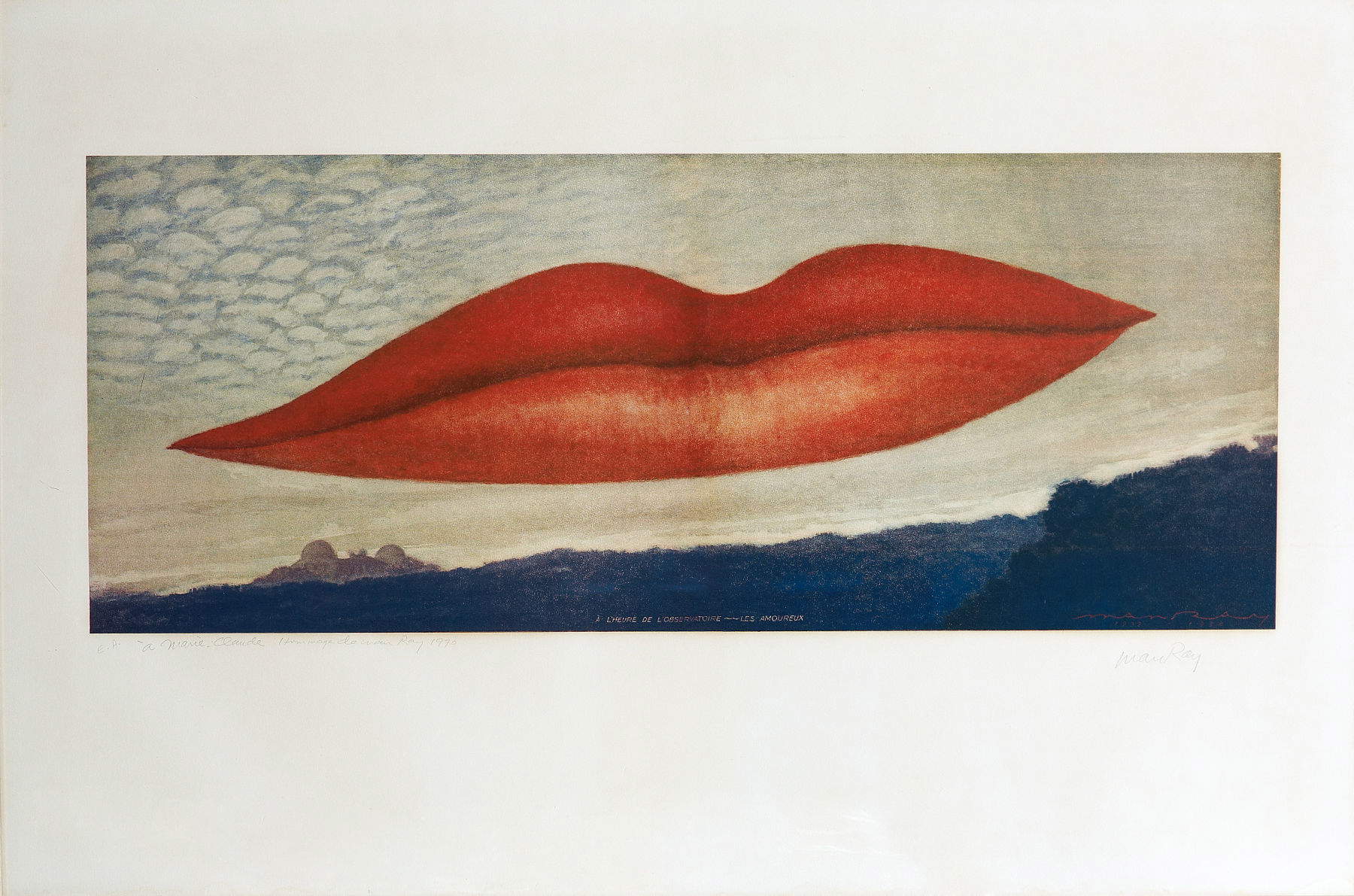
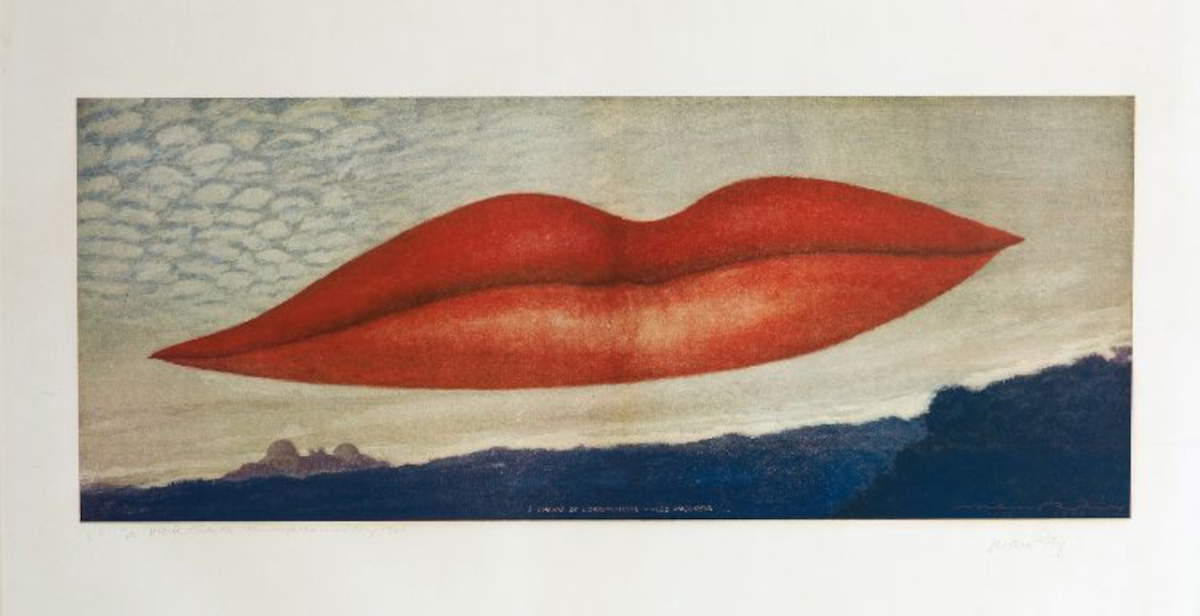
Painting remains a constant area of his activity. Works such as À l’Heure de l’Observatoire, les Amoureux (1932-1934) show a symbolic and visionary dimension in which biographical and imaginary elements overlap. The painting, with Lee Miller’s lips suspended over a nocturnal landscape, is interpreted in the context of a phase marked by separation and cosmic transfiguration of personal experience.
Alongside the painting, the graphic production reflects a desire for wide dissemination of the work, independent of traditional concepts of uniqueness and originality. This approach is also reflected in the objects d’affection, in which Man Ray intervenes in ready-mades by transforming them into works. Cadeau of 1921, an iron with nails attached to the base, was created on the day of the opening of his first solo exhibition in Paris; the object was taken away on the same day and subsequently replicated beginning in 1963. Similarly, The Indestructible Object of 1931, a metronome with an applied eye, will evolve into An Object to Destroy at the end of the relationship with Lee Miller, confirming a logic of continuous reproducibility and transformation.
The relationship between design and artistic practice also emerges in projects such as Palettable, a palette-shaped table conceived in 1941 and later edited in 1971, and in the 1955 Monument to the Unknown Painter. In these works, a crossing of boundaries between applied arts and visual arts is evident, in line with a vision that considers the work as a device and not as a static object.
The exhibition also includes materials related to the history of the avant-garde, such as documentation of Résurrection des Mannequins, a staging of the 1938 International Exhibition of Surrealism at the Galerie Beaux-Arts in Paris, which featured artists such as Dalí, Ernst, Miró, Duchamp and Man Ray. The installation of female mannequins represents one of the best-known moments of Surrealist scenic experiments. Also featured are the artist’s rare film experiences, considered an autonomous but coherent part of his research. The films made contribute to delineating a conception of art as a total experience, devoid of rigid disciplinary separations and open to contamination between languages.
“I paint what cannot be photographed, what comes from imagination, dreams or an unconscious drive. I photograph the things I do not wish to paint, the things that already have an existence,” said Man Ray.
The project features loans from Italian and international museum institutions, galleries and private collections. The exhibition is part of the programmatic line of the Villa dei Capolavori, which over the years has hosted exhibitions dedicated to figures such as Miró, de Chirico, Cocteau, Warhol and Munari, in an itinerary devoted to the avant-garde of the 20th century. The catalog, published by Dario Cimorelli Editore, collects the complete documentation of the works on display and a series of essays signed by Paolo Albani, Silvana Annicchiarico, Andrea Bellavita, Eva Brioschi, Alice Ensabella, Marco Meneguzzo, Alessandro Nigro and Alessandra Vaccari, as well as contributions from the curators.
 |
| Man Ray, an extensive Italian retrospective at the Magnani-Rocca Foundation |
Warning: the translation into English of the original Italian article was created using automatic tools. We undertake to review all articles, but we do not guarantee the total absence of inaccuracies in the translation due to the program. You can find the original by clicking on the ITA button. If you find any mistake,please contact us.