




by Redazione 28/05/2026



Categories: Museums / Disclaimer
The Palazzina di Caccia di Stupinigi Hunting Lodge opens the Crivelli and Principini Rooms in the museum itinerary: picture galleries among still lifes, hunting scenes, and Savoy dynastic portraits, one hundred years after the creation of the Museum of Furniture.
The Palazzina di Caccia di Stupinigi expands its tour with the opening of the Sale Crivelli and Principini, two new rooms dedicated to a lesser-known part of the collections of the Museum of Furniture. The intervention is part of the celebrations for the 100th anniversary of the museum, which was established in the 1920s, when a substantial nucleus of works was transferred to the Savoy residence to form a display consistent with the building’s historical function.
In particular, the new rooms delve into the pictorial heritage of the Palazzina, which alongside the famous collection of eighteenth-century furnishings preserves a collection of more than two hundred paintings dated between the seventeenth and nineteenth centuries. It is a heterogeneous ensemble that includes still lifes, hunting scenes, animal painting and court portraiture, organized according to decorative and thematic criteria that reflect Savoyard collecting practices.
The opening of the Crivelli Room and the Principini Room allows this nucleus to be read as a coherent system of picture galleries, in which the decorative function is intertwined with the representation of court life and the construction of dynastic imagery. On the one hand, the canvases by Angelo Maria Crivelli and his son Giovanni restore a naturalistic repertoire related to hunting and the representation of game; on the other, the portraits of the little Savoy princes and families connected to the dynasty document the role of childhood in the communication of power and dynastic continuity.


The Crivelli Room
The Crivelli Room completes the tour of the King’s Apartment and occupies a room that was used as a small bedroom in Savoy times. The restored room is now dedicated to a nucleus of fifteen paintings by Angelo Maria Crivelli, known as il Crivellone, and his son Giovanni, known as il Crivellino, both of whom were active between the late seventeenth and mid-eighteenth centuries and are considered among the leading Lombard interpreters of animal and still life painting.
The two artists often worked in collaboration, developing a similar pictorial language, recognizable for its attention to naturalistic rendering and the construction of compositions with a strong decorative impact. Giovanni Crivelli was called upon in 1733 by Filippo Juvarra to create the eight paracamini in the Palazzina’s Central Hall, which are still preserved in the residence today, confirming the central role of the Crivelli family in the decorative apparatus of Savoy.
The works on display today come from Moncalieri Castle and flowed into the Stupinigi collections during the 20th century, as part of the residence’s musealization project. The pictorial cycle documents a genre particularly common in aristocratic Savoy residences, characterized by courtyard scenes, depictions of game, fish, woodland settings and floral compositions, constructed according to a logic that alternates naturalistic observation and scenic construction.
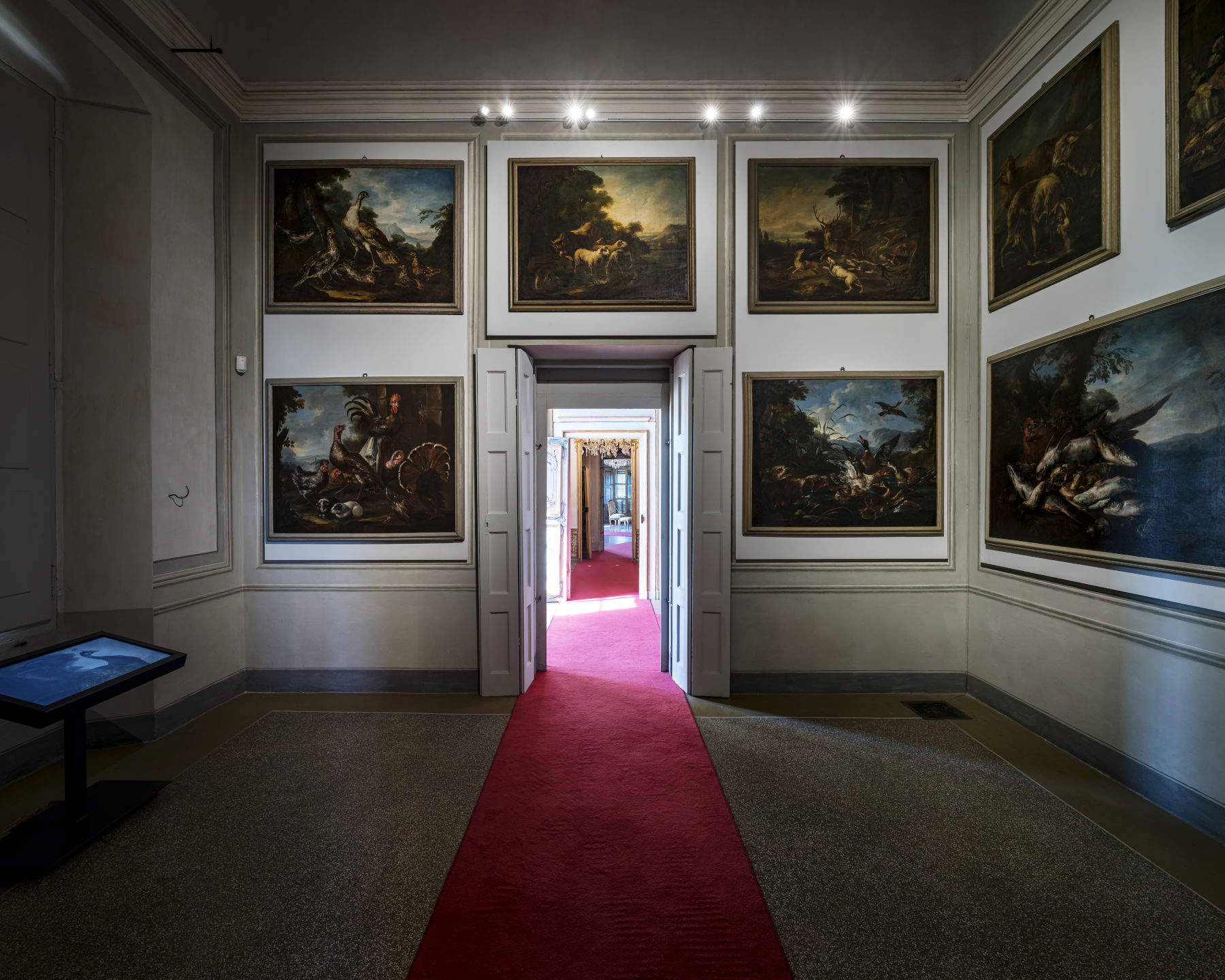
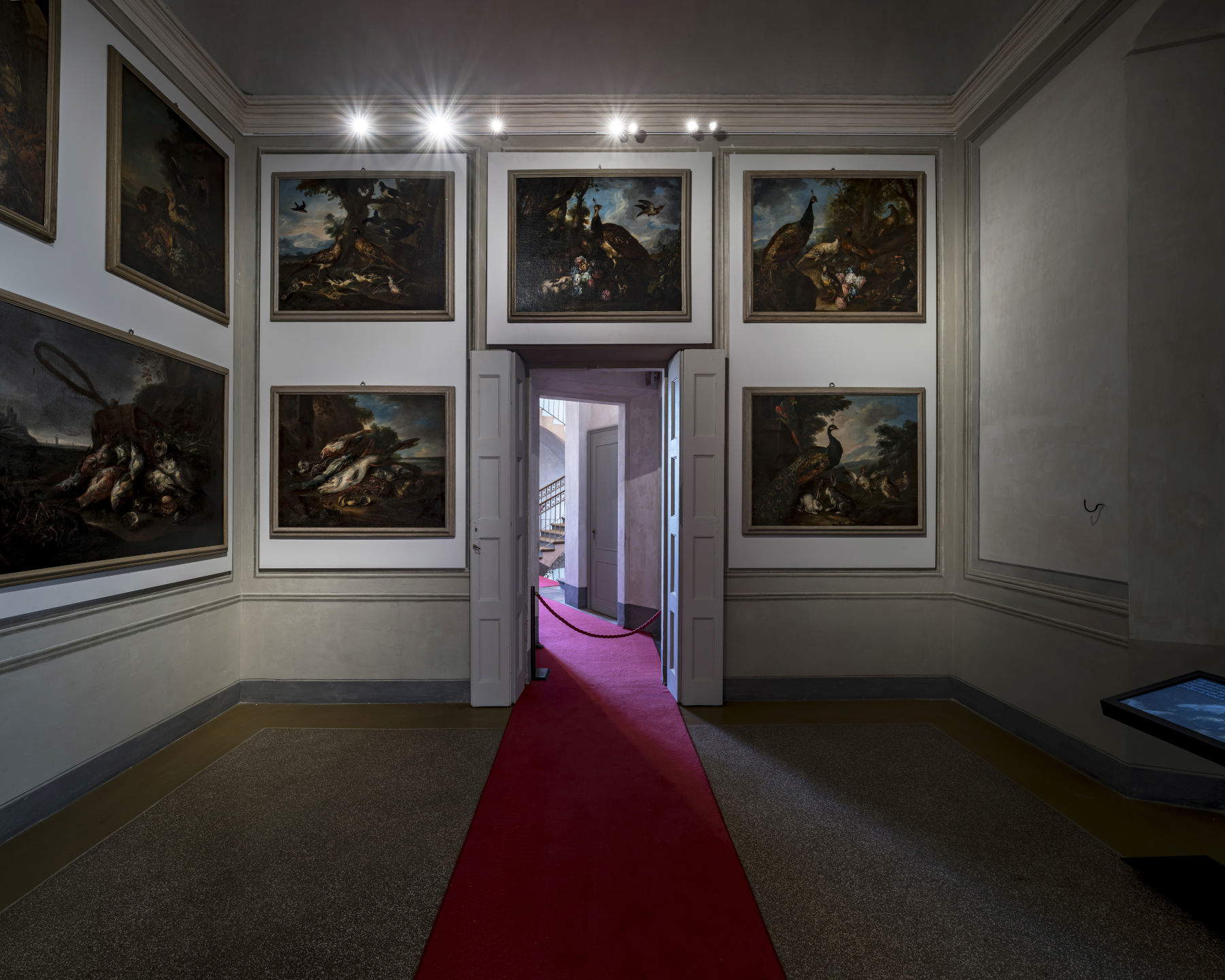
Among the works attributed to Crivellone recur subjects such as Pheasant, hens and chicks, Pheasants and other game birds with magpie, Peacock, rabbits and flowers, Peacock, rabbits and quail, and Poultry and rabbits. In these paintings the animals are depicted in quiet conditions, with particular attention to the rendering of anatomical details, plumage and fur, in compositions that privilege the descriptive and decorative dimension. A different register emerges in Ducks in a Pond Assaulted by Two Dogs, where the scene opens to a more dynamic and narrative construction. The animals are caught in the instant before the action: the ducks are surprised by the hunting dogs while the background renders a watery landscape and a cloudy sky, in a composition that introduces elements of visual tension and movement.
Crivellino’s works focus instead on still lifes of fish and natural materials. In Fish in the Open with Basket of Vegetables and Tub with Net and Snail, the composition integrates fish, shells and vegetables arranged next to an overturned basket, with the presence of a snail placed on the wicker. In the background is a seascape characterized by dusky light. Similar compositional solutions are found in Fishes in the Open with Shells and Porcini Mushrooms and Fishes in the Open with Shrimp Bucket, where the focus is on textural effects and luministic rendering of natural elements. The series also includes Peacock with pheasants, ducks and other birds around flowers, a work that echoes Crivellone’s typical compositions. The peacock occupies the central scene with its tail unfurled, while other birds are arranged around it according to a compositional balance built on opposing directions and movements.
The cycle on display was partly restored between 2024 and 2025 thanks to the contribution of AON spa and the care of Open Care of Milan. A previous intervention was carried out in 2008 by Nicola Restauri of Aramengo with funds from the Piedmont Superintendency, while a recent extraordinary maintenance was carried out by the Conservation and Restoration Center “La Venaria Reale.”
The Principini Room
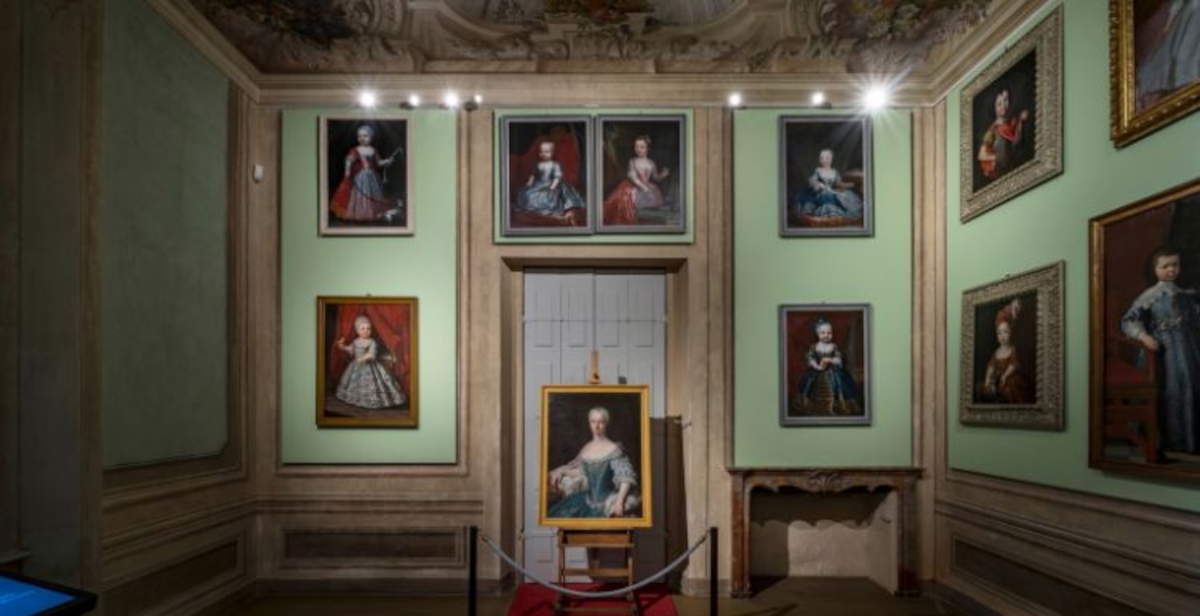
The Toilet Rooms of the Queen’s Apartment and the next room house the Principini Room, dedicated to a collection of 23 portraits of children and infants belonging to the House of Savoy or related to it. The nucleus constitutes a relevant repertory for the study of child portraiture between the 17th and 18th centuries and for the analysis of fashion and dynastic iconography.
The works present authors active at the Savoy court and in the French sphere, including Francesco Cairo, Maria Giovanna Battista Clementi known as La Clementina, Giuseppe Duprà, as well as painters close to the circle of Nicolas de Largillière and Pierre Gobert, who were also active for the court of Lorraine. The pictorial quality and iconographic variety make the collection a coherent whole for interpreting strategies of dynastic representation. Among the works on display is the large portrait of Francis Hyacinth and Charles Emmanuel II with tennis racket, dated 1636 and attributed to Francis Cairo, now permanently included in the itinerary after numerous national and international loans.
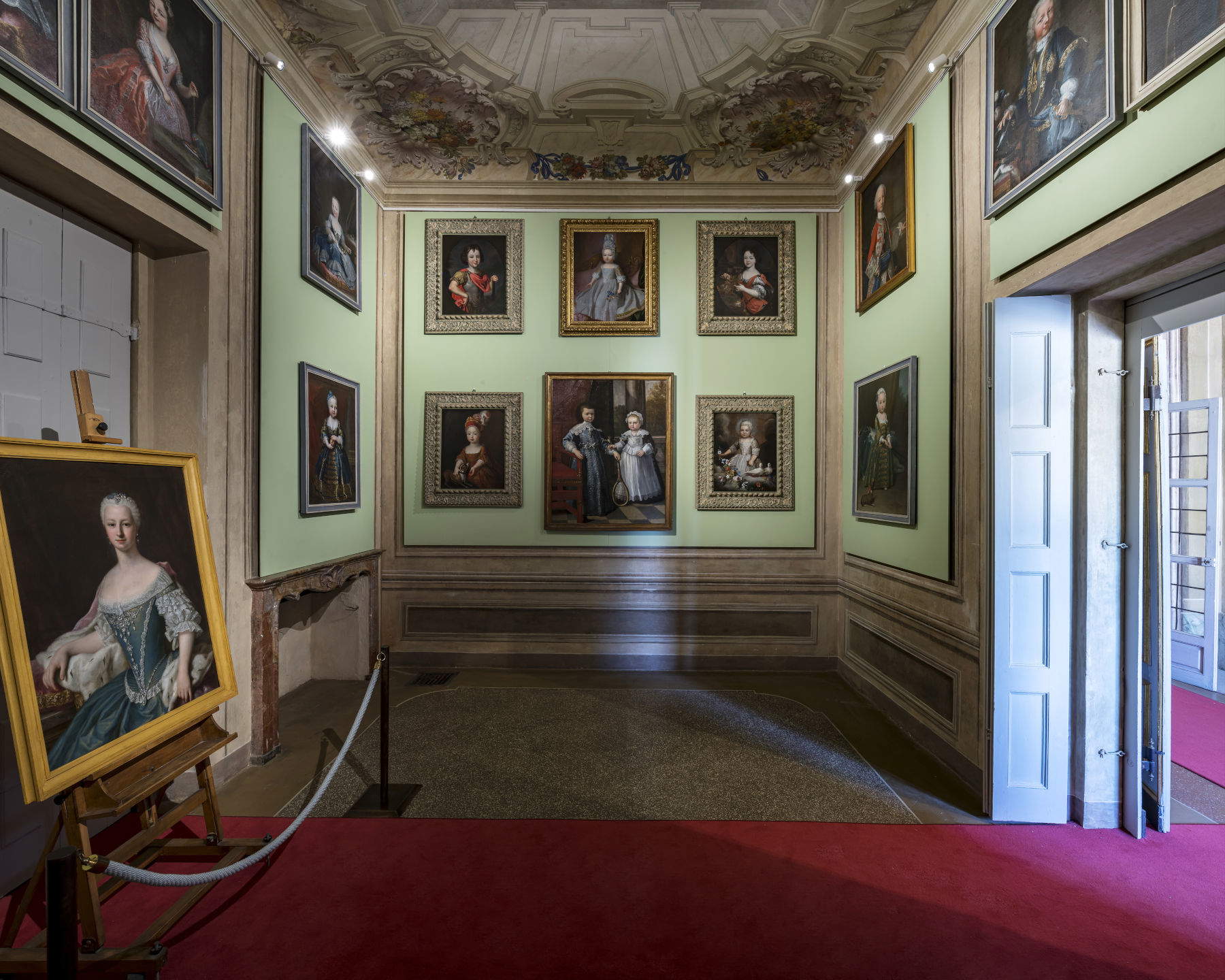
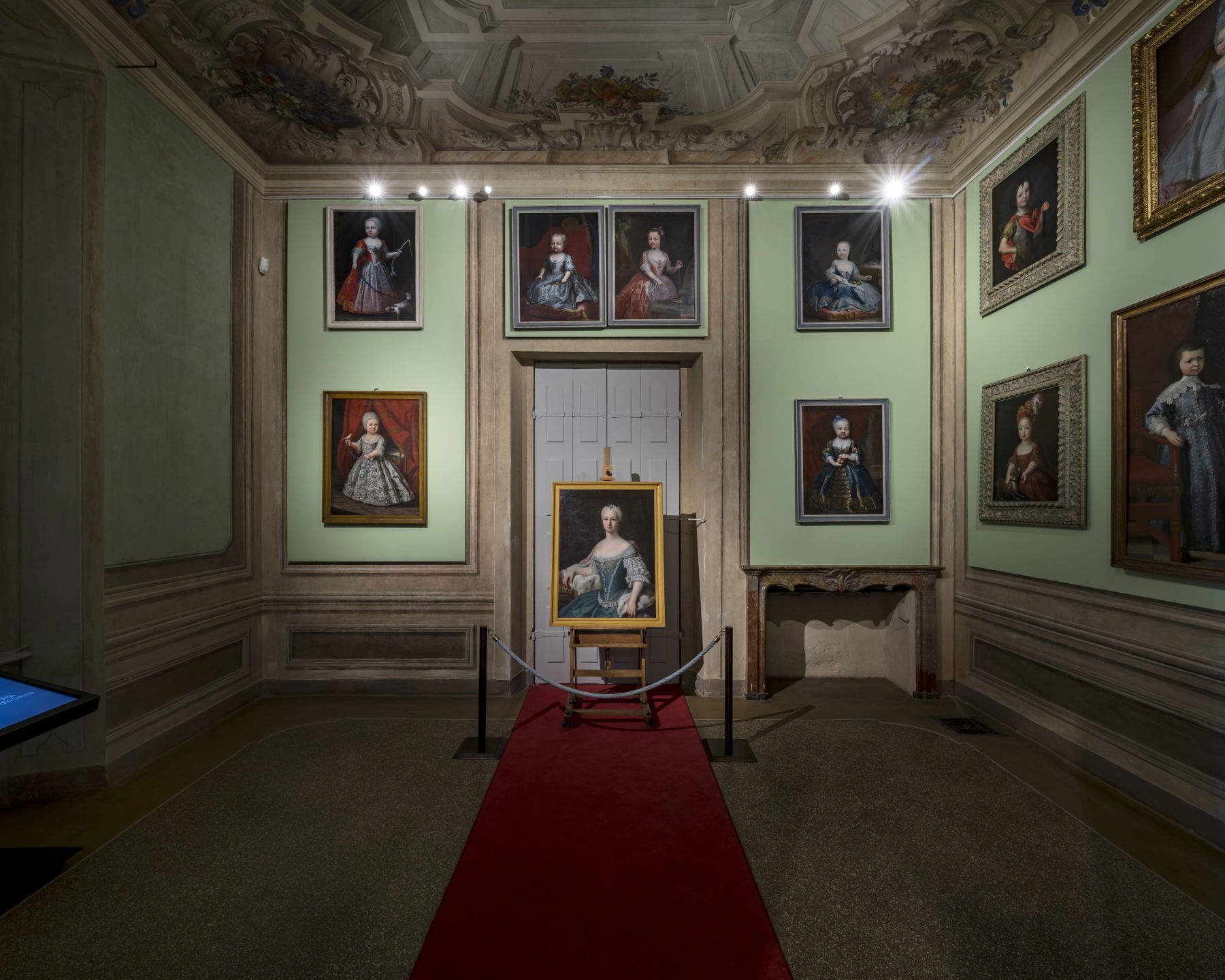
The nucleus also includes two main series. The first concerns the children of Charles Emmanuel III of Savoy had by his wives Anna Christina of the Palatinate-Sulzbach and Polissena of Hesse. The portraits include Victor Amadeus Theodore, depicted with symbolic elements of the male role such as a whip and a small dog, the future Victor Amadeus III, depicted playing with a small bird, and his sisters Eleanor, Louise Gabriella, and Felicita, as well as Emanuel Philibert, Duke of Aosta, portrayed with iconographic attributes related to dynastic succession. There are also three portraits of Victor Amadeus III at different ages, depicted in ceremonial and representative contexts, with elements referring to the Savoyard orders of knighthood.
The second series concerns the children of Victor Amadeus III and Maria Antonia Ferdinanda of Bourbon-Spain, painted by Giuseppe Duprà. They include Charles Emmanuel IV, Victor Emmanuel I, Charles Felix and the Duke of Monferrat Maurice Joseph, all represented according to iconographic conventions that highlight rank, dynastic role and symbolic attributes, often accompanied by the presence of dogs, a recurring element in the compositions. The set of works was the subject of a systematic study initiated by Angela Griseri and Elisabetta Ballaira together with Federico Zeri, published in 1995.
The design of the new rooms was supervised by Officina delle Idee and Diego Giachello, with implementation by Paschetto s.a.s. Historical research was conducted by Stefania De Blasi of the Conservation and Restoration Center “La Venaria Reale.”
The portrait of Maria Ferdinanda of Savoy.
The exhibition itinerary also includes the recent restoration of the portrait of Queen Maria Antonia Ferdinanda of Savoy, supported by Rotary Club District 2031. The intervention constitutes the first systematic recovery of images of court ladies in relation to the core of portraits of princes, expanding the reading of the representation of the royal family between the seventeenth and eighteenth centuries.
Maria Antonia Ferdinanda of Bourbon-Spain, daughter of Philip V of Spain and Isabella Farnese, married Prince Victor Amadeus, future Victor Amadeus III, in 1750, entering the Savoy court at a time of political and cultural transformation. Queen of Sardinia from 1773 to 1796, she frequently stayed at the Palazzina di Caccia in Stupinigi, which became a venue for events, parties and hunting parties in the summer.
 |
| Stupinigi, new Crivelli and Principini Rooms in the Furniture Museum |
Warning: the translation into English of the original Italian article was created using automatic tools. We undertake to review all articles, but we do not guarantee the total absence of inaccuracies in the translation due to the program. You can find the original by clicking on the ITA button. If you find any mistake,please contact us.