




by Redazione 08/06/2026



Categories: News / Disclaimer
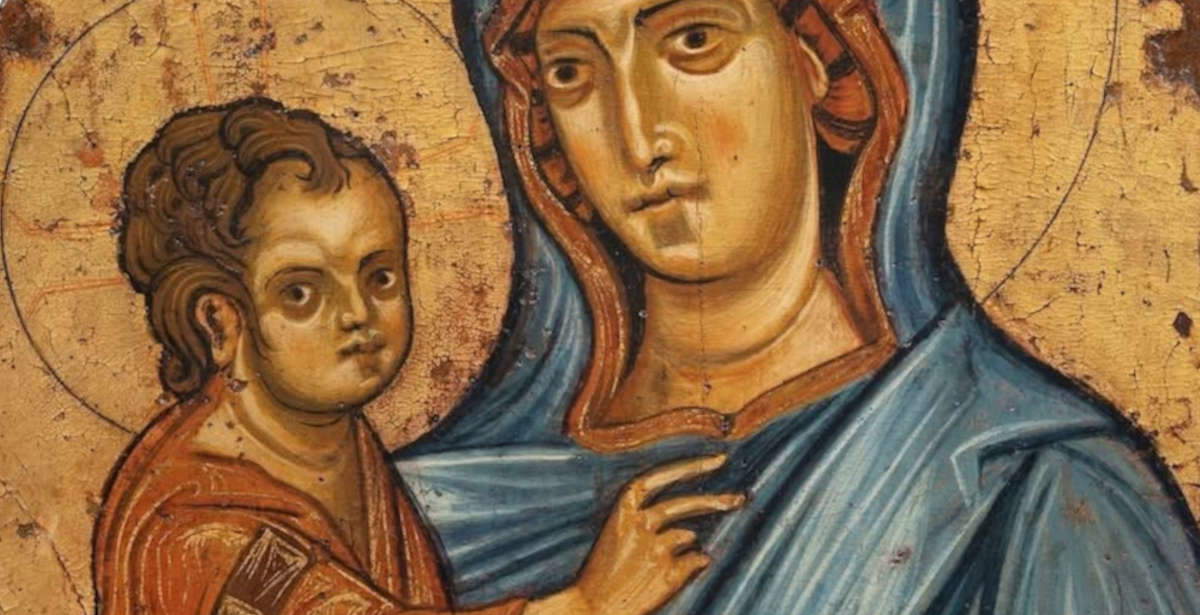
Sold as a modest 19th-century work and cleared for export, a Madonna and Child turned out to be a rare 13th-century painting by the Master of the Baptistery of Parma, which the MiC's Genoa Export Office did not recognize. After years of appeals, the Council of State confirmed that it was impossible to belatedly cancel the go-ahead free

The case of the Madonna and Child executed by the thirteenth-century painter of the Parma Baptistery dome, also known as the “Master of the Baptistery of Parma,” at the center of a complex affair between the Italian state and a Swiss company, the owner of the painting, is causing much discussion in the art historian community these hours, and has been resolved by the Council of State: To summarize brutally, the work can be said to have ended up abroad because it was considered a mediocre 19th-century work instead of an important 13th-century painting.
However, let us see the story in detail, tracing it through what is written in the rulings of the Lazio Regional Administrative Court and the Council of State. The painting appeared on the market in February 2019, when the Pandolfini auction house in Florence put up for sale, with free bidding, a tempera on panel described as “Italian School, 19th century, Madonna and Child.” A Swiss company is awarded the work for the sum of €37,3591.90, and in March 2020 files a complaint with the Export Office in Genoa indicating a value of the work of €38,000. The painting was examined, and the commission of the Export Office issued a report dated July 3, 2020, in which it stated that it considered that “the tempera painting on panel depicting a Madonna and Child bears in the complaint the attribution to the Italian school in the Byzantine style, but on the back it has the following inscription inscribed: painted by Alfonso Martorelli Fiori Bologna anno 1850. It has not been possible to trace the identity of this artist, who seems to have taken as a model for this painting the miraculous image of the Madonna of St. Luke, a work from the mid-13th century, which is preserved in the sanctuary of the same name in Bologna. It is a work of some interest in relation to the local devotion to this venerated image; from the point of view of quality it is a modest work that can obtain the certificate of free circulation.” The Ministry therefore places no constraints on the work, which can leave Italy.


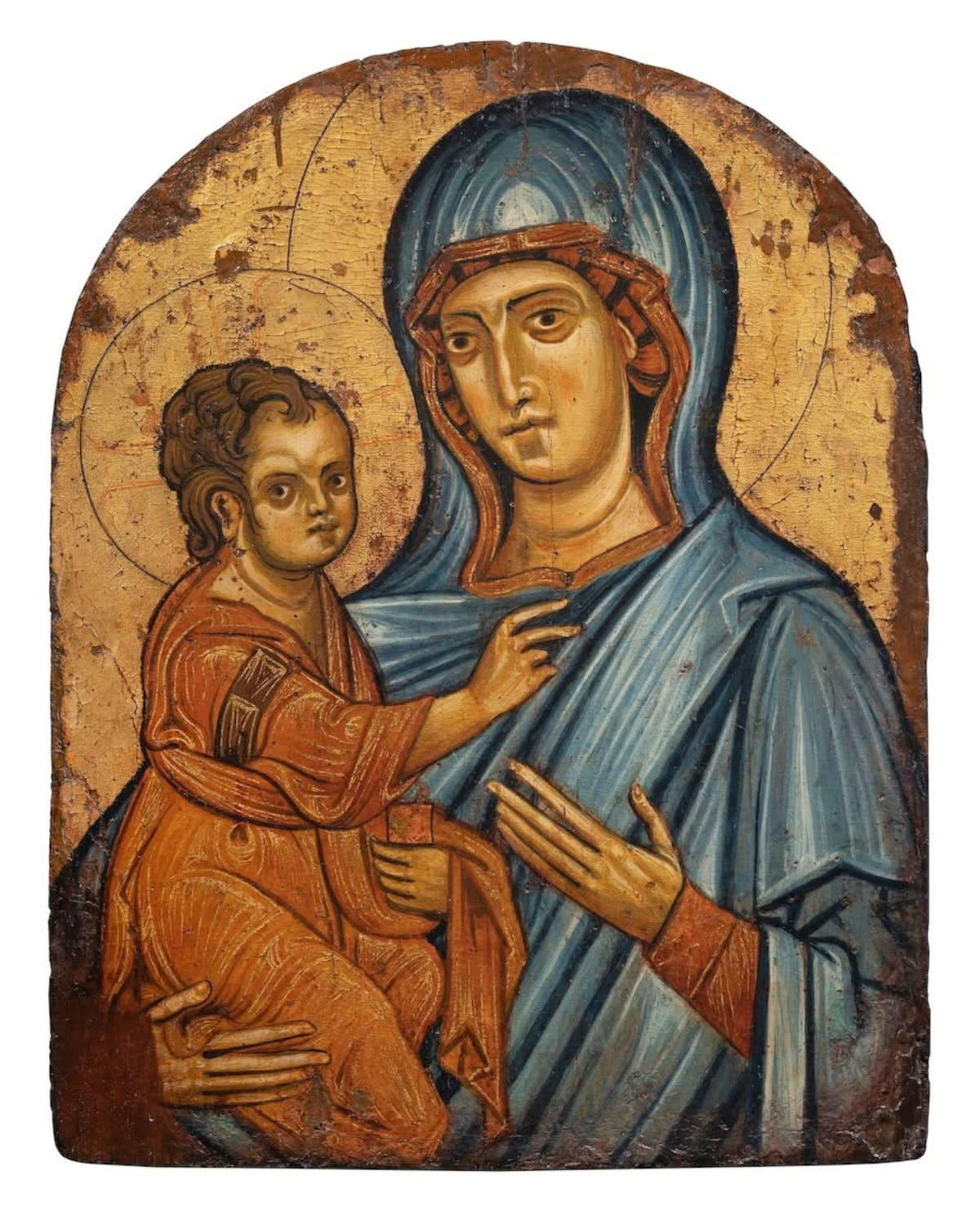
Two years later, it is October 2022, the painting is put up for auction by Christie ’s in the Old Masters Evening Sale scheduled for December 8, 2022, where it is proposed as a work by the Master of the Baptistery of Parma, an artist active between 1240 and 1270, with an estimate of £300,000, ten times the declared value. The catalog entry acknowledges that the painting is in fact a thirteenth-century work that had been published by Miklos Boskovits, a leading expert on medieval Italian art, in an issue of the scholarly journal Prospettiva published in 1988, and then later by Daniele Benati(La città sacra. Mural and panel painting in the Bolognese thirteenth century in the catalog of the exhibition Duecento. Forms and Colors of the Middle Ages in Bologna, held in Bologna in 2000) and by Maria Laura Tomea Gavazzoli (article Qualche osservazione sul neoellenismo dei Maestri del Battistero di Parma published in issue 154 of the scientific journal Arte Lombarda, 2008). A restoration that took place shortly before the sale had in fact ascertained that the work was indeed the one published in the scientific journal. The inscription on the back (“ Alfonso Martorelli Fiori Bologna anno 1850”) is also resolved, with “1850” being revealed for “1350.” However, this is an apocryphal addition. The Ministry of Culture therefore asks Christie’s to suspend the sale, and succeeds in obtaining it.
On March 16, 2023, the Directorate General for Archaeology, Fine Arts and Landscape self-authorizes thecertificate of free circulation it had issued in 2020, attaching a report by Professor Angelo Tartuferi, one of Italy’s leading experts on medieval art, according to which the painting has the elements of “artistic quality artistic quality,” “rarity,” “relevance of the representation,” and “relevant evidence, from an archaeological, artistic, historical, ethnographic point of view, of significant relations between different cultural areas,” which would require the state not to issue the certificate and thus bind the work. The Genoa Export Office, on May 22, 2023, denies a new certificate of free movement, and on October 10, 2023, the Regional Commission for Cultural Heritage of Liguria declares the painting to be of particularly significant cultural interest. The company therefore challenges all the Ministry’s measures before the Lazio Regional Administrative Court.
The Lazio Regional Administrative Court, in its ruling 7366 of 2023 published on May 31, 2025, upheld the company’s appeal in full, annulling the ministerial measures on the basis of two basic pillars. The first, the violation of the time limit for self-protection: the collegium found that the Ministry had acted beyond the maximum time limit of 12 months provided by law for ex officio annulment. The Ministry argued that it could exceed this time limit by invoking an exception provided by law, which allows annulment beyond 12 months in case of “false representation of facts.” However, the TAR ruled that the relevant “misrepresentation” to exceed the time limit must be malicious or culpable. In this case, it was not shown that the company was aware of themisrepresentation at the time of submission. On the contrary, the company had purchased the painting years earlier precisely as a 19th-century work. In addition, the TAR pointed out that the Ministerial Commission itself, when issuing the certificate in 2020, did not consider it necessary to investigate doubts about dating. The Tribunal therefore reiterated, also recalling the recent jurisprudence of the Constitutional Court (Judgment No. 88/2025), that the right to property and the certainty of legal relations require that the power of annulment not be exercised arbitrarily and without temporal limits. Even in the presence of sensitive public interests (such as the protection of cultural heritage), the administration must comply with legal time limits. If the private party has acted in good faith, the reliance on the stability of the title obtained (the certificate of free movement) deserves protection. The effect of the first instance ruling, therefore, is that the free movement order becomes fully effective again, invalidating the Ministry’s claims to keep the work in Italy through the late cancellation. Already this first judgment is significant because it confirms that, even in the sensitive area of Cultural Heritage, the administration is bound to strict compliance with the terms of proceedings and that the “misrepresentation” must be proven as conduct actually attributable (malicious or grossly negligent) to the private party in order to justify the exceeding of the terms of self-defense.
Subsequently, the Ministry in turn challenged the ruling before the Council of State, taking the view that for “misrepresentation” the objective dissimilarity of the facts and not the willfulness of the private party is sufficient, that the work submitted to the Export Office would be an aliud pro alio compared to the one that appeared at Christie’s auction (i.e., the property would be very different: the painting in fact was restored) and that the TAR would sacrifice the public interest in the protection of cultural heritage in favor of reliance on the private party.
The case ended with the Council of State’s ruling of May 21, 2026, which confirmed what had also been established by the Palazzo Spada in ruling 2783 of 2025, namely, that the false representations that allow the time limit for self-defense to be exceeded are those that are fraudulent or that are in any case attributable to the private party. The Council of State, in rejecting the Ministry’s appeal, noted that the Ministry itself did not provide evidence to support a hypothetical awareness of the erroneous dating by the company, that the Commission of theExport Office in Genoa did not deem it necessary to make findings on the painting despite noting the derivation from a 13th-century model (and thus confirmed the dating), that so-called aliud pro alio is inadmissible because it is formulated without any principle of proof.
This is not the first time that the Ministry has failed to recognize an important painting, and that once it has discovered that it has missed a major work it moves late to try to fix the error: something similar happened, for example, with Giorgio Vasari’sAllegory of Patience .
 |
| An oversight costs us a rare 13th-century painting by the Master of the Baptistery of Parma |
Warning: the translation into English of the original Italian article was created using automatic tools. We undertake to review all articles, but we do not guarantee the total absence of inaccuracies in the translation due to the program. You can find the original by clicking on the ITA button. If you find any mistake,please contact us.