





It concludes with a set of recommendations accepted in full by the Foundation for the Historical Collections of the House of Orange-Nassau (SHVON) the independent research process launched in 2022 on the provenance and legitimacy of objects of colonial origin preserved in the Royal Collections of the Netherlands. The investigation, the results of which were released on May 28, 2026, represents a new chapter in the thought process involving European cultural institutions, museums and historical collections called upon to confront the legacies of the colonial past. The committee charged with overseeing the study delivered its findings and recommendations to the SHVON board on May 13, 2026. The board, composed of Queen Máxima as chair, expressed full support for the work done by the experts and announced the adoption of all the directions formulated by the research team.
“We are grateful for the thorough and independent investigation conducted by the committee chaired by Professor Ekkart,” said Queen Máxima. “We welcome the findings and gladly adopt all the recommendations. Care in the management of objects from the colonial period within the Royal Collections is vital. A solid foundation has now been laid in this regard. In the coming period, based on the committee’s recommendations, we will continue to work on making information about objects acquired in colonial contexts accessible. Transparency is a prerequisite for open dialogue with stakeholders in countries of origin.”
The initiative stems from a desire to contribute to the responsible management of colonial collections and to address issues related to the historical injustices produced by colonialism. According to what the foundation points out, both King William Alexander and Queen Máxima consider legal and equitable management of the objects housed in the Royal Collections a priority and attach great importance to independent research that can shed light on how the artifacts were acquired. Although it is a private collection and not a national collection, SHVON has chosen to align its work and future decisions as closely as possible with the guidelines adopted by the Netherlands on colonial heritage. This choice reflects the growing international interest in the provenance of works and the need to establish a dialogue with the communities and countries from which these holdings come.
The survey examined over a thousand objects still in the foundation’s collections, including those on long-term loan to national and international museums. Most of the artifacts analyzed came from former Dutch colonies, particularlyIndonesia, Suriname, and the Caribbean islands, but objects from territories that were formerly under the control of other colonial powers were also considered.
One of the most relevant aspects that emerged from the research concerns the way the objects were acquired. According to the committee, virtually the entire SHVON colonial collection consists of gifts. For the vast majority of these artifacts, although acquired within a system characterized by deeply unequal colonial relations, no direct evidence was found to suggest that the donations occurred involuntarily. The committee did, however, identify a number of specific cases in which the presence of the objects in the Royal Collections might not be considered fully legal or equitable. These are mainly artifacts related to military operations or acquired as spoils of war, circumstances that open questions about their actual legitimacy.
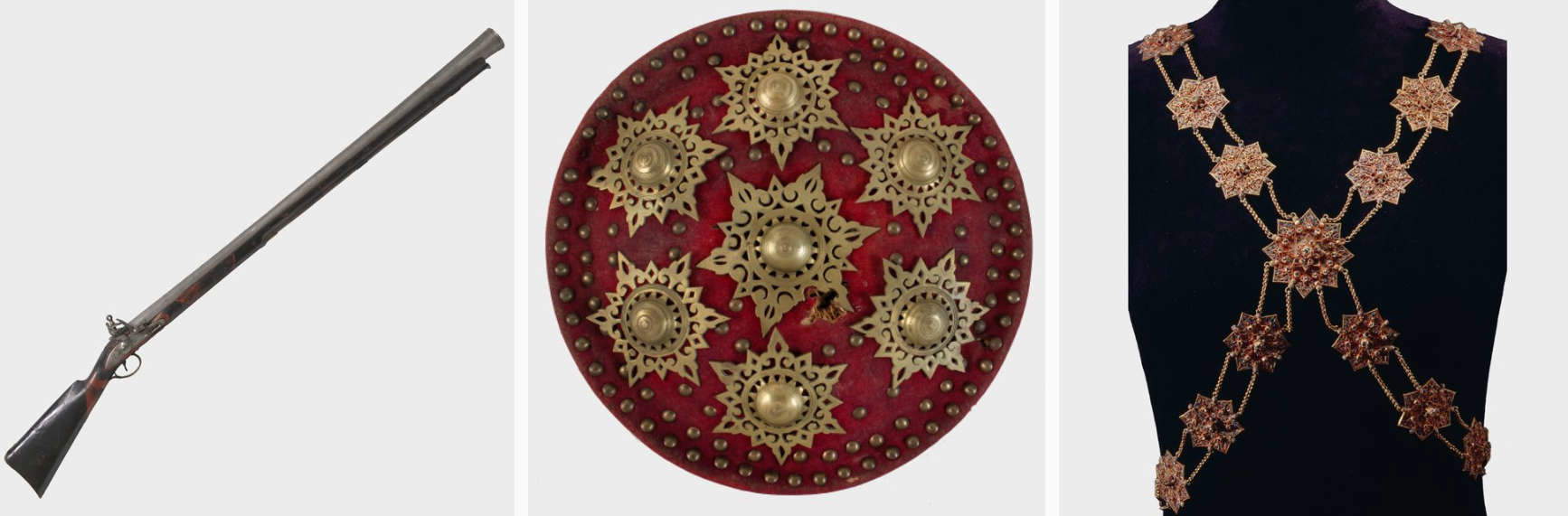
Among the most significant examples cited in the report is an arquebus that belonged to Raden Intan, prince of Keratuan Darah Putih in the kingdom of Lampung. The prince was killed in 1856 by Dutch soldiers, and the weapon was later given to King William III. Another case involves a round shield, known as Périsé awi, which belonged to an Aceh military commander and was allegedly captured during the Samalanga expedition of 1877 before also being offered to the Dutch ruler. Also among the items that have attracted scholarly attention is a gold amulet necklace named Simplah. The jewel was donated in 1909 by the district chiefs of Pidië and Meureudoe in the Aceh region on the occasion of the birth of Princess Juliana. The donation occurred shortly after the conclusion of hostilities in the area, a factor that prompted the board to question the context in which the gift was made.
According to the SHVON board, the question regarding the presence of these objects cannot be addressed unilaterally. In fact, the foundation shares the position expressed by the experts that any decision should be made in dialogue with representatives of the former colonies and the communities concerned. For this reason, one of the committee’s main recommendations concerns transparency. The foundation has announced that it will make the data collected during the research available online as soon as possible. The goal is to build a shared knowledge base that will enable informed comparisons to be initiated about the future of objects that raise questions from the standpoint of legitimacy or fairness.
To carry out this project, SHVON has already allocated the necessary resources and appointed a researcher to take charge of the digital publication of the results. The foundation also plans to seek the advice of specialists to accompany the new phase after the conclusion of the survey. The goal is to ensure that any discussions with countries and communities of origin can take place as transparently and constructively as possible.
|
| Royal Dutch Collections, investigation into objects of colonial origin concluded |

Warning: the translation into English of the original Italian article was created using automatic tools. We undertake to review all articles, but we do not guarantee the total absence of inaccuracies in the translation due to the program. You can find the original by clicking on the ITA button. If you find any mistake,please contact us.
























 IT
IT FR
FR DE
DE ES
ES CN
CN


