





The landscapes of his homeland would always remain etched in Guercino’s mind: the woods along the banks of the Rhine, the countryside around his hometown of Cento, and the dusty roads that cut through this stretch of the Po Valley halfway between Bologna and Ferrara. To speak of Guercino is to speak of Cento; to speak of Cento is to speak of Guercino. The two names are like two mirrors placed opposite one another, two reflections gazing at each other endlessly. Guercino is a sort of municipal deity, a kind of genius loci. Few places maintain such a constant and vibrant connection with one of their own artists. When Goethe passed through Cento on his journey through Italy, writing about this little town that struck him as so beautiful, charming, vibrant, and industrious—a town populated by friendly residents and animated by an almost ceremonial grace— he noted—beyond the presence of that great absentee who resonated almost like a deity whose name was “on the lips of children as well as adults”—that Cento lies in the midst of a boundless plain. Countryside everywhere, cultivated fields stretching as far as the eye can see. Today, the town continues to thrive on this alliance with the fields and agriculture; its life depends largely on the fruits of the earth and on the wise harmony that, in these parts, human beings have managed to maintain with nature. Nature is generous in these parts. And people reciprocate by respecting it, striving to keep the balance that unites them as intact as possible.
In Guercino’s time, things were not so different. Cento derived its prosperity from hemp. It was cultivated, processed, and sold with a dedication and organization that had something of an industrial character. Consequently, a hardworking entrepreneurial class had emerged which, as Daniele Benati recently wrote, invested its income with the aim of fostering “a well-founded cultural ambition”—an ambition that found “its source of pride in the decoration of the city’s churches and palaces.” Cento would continue to occupy a privileged place in Guercino’s career. A small town, certainly, but one brimming with opportunities: Bologna to the south, Ferrara to the north. There was no need to venture too far afield. Therefore, at least until 1642, Guercino left Cento only on a few occasions, and always for brief stays, motivated by study or work. In 1617, he went to Bologna. The following year, to Venice. Between 1621 and 1623, to Rome. And so it continued until 1642, the year of his move to Bologna, following the death of Guido Reni: Giovanni Francesco Barbieri wanted to become his successor. The move, however, did not amount to a farewell, given the proximity to Bologna, and so the painter from Cento was able to continue working for Cento as well.
The city played a major role in his early career: Cento’s ruling class had immediately recognized Guercino’s talent, and one of his first commissions came from a local nobleman, Count Bartolomeo Pannini, who in 1615 had his house in Borgo di Mezzo renovated, now known as Corso Guercino (how could Cento’s street naming not pay homage to that illustrious son?), and had decided to entrust the decorations to the twenty-four-year-old painter. The frescoes kept Guercino busy for a couple of years: the work was of such importance that the artist chose to surround himself with highly capable assistants, including Bartolomeo Gennari, who was just over twenty years old, the son of Benedetto, who was Guercino’s first and only teacher (who perhaps preferred to see himself more as a self-taught artist: after all, observing the great masters played a far greater role in his training than the teachings of his fellow citizen). Casa Pannini still stands, although its appearance is no longer that of the early seventeenth century; however, the Guercino frescoes inside—which ultimately adorned eleven rooms—are no longer there: in 1840, Bartolomeo’s last heirs, the Chiarelli-Pannini family, sold the house to Francesco Diana, who, upon noting the terrible state of preservation of the frescoes (the damage caused by humidity and water seepage had reduced them to shadows, to faded outlines, to traces of what they had once been), commissioned the restorer Giovanni Rizzoli, from Pieve di Cento, to strip the frescoes and transfer them onto canvas. On July 23, 1840, the work was completed, and the process yielded one hundred and forty paintings, some of which are now preserved at the Pinacoteca di Cento, while others have ended up in the obscurity of private collections. They had been scattered following Diana’s death, divided among her heirs. The museum in Cento now holds forty-nine of them.
The American art historian Dwight Cameron Miller, in his 1964 entry on Guercino in the *Dizionario Biografico degli Italiani*, went so far as to note that the Casa Pannini cycle is “one of the most poetically evocative ensembles in 17th-century Italian painting.” The literary theme of the stories of Ulysses is complemented by mythological scenes and figures, as well as landscapes and glimpses of rural life in 17th-century Emilia. There is a series of lively hunting scenes, such as the one depicting horsemen chasing deer and wild boars. There is a quieter scene in which a solitary hunter, with his dog and rifle already aimed, hopes to bring home some of the ducks swimming obliviously in a pond. There is a shepherd who, weary at the end of a day’s work, watches his sheep resting in the shade of a grove, with the light of sunset coloring the sky over the plain. There is a horse grazing on the grass. There is also a scene celebrating the most flourishing industry in early-17th-century Cento: several female workers are busy extracting hemp from the retting pit. This activity is attested in no other paintings except in the Casa Pannini cycle. Then there are the frescoes that once decorated the Summer Room: at Casa Pannini, among other spaces, there were four rooms dedicated to the seasons, where Guercino painted frescoes depicting the activities of spring, summer, fall, and winter. The landscape became a calendar: in the Summer Room, one could then admire views of the Rhine, including a scene that focused on the work of fishermen tending to their nets; this was followed by the harvest, and consequently, a scene of threshing wheat surrounded by celebrating peasants.
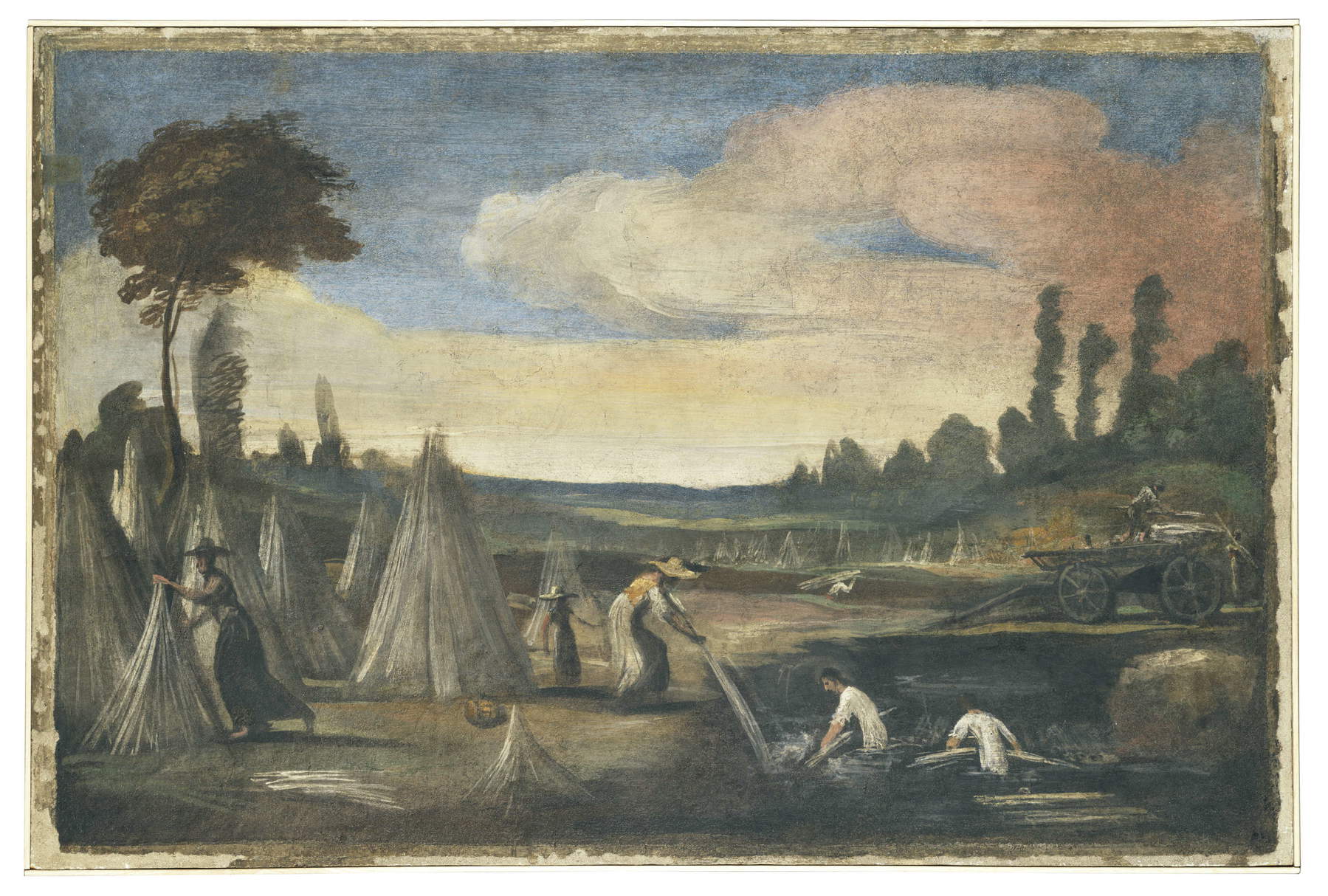
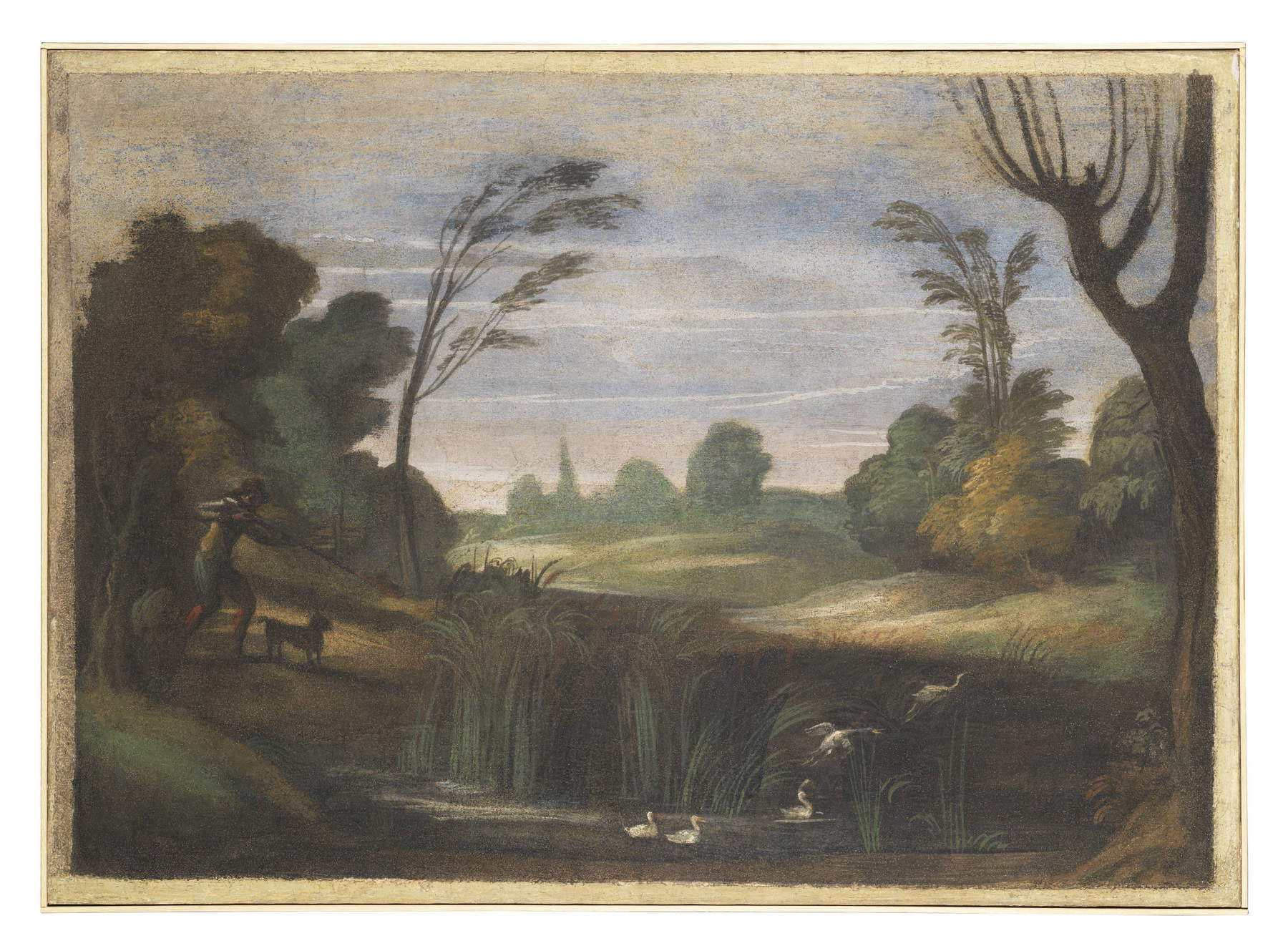
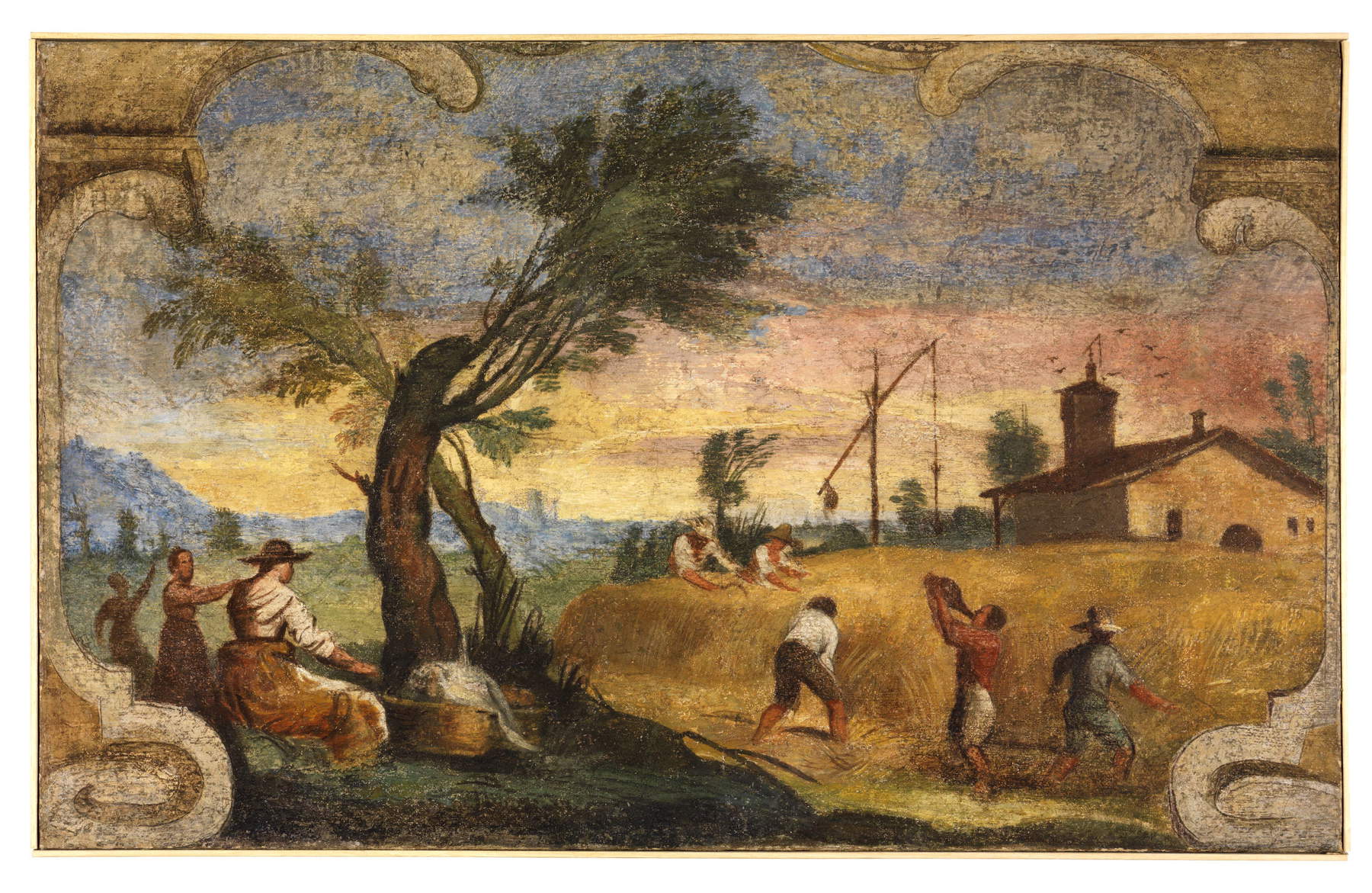
These frescoes, wrote Fausto Gozzi, “in their details also acquire extraordinary anthropological value, because they document summer work in the fields interspersed with leisure and idleness, ranging from harvesting with a sickle to threshing wheat with horses’ hooves in the manor courtyard, and from outdoor breakfasts in the magnificent Italian gardens to boat trips.” Gozzi also recalled how Cesare Gnudi had described the Guercino of Casa Pannini as a “village storyteller”: a young painter, the Guercino of Casa Pannini, yet an artist already so powerful, so accomplished, so sensitive as to reveal a sense of nature, as well as of daily life. A sense of nature, Gnudi noted, that recalls the painting of Dosso Dossi, and which takes on in these paintings “a naive freshness of observation and invention, which is something entirely new and which, taken as a whole, offers an important and significant aspect of the young Guercino’s poetic world”. It is an entire poetic world—tiny, local, serene—linked to the repetition of everyday gestures and activities, tied to a time marked by the changing of the seasons and the rhythms dictated by the earth, a world in which the coexistence of human beings and nature is peaceful and balanced. A world where work alternates with celebration, since toil, in that world, did not preclude joy. And Guercino records it all, documents every moment, transforming himself into the rustic chronicler of that poetic world of simplicity. This sensibility stands in contrast to that of other Emilian artists such as Annibale Carracci or Domenichino: in the frescoes of Casa Pannini, there is no room for any solemn interpretation of the landscape; there are no classicist reveries, no dreams of antiquity. On the contrary, it is a welcoming landscape, one that embraces the humble, that welcomes those who work in harmony with nature: Guercino’s attention focuses on the farmers, the fishermen, the hunters, the shepherds, and the country women hanging out their laundry. Denis Mahon, the English scholar who devoted much of his work to Guercino, noted that the rural scenes at Casa Pannini are based on some drawings the artist had previously executed, featuring similar subjects, though they were likely not originally intended for these rooms. Evidently, the painter had a vast repertoire at his disposal, which was mostly transferred to the walls by his assistants: in many of the fragments, the quality of the final result does not match that of the works that can be attributed with certainty to Guercino’s hand. Several sections, however, stand out, such as the one depicting the hunter shooting at ducks, or the landscape with the horse known as “La Rozza,” derived from an engraving by Antonio Tempesta, from whom Barbieri borrowed many ideas, especially for the hunting scenes. Nevertheless, as Prisco Bagni—author of a book entirely dedicated to the decorations of Casa Pannini—wrote, “the artistic quality of the painting is such that it manages to transform that cold image into a poignant evocation of an old, worn-out horse now at the end of its days.” One does feel moved by that thin, white horse, yes; but that tired, emaciated animal also reminds us that in nature, everything comes to an end. And for that era, it was a normal occurrence.
Even when the painting is not of the same quality as the master’s, the premise holds that the creative elements are unquestionably his own, even when they draw on Tempesta’s models, since Guercino manages to offer his own reinterpretation. And then, even if one must look beyond the roughness of certain executions, one senses that the painter is deeply involved, that he feels personally engaged, that he perceives those places as his own. In the landscapes of Casa Pannini there is a strong sentimental tone, and the scenes of rural life are transformed here “into minute elegies,” to borrow an image from Stefano Zuffi. Elegies that convey a sense of melancholic, frayed, yet necessary peace.
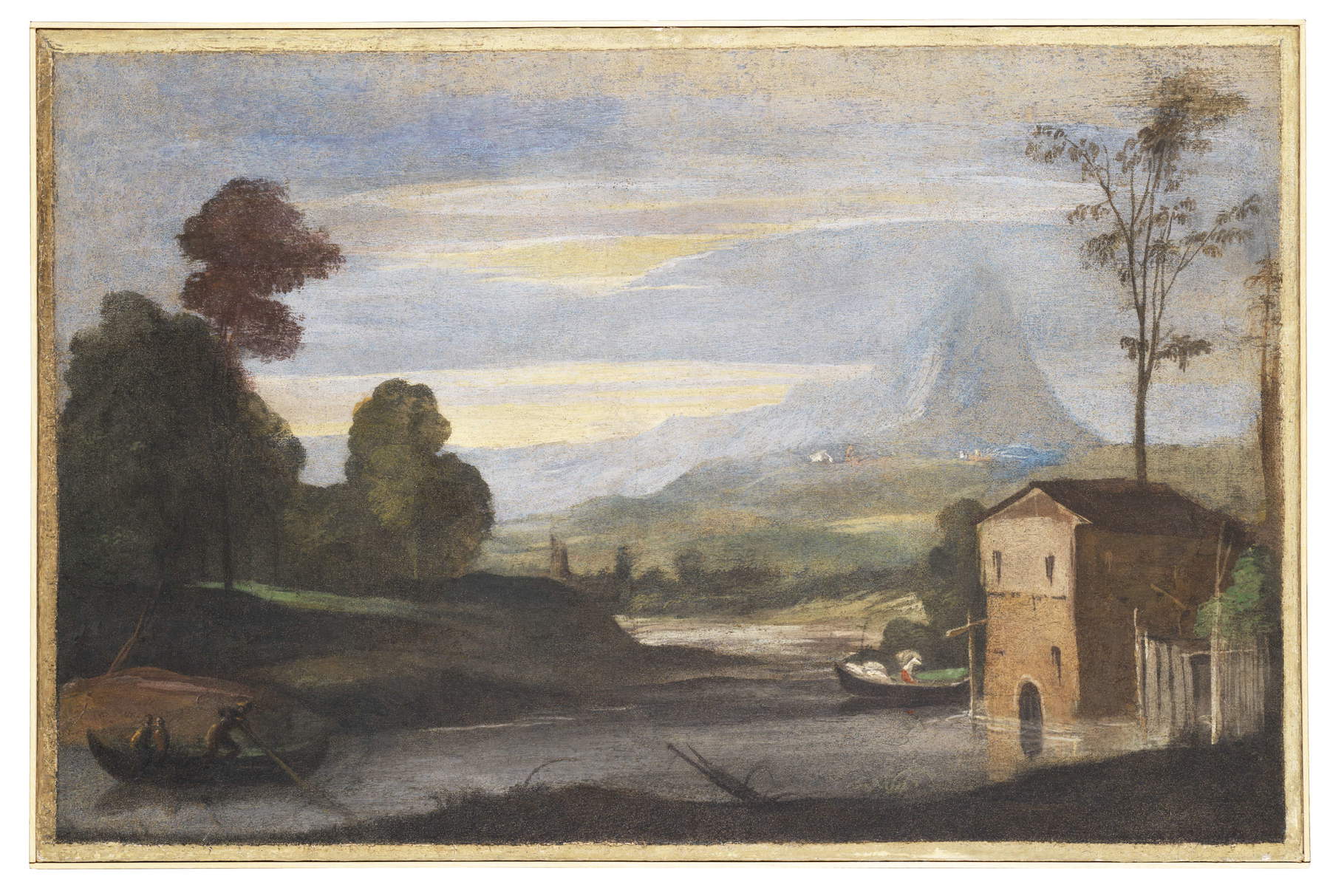
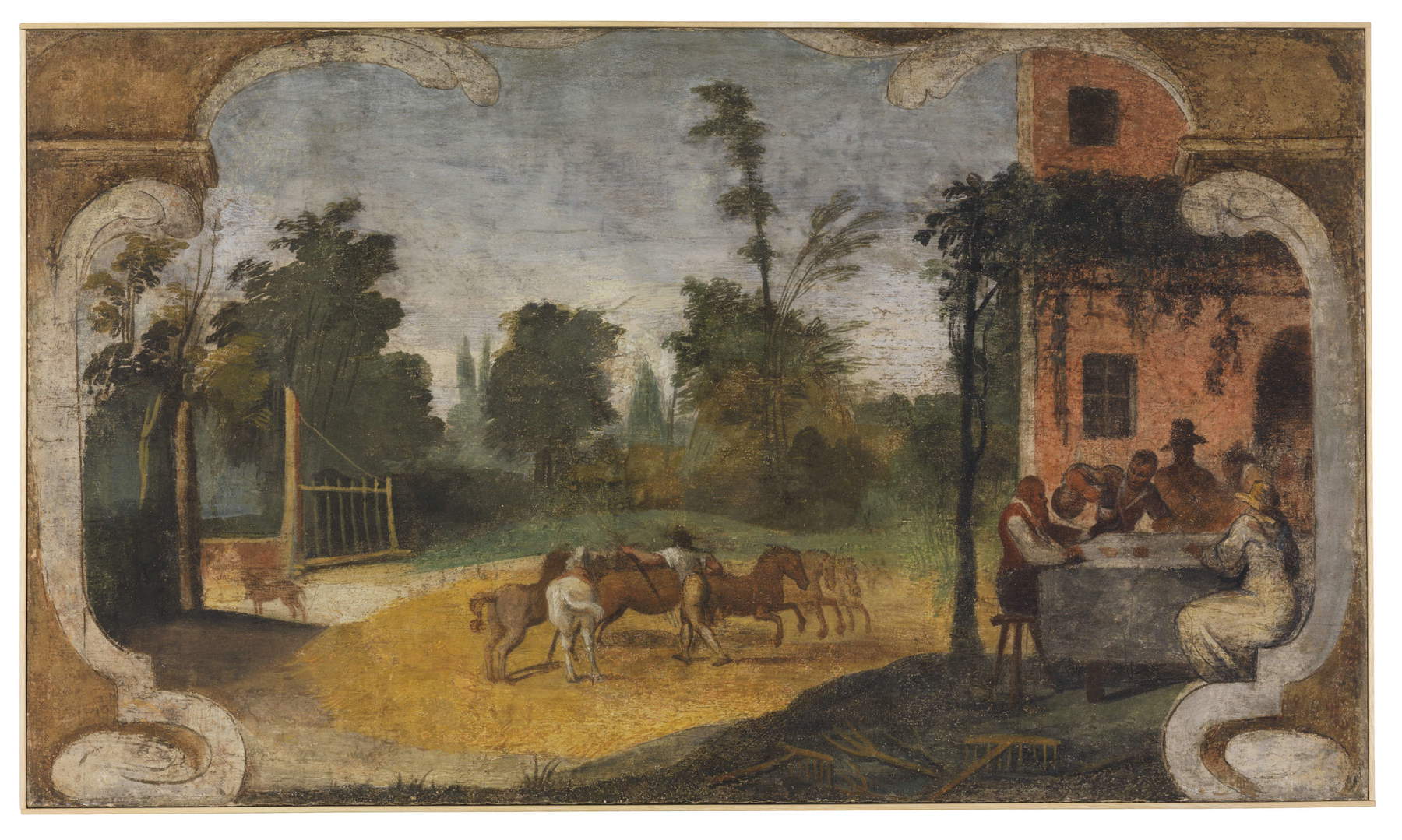
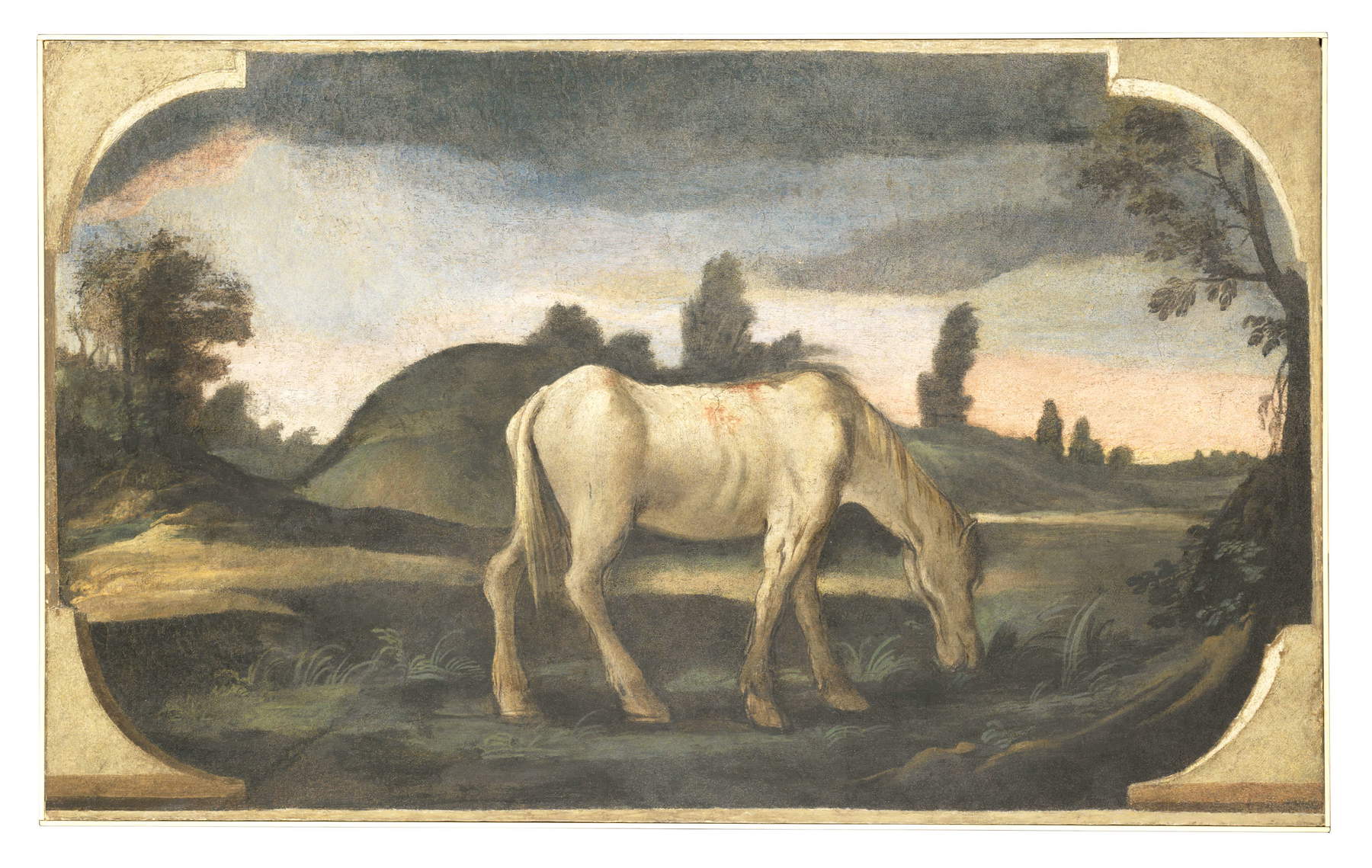
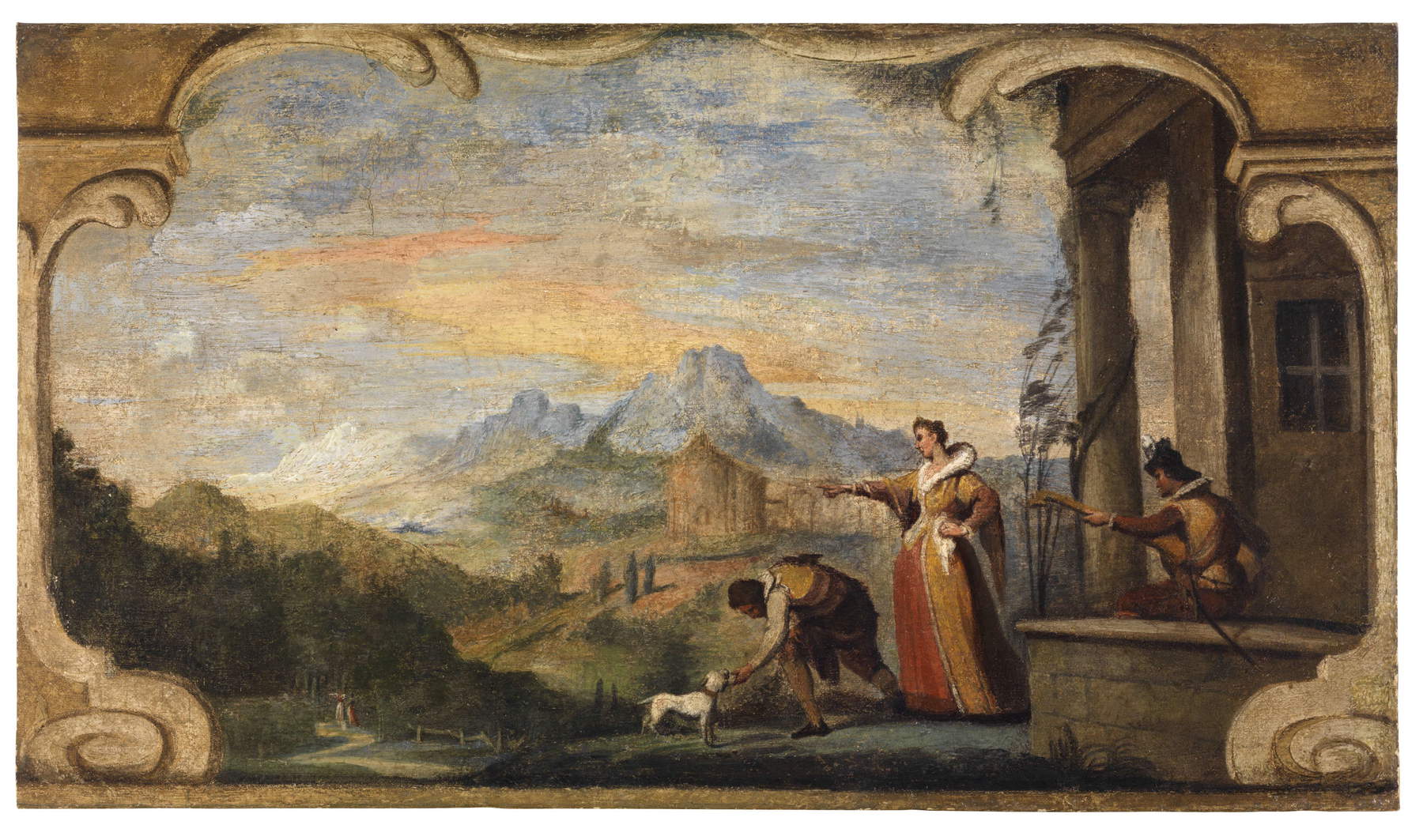
The same could be said of another cycle of frescoes, those at Casa Chiarelli (formerly Benotti), first mentioned in 1768 by the historian Orazio Camillo Righetti Dondini in his book *Le pitture di Cento*, where, in the description of the “House of Mr. Giampaolo Benotti,” he refers to the “band around the ceiling, depicting various naturalistic perspectives with several small figures scattered here and there.” Righetti Dondini’s guide is said to have ensured lasting fame for Guercino’s frescoes, which date from the same period as those in Casa Pannini and were therefore painted around 1617. The removal, however, took place in 1961: it was Tarsilla Chiarelli, the property’s owner, who took the initiative to have the frescoes removed so that they could be saved from the deterioration caused, here as well, by moisture and water seepage (and, incidentally, at Casa Chiarelli, one can still appreciate the original layout in the ground-floor room that housed the frieze: note the empty spaces). Following their removal, it was decided to restore the paintings: this provided a favorable opportunity to study them and confirm their attribution to Guercino. In this case as well, the artist enlisted the help of his collaborators, but the master’s hand is evident in some of the finest sections: for example, in the *Rural Courtyard with a Well and a Pile of Firewood*, as noted by Nicholas Turner, who is also credited with having published, in 1989, several drawings related to the Benotti cycle, and above all with having firmly attributed them to Guercino (previous opinions had been to the contrary: even Mahon considered them too weak).
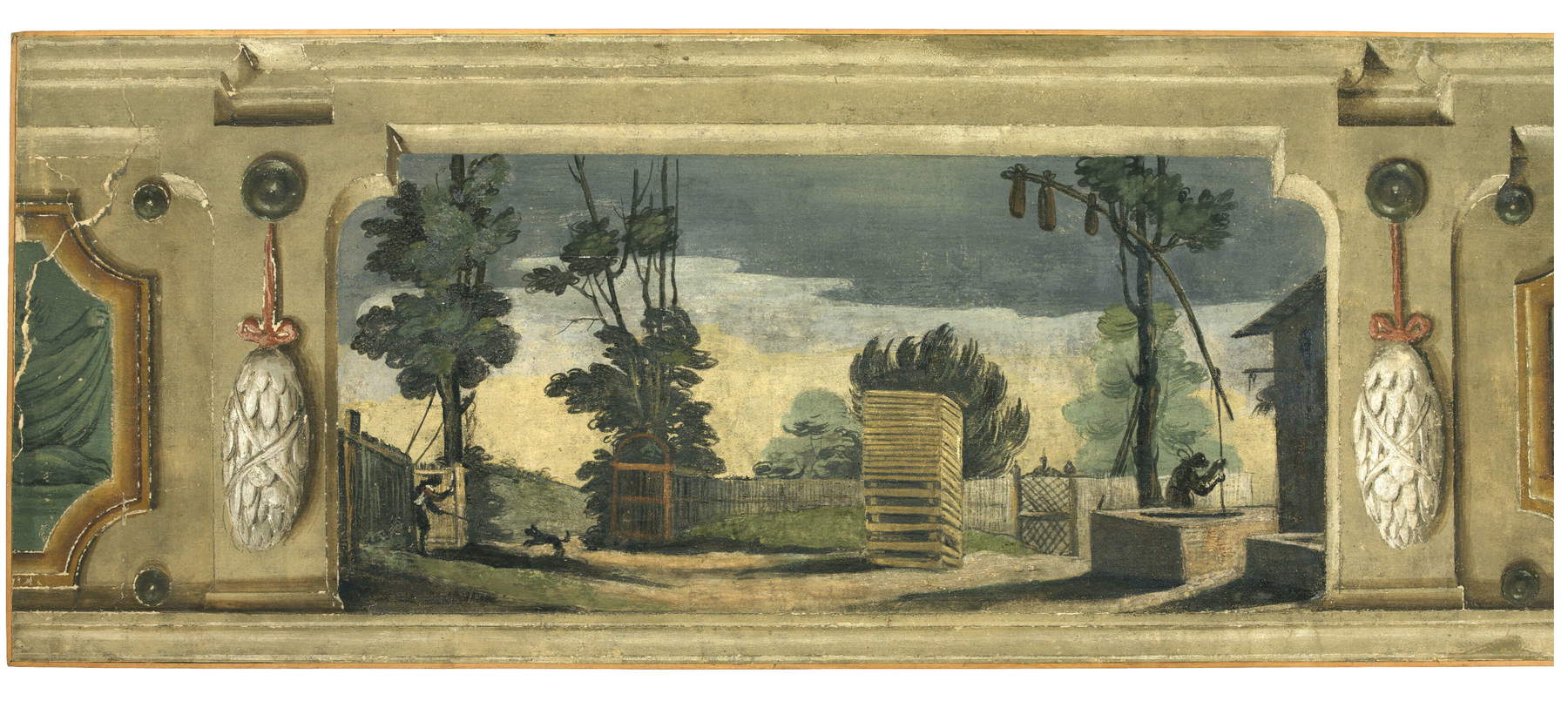
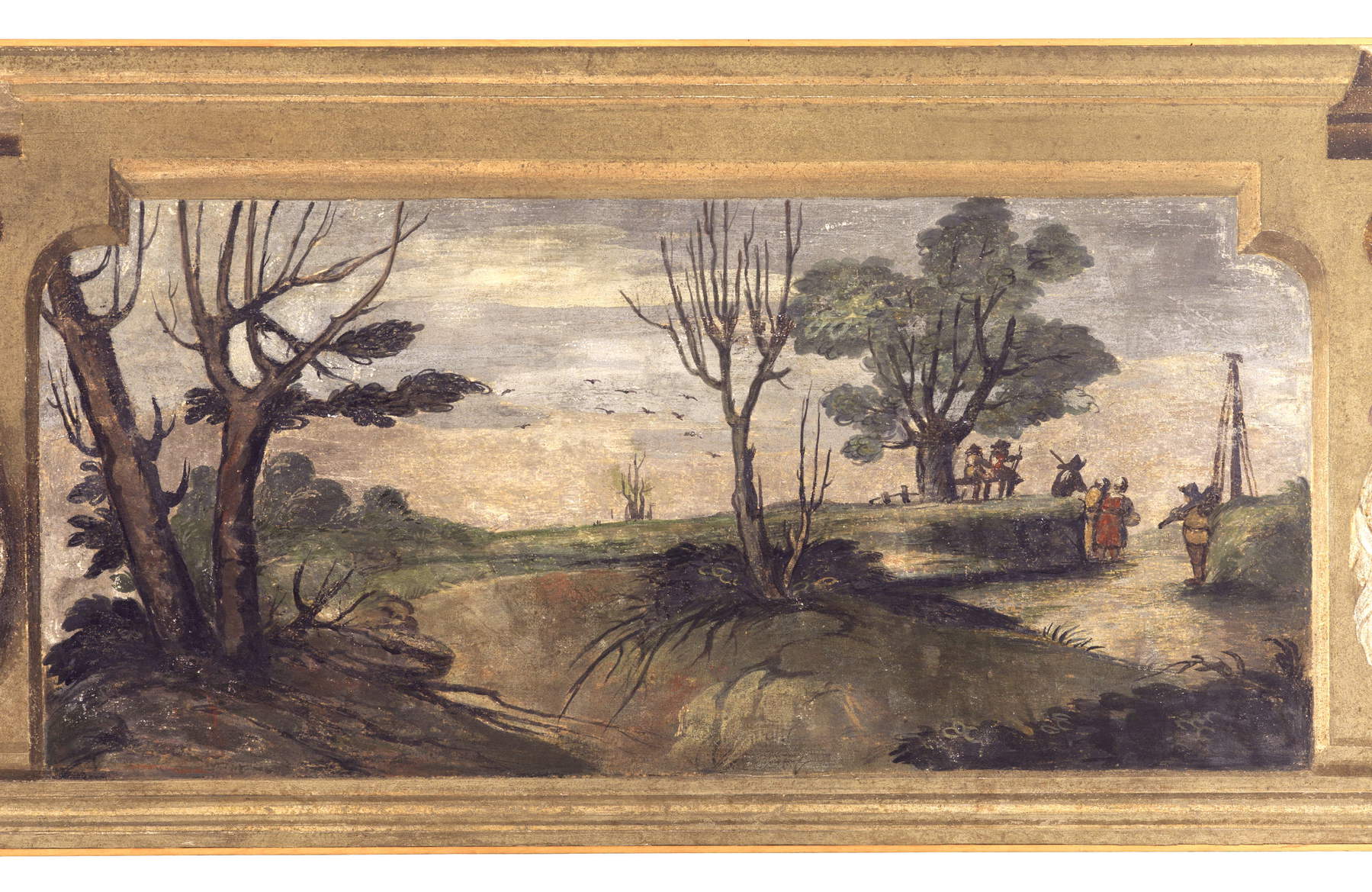
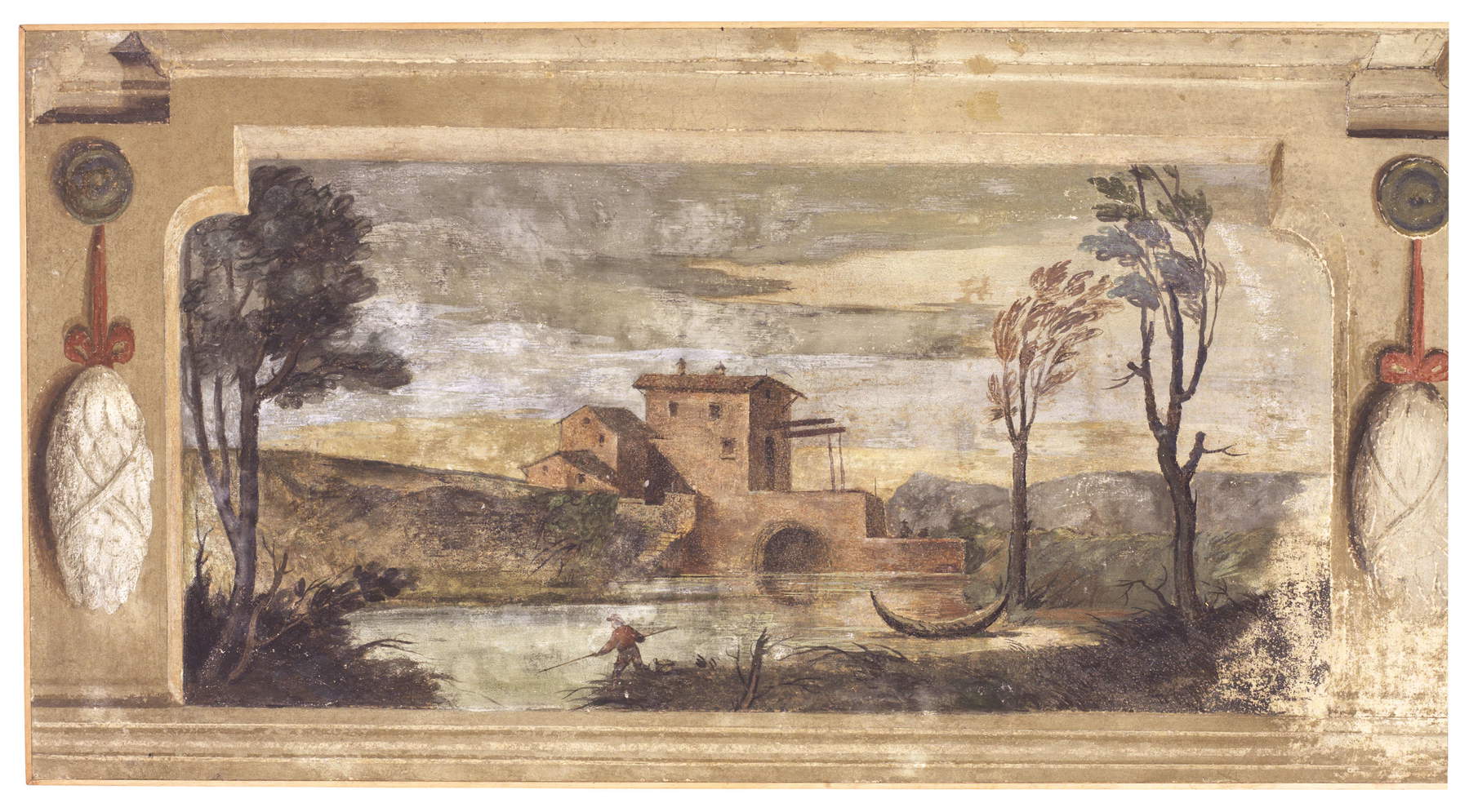
The frieze consists of seven panels depicting rural landscapes, similar to those in Casa Pannini, alternating with allegorical or mythological figures painted in monochrome. And just as in Casa Pannini, the bucolic serenity of the Cento countryside radiates throughout the landscape and emerges from some delightful details, such as the dog running to greet its owner as he passes through the gate of his estate, the fisherman standing on the banks of a river while waiting for a fish to bite, or the travelers waiting to board a boat. The immediacy is the same as in the frescoes at Casa Pannini. And one notices a similar, almost emotional engagement, evident especially where Guercino’s hand reveals itself through its freshness and atmospheric qualities. “Spirited frescoes,” as David M. Stone called them in a 2019 article in the Burlington Magazine . And these “spirited frescoes” have been part of everyone’s cultural heritage since 2018: the Municipality of Cento has commendably acquired them for the Civic Art Gallery, where they join two tempera paintings—also from Casa Benotti—created by one of Guercino’s collaborators and depicting a Landscape with a Country Festival and a Landscape with an Attack by Armed Men, demonstrating how it was not uncommon for the tranquility of the Cento countryside to be dramatically disrupted by raids from various brigands and bandits who brutally interrupted the festivities in the farmyards with robberies and kidnappings. These two related scenes, inspired by Guercino (to whom the concept is attributed—as evidenced by several drawings preserved at the Louvre)—were based on a news story of the time and date from the same period as the Casa Benotti cycle.
The frescoes were exhibited to the public for the first time between late 2019 and early 2020 at the exhibition *Baroque Emotion. Guercino in Cento, curated by Daniele Benati and staged at two venues—the Pinacoteca San Lorenzo and the Rocca: they had been installed right within the halls of Cento’s medieval castle, allowing for a first-hand comparison with the Casa Pannini cycle. For Cento, this acquisition represented a recovery of memory. A fragment of the city’s history, Cento can now present to the public two of the most significant works by the young Guercino—works that are, however, more than just two pieces of art: they are a fragment of time, they are the very life of the region, they are unintentional records that capture the gestures, the work, and the customs of Emilia in the early 17th century.

The author of this article: Federico Giannini
Nato a Massa nel 1986, si è laureato nel 2010 in Informatica Umanistica all’Università di Pisa. Nel 2009 ha iniziato a lavorare nel settore della comunicazione su web, con particolare riferimento alla comunicazione per i beni culturali. Nel 2017 ha fondato con Ilaria Baratta la rivista Finestre sull’Arte. Dalla fondazione è direttore responsabile della rivista. Nel 2025 ha scritto il libro Vero, Falso, Fake. Credenze, errori e falsità nel mondo dell'arte (Giunti editore). Collabora e ha collaborato con diverse riviste, tra cui Art e Dossier e Left, e per la televisione è stato autore del documentario Le mani dell’arte (Rai 5) ed è stato tra i presentatori del programma Dorian – L’arte non invecchia (Rai 5). Al suo attivo anche docenze in materia di giornalismo culturale all'Università di Genova e all'Ordine dei Giornalisti, inoltre partecipa regolarmente come relatore e moderatore su temi di arte e cultura a numerosi convegni (tra gli altri: Lu.Bec. Lucca Beni Culturali, Ro.Me Exhibition, Con-Vivere Festival, TTG Travel Experience).
Warning: the translation into English of the original Italian article was created using automatic tools. We undertake to review all articles, but we do not guarantee the total absence of inaccuracies in the translation due to the program. You can find the original by clicking on the ITA button. If you find any mistake,please contact us.

























 IT
IT FR
FR DE
DE ES
ES CN
CN


