




by Redazione 03/03/2026



Categories: Ancient art / Disclaimer
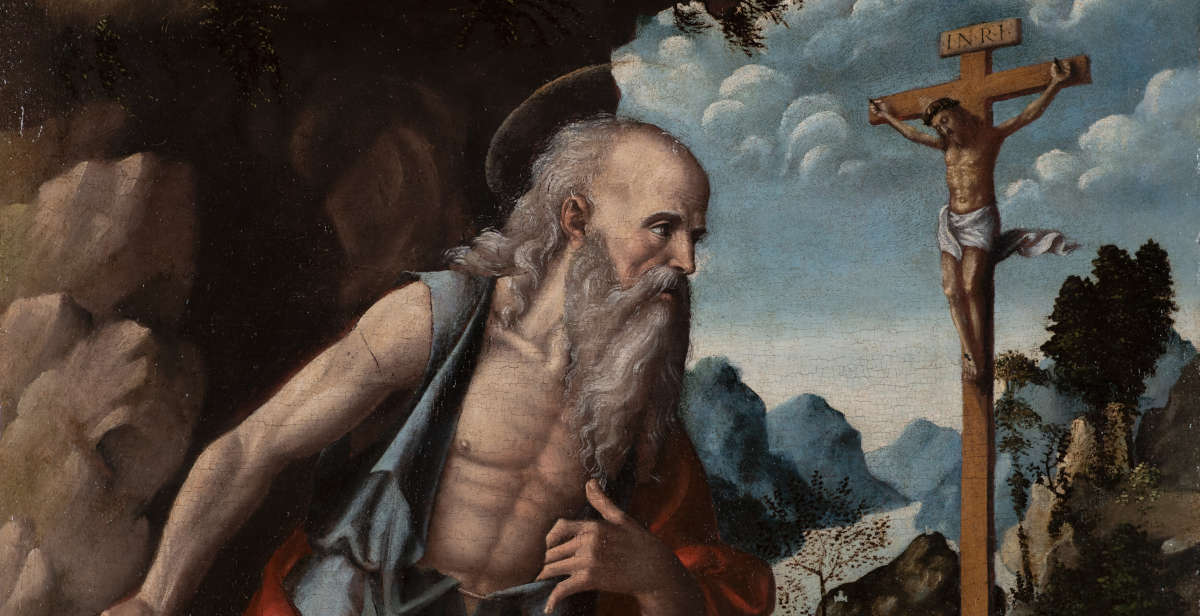
From March 21-30, 2026, Galerie Duponchel presents an exhibition in Paris devoted to 16th-century Italian art, with several previously unseen works. Prominent among the works on display is a Penitent Saint Jerome, hitherto considered anonymous, attributed with certainty to Giovanni Francesco Caroto by Mauro Lucco, an expert on the Venetian Renaissance.


A major discovery for 16th-century Veronese painting emerges in Paris, where the young Galerie Duponchel is opening its first exhibition devoted to Old Masters drawings and paintings. The exhibition, hosted from March 21-30, 2026 in the spaces of Galerie Michel Descours, at 10 rue de Louvois, offers a journey through Italian art from the height of the Renaissance to the late Baroque and features, among other works, a Penitent Saint Jerome attributed with certainty to Giovanni Francesco Caroto (Verona, 1480 - c. 1555) by one of the foremost experts on Venetian and Emilian Renaissance painting, Professor Mauro Lucco, author of fundamental monographs devoted to Giovanni Bellini, Andrea Mantegna, Giorgione, Bartolomeo Montagna, Antonello da Messina and Dosso Dossi, among others.


The painting, datable between 1515 and 1518, is an oil on poplar panel measuring 56.5 by 50.5 centimeters, set in a gilded box frame that measures 73 by 66.8 centimeters. It reappeared in 2022 on the French market as an anonymous work, and is first attested in a collection around Brescia in 1859, as attested by two red wax seals on the back of the panel, traceable to the Brescia Province of the Imperial Regia Delegation, with the Habsburg double-headed eagle and the inscription “Province of Brescia I.R. Delegazione”: a second seal, more worn, bears the partial inscription “Boll... d’Espor.../Bresc...,” referring to the customs office for the export of works of art. The presence of the imperial-regional inscription indicates that the customs operation dates to a period before 1859, the year in which, after the Second War of Independence, the part of the Lombardo-Veneto Kingdom located beyond the Adige River passed from Austrian control to the Kingdom of Piedmont-Sardinia.


More recently, the painting was in a private collection in Hauts-de-France. The state of preservation was judged to be excellent. After a cleaning operation performed by Cinzia Pasquali at the Arcanes atelier in Paris, the paint surface was found to be free of significant gaps and perfectly legible in its stylistic characteristics. The good conservation is also due to the care taken by the artist in preparing the back of the panel, which was treated with a dark brown primer to prevent deformation due to humidity. In some small areas where the preparation has detached, poplar wood fiber is visible. Radiographic analysis performed during the restoration revealed a significant element: the saint was initially conceived in profile and later changed to a very pronounced three-quarter view. This finding helps to understand the artist’s creative process and strengthen the attribution.


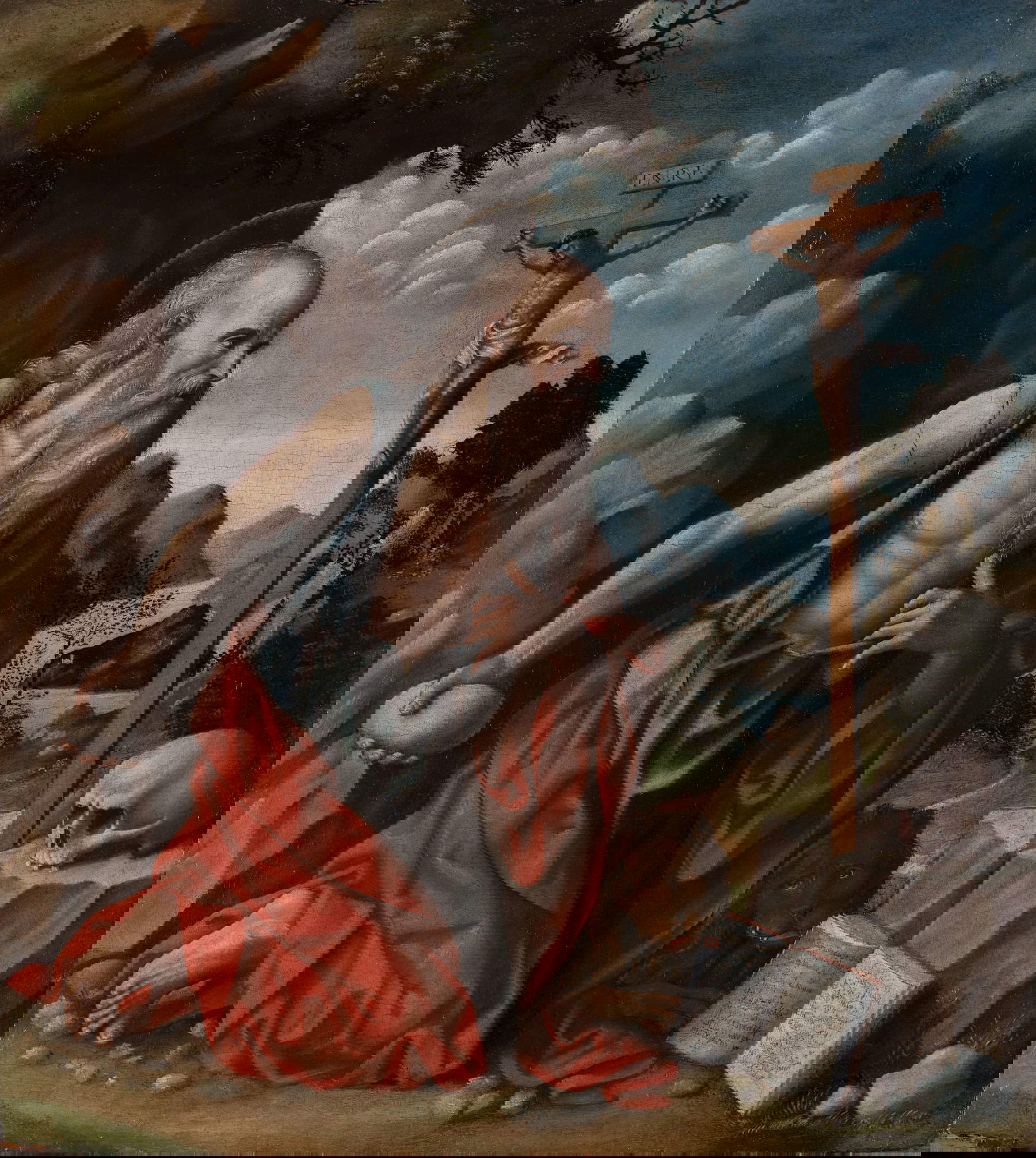
According to Lucco, the network of complex zigzag folds in the drapery of Saint Jerome clearly recalls the Mantegna-inspired models painted by the Veronese Francesco Bonsignori, during his stay in Mantua from 1477 (as indicated by a document found by Stefano L’Occaso). This stay did not prevent Bonsignori from sending some of his major works to Verona. This parallel is particularly evident in the comparison (unfortunately possible today only through photography) with the Saint Sebastian in the Kaiser-Friedrich-Museum in Berlin, dated 1485 and destroyed during the 1945 war. Other details also point to the Mantegna origin of the work: the outline of the rocks to the saint’s left, reminiscent of those in the Uffizi’s Madonna of the Caves, and the landscape itself, with hills emerging from the water and a small, fragile tree indicating depth (a motif found in other Mantegna-influenced Mantuan works).
“If these details indicate a rather unambiguous cultural origin,” Lucco writes in his study, “we will have to look among the Veronese artists who stayed in Mantua for a more or less long period, during the chronological span deduced from previous observations. The fact that there are very few of them, no more than three or four, and the particular morphology of the rocks, typical of Mantua until the completion of the Redondesco altarpiece, point toward a single possible name: Giovanni Francesco Caroto.”
Giorgio Vasari, in the Lives, recalls Caroto’s stay in Mantua with Andrea Mantegna. While we cannot literally accept the account that Mantegna brought out works by his pupil as his own, Caroto’s presence in the Gonzaga city remains documented. “As proof,” Lucco explains, “his altarpieces in Redondesco and Santa Maria della Carità remain in the city of the Gonzagas to this day.” The profile of Saint Bovo in the Carità altarpiece is, moreover, very similar to that of the San Girolamo, and even more so to the first idea, later modified, revealed by the X-ray. The profile of St. Jerome is later found in a Madonna and Child acquired in 2016 by the Museo di Palazzo Ducale in Mantua under the name Caroto, although it was later re-attributed to Bonsignori, between 1510 and 1515. The physiognomic similarities between the St. Jerome and figures of the Charity altarpiece, as well as comparisons with the Lamentation over the Dead Christ already in the Fontana collection in Turin and dated 1515, reinforce the work’s placement in the period the artist spent at the court of the Paleologi in Casale Monferrato, in the service of William IX between 1514 and 1518.
The first mention of Caroto in Casale dates back to July 12, 1516, and concerns a donation of land by William IX, of which he was a beneficiary. However, given that the Lamentation over the Dead Christ, already painted at the time, is probably what remains of the decoration of William IX’s private chapel, it is not unreasonable to think that Caroto arrived in town as early as 1514, almost as an immediate replacement for Macrino d’Alba, who passed away in 1513. Observing the drapery arrangement of the San Girolamo, the deep hue of the palette, the tension of the gestures, and the volumetric rendering of the figures show a close kinship with the Compianto and the San Sebastiano preserved in the church of Santo Stefano in Casale. Recurring elements, such as the rounded shape of the nails and the nervousness of the fingers, would constitute further stylistic clues consistent with Caroto’s production. The panel thus adds to the very few known works (just two) from this Piedmontese sojourn, a circumstance that contributes to a better assessment of the artist’s role in 16th-century Veronese painting, which is still the subject of in-depth study even after the major monographic exhibition in 2022.
Galerie Duponchel’s exhibition, entitled De Polidoro à Baciccio. Dessins et tableaux du XVIe au XVIIIe siècle offers a broad overview of Italian art of the time and the spread of its models in Europe, with works from the schools of Venice, Verona, Florence, Rome, Naples and Messina, and with references to the centers of Paris, Fontainebleau and Lisbon. Alongside Caroto are masters such as Polidoro da Caravaggio, Nicolò dell’Abate, Girolamo Muziano, Alessandro Turchi, Jacques Stella and Baciccio, along with lesser-known but high-quality artists.
Several unpublished works are on display. Among the other discoveries presented is an unpublished drawing by Girolamo Muziano (Brescia, 1532 - Rome, 1592), a Study for the Preaching of St. Jerome, made around 1582 in sanguine, preparatory for the large altarpiece commissioned by Pope Gregory XIII for the Gregorian Chapel in St. Peter’s in Rome. The sheet, from the collection of Everhard Jabach and recently from a private collection in Burgundy, has been recognized as autograph by Professor Patrizia Tosini.
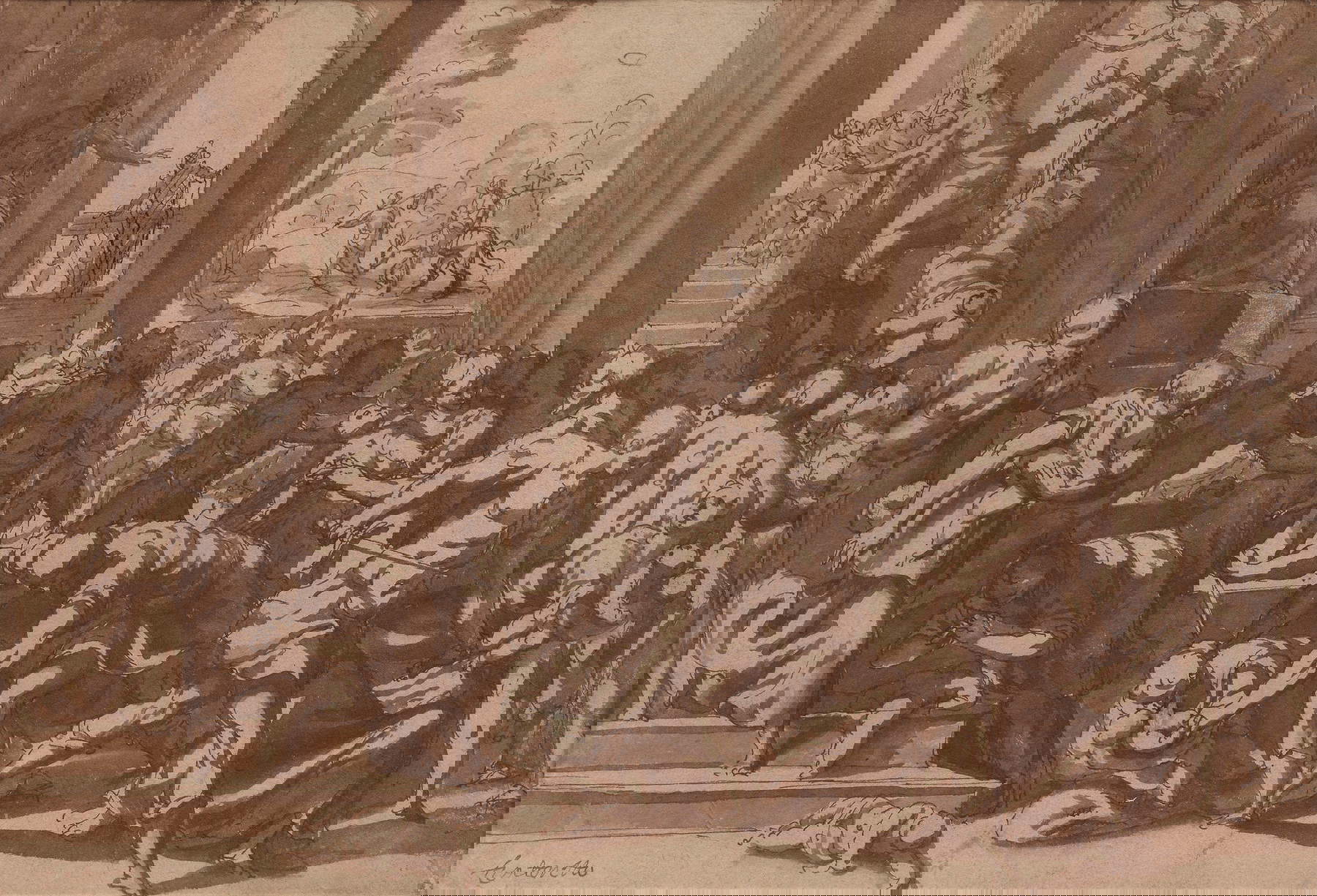
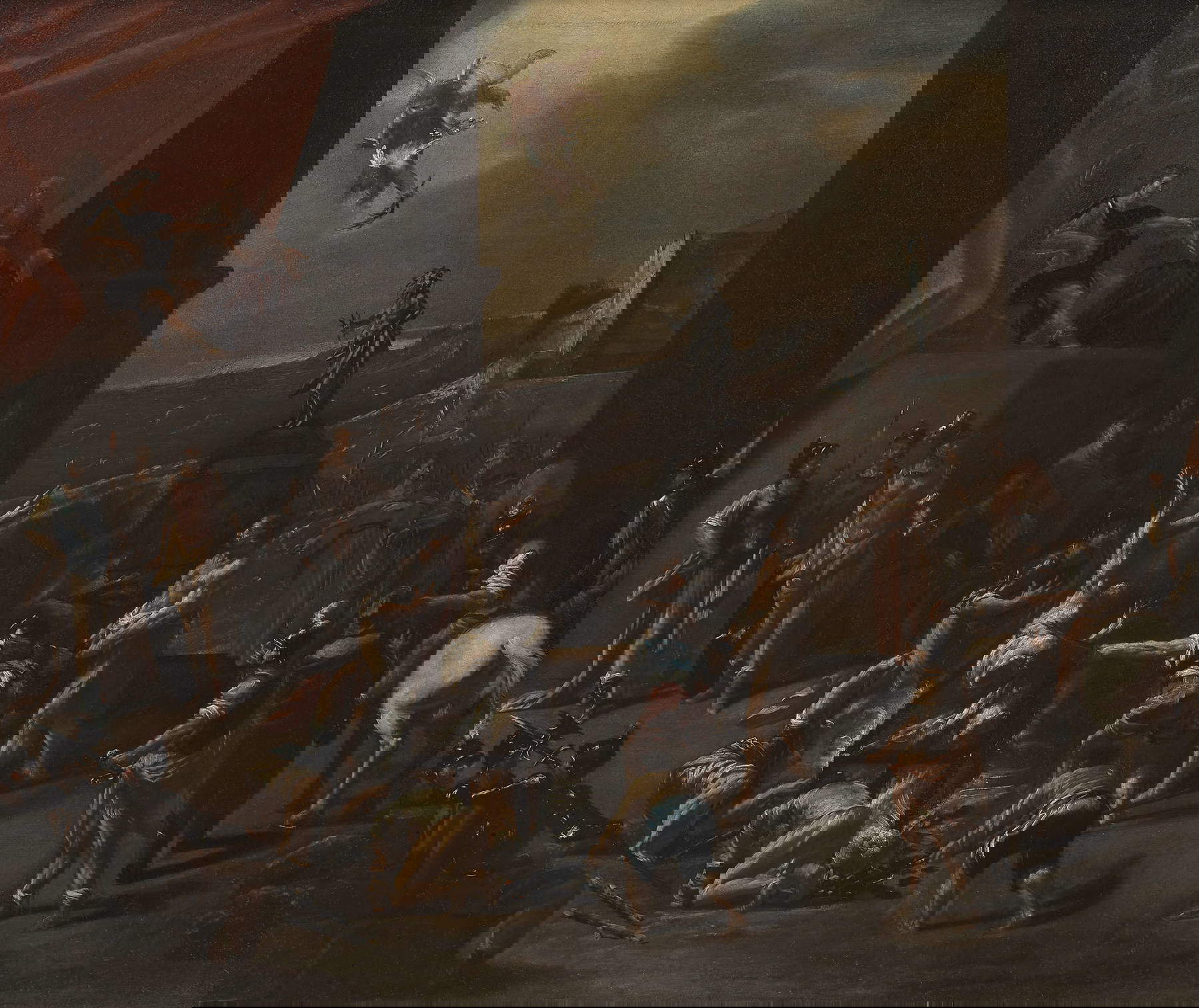
A further rediscovery concerns a Massacre of the Innocents attributed with certainty to the elusive Venetian Pietro Malombra (Venice, 1556 - 1618), thanks to studies by Bert W. Meijer and Andrea Piai. The Venetian artist, active in the late 16th and early 17th centuries, was mentioned by Marco Boschini as part of a circle linked to Palma il Giovane. The sheet, datable between 1586 and 1590, is part of a graphic corpus now reduced to a few dozen examples. Also worth mentioning is a Martyrdom of St. Lawrence attributed to the so-called Master of Martyrs, active in Naples in the first half of the 17th century. The attribution was confirmed by Pierluigi Leone de Castris, who first studied this still unidentified artist, close in style to Filippo d’Angeli, François de Nomé known as Monsù Desiderio and Cornelio Brusco.
The exhibition is open Monday through Friday from 9:30 a.m. to 7 p.m., with special openings on the weekends of March 21 and 22 from 10:30 a.m. to 7 p.m. and March 28 and 29 from 9:30 a.m. to 7 p.m., as well as by appointment. The initiative marks Galerie Duponchel’s entry into the field of exhibitions devoted to Old Masters and features a set of works largely unpublished or recently attributed thanks to research conducted in collaboration with art historians and connoisseurs.
 |
| Paris, a painting by Caroto discovered: important addition to the Veronese painter's catalog |
Warning: the translation into English of the original Italian article was created using automatic tools. We undertake to review all articles, but we do not guarantee the total absence of inaccuracies in the translation due to the program. You can find the original by clicking on the ITA button. If you find any mistake,please contact us.