





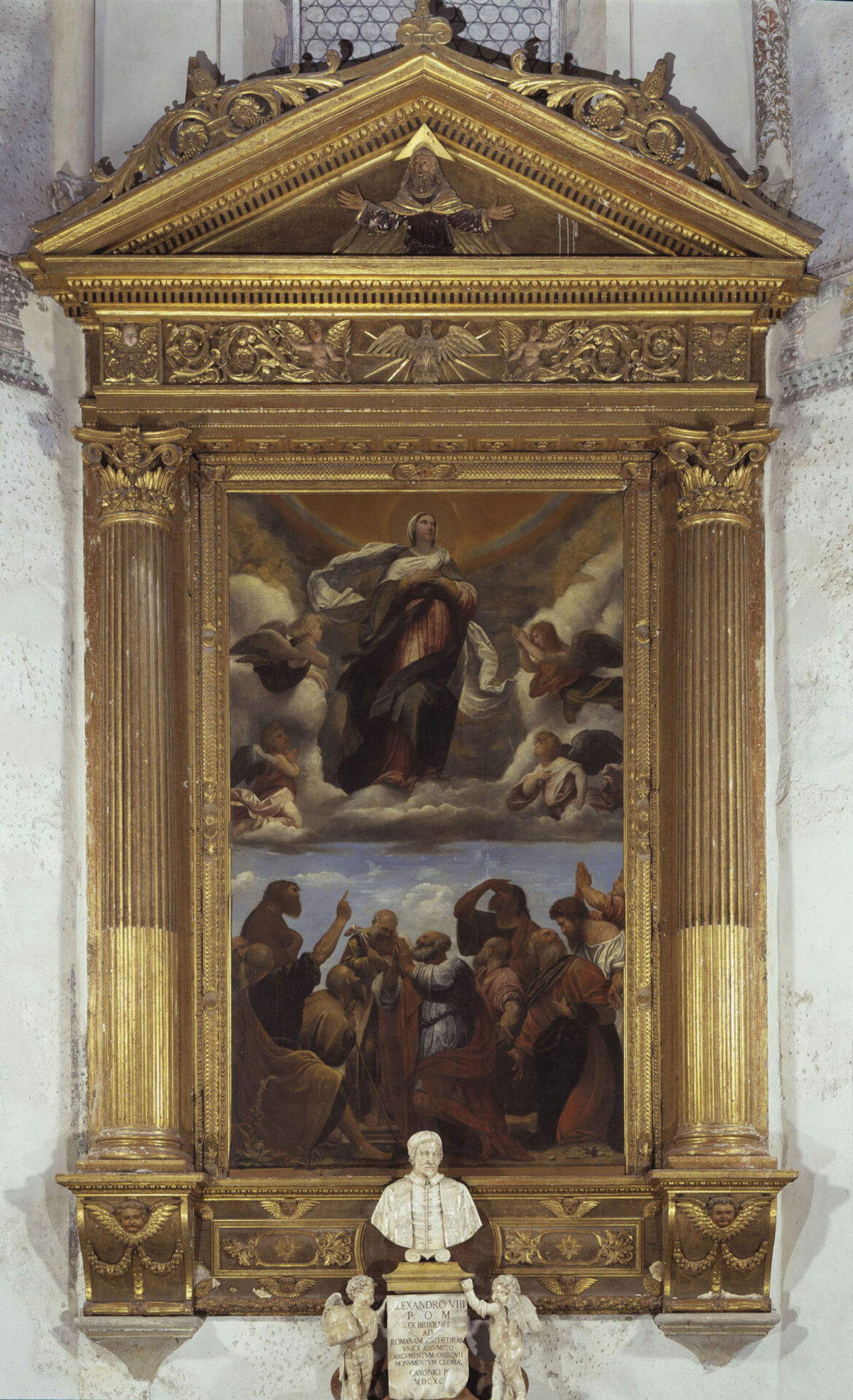
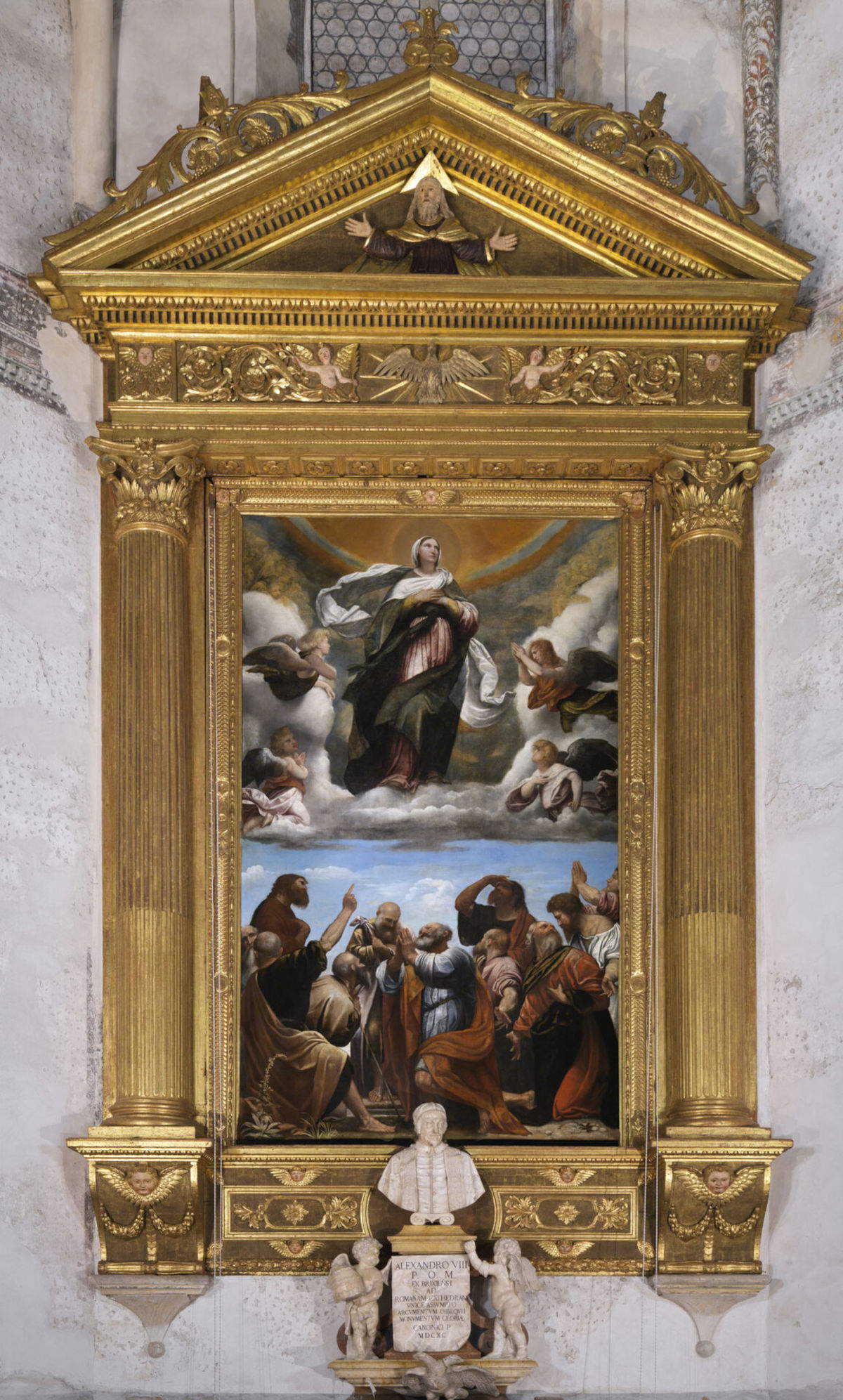
On June 13, 2026, at 8:30 p.m., the outcome of the restoration of theAssumption of the Virgin by Alessandro Bonvicino known as Moretto, a work placed on the high altar of Brescia’s Old Cathedral, will be presented to the public. The canvas, created between 1524 and 1526, underwent a six-month conservation campaign that also involved the monumental carved and gilded wooden ancona that frames it.
The intervention was promoted and supported by Ca’ del Bosco and the Venetian Heritage Foundation, with the sponsorship of the Diocese of Brescia and the Cathedral Parish. The scientific and organizational coordination was entrusted to Davide Dotti, while the restoration operations were carried out by Antonio Zaccaria’s laboratory. Supervision was provided by Silvia Massari and Andrea Quecchia of the Brescia Superintendency.
The conservation activities concerned both the structural problems of the canvas and the recovery of the aesthetic balance of the work. The intervention was preceded and accompanied by a series of non-invasive diagnostic investigations, conducted by Vincenzo Gheroldi, aimed at analyzing the state of conservation and the execution techniques used by the painter, also in relation to elements not immediately visible.
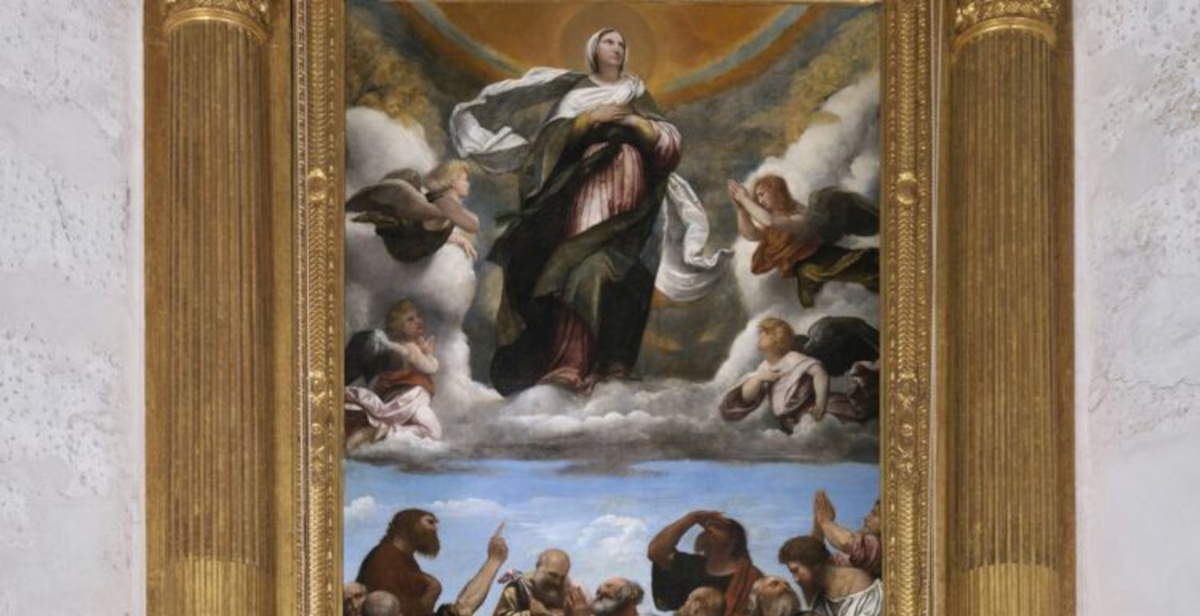
The altarpiece depicting theAssumption of the Virgin is developed on two overlapping narrative registers, separated by a band of clouds. The upper register depicts the Virgin, a central and monumental figure, accompanied in heaven by angelic hosts. The composition highlights a solemn and hierarchical setting of the sacred scene. In the lower register, on the other hand, the apostles are depicted around the empty tomb. The figures manifest diverse reactions through gestures and postures that suggest astonishment, surprise, and disbelief at the event described. The variety of expressions contributes to the construction of a dynamic scene, set on a plurality of attitudes that emphasize the narrative dimension of the work.
“We are really proud to have contributed to the important restoration of a work of deep symbolic value for the city of Brescia together with the Venetian Heritage Foundation,” says Maurizio Zanella, founder and president of Ca’ del Bosco. “Ca’ del Bosco’s connection with the world of art and sculpture, in particular, is well known.”
“It is an honor for me and for the Foundation I direct,” says Toto Bergamo Rossi, director of Venetian Heritage, “to have financed this restoration work in partnership with an Italian excellence like Ca’ del Bosco. Since 1999 Venetian Heritage has been promoting Venetian culture through a vast campaign of restoration work carried out in Venice, but also in the territories that were formerly part of the Serenissima Republic. Brescia was an integral part of the Venetian dominions from 1426 until the Napoleonic invasion in 1797. The altarpiece in the Duomo Vecchio clearly testifies how the Venetian painting of the great Titian influenced the young Alessandro Bonvicino known as il Moretto.”
"Restoring Moretto’sAssumption," recallsAntonio Zaccaria, Restauro Beni Culturali, “together with the monumental altarpiece that frames it, has meant dealing with an altarpiece that, since its creation, has assumed an identity value for the city of Brescia and has therefore been the object, over the centuries, of repeated conservation attention. The most delicate challenge was, therefore, the removal of two ancient layers of paint, respecting the traces left by past interventions, and the execution of a selective cleaning, calibrated on the different characteristics of pigments and materials. Decisive was the continuous dialogue between diagnostic investigations and technical operations, which oriented to a new and different methodological approach. The opening of the site to the public made this complexity visible, transforming the restoration into an experience of participation and knowledge. The result is twofold: on the one hand the restitution of a correct legibility of the work, and on the other a deeper understanding of its genesis and a renewed awareness of the bond that continues to unite it to its community.”
“The technical studies,” for Vincenzo Gheroldi, author of the diagnostic campaign, “have made it possible to reconstruct the painter’s way of proceeding and to recognize his different rethinking during the course of the work and to identify the different restoration interventions that, over time, have been layered on the painting. In addition, the diagnostic investigations followed the various phases of the restoration, verifying the first tests, the effectiveness of the conservation operations and the correctness of the subsequent interventions.”
“The decision to operate directly in the Old Cathedral,” argues Msgr. Gianluca Gerbino, parish priest of the Cathedral, “transformed the altar area into a real restoration site. The intervention, therefore, was not just a ”cleaning“ of an ancient painting: it was a way to protect a symbol of the city and return to the public a work that is part of Brescia’s artistic and religious identity. I thank the proponents and specialists of this significant recovery that marks the history of our City and our Diocese.”
“It was a great honor,” emphasizes Davide Dotti, "to coordinate at the scientific and organizational level an event of such high artistic and cultural importance as the restoration of one of the most important works of Moretto’s early maturity, to be counted among the protagonists of Italian Renaissance painting. The altarpiece with theAssumption of the Virgin is not only a masterpiece of art history that enjoyed wide critical acclaim over the centuries, but is also a symbol for all Brescians, lay and believing, preserved in an iconic place in the city. The constant discussion and dialogue with restorer Zaccaria and diagnostician Gheroldi during the 7 seven months of work allowed for a deeper understanding of the master’s refined painting technique, his way of constructing the articulate composition, spreading the color on the canvas and, at times, retracing his steps to correct details that did not satisfy him."
 |
| Restoration of Moretto's Assumption in Brescia's Duomo Vecchio completed. |

Warning: the translation into English of the original Italian article was created using automatic tools. We undertake to review all articles, but we do not guarantee the total absence of inaccuracies in the translation due to the program. You can find the original by clicking on the ITA button. If you find any mistake,please contact us.



























 IT
IT FR
FR DE
DE ES
ES CN
CN


