





For more than four millennia, one of the biggest questions related to Stonehenge has concerned the provenance and transportation of its massive stones. Today new international research adds an important piece to the reconstruction of the history of the famous megalithic monument in southern England, focusing in particular on theAltar Stone, the large sandstone block located at the center of the complex. According to the results of the study, published June 4 in the Journal of Quaternary Science, the megalith would have made an extraordinary journey from northeastern Scotland to the Salisbury Plain, traveling some 700 kilometers through complex terrain and vastly different natural environments. The investigation was led by researchers from Curtin University in Australia in collaboration with specialists from Sheffield Hallam University, the University of Sheffield, Wessex Archaeology, and the University of Bristol in the United Kingdom. The goal was to understand how a stone weighing about six tons managed to reach Stonehenge and to see whether the transport could have been attributed to glaciers of the last ice age or to the direct intervention of prehistoric people.
In recent years, geological analyses had already profoundly altered knowledge about the origin of the Altar Stone. For a long time it had been believed that the block came from Wales, similar to the so-called bluestones found in the monument. Later, thanks to sophisticated geological identification techniques based on analysis of the rocks’ mineralogical fingerprint, scholars instead identified a much more northern provenance, traceable to northeastern Scotland.
However, a fundamental question remained open: how it was possible for a stone of such size to have covered such a considerable distance in Neolithic times. To answer this question, the new study combined several scientific methodologies. On the one hand, researchers performed provenance analyses of sandstones by dating specific mineral grains, particularly detrital zircons, which represent a kind of geological signature capable of linking a rock to its place of origin. On the other hand, they used computer models to reconstruct the movements of the great ice sheets that affected Britain during the last ice age.
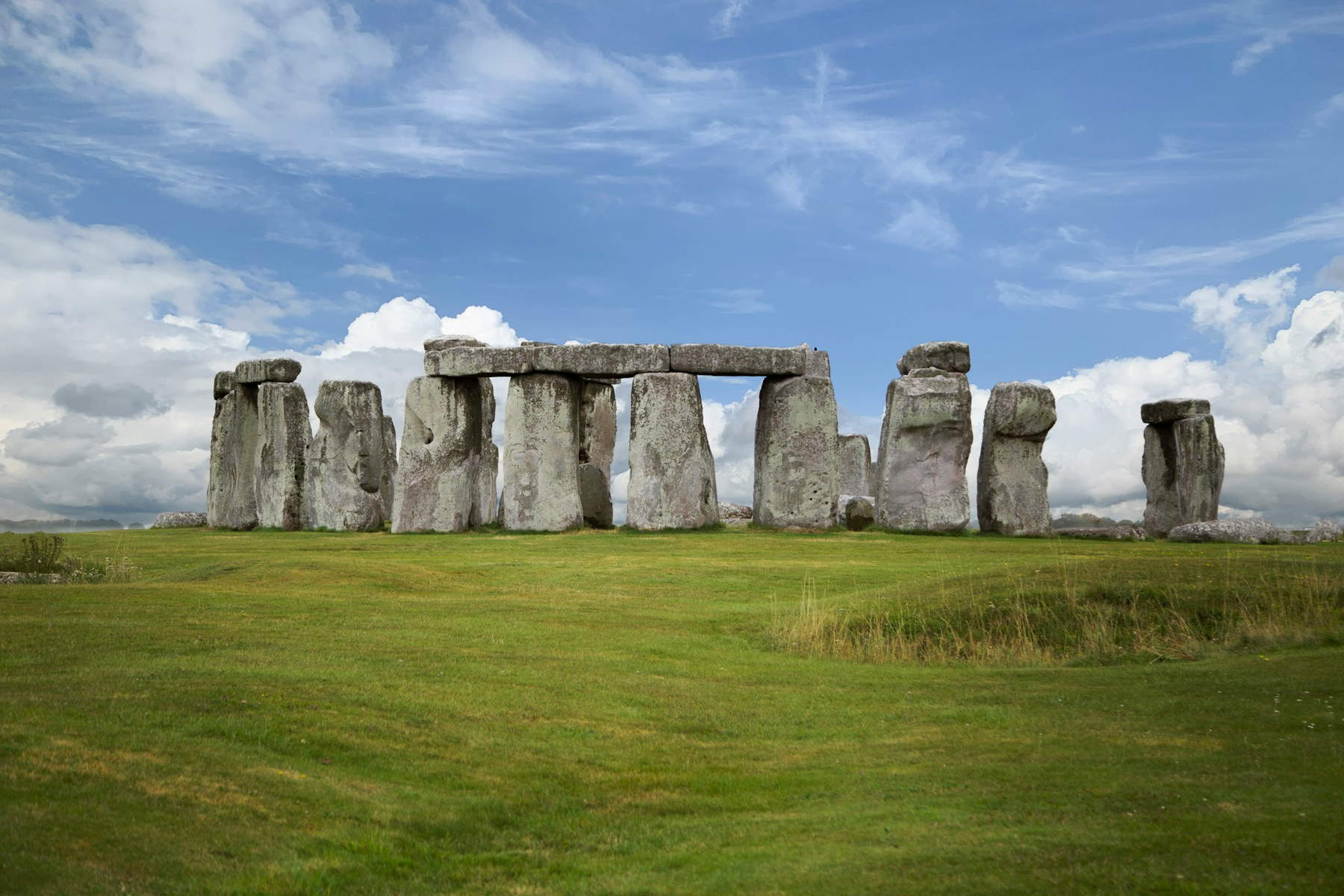
The Altar Stone is now considered a sandstone megalith weighing about 6,000 kilograms. Available evidence suggests that its origin lies within the Orcadian Basin, a vast sedimentary basin in northeastern Scotland. However, the exact location of the extraction site remains unknown and is one of the goals of future research. The possibility that the boulder was naturally transported by glaciers had been advanced in the past as one of the most plausible explanations. In such a scenario, the stone could have been incorporated into the ice and subsequently deposited much further south during the retreat of the glacial masses. However, the results obtained by the research team show that this hypothesis has many critical issues.
Indeed, simulations of ancient glacial dynamics indicate that the transport paths southward from northeastern Scotland were extremely limited and localized. This means that the exact identification of the area of origin of the Altar Stone is crucial in assessing the plausibility of glacial transport. Some candidate areas located further south within the Orcadian Basin are theoretically more compatible with a southward shift operated by glaciers, but show a less convincing correspondence with the zircon features present in the Stonehenge stone.
In contrast, sandstones from the Caithness region on the mainland of northeastern Scotland provide the most convincing correspondence from the point of view of zircon chronological structure. This very area thus appears to be one of the strongest candidates for the origin of the Altar Stone. However, glaciological models show that the ice flows from Caithness were mainly directed to the northeast and not to southern England.
According to the simulations, there was only a local southeast-oriented path leading in the direction of the Dogger Bank, a large area now submerged in the North Sea. In this scenario, the ice could have transported the stone to that region, reducing the distance humans would subsequently have had to travel from about 700 to about 400 kilometers.
Even this reconstruction, however, has a significant problem. The Dogger Bank was in fact submerged by the sea level rise that occurred after the end of the last ice age. Scholars point out that this submergence would have occurred before the probable arrival of the Altar Stone at Stonehenge, creating a chronological difficulty that makes an explanation based solely on natural processes insufficient.
The results of the study thus lead to an important conclusion: glacial transport may have represented an intermediate stage in the stone’s long journey, but it would not have been able, by itself, to explain its final placement in the Salisbury Plain. Even in the most favorable hypothesis of a glacial contribution, substantial human intervention would still have been required to complete the journey. The research thus reinforces the conclusions of earlier studies that had already ruled out the exclusive role of glaciers in moving the Stonehenge stones. The scholars’ attention has therefore focused on theconcrete reconstruction of the journey that the Altar Stone may have made thousands of years ago.
According to Dr. Anthony Clarke, co-principal author of the study and a member of the Timescales of Minerals Systems Group in the School of Earth and Planetary Sciences at Curtin University, the evidence gathered outlines a scenario characterized by careful planning and considerable organizational capacity. “Rather than being naturally transported by ice, the evidence points to deliberate and carefully planned movement across a difficult and varied landscape,” Clarke explained. The scholar pointed out that simulations show that glaciers may have transported rocks part of the way during the last ice age, potentially as far as the Dogger Bank in the North Sea, but not as far as southern England. Consequently, the rock would still have had to have been moved hundreds of kilometers by human groups. According to Clarke, the data obtained also demonstrate the absence of viable glacial routes that could directly connect the region of origin to Stonehenge. This element further strengthens the interpretation that human transportation was an indispensable component of the entire operation.
The hypothesis currently considered most plausible by scholars is that of a multi-stage displacement. The megalith could have been hauled overland for long stretches, at the same time taking advantage of waterways, riverways or coastal routes whenever conditions made it possible. Such a strategy would have allowed exceptional distance to be covered while reducing the logistical difficulties associated with transporting a six-ton stone.
The implications of the research go beyond simply reconstructing the route of the Altar Stone. Indeed, the study offers new insights into the technical and organizational capabilities of Neolithic communities in Britain. Transporting a block of this size across hundreds of kilometers would have required extremely detailed planning, cooperation between different human groups and extensive knowledge of the terrain. “Transporting a stone of this size for such a long distance would have required planning, coordination and a deep understanding of the landscape, not to mention extraordinary determination,” Clarke said. For the researchers, this level of organization suggests that Neolithic populations probably possessed more advanced logistical and social skills than previously recognized. The construction of Stonehenge thus increasingly emerges as the result of extensive collaborative networks and a remarkable ability to mobilize human resources on a large scale.
A further aspect highlighted by the research concerns the value of the interdisciplinary approach. Indeed, the combination of high-precision geological analysis and sophisticated computer models has made it possible to address an issue that has been open for decades and significantly narrow the field of possible explanations. “The study demonstrates how the combination of geological analysis and computer modeling can help resolve long-standing questions about how Stonehenge was built,” Clarke concluded.
Future research efforts will be geared toward more precisely identifying the exact point of origin of the Altar Stone in northeastern Scotland and further reconstructing possible routes used by prehistoric communities. Scholars hope that new geological analyses and further simulation models will provide even more accurate details on how one of Stonehenge’s most enigmatic megaliths managed to reach its final destination.
The study, titled From Highlands to Henge: Refining the Provenance and Transport Pathways of Stonehenge’s Altar Stone, was published in the Journal of Quaternary Science with DOI 10.1002/jqs.70080 and is one of the most recent contributions to the scientific debate about the origins and construction of one of the world’s most famous prehistoric monuments.
|
| Stonehenge, how did the stones travel? Research advances a new hypothesis |

Warning: the translation into English of the original Italian article was created using automatic tools. We undertake to review all articles, but we do not guarantee the total absence of inaccuracies in the translation due to the program. You can find the original by clicking on the ITA button. If you find any mistake,please contact us.






























 IT
IT FR
FR DE
DE ES
ES CN
CN


