



by Redazione 24/04/2026



Categories: Contemporary art / Disclaimer
At Cremona's San Carlo Church, the work "Sospeso nel moto con addebito di vuoto" by Guglielmo Castelli and Fabio Cherstich transforms space into a traversable experience with a work somewhere between painting, installation and performance, between Baroque suggestions and contemporary research.
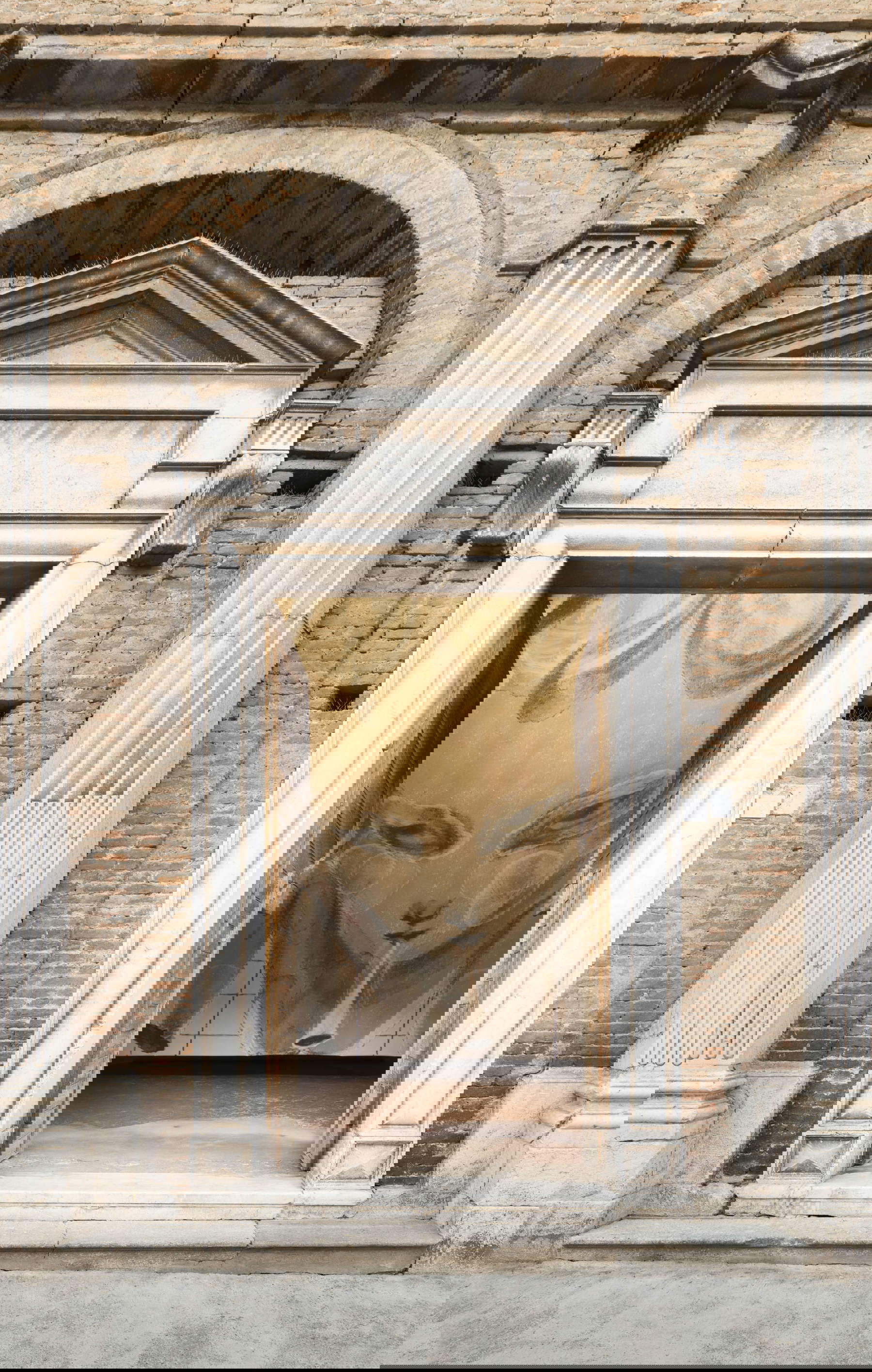
A kind of runway , of large canvas inside a seventeenth-century church. It happens in Cremona where, until June 2026, the church of San Carlo hosts Sospeso nel moto con addebito di vuoto, a project signed by Guglielmo Castelli and Fabio Cherstich that takes the form of an environment in which painting, sound and movement combine to redefine the perception of space. Open by appointment, the work develops as a complex device that relates visual and sound dimensions, inviting the public to a traversable and non-frontal experience.
The title and conceptual framework of the work originate in a nursery rhyme written by Guglielmo Castelli, which accompanies and orients the imagery of the project. Some of the tensions that structure the intervention emerge in the verses, including suspension, fall, uncertainty and the possibility that even error can take its own form. The text introduces a poetic horizon that is translated into space through a series of visual and sound elements capable of evoking an unstable and transforming condition.


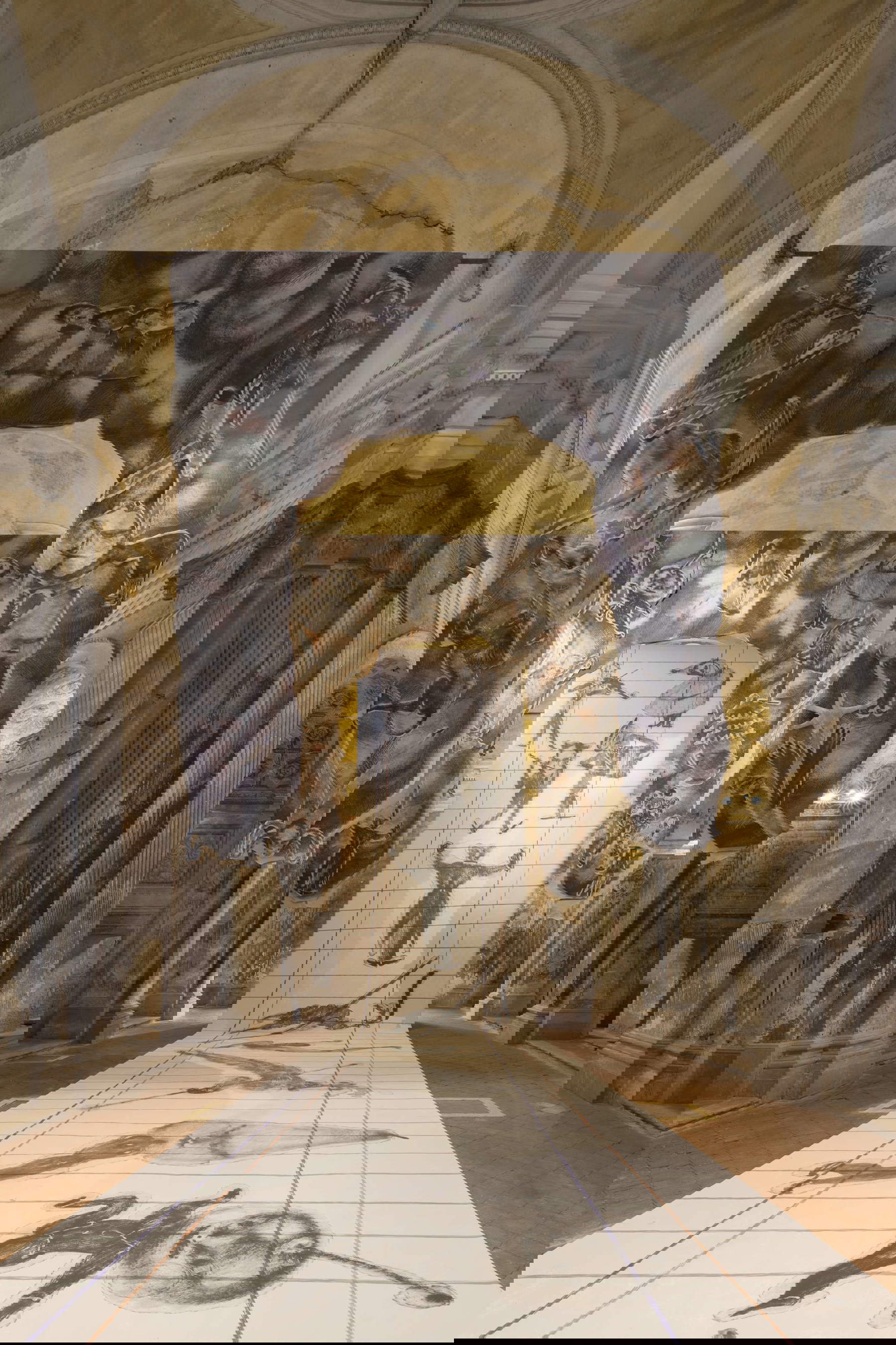
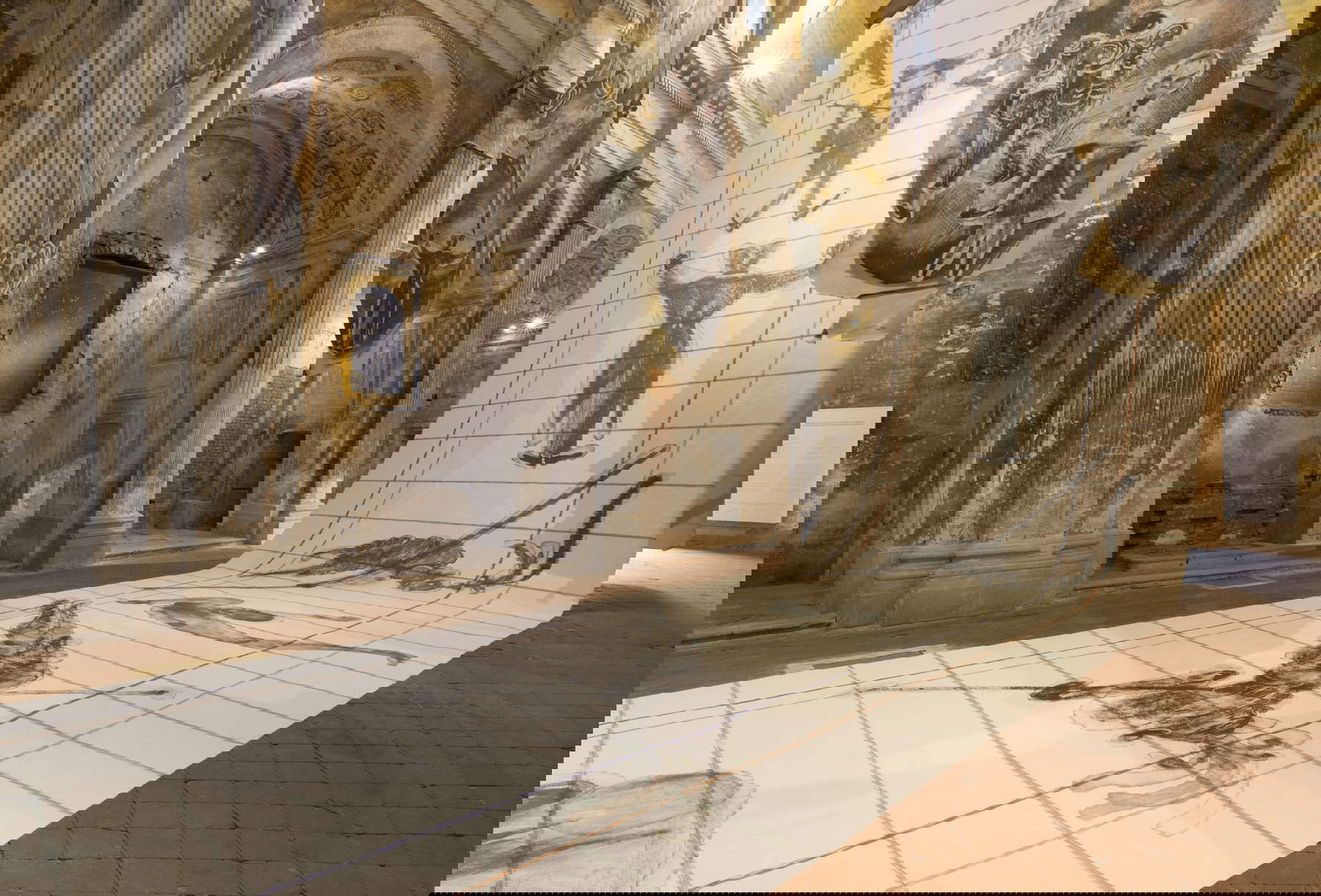
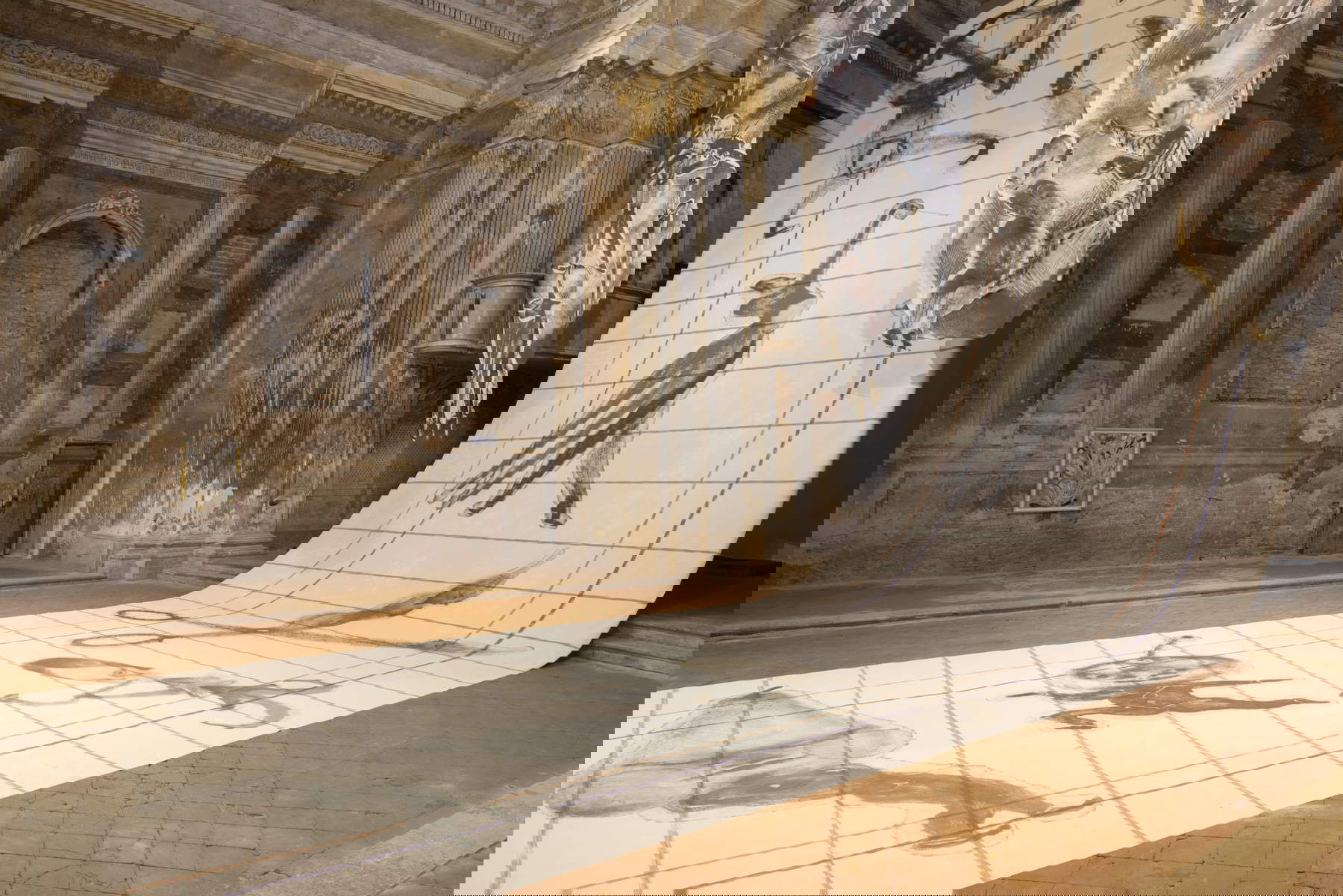
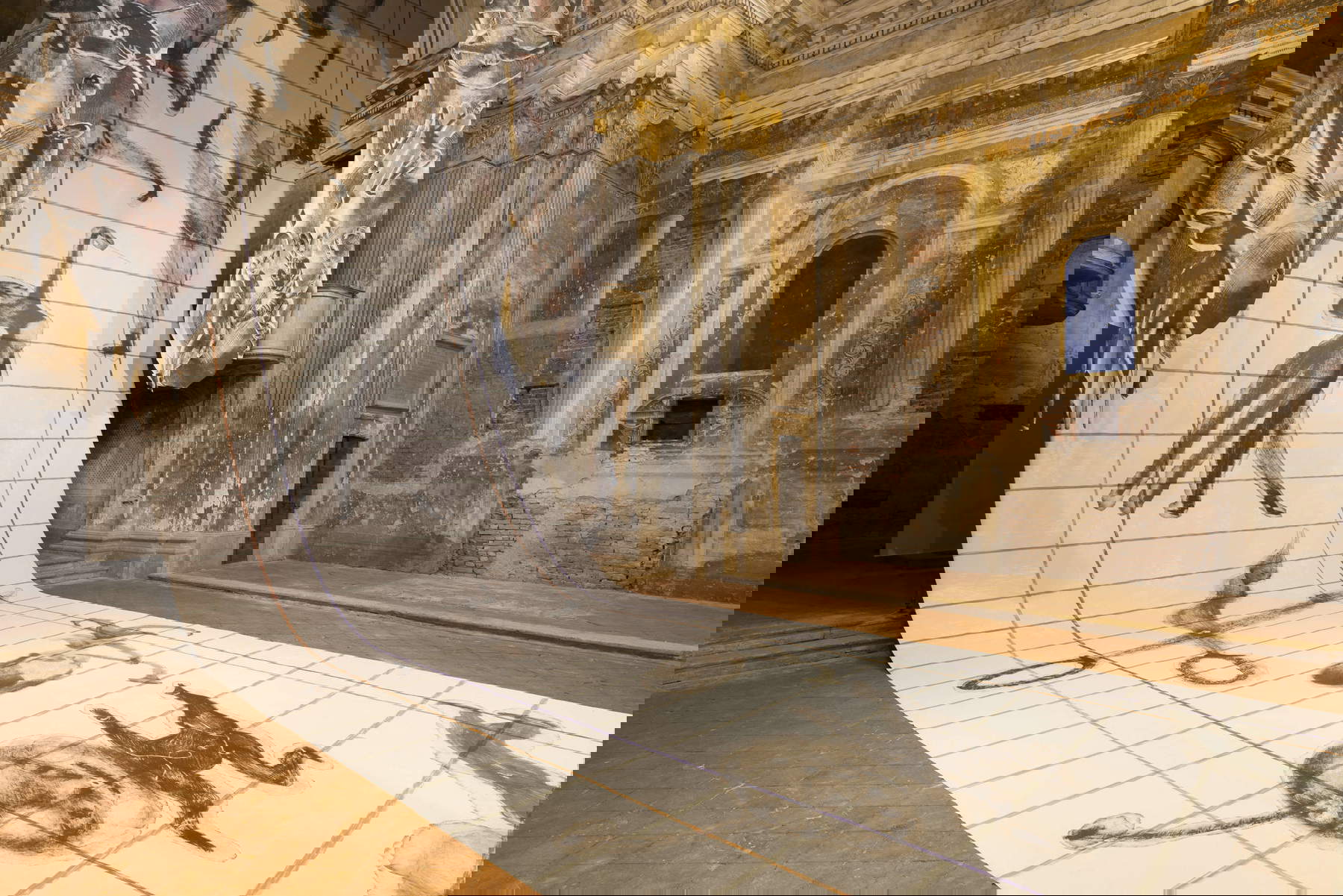
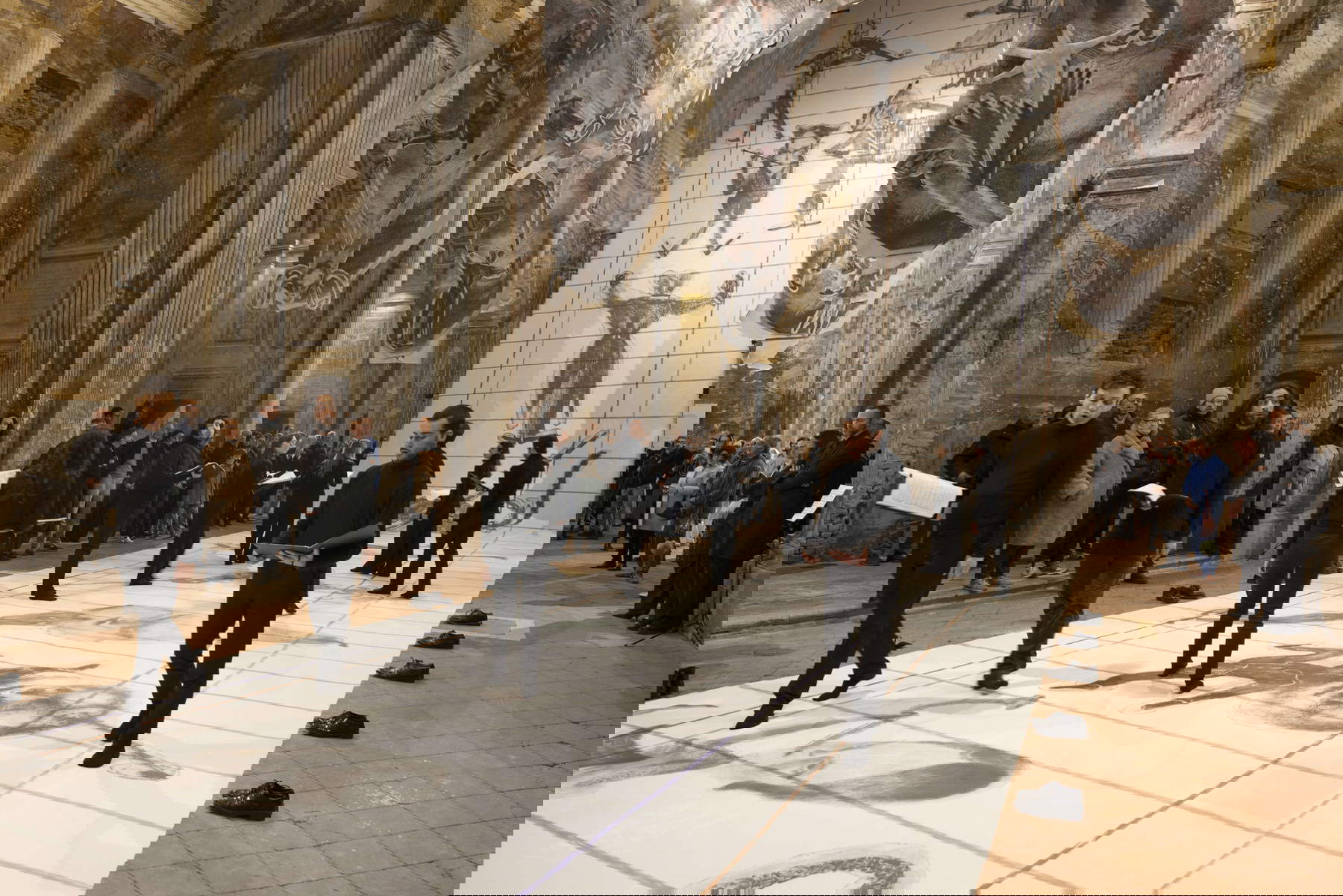
Inside the church, the work takes shape as an environment that does not merely occupy the architectural space, but redefines it through what passes through it. The scene is built from a large limbo that gradually rises from the floor to become a continuous backdrop. This surface orients the gaze and accompanies movement, suggesting a dynamic of sliding and falling. In fact, its configuration derives from the idea of descending bodies, also evoked by the pictorial silhouettes that seem to be pushed downward, as if sliding along the stage floor.
Above this horizon are articulated movable skies inspired by the devices of Baroque theater. Drapes, wings and light apparatuses construct a mobile and unstable depth, capable of suggesting transformations without resorting to traditional perspective construction. The reference to historical theater translates into a dynamic use of space, where the illusion is never accomplished but remains in a state of continuous redefinition.
Guglielmo Castelli’s painting expands beyond the two-dimensional surface to become an integral part of the environment. The figures that populate the space are fragile and suspended, composed of bodies, fragments and allusive presences that emerge and dissolve in the pictorial context. In this project, the images also recall the Baroque iconographic tradition of the fall of giants, with bodies plummeting and losing balance, as if the space itself is traversed by a constant force that pulls them downward.
The work is part of the programming of San Carlo, an exhibition space dedicated to contemporary art made possible by the commitment of Lorenzo Spinelli, which is established as a place for research, creation and sharing. In this context, Castelli and Cherstich’s project finds a coherent place, developing a reflection on the relationship between work and environment and the possibility of transforming the exhibition space into a field of experience.
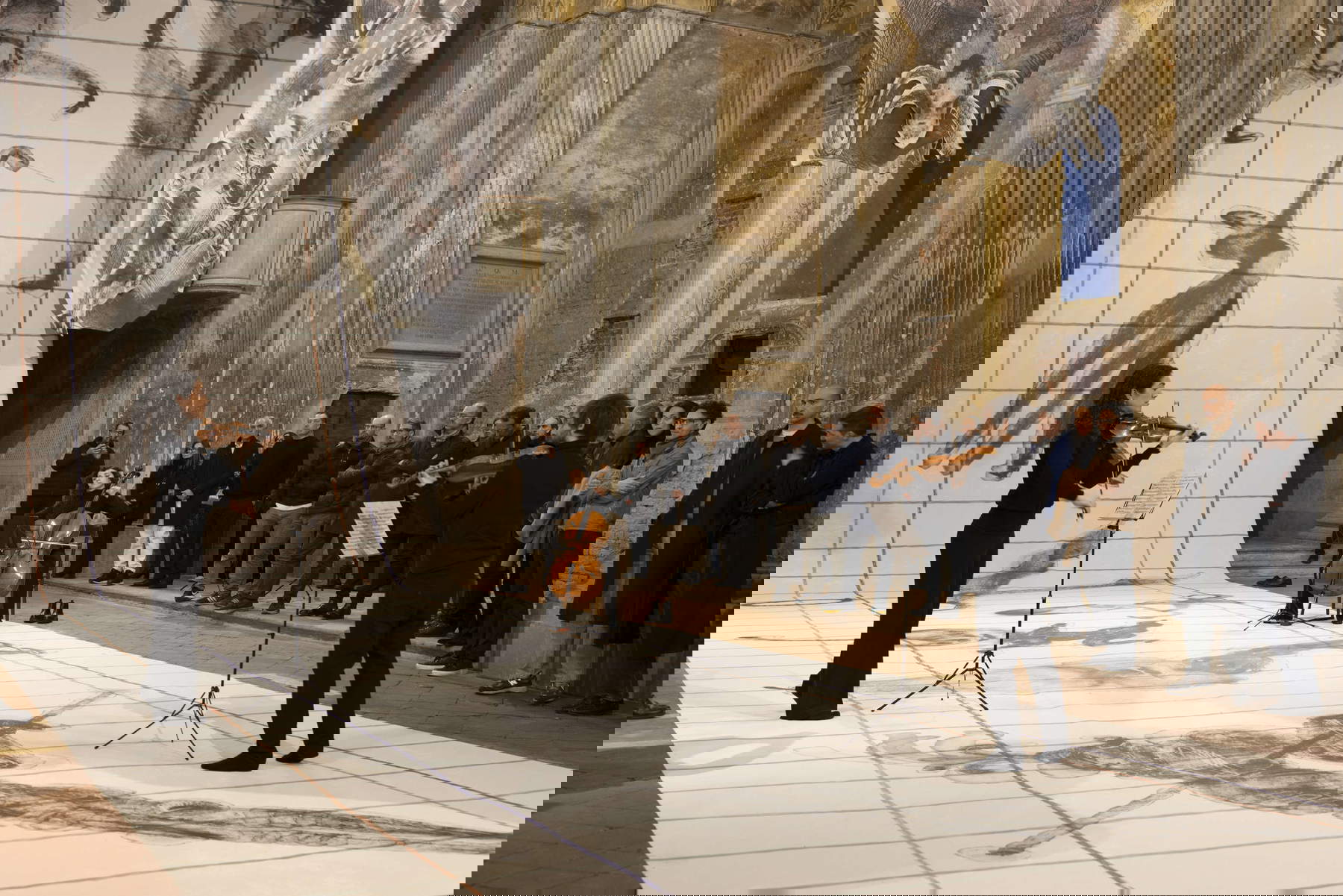
The installation is activated through a performative intervention involving a string trio and a chorus of performers. The performative presences inhabit the space intermittently, alternating between appearing and evading the gaze. Bodies move between architectures and images, hiding and re-emerging, sometimes configuring themselves as a compact chorus, sometimes as a distant echo.
The song traverses the space drawing on the madrigal tradition, then gradually opening up to more rarefied fragments that approach contemporary music. This passage unfolds as an ideal trajectory that reaches as far as John Cage’s experience, suggesting a broadening of sound language and a reflection on the relationship between structure and randomness.
Beyond the performative moment, the work continues to exist as an autonomous installation. The audience can access the space and move freely among the elements that make up the scene, experiencing a direct relationship with the images and architecture. In this sense, “Suspended in Motion with Debit of Emptiness” is configured as a spatial composition balanced between different languages, in which the visual, sound and bodily dimensions intertwine without hierarchies.
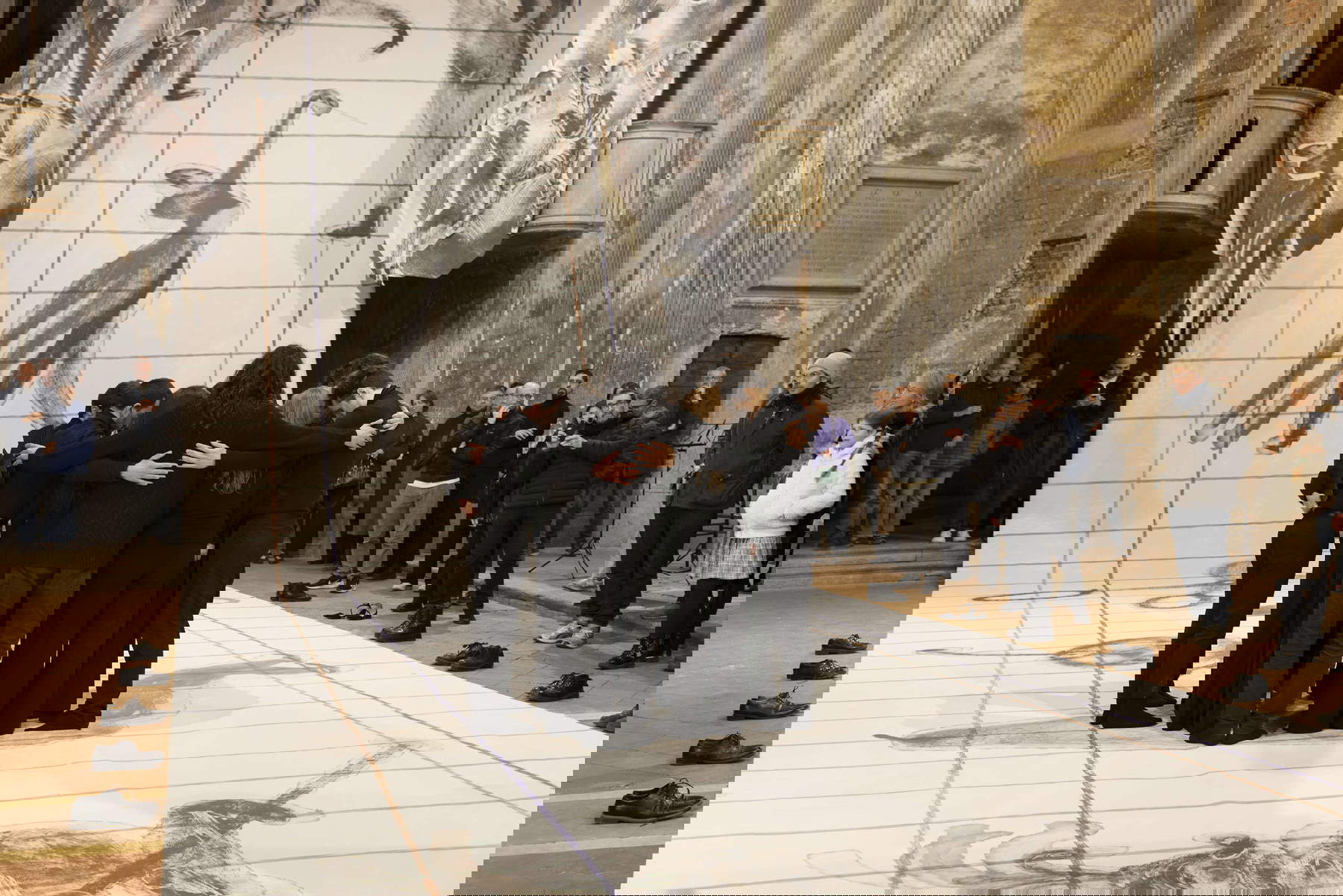
The scene is no longer presented as a place to be observed frontally, but as a space to be traversed, in which experience is constructed through movement and perception. The work invites one to confront a condition of instability and suspension, in which the fall is not a sudden event but a gradual process, and in which even error can find its own form and necessity.
The work of Guglielmo Castelli (Turin, 1987) is distinguished by a painting that builds worlds on the verge of unraveling or taking shape. Figures emerge from liquid backgrounds and dissolve in sudden transparencies, traversing the painting like a place of passage. The characters seem to move within emotional states rather than defined environments, while the space is configured as a field of tension between presence and absence. His research has been developed through solo projects presented in international institutions such as Kunsthalle Wien, Castello di Rivoli Museo d’Arte Contemporanea, Fondazione Bevilacqua La Masa, Villa Medici, Aspen Art Museum and MACRO in Rome, as well as numerous participations in group exhibitions in museum contexts and foundations in Europe and the United States.
Fabio Cherstich, director and set designer, brings to the project a practice that combines attention to the image and interest in visual languages. His path develops between theater and opera, with collaborations in institutions such as the Mariinsky Theater in St. Petersburg, the Teatro Massimo in Palermo, the Teatro dell’Opera in Rome, the Avignon Opera and the Théâtre Maillon in Strasbourg. His works have been presented in international festivals including the Festival d’Avignon, the Festival dei Due Mondi in Spoleto and other festivals dedicated to contemporary performing arts. Alongside his theatrical activity, he has developed projects for the world of fashion and design, collaborating with international brands and companies.
|
| A large decorated cloth in a 17th-century church: in Cremona, the work of Castelli and Cherstich |
Warning: the translation into English of the original Italian article was created using automatic tools. We undertake to review all articles, but we do not guarantee the total absence of inaccuracies in the translation due to the program. You can find the original by clicking on the ITA button. If you find any mistake,please contact us.