





The Holy See’s Dicastery for Culture and Education has announced the 24 artists involved in the Holy See Pavilion at the 61st International Art Exhibition - La Biennale di Venezia. The project, curated by Hans Ulrich Obrist and Ben Vickers in collaboration with Soundwalk Collective, entitled The Ear is the Eye of the Soul, will take place in two venues in the city of Venice: the Mystical Garden of the Discalced Carmelites in the Cannaregio district and the Complex of Santa Maria Ausiliatrice, in Castello. Created in response to the curatorial vision proposed by Koyo Kouoh for the Biennale Arte 2026, which urges people to slow down and listen on a more collected and silent dimension, the exhibition project is proposed as a kind of sound prayer, inviting a’contemplative experience of listening, inspired by the figure and legacy of St. Hildegard of Bingen, a medieval abbess, poetess, healer and composer who lived between 1098 and 1179.
Artists featured in the Discalced Carmelite Mystical Garden include Bhanu Kapil, Brian Eno, Carminho, Caterina Barbieri, Devonté Hynes, FKA Twigs, Holly Herndon and Mat Dryhurst, Jim Jarmusch, Kali Malone, Kazu Makino, Laraaji, Meredith Monk, Moor Mother, Otobong Nkanga, Patti Smith, Precious Okoyomon, Raúl Zurita, Soundwalk Collective, Suzanne Ciani, Terry Riley and the Benedictine nuns of the Abbey of St. Hildegard of Eibingen, while the St. Mary Help of Christians Complex will feature works by Alexander Kluge, Ilda David’ and Tatiana Bilbao. The last work of the well-known director and author Alexander Kluge, who died on March 25, 2026 at the age of 94, will be presented precisely at the Castello venue, where it will be visible as an integral part of the Pavilion; Kluge himself is also credited with the title of the pavilion.
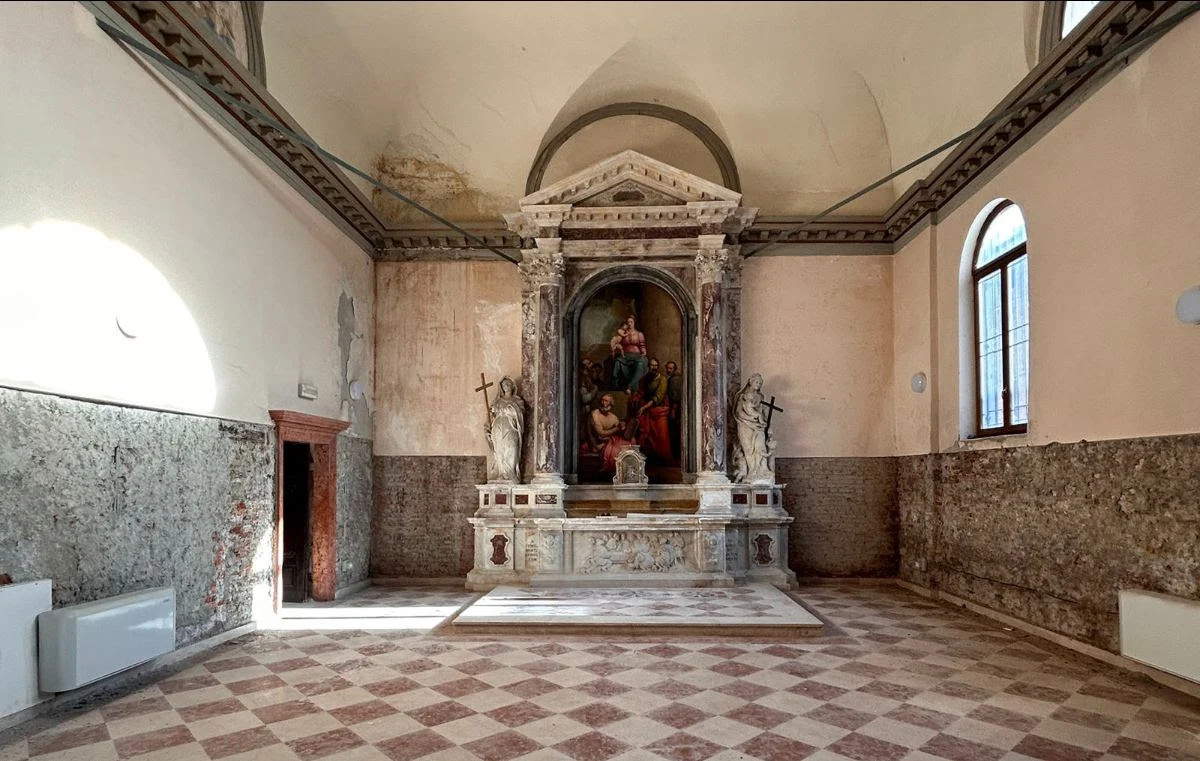
The first section of the exhibition, housed in the ancient Venetian Mystical Garden, a green monastic space concealed within a 17th-century convent cared for by the Discalced Carmelites, features new sound works created by twenty contemporary composers, musicians, poets and artists, works that dialogue with Hildegard’s songs, texts and visionary images through voice, instruments and, in some cases, silence; here visitors will be invited to listen to the works through headphones and immerse themselves in a reflective experience, made possible in part by a site-specific device designed by Soundwalk Collective that detects and returns the sounds of the garden in real time.
In the second venue, located in the sestiere of Castello, the Complex of Santa Maria Ausiliatrice will be transformed into a contemporary scriptorium, recalling the medieval places dedicated to copying and decorating manuscripts, and will be developed around three main nuclei: a living archive, Alexander Kluge’s latest work and the sound liturgy of the nuns of Eibingen Abbey; the archive has been curated in close collaboration with Sr. Maura Zátonyi OSB and theAcademy of St. Hildegard, whose work on the study, transmission and preservation of the saint’s legacy has been a source of inspiration for the Pavilion’s artists and collaborators, and within it will be possible to consult a multilingual library dedicated to Hildegardian texts, Ilda David’’s artist books, and a new monastic architectural project signed by Tatiana Bilbao Estudio; in addition, the venue will host Kluge’s final work, completed before his death in March 2026, a large installation composed of films and images in twelve stations distributed in three rooms, according to a logic that recalls the industrial process of the restoration underway in the building.
Finally, the presentation at the Complex of St. Mary Help of Christians represents a further development of the Holy See Pavilion at the 19th International Architecture Exhibition of the Venice Biennale, which carries forward both the intervention on the site and the architectural project called Opera Aperta (2025), created by Tatiana Bilbao Estudio together with MAIO Architects.
Commissioner of the Holy See Pavilion is Cardinal José Tolentino de Mendonça, Prefect of the Holy See’s Dicastery for Culture and Education.
|
| Holy See Pavilion at Venice Biennale 2026 will be inspired by Hildegard of Bingen |

Warning: the translation into English of the original Italian article was created using automatic tools. We undertake to review all articles, but we do not guarantee the total absence of inaccuracies in the translation due to the program. You can find the original by clicking on the ITA button. If you find any mistake,please contact us.

























 IT
IT FR
FR DE
DE ES
ES CN
CN


