



by Redazione 17/05/2026



Categories: Contemporary art / Disclaimer
At the Spanish Pavilion of the 61st Venice Biennale, artist Oriol Vilanova presents Los restos, a project curated by Carles Guerra that stems from more than two decades of collecting postcards and builds an immersive archive made of fragments, memory and accumulation.

The Pavilion of Spain at the 61st International Art Exhibition of the Venice Biennale presents Los restos, a project by artist Oriol Vilanova (Manresa, 1980), curated by Carles Guerra, which transforms the exhibition space into an enveloping and temporary environment defined as an “anti-museum.” The exhibition also marks the reopening of the Pavilion after a renovation completed in 2025 and is part of initiatives promoted by Acción Cultural Española (AC/E) and the Spanish Agency for International Development Cooperation (AECID), with the support of Fundación Botín.
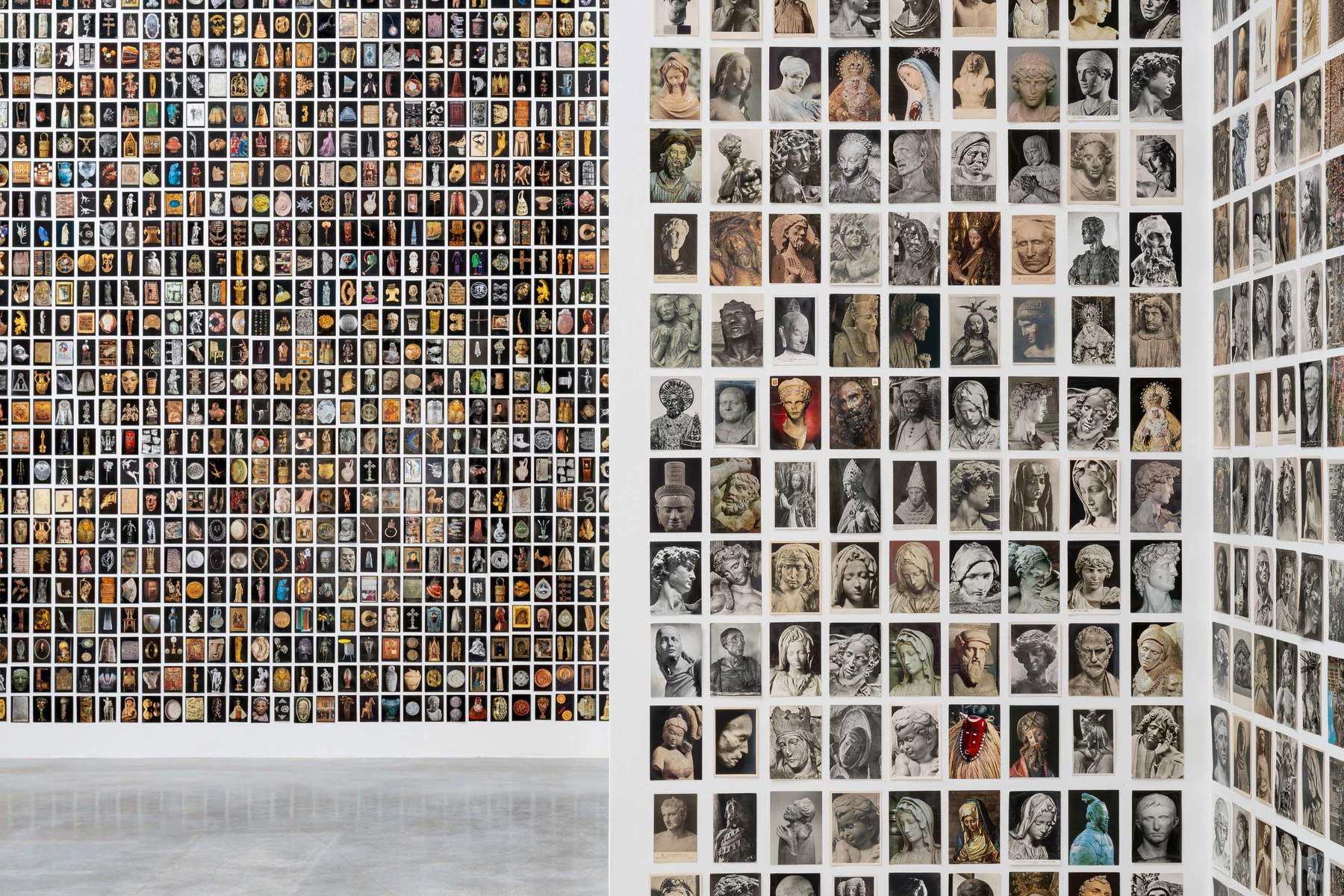
The project is based on a practice that Oriol Vilanova has been carrying out for more than two decades and which constitutes the core of his research: the systematic collection of postcards from flea markets and informal circuits of the everyday economy. These materials, originally intended for personal communication and global tourist circulation, are removed from their original contexts and re-grouped within the Pavilion in an exhibition structure that renounces any narrative hierarchy or orderly classification.
Within the Venetian space, the postcards are arranged as a dense and layered visual field, in which accumulation and repetition replace chronological linearity and museum taxonomy. The result is an environment that is not presented as a stable archive, but as an ever-changing constellation, where each fragment retains traces of its own circulation and loss of original meaning. The logic of the work does not aim at the definition of a closed narrative, but at the opening of a perceptual and interpretative process in constant redefinition.


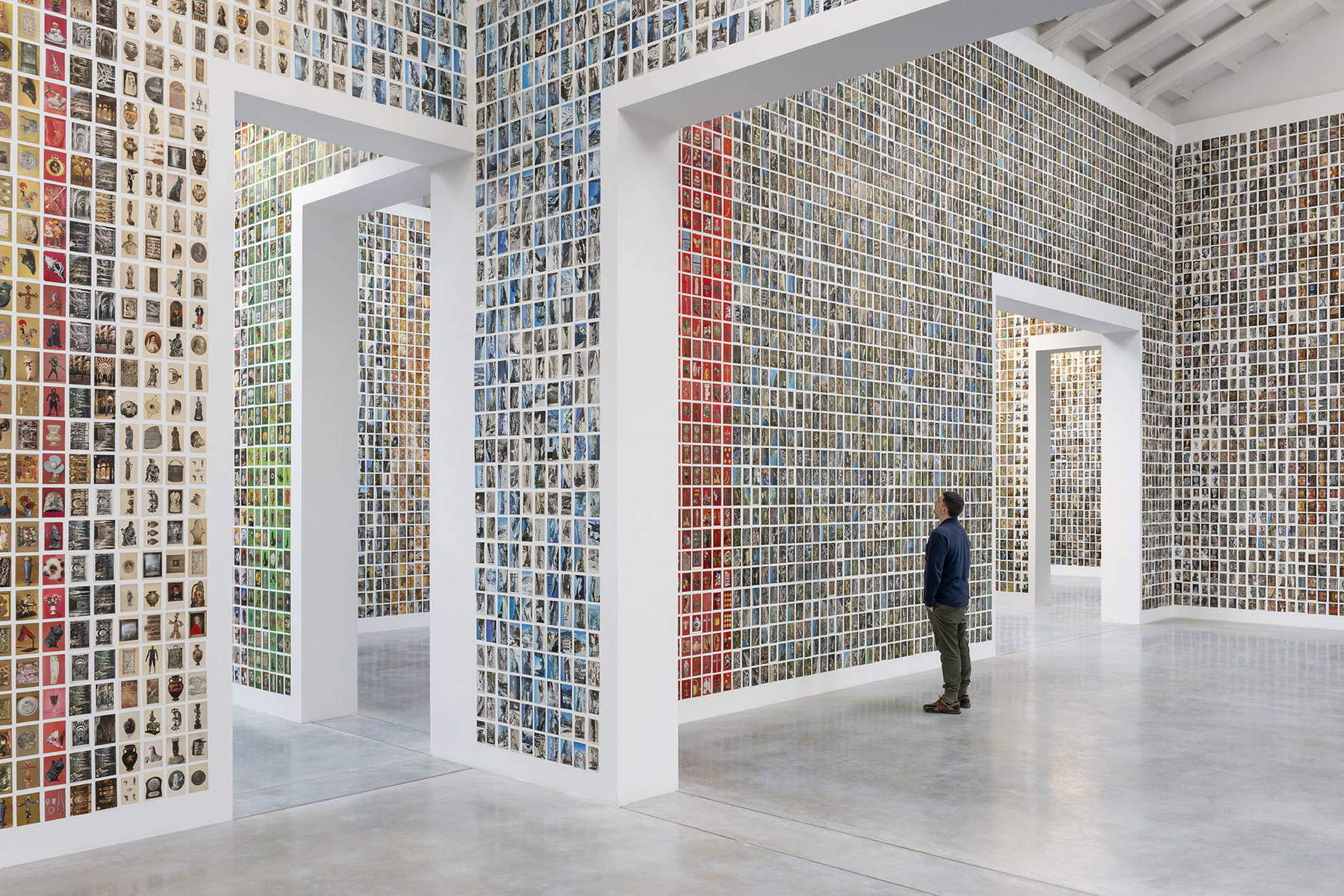
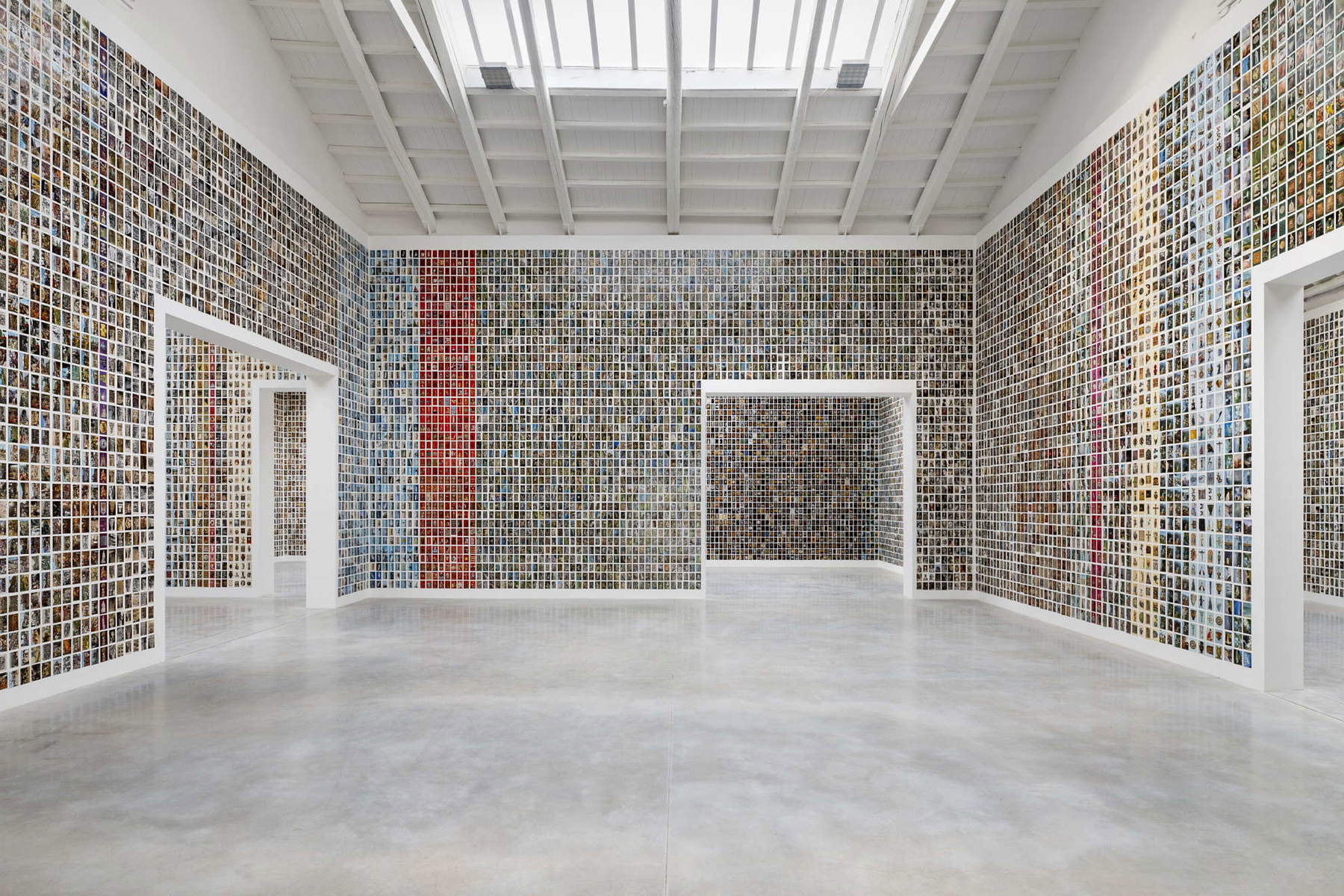
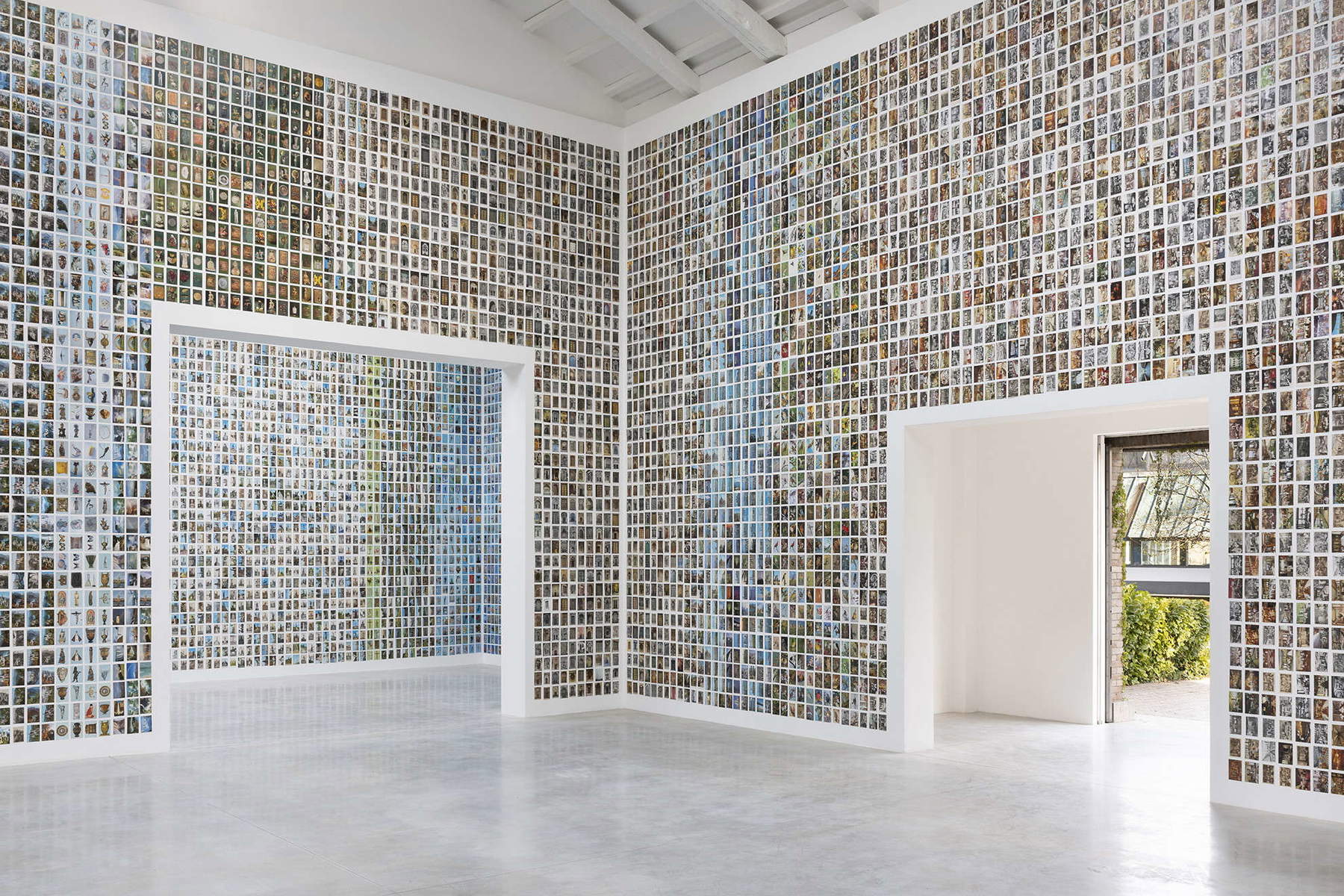
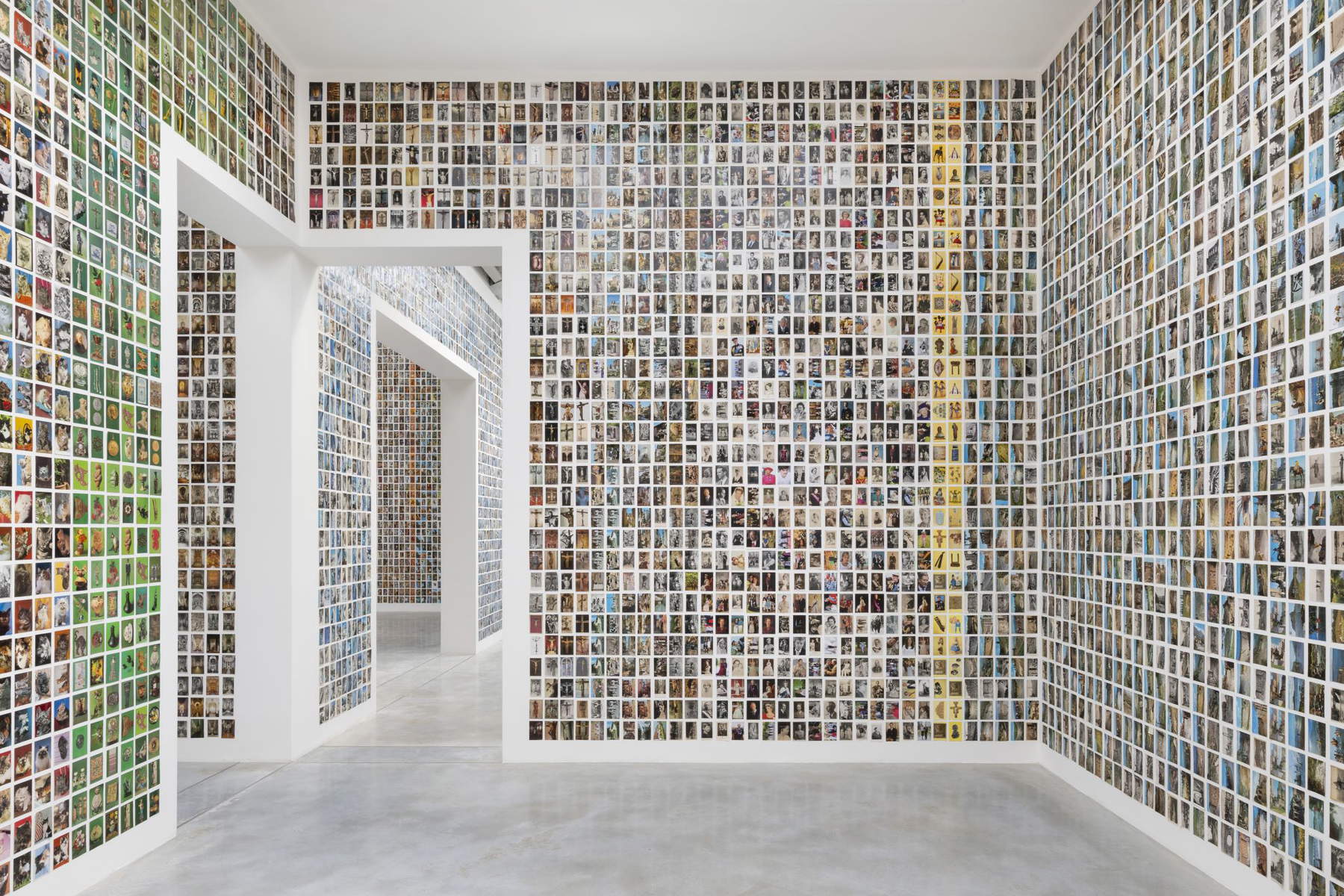
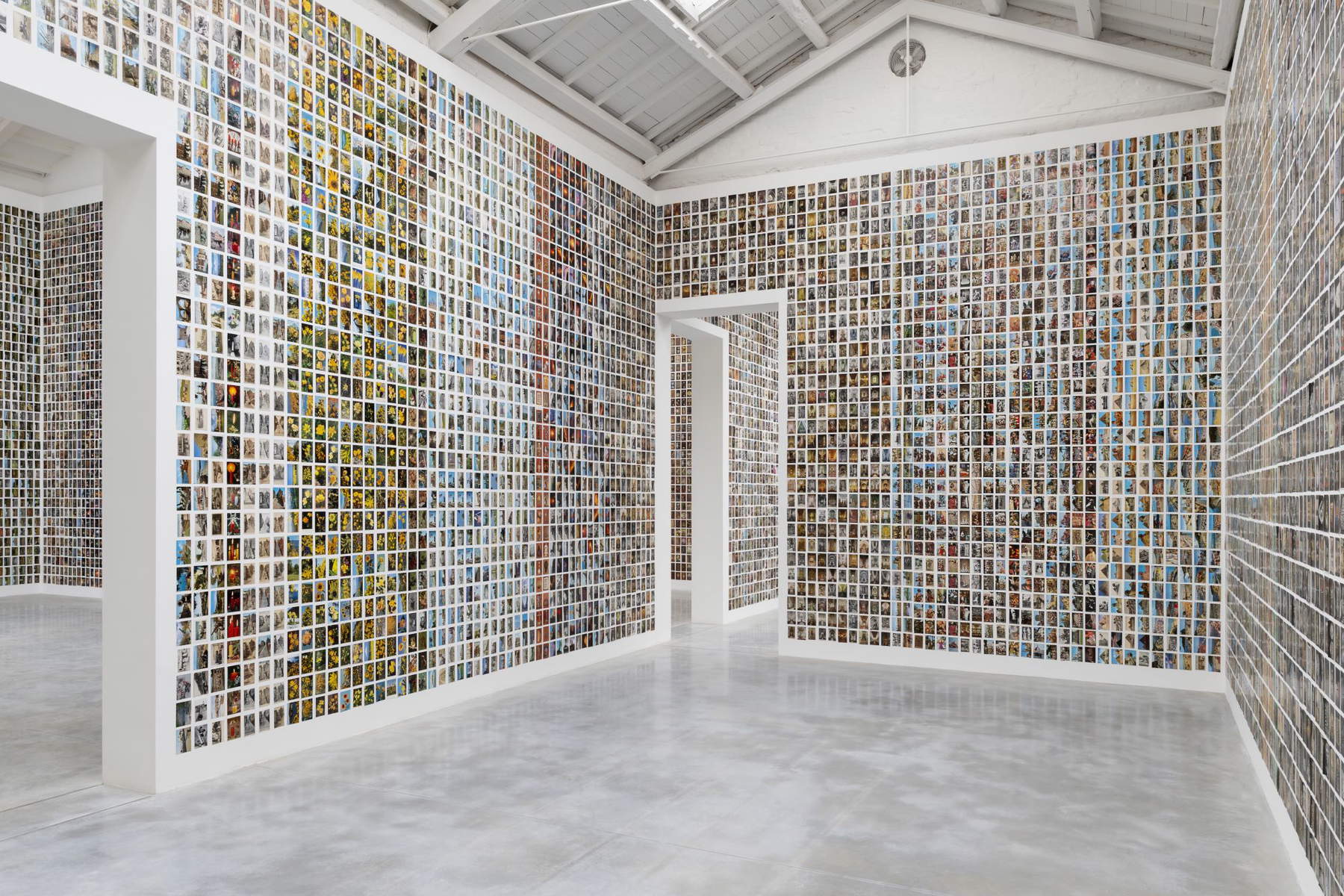
Los restos is thus configured as an exhibition practice that aspires to question the very concept of the museum, replacing it with an unstable form of organization of visual material. The installation deliberately avoids the construction of a narrative sequence or typological order, favoring instead an iterative and open structure in which the gesture of collecting, ordering and re-presenting becomes itself part of the work. In this sense, the project does not merely show a collection, but exposes the very process of collection as a form of thought.
Vilanova’s practice lies at the intersection of persistence and dissolution, where the accumulation of images cannot be separated from their progressive fading. Postcards thus become unstable documents, traversed by dynamics of memory and loss, which seek to challenge traditional categories of value, archive and representation. The project raises recurring questions in the artist’s research related to the circulation of images, the construction of memory and the ways in which cultural objects are classified, preserved and reinterpreted.
In Los restos, the act of collecting is also understood as a situated and enduring practice, capable of tensioning the boundaries between private and institutional spheres, between affective attachment and archival systematization. A different economy of attention should therefore emerge, based on repetition, care and contingency, in which meaning is never fixed once and for all but is produced through the relationship between heterogeneous elements.
The installation at the Spanish Pavilion extends beyond the physical space of the Biennale through a series of additional devices that expand the project on an editorial and performative scale. A central element is the artist’s book, designed by Zak Group and accompanied by texts by Carles Guerra, Catherine Mayeur, Pedro G. Romero, Joëlle Tuerlinckx, and Vilanova himself. The volume is configured as an autonomous work that integrates critical reflection and visual sequences of postcards, re-proposing in editorial form the modular logic of the installation and transforming the archive into a portable and speculative device.
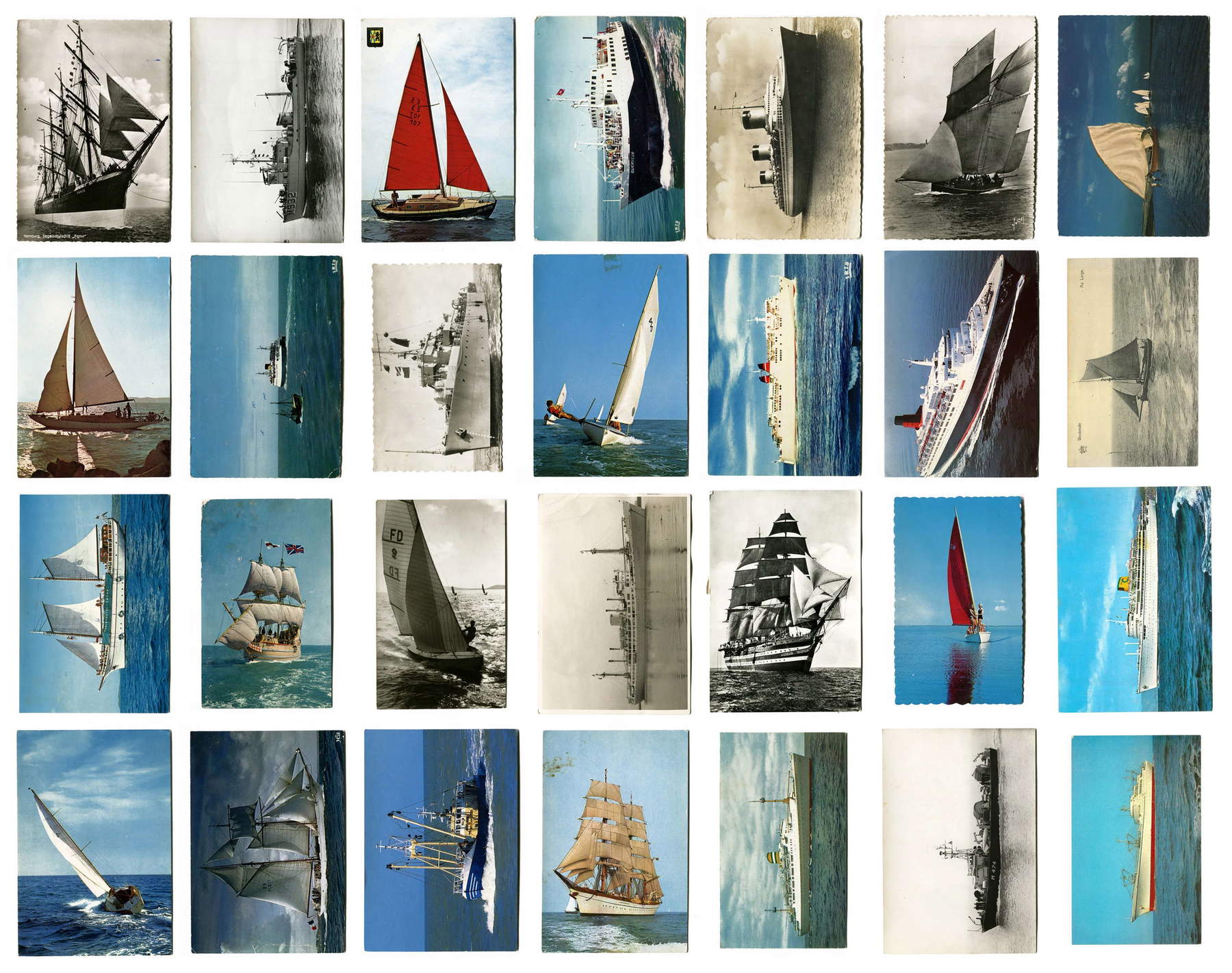
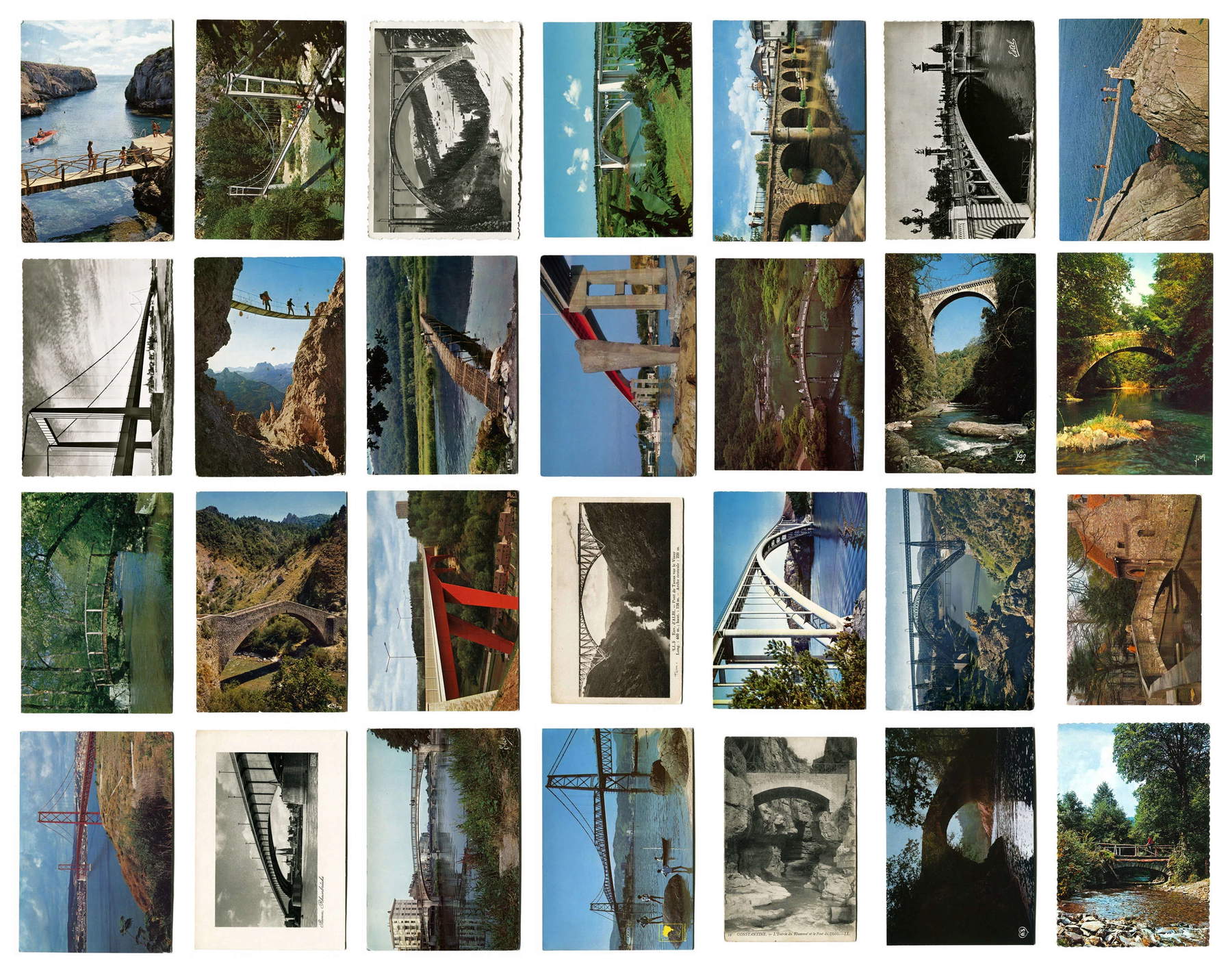
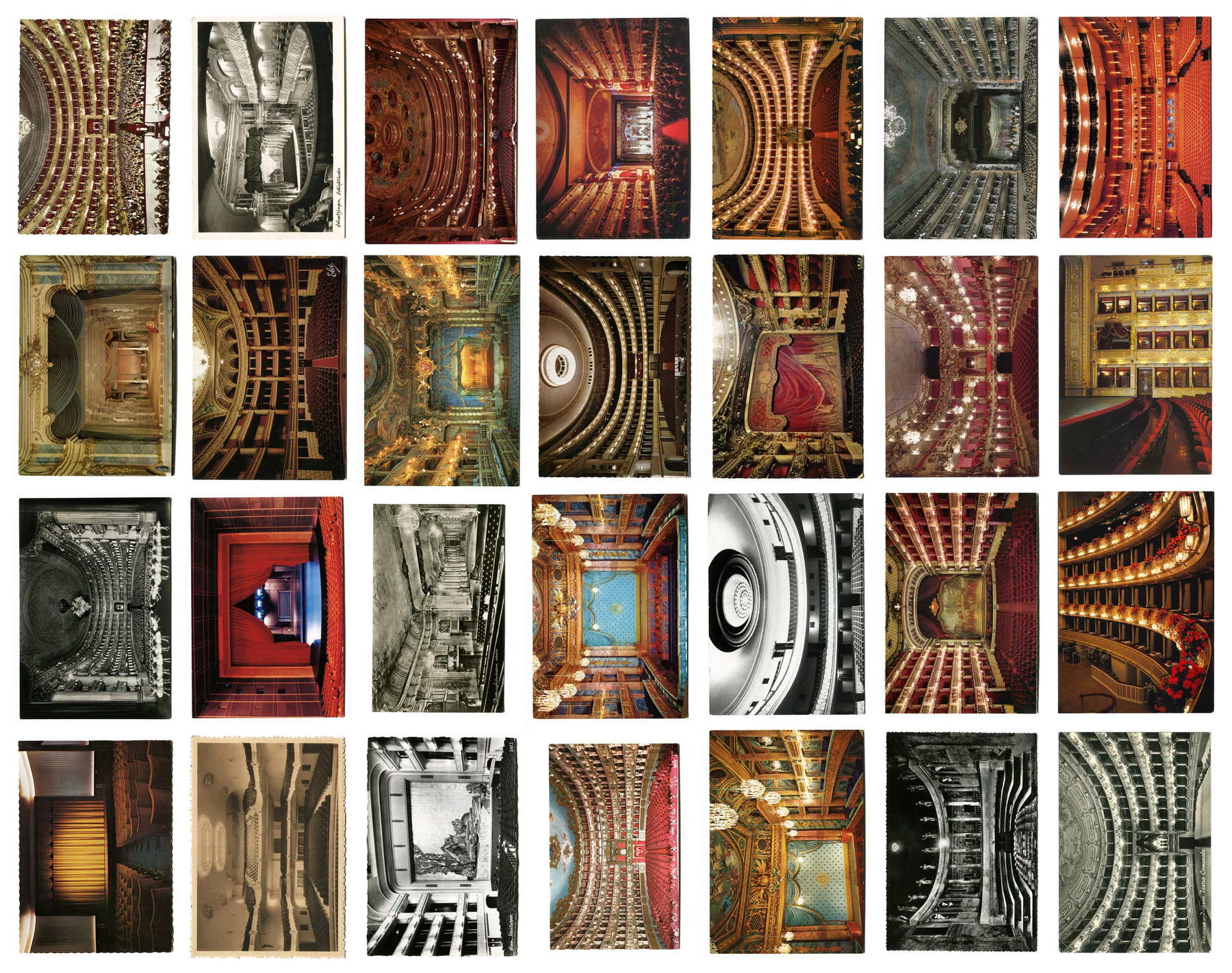
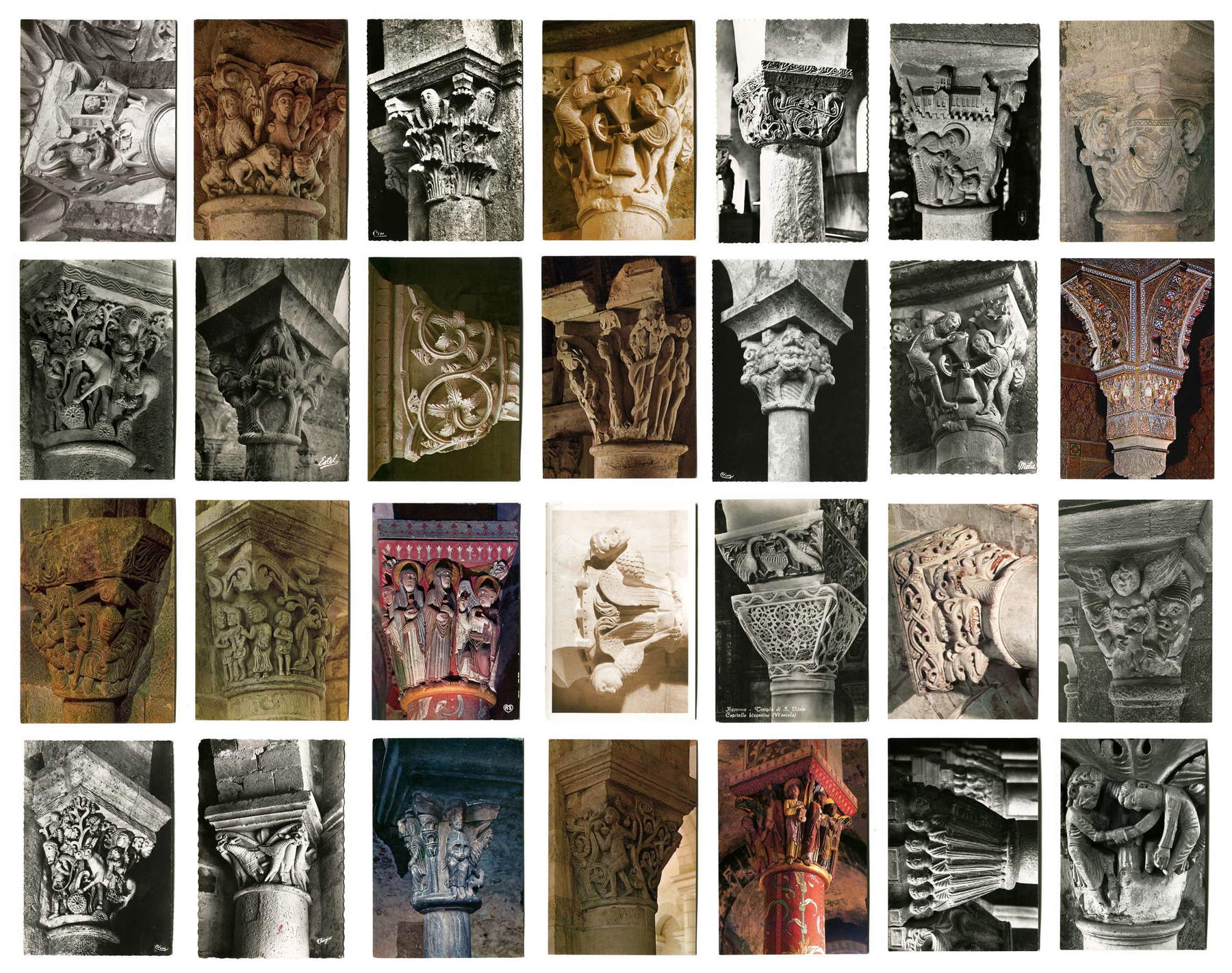
Alongside the publication, the project also includes a performative component entitled El fantasma de la libertad, planned for 2026 and realized as an unannounced intervention during the Biennale. The action will take place between the Giardini and the Arsenale, configuring itself as a series of chance encounters in which the body itself becomes an exhibition support. The stated inspiration is Luis Buñuel’s film, from which derives an idea of freedom understood as discontinuity and displacement of forms of perception and representation.
The curatorship of the project is entrusted, as mentioned, to Carles Guerra, while the Spain Pavilion team includes Ingrid Sala in the role of Studio Manager, Carolina Ciuti as assistant curator, Alessandra Biscaro as PR manager and the Zak Group studio for graphic design. The organizational structure is supported by AC/E and AECID, in collaboration with Fundación Botín, as part of the strategy of international promotion of Spanish contemporary art.
The project Los restos also fits into the theoretical context of the 61st Art Biennale, directed by Koyo Kouoh and articulated around the theme In Minor Keys, an invitation to go beyond traditional exhibition logics to explore noncanonical forms of listening, attention and knowledge. In this framework, Vilanova’s installation takes on additional significance, posing as a reflection on the fragility of archival systems and the unstable nature of contemporary cultural memory.
Through the transformation of the Spanish Pavilion into an environment devoid of hierarchies and fixed narrative structures, Los restos proposes a different mode of experiencing art, in which vision is not organized according to linear criteria but is constructed through dispersion, repetition and accumulation. The work thus invites us to consider images not as static elements to be interpreted, but as active fragments of a continuous process of production and dissolution of meaning.
|
| Oriol Vilanova turns the Spain Pavilion into an "anti-museum" at Biennale 2026 |
Warning: the translation into English of the original Italian article was created using automatic tools. We undertake to review all articles, but we do not guarantee the total absence of inaccuracies in the translation due to the program. You can find the original by clicking on the ITA button. If you find any mistake,please contact us.