





Through October 30, 2026, Venice is hosting *Return | Ritorno*, a solo exhibition by artist and poet Arch Hades. The exhibition is held in the spaces of the Scoletta Battioro e Tiraoro in Venice, a building overlooking the Grand Canal that was originally used for religious worship and has now been transformed into an exhibition space. Supported by the Erarta Foundation, the project presents a series of new large-scale works that occupy the building’s three levels and create a journey through painting, sculpture, sound installation, and poetic language. With this exhibition, Arch Hades continues a body of work that intertwines different artistic languages and has, in recent years, found its own distinctive voicein the intersection of visual art and spoken word. Return | Ritorno represents a further development of this path and expands upon the reflections already explored in the solo exhibition held in London in 2025, an occasion on which the artist experimented for the first time in an organic way with the combination of recited poetry and visual works to create synesthetic perceptual experiences.
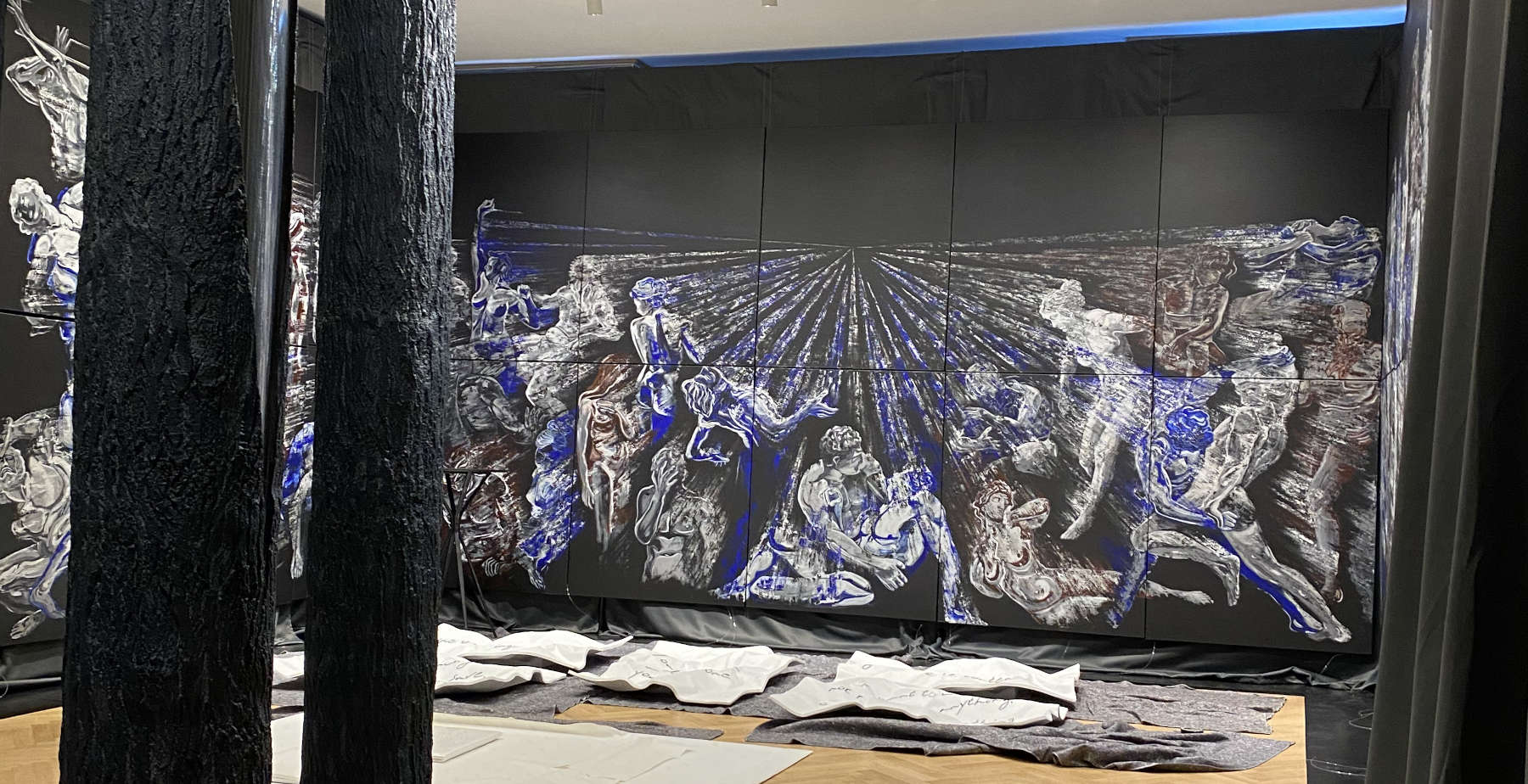
The entire Venetian project revolves around a reflection on the human condition, addressed through images suspended between vulnerability and control, fragility and resilience. Painting, sculpture, and sound intertwine to construct interior environments that invite the visitor to engage with universal themes such as memory, loss, time, identity, and the search for meaning. The centerpiece of the exhibition is the work that gives the entire project its title, Return, created in 2025. It is an imposing pictorial composition consisting of twenty-two panels that, taken together, reach a length of thirteen meters. The work occupies the walls of the building’s upper floor and unfolds as a sort of grand visual narrative composed of sixty-three life-size figures.
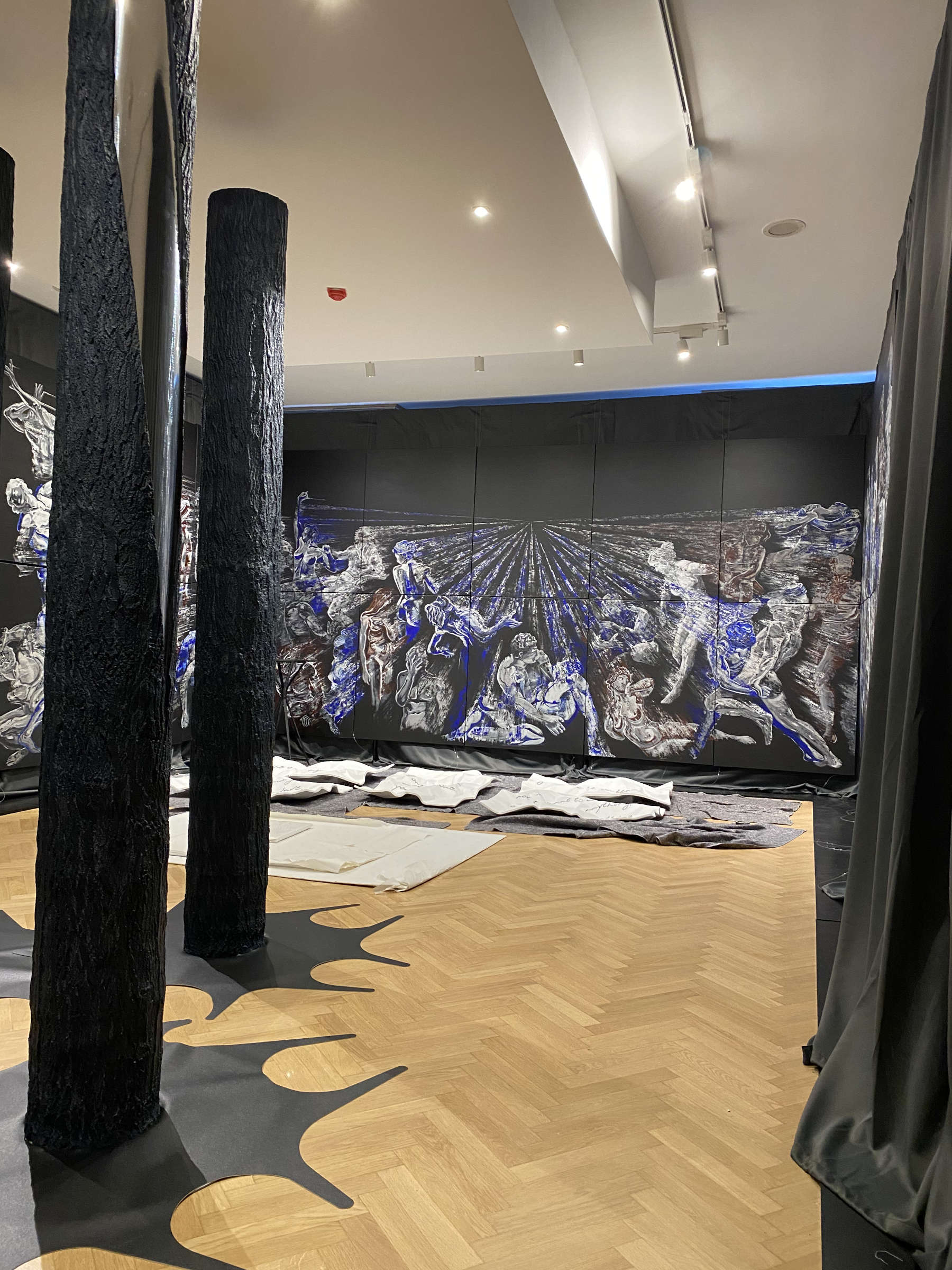
The monumentality of the work explicitly evokes the tradition of Greco-Roman sculpture, to which Hades pays homage through meticulous anatomical construction and a formal approach marked by precision. The installation of the painting across three different walls also references the structure of altar triptychs, establishing a direct dialogue with the history of religious art and with the symbolic function of the space hosting the exhibition. The sixty-three figures depicted by Hades appear simultaneously isolated and interconnected. Each expresses its own emotional state, yet all seem drawn toward a central point in the composition—a sort of abyss that acts as a magnetic and symbolic force. The work thus aims to function as a grand visual meditation on human life, in which bodies become vehicles for emotions, memories, and inner transformations. Through a rigorous construction and a carefully orchestrated composition, Hades addresses themes that have run through his poetic work since its inception, transforming them into monumental images.
Alongside the large-scale pictorial installation is Sphinx, a new work from 2026 conceived as an immersive sculptural installation. Crafted from mirrored chrome, the work occupies one of the exhibition’s main spaces and presents itself as a structure that simultaneously evokes the world of ancient civilizations and that of possible future scenarios. The installation evokes both the ruins of ancient Egypt and imagery from contemporary science fiction. The reflective surfaces continuously alter the perception of space and directly engage the visitor, who becomes an integral part of the work through their own reflection.
A central role within the exhibition is also reserved for the Confessions series, launched in 2025 and still in development. The works belonging to this cycle originate from a private practice that has accompanied the artist since childhood: the writing of personal diaries.
Over the years, Hades has accumulated a vast archive of notes, reflections, and autobiographical fragments. For this series, the artist retrieves phrases from pages that have since been abandoned or discarded and transforms them into large-format visual works. The texts are enlarged and transferred onto surfaces that evoke materials such as concrete and marble, giving the words a physical and monumental presence. Through this process, the private dimension of writing is made public. Thoughts originally intended for intimacy become part of a collective and shared experience. According to the artist, the possibility of making feelings and emotions public helps to create connections between people and reduce the sense of individual isolation.
The series also represents a significant departure within his artistic practice. For the first time, text does not merely serve as a conceptual support for the images but takes on a central role within the work itself. Words become visual matter, concrete objects capable of exploring the relationship between memory, confession, and permanence.
At the heart of Arch Hades’s practice remains a particular focus on the themes of loss, existentialism, and the relationship between the individual and digital society. His works explore how people construct their identities in a context increasingly influenced by social media and constant communication.
In recent years, Arch Hades has established a strong presence on the international art scene through numerous solo exhibitions. These include Arch Hades, held at Ladbroke Hall in London in 2024, and We Are All Just Passing Through, presented at 8 Berkeley Square in 2025. Also in 2025, the artist was included among the twenty-nine featured artists in the Post-War and Contemporary Art Day Sale organized by Christie’s in London to raise funds for the Great Ormond Street Hospital Charity. Through her collaboration with Licht Feld Gallery, she also regularly participates in major international art fairs, including ZONAMACO, Art Miami, Art Dubai, and the LA Art Show.
Her work also includes performances and public interventions. Among her most recent engagements are her participation in the opening of the Italian Pavilion at the Venice Architecture Biennale and the “re” poetry symposium held at Ladbroke Hall in 2025.
 |
| Arch Hades brings “Return” to Venice, a journey through poetry, art, and the human condition |

Warning: the translation into English of the original Italian article was created using automatic tools. We undertake to review all articles, but we do not guarantee the total absence of inaccuracies in the translation due to the program. You can find the original by clicking on the ITA button. If you find any mistake,please contact us.

























 IT
IT FR
FR DE
DE ES
ES CN
CN


