





The National Archaeological Museum of Naples and the Museo e Real Bosco di Capodimonte return to share the same exhibition space with The Echo of Artemis, a project that marks the preview of the MiC’s recent acquisition destined for Capodimonte and relates ancient and eighteenth-century production within a single reading path.
In the MANN Atrium, from May 13 to June 8, 2026, the confrontation is built around the celebrated ArtemisEphesia (2nd century AD) and the Sacrifice to Diana of Ephesus (circa 1790) by Filippo Tagliolini, a refined biscuit from the Royal Factory of Naples that has recently entered the Capodimonte collections. The initiative is part of a framework of increasingly close collaboration between the two institutions, which share a heritage that naturally dialogues between Farnese antiquities and neoclassical reinterpretations, restoring to the public the continuity of the same visual tradition through the centuries.
The statue of Artemis Ephesia belongs to the original 16th-century nucleus of the Farnese Collection, transferred from Rome to Naples in 1788. On the occasion of that transfer, sculptor Giuseppe Valadier made the statue’s missing head, feet and hands in painted bronze, integrating the ancient parts in alabaster. The sculpture then remained on display in the Palazzo degli Studi until 1805, when the Farnese collections were transferred to the New Museum of Old Naples, the institution from which the present MANN derives.
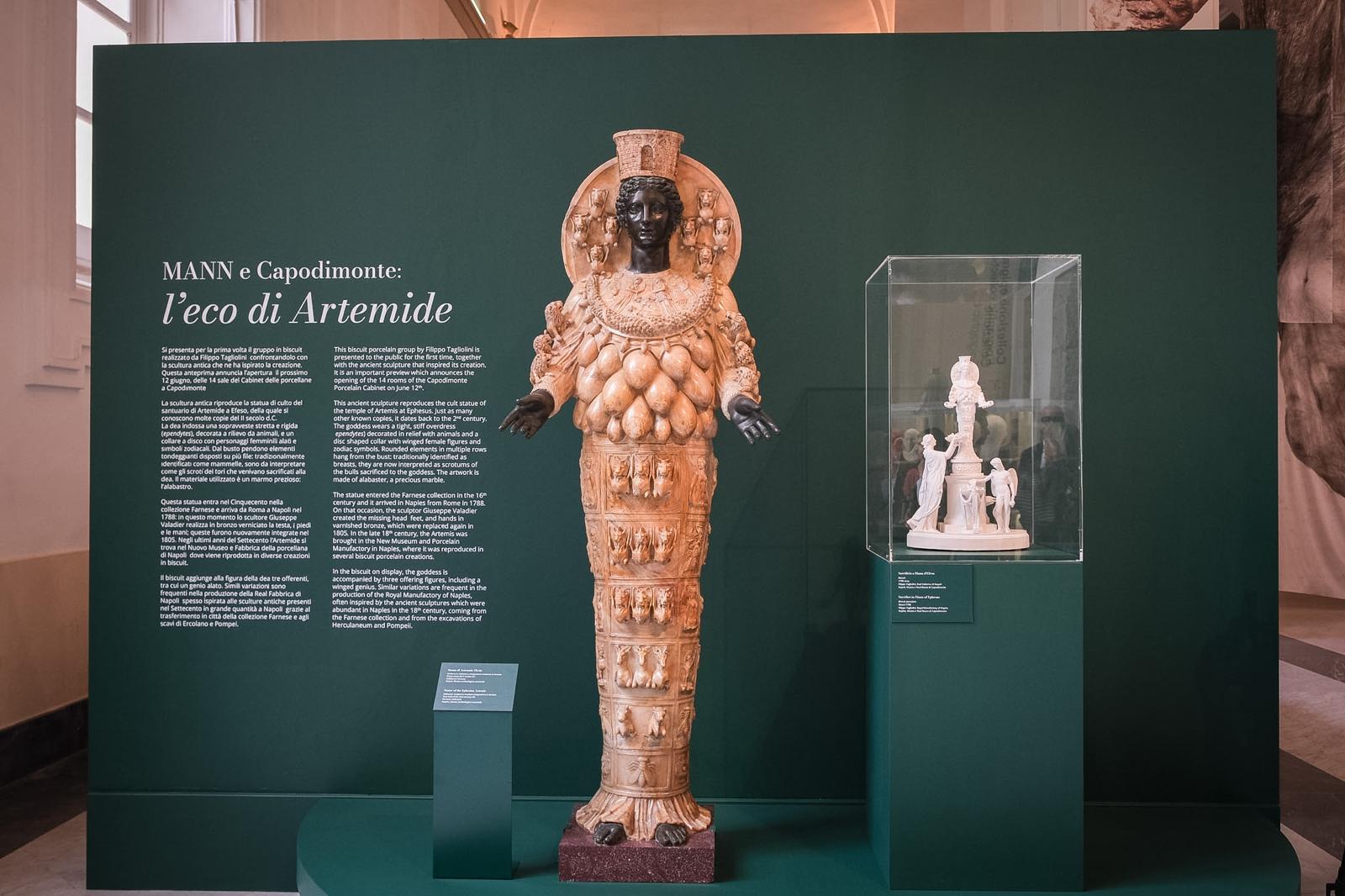
The archaeological work belongs to the group of numerous Roman replicas of the cult statue from the shrine of Artemis at Ephesus, which can be dated to the second century AD. The goddess wears a rigid surcoat, known as an ependytes, decorated with animal figures, while winged female figures and zodiac symbols appear on the disc collar. On the bust, on the other hand, hang round elements arranged in several rows, traditionally interpreted as breasts but now generally identified with the scrotums of bulls sacrificed to the goddess. In the sanctuary at Ephesus, the original cult statue, from the Archaic period, was made of wood and adorned with clothing and jewelry.
The iconographic fortune of the Ephesian Artemis in the eighteenth century was also particularly relevant to the Royal Porcelain Factory in Naples, where the subject was reproduced in several versions in biscuit. The specimen presented at the MANN integrates the figure of the goddess with three offerers, including a winged genie. Variants of this type turn out to be frequent in the production of the Neapolitan manufacture, which often drew inspiration from antiquities then in the city, from both the Farnese Collection and the excavations at Herculaneum and Pompeii.
In all likelihood, this piece was produced in the late 18th century. Art historian Alvar González-Palacios confirms this by citing the diaries of Carlo Gastone della Torre di Rezzonico, who saw the work precisely in the workshops of the Royal Porcelain Factory. Rezzonico describes with amazement the Artemis Ephesia (or Diana), which arrived from Rome along with other statues in the Farnese collection, as an extraordinary work characterized by the contrast between the bronze of the head and limbs and the alabaster of the bust, thickly historiated with natural symbols.
“Building connections of times and identities: with this assumption,” comments the Director General of the National Archaeological Museum of Naples, Francesco Sirano, “we welcome the installation on the echo of Artemis as the first step of a cultural journey that will lead us to narrate, in a dimension always shared with the public, the historical fortune and topicality of our collections. We have chosen to embark on this journey by physically starting from our Atrium, a point of reception for visitors and a dialogue with Capodimonte, the city’s other major state museum, which is inextricably linked to MANN in terms of museographic profile and heritage history. This exhibition, valuable, scholarly and, at the same time, of particular popular impact, is the forerunner of a good practice of inter-institutional synergy to communicate the exceptional nature of our archaeological and historical-artistic heritage.”
“The recent acquisition by the Ministry of Culture for Capodimonte, which allowed the precious work from the antiquarian market to remain in Italy,” says the Director General of the Capodimonte Museum and Real Bosco, Eike Schmidt, “was a beautiful opportunity for this significant collaboration with the MANN. Great is the suggestion in admiring the 18th-century porcelain next to the sculpture that inspired its creation. A preview that is meant to announce the opening at the Museo e Real Bosco di Capodimonte, next June 12, of 14 rooms all dedicated to porcelain, a path that for the first time makes one of the world’s largest and most important collections of this most precious art accessible to the public.”
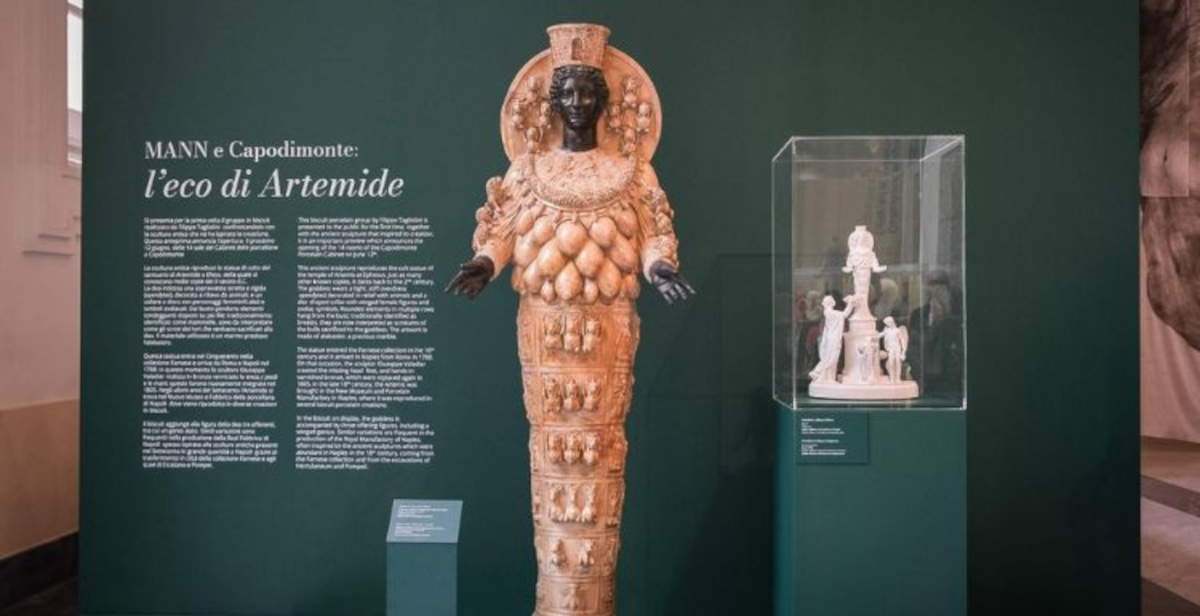 |
| Artemis Ephesia meets Tagliolini's biscuit at the MANN in Naples |

Warning: the translation into English of the original Italian article was created using automatic tools. We undertake to review all articles, but we do not guarantee the total absence of inaccuracies in the translation due to the program. You can find the original by clicking on the ITA button. If you find any mistake,please contact us.

























 IT
IT FR
FR DE
DE ES
ES CN
CN


