





From April 29 to Sept. 6, 2026, MAXXI L’Aquila will host AI WEIWEI: Aftershock, an exhibition entirely dedicated to Ai Weiwei (Beijing, 1957), a Chinese artist, architect and activist who is among the best-known figures on the international contemporary scene. The project is curated by Tim Marlow, director and managing director of the Design Museum in London, and is realized with the support of the City of L’Aquila. The exhibition is part of the program for the year in which the Abruzzo capital is the Italian Capital of Culture and is a tribute to the city and its recent history, particularly its relationship with the 2009 earthquake and the long process of reconstruction that followed. The venue for the exhibition is Palazzo Ardinghelli, a Baroque building that houses MAXXI L’Aquila and represents one of the most important interventions of architectural recovery following the L’Aquila earthquake. The dialogue between the works and the spaces of the palace constitutes one of the central axes of the entire exhibition project.
In fact,Aftershock takes shape as a confrontation between Ai Weiwei’s artistic research and the material and symbolic history of the building. The centerpiece of the exhibition is a series of works created after the 2008 Sichuan earthquake, dedicated to the memory of loss and the consequences of natural disasters, but also to man-made conflicts, corruption and the forms of contemporary tragedy. Also emerging in parallel is a reflection on resilience and the capacity of creative effort to transform trauma into testimony.
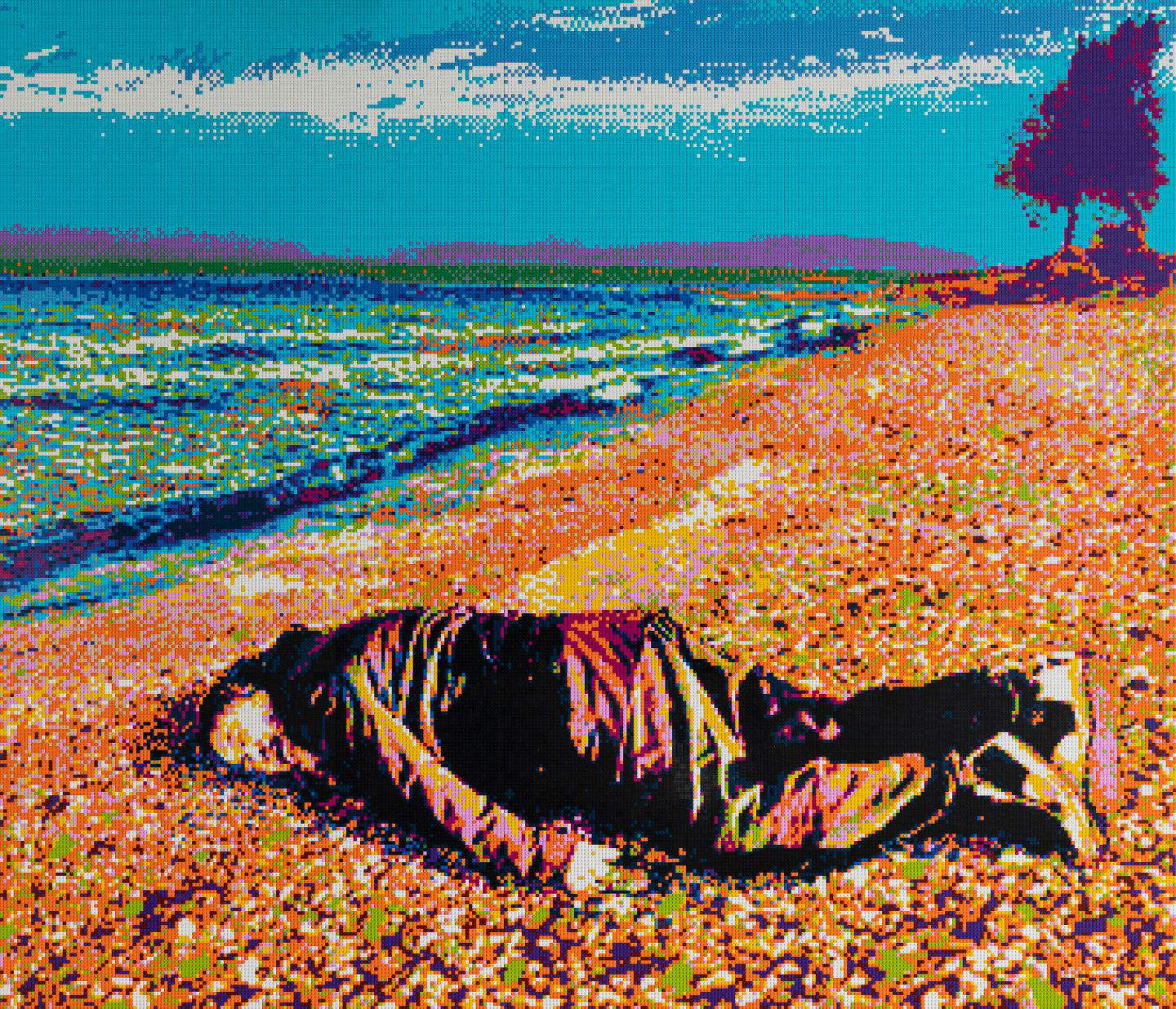
The itinerary brings together about seventy works, some of them previously unseen, and spans the artist’s entire career. Installations, videos, photographs, sculptures and works conceived as paintings alternate with reinterpretations of well-known images from the history of Western art, from Edvard Munch to Vincent van Gogh to Ed Ruscha, reworked through the use of toy bricks, a material that Ai Weiwei has been employing for years because of its ability to evoke as much the logic of the pixel and digital reproduction as that of the mosaic and modular construction.
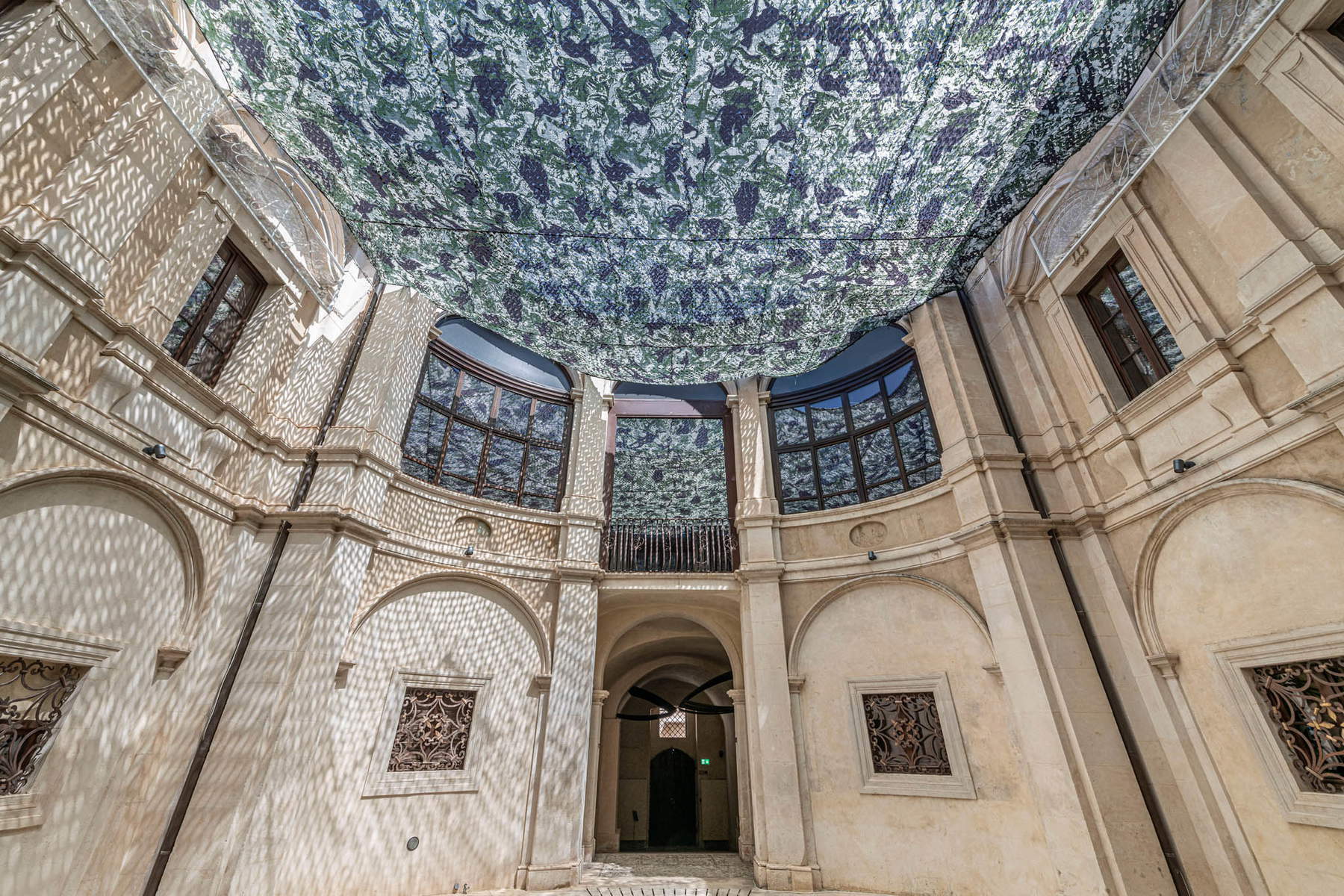
The dialogue with Palazzo Ardinghelli already begins in the inner courtyard, where a veil from the 2025 series Camouflage Nets is installed. The work reworks camouflage patterns in a key that introduces unexpected elements: figures of cats emerge among the weaves, fragile and innocent presences that refer to civilian victims of conflicts. In the same space, the LED work Кому війна, кому мати рідна, also from 2025, takes up a Ukrainian proverb that can be translated as “For some people war is war, for others war is a dear mother,” opening a reflection on the inequalities produced by conflicts and the benefits that some people derive from wars.
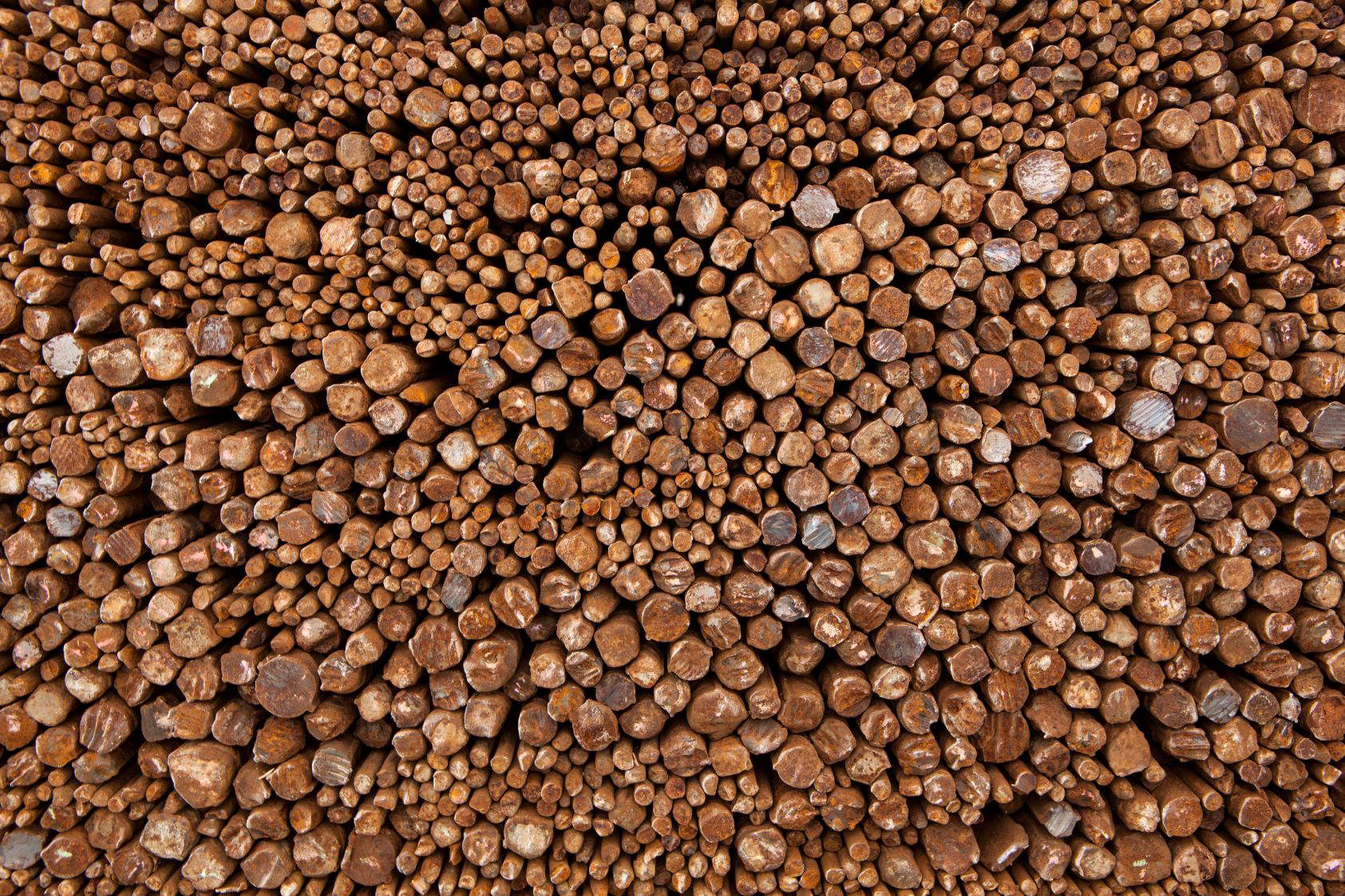
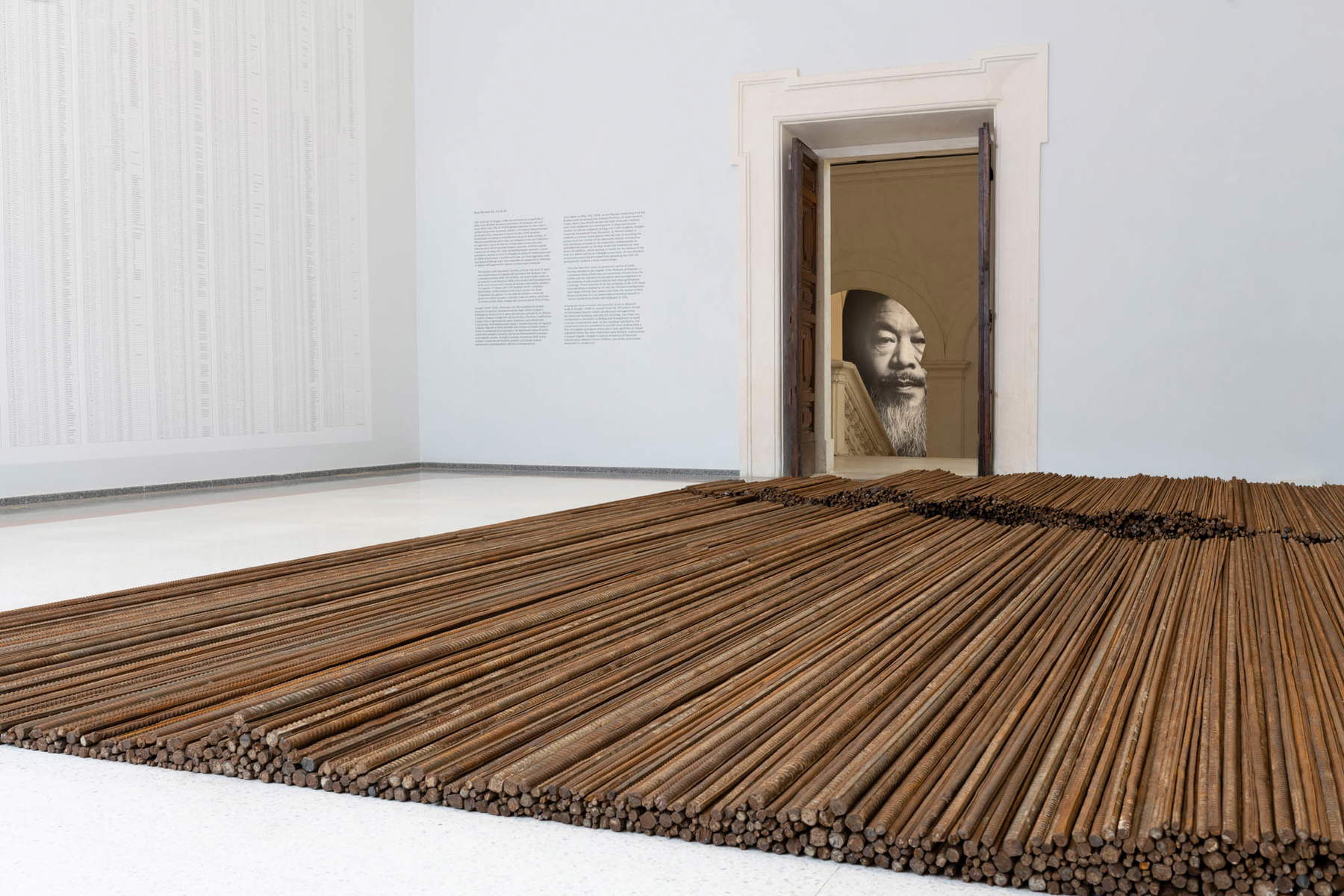
On the main floor, the first three exhibition rooms house installations dedicated to Straight, one of the central works of Ai Weiwei’s entire output and among the most important memorials in recent contemporary art. The work was created in response to the Sichuan earthquake of May 12, 2008, an earthquake measuring 8 on the Richter scale that claimed more than 90,000 lives, including 5,197 students who died in the collapse of school buildings.
Made between 2009 and 2012 with 150 tons of steel rods clandestinely recovered from collapsed schools, Straight is presented in L’Aquila for the first time articulated in three separate rooms. The work is accompanied by a list of the names of the students who died, the result of a civil investigation also promoted by the artist himself, who publicly denounced the seismic inadequacy of the schools and the responsibilities linked to corruption and building mismanagement, suffering major personal consequences for this. The 2014 commemorative sculptures Rebar and Case, which insist on the relationship between testimony, mourning, and public responsibility, also refer back to the same affair.
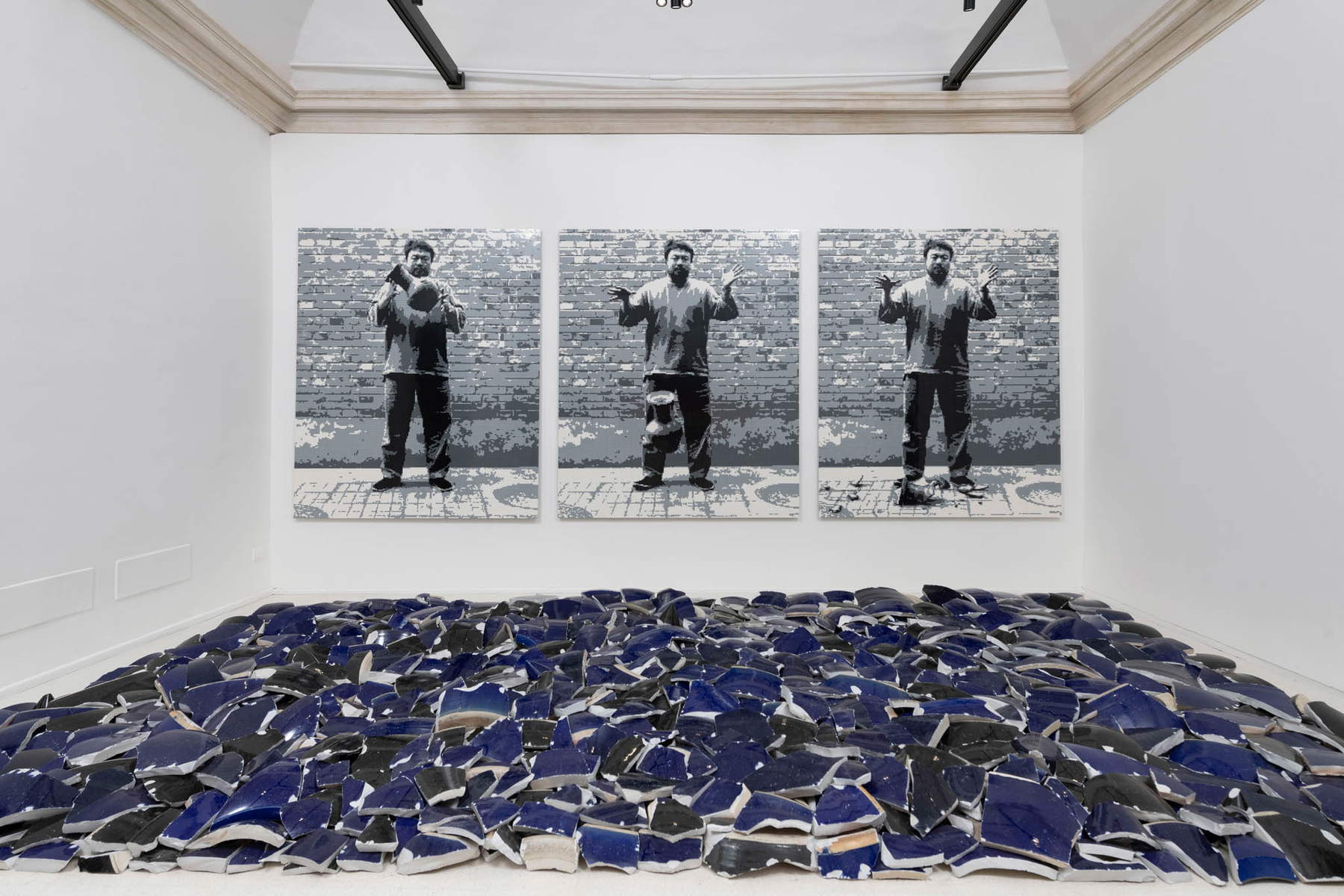
A subsequent room addresses the theme of heritage destruction and memory reconstruction. On the floor are fragments of ancient porcelain sculptures destroyed in 2018 by the Chinese state inside an artist’s studio. The work, Left Right Studio Material, transforms that repressive episode into an act of recording and permanence. The work relates to the photographic reworking of Dropping a Han Dynasty Urn from 1995, one of Ai Weiwei’s best-known works, and to FUCK ’EM ALL from 2024, which quotes Ed Ruscha and reverses his imagery in a gesture of open opposition. Both works are made from toy bricks and are part of a selection of wall sculptures found along the route.
This is followed by a series of vitrines reminiscent of museum or luxury boutique displays and housing seemingly ordinary or deliberately disturbing objects. Marble Toilet Paper, a toilet paper roll carved from marble, becomes an ironic anti-monument to the emergence of Covid-19. Sex toys and handcuffs made of jade, a material traditionally associated with purity in Chinese culture, empty its original symbolic value. A reconstructed crutch made of glass, wood and stainless steel, on the other hand, refers back to the secret detention suffered by the artist in 2011 and becomes a symbol of control and oppression.
On display in the corridor are photographs taken between 1983 and 1993 during his years in New York, the city where Ai Weiwei lived for about twelve years. These are spontaneous images, rarely constructed, depicting people, urban details and fragments of everyday life. The next section presents three filmic works: 2016’s Floating, dedicated to the migration crisis and the plight of refugees; 2017’s Laziz, which tells the story of a tiger in the Gaza zoo, read as an indirect victim of conflict; and 2013’s Dumbass, a visually striking work that takes the form of a parody of a heavy metal music video and satirically reconstructs the artist’s secret detention experience. Further on, two video works from 2005, Beijing: The Second Ring and Beijing: The Third Ring, document the urban transformation of Beijing in the early 2000s, at a time of accelerated expansion and redefinition of the city.
A room devoted to the theme of war and military engagement collects Last U.S. Soldier Leaving Afghanistan from 2022, a reconstruction with bricks of a photograph depicting the last U.S. soldier as he leaves the Kabul airport, and Combat Vases from 2023, a white porcelain military helmet interpreting the Western response to the war in Ukraine, which the artist considers insufficient and ineffective. Opposite, U.S. Flag in Black reinterprets the American flag through thousands of black and white buttons and establishes a direct reference to Jasper Johns, an important figure in Ai Weiwei’s visual education.
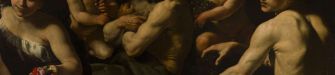
In the following rooms, the comparison with Western art history becomes more explicit. Scream reworks Edvard Munch’s The Scream, while Untitled (After Van Gogh) combines Vincent van Gogh’s 1888 The Sower at Sunset with a photograph of a locust invasion in Pakistan in 2020, accentuating a dimension of crisis and instability. These works are joined by Small black chandelier, a black glass chandelier decorated with eerie figures that, instead of reflecting light, seems to absorb it. Also appearing is a reproduction of Guido Reni’s Atlanta and Hippomenes, an image that Ai Weiwei had known through European art books that belonged to his father.
A later section introduces a repertoire of symbolic and mythological creatures. Yu-Niao, a flying mouse mentioned in ancient Chinese texts, is transformed into a three-dimensional structure made with the traditional kite technique. On the floor, blue Murano glass fragments of 2017’s Twitter Bird evoke the decline of the social network icon that had allowed the artist to communicate after being excluded from Chinese platforms. On the wall, St. George and the Dragon from 2022 reinterprets Vittore Carpaccio’s work with bricks, while a six-clawed dragon applied to the near-perfect replica of a Ming vase opens a reflection on the concept of authenticity and copying.
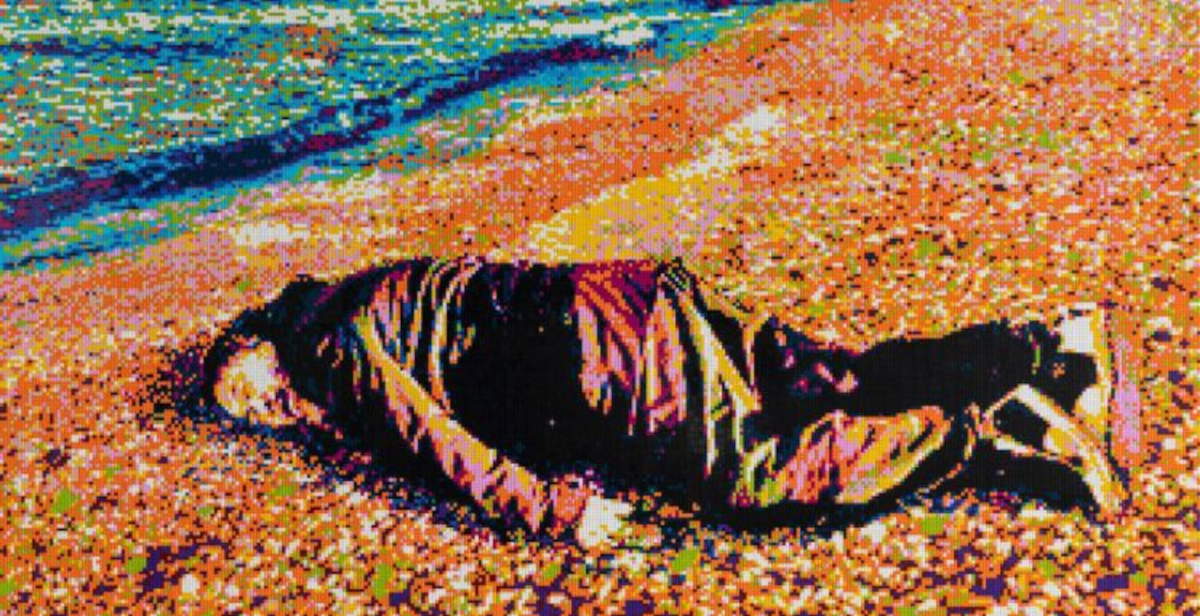
After the Death of Marat addresses the theme of the refugee crisis through a direct reference to the photograph of the body of Alan Kurdi, the Syrian child found dead on the beach of Lesbos in 2015 while fleeing his country. Ai Weiwei replaces the figure of the child with his own image, maintaining the same pose and turning the reference into an act of identification and responsibility. The discourse continues with 2016’s Lotus, made from life jackets recovered in Lesbos and used by refugees during the sea crossing.
The theme of painting as mirror or portal runs through another installation built from Balthus’ Thérèse Dreaming. The work, made from toy bricks, includes quotations from Ai Weiwei’s own earlier works, such as Han Dynasty Urn with Coca Cola Logo from 1994 and Stool from 1997, in which two stools are melted down, altering their original function. The two sculptures are also placed in the same room, producing further perceptual slippage.
After visiting the Ukrainian front, Ai Weiwei created new works that investigate the relationships between memory, history and conflict, some of which are presented here for the first time. These include Whitewashed Remnants of History of the State of Emerging Future Works from 2025, which uses chairs from the Qing Dynasty along with a Neolithic vase, a life jacket and a camouflage military uniform, all covered in white. The operation undoes the original use of the objects and builds a new system of meanings related to war and historical stratification. The same logic returns in two wall works composed of camouflage jackets arranged in a circular form, one whitewashed and the other covered with buttons. The last room is dominated by F.U.C.K. from 2024, the artist’s first work made with buttons. Four World War II military stretchers support a hand-sewn composition that is essential and deliberately provocative. The work recalls the 2000 exhibition Fuck Off in Shanghai and offers a reflection on the radical polarization running through the present, as much in political discourse as in social dynamics.
"The exhibition AI WEIWEI: Aftershock marks a pivotal moment in the history of the museum on the eve of the fifth anniversary of its opening," says Maria Emanuela Bruni, President of the MAXXI Foundation. “As the title of the exhibition highlights, Ai Weiwei’s works activate a reflection on contemporary reality: at a time when it is human beings who cause conflict, corruption and natural disasters, the artist’s works are ’aftershocks’ that shake consciences by raising questions that are always relevant.”
"Welcoming Ai Weiwei ’s Aftershock in the year in which we are the Italian Capital of Culture takes on a particularly profound meaning: his work, marked by the experience of the Sichuan earthquake, dialogues authentically with the recent history of our city, transforming pain into memory and responsibility," says Pierluigi Biondi, Mayor of L’Aquila. “Ai Weiwei’s work, capable of crossing languages and disciplines, strongly reminds us of the role of art as an instrument of truth, memory and civil commitment, in defense of human rights and freedom of expression. L’Aquila has chosen to restart from culture after the 2009 earthquake. Exhibitions like this one strengthen our vocation for international dialogue and leave an important message, especially for young people: from wounds can come a new awareness and a more just and shared future. I thank MAXXI for the valuable work that made this exhibition possible, offering L’Aquila a cultural event of international significance.”
“All of Ai Weiwei’s work invites us to look at the world in different ways, through different objects and materials,” continues TimMarlow, curator of the exhibition. “Although rooted in the artist’s personal experience, it has universal resonance: Ai Weiwei’s relentless struggle for the right of individuals to express themselves freely and not be subject to the illegal dictates of authoritarian regimes stems from the hardships he himself faced, as well as his abiding concern for those who are powerless to resist.”
 |
| At MAXXI L'Aquila, exhibition dedicated to Ai Weiwei recounts catastrophes and memory |

Warning: the translation into English of the original Italian article was created using automatic tools. We undertake to review all articles, but we do not guarantee the total absence of inaccuracies in the translation due to the program. You can find the original by clicking on the ITA button. If you find any mistake,please contact us.



















 IT
IT FR
FR DE
DE ES
ES CN
CN


