





From June 16, 2026, to April 4, 2027, the Santa Giulia Museum in Brescia will host *Franca Ghitti: A Story of Other Alphabets*, the first solo exhibition dedicated to the Brescia-born artist at the museum complex. The project, conceived specifically for the museum’s spaces, brings some of the most representative works of her oeuvre into dialogue with the permanent collection, creating a unique encounter between contemporary art and the museum’s holdings. Sponsored by the City of Brescia and the Brescia Museums Foundation, curated by Fausto Lorenzi and Elena Pontiggia, and organized in collaboration with the Franca Ghitti Archive Foundation, the exhibition represents the fourth installment of Palcoscenici Archeologici, the program that fosters an encounter between the city’s historical and archaeological heritage and the most significant expressions of Italian contemporary art. The initiative thus continues the effort to highlight artists connected to the Brescia region, thanks in part to the cultural legacy of Bruno Romeda.
Franca Ghitti ’s (Erbanno, 1932 – Brescia, 2012) artistic practice is rooted in the Camonica Valley, a land rich in historical and cultural heritage that profoundly influenced her creative language. From rock carvings, a UNESCO World Heritage Site, to Romanesque parish churches, and the artisanal traditions of ironworking, the artist was able to transform these elements into an original expressive vocabulary. Even the ancient Vicinie, communal forms of mutual aid, resurface in her works as symbols of shared memory and collective identity.
The exhibition offers a direct comparison between the work of Franca Ghitti, one of the most important figures in contemporary Italian sculpture, and the two thousand years of history recounted by the museum itinerary of the monastery of San Salvatore and Santa Giulia. Her works engage in dialogue with artifacts and testimonies from the Roman, Lombard, Carolingian, Romanesque, and Renaissance periods, evoking gestures, rituals, and practices of daily life. Drawn from the Franca Ghitti Archive, the Franca Ghitti Museum in Darfo Boario Terme, and a private collection, the works on display bring together sculpture, painting, and architecture.
Originally from the Camonica Valley, the artist has developed a body of work within the Italian art scene by repurposing materials associated with manual labor—such as weathered wood, nails, sawmill scraps, and forge residues, transforming them into works that recall objects and structures of daily life such as maps, tables, doors, gates, and kiosks. These elements take on a monumental and symbolic dimension, evoking both the world of labor and that of ritual. Rather than nostalgically celebrating a vanished world, Ghitti has constructed a contemporary language capable of reinterpreting popular culture and community traditions from a perspective open to international dialogue. As she herself recalled, her goal was not to find an individual voice, but to give space to the many voices of a community and a territory, transforming local memory into a universal reflection.
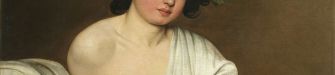
The exhibition begins in the rooms dedicated to the history of the Benedictine women’s monastery of San Salvatore and Santa Giulia and to the tradition of monastic life. In this context, two paintings are presented, *Child with Cat* and *Tale of the Valley No. 2*, testaments to Franca Ghitti’s artistic beginnings. One of the central aspects of her artistic exploration is already evident in these works: the organization of space through backgrounds that resemble actual maps, foreshadowing developments that would characterize her mature artistic language. The same space also features the Tavole chiodate, described by the artist as a sort of “magic box,” in which the repetition of the nail transforms into a system of signs, almost a primordial script. Alongside them are the Mappe, wooden surfaces carved with gouges and chisels that evoke the rock engravings of the Camonica Valley and render a symbolic geography composed of fields, woods, human activities, and settlements.
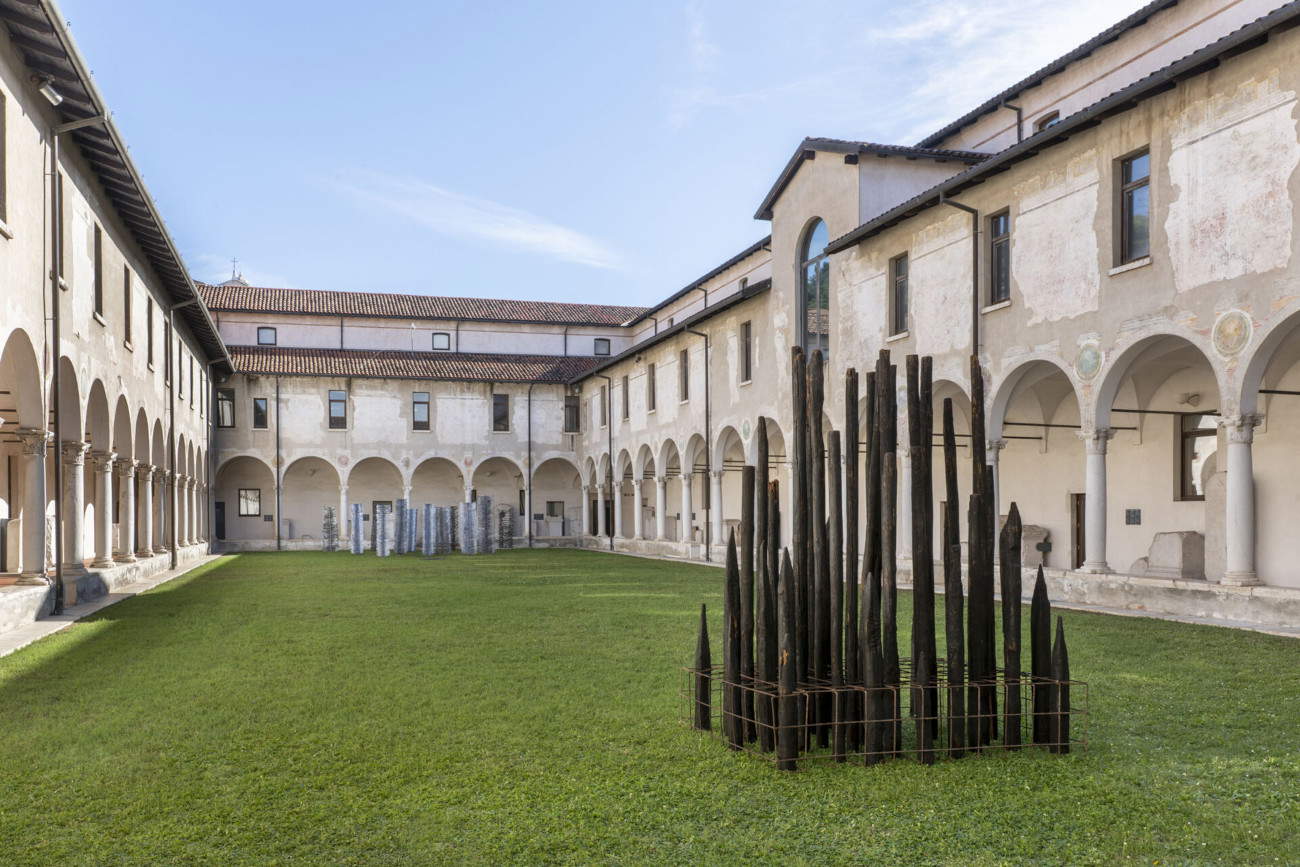
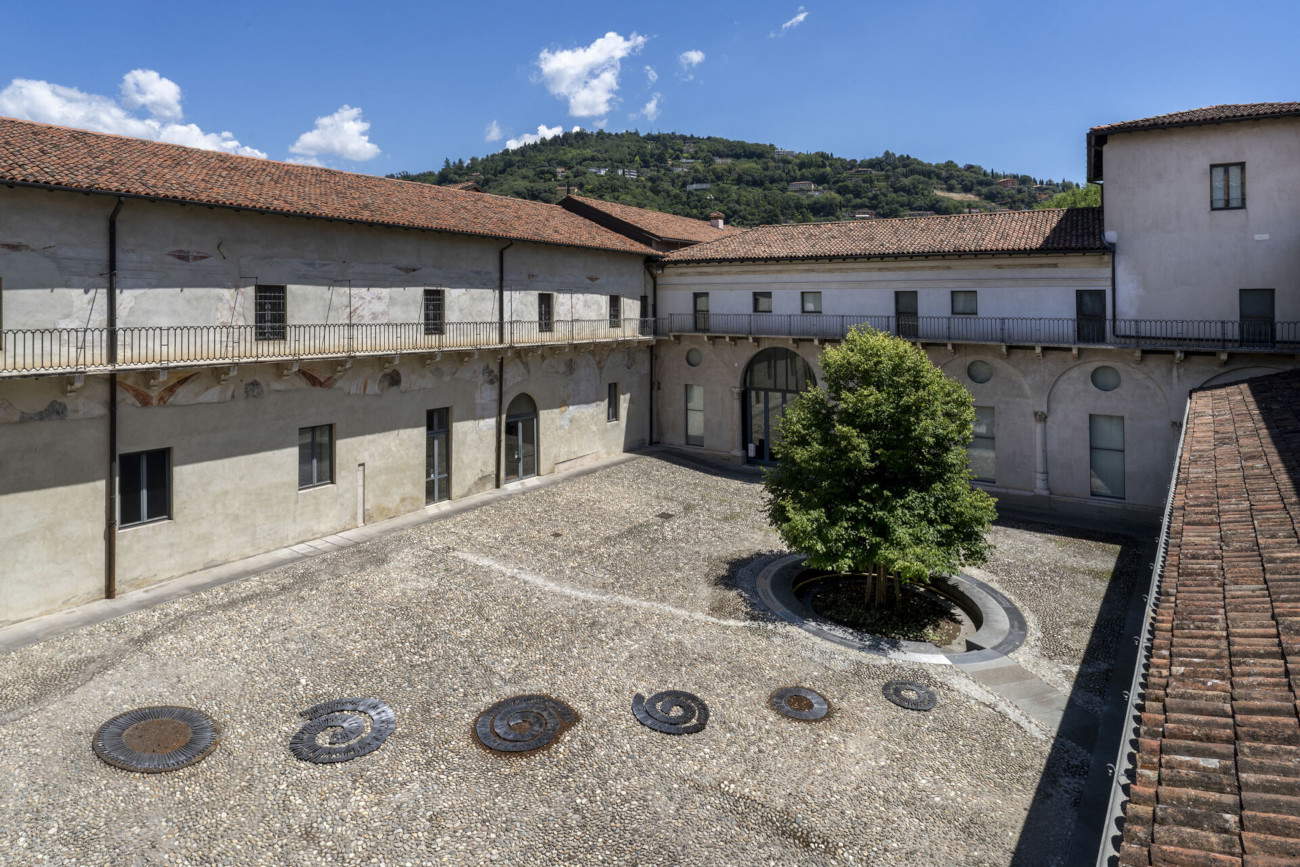
The exhibition continues in the cloister of Santa Maria in Solario, where visitors encounter Mappa: lunario, a monumental composition that, through the rigorous repetition of signs, introduces the installations Meridiane, spirali e labirinti, arranged on the courtyard’s paving. Created with recycled materials from ironworking, these works are structured according to essential geometric patterns that evoke the ancestral need to demarcate, protect, and safeguard a space.
In the large Renaissance cloister, in the northern part of the monastery, two different interpretations of the theme of the forest are juxtaposed. The Forest / Sail-Trees, characterized by silver-colored trunks and a canopy composed of metal scraps, ideally recalls the forest evoked in Shakespeare’s Macbeth, though here it takes on a positive value of protection and refuge. Opposite it, the Burned Forest offers a more dramatic reflection on loss and destruction, transforming the material consumed by fire into a symbol of a wounded memory and a violated nature.
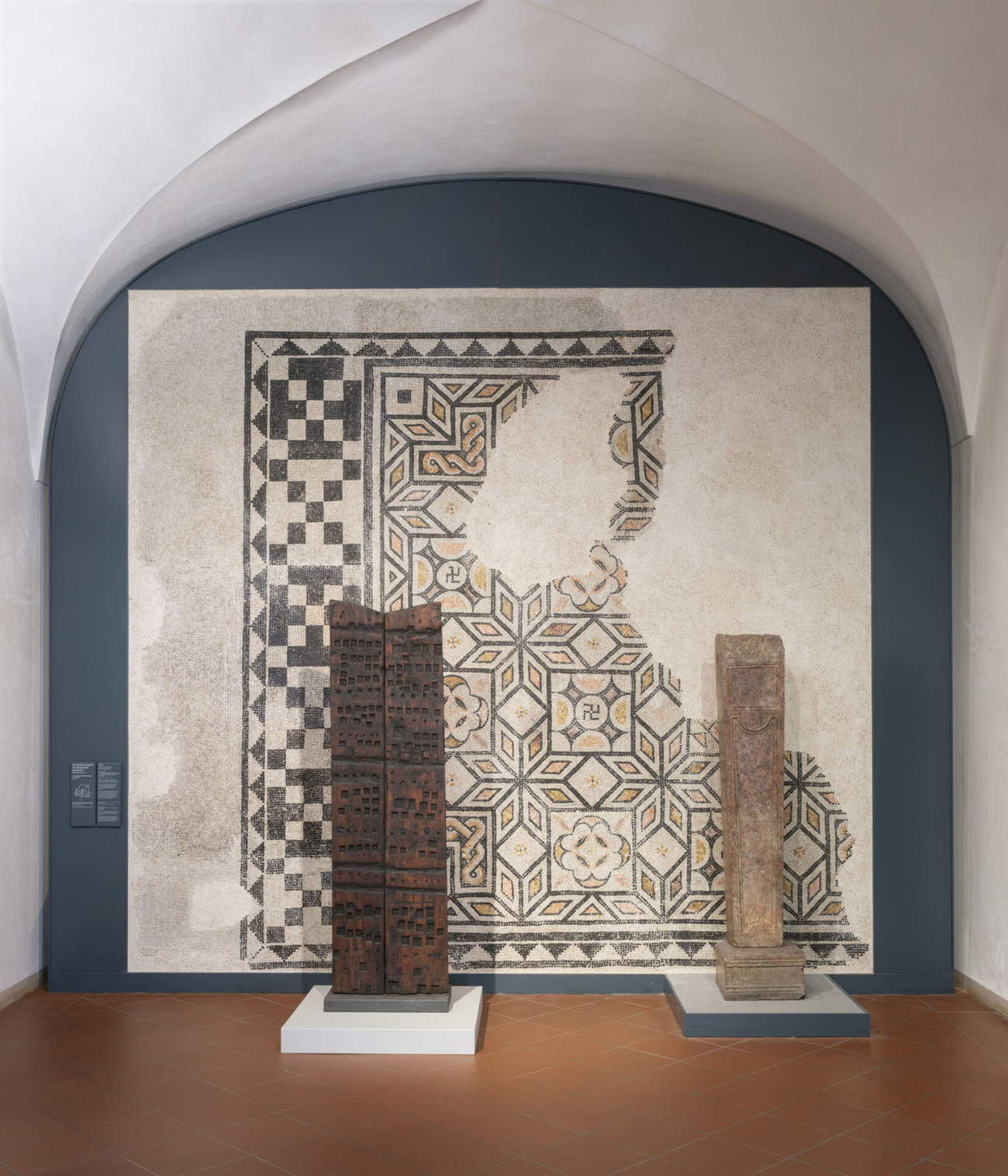
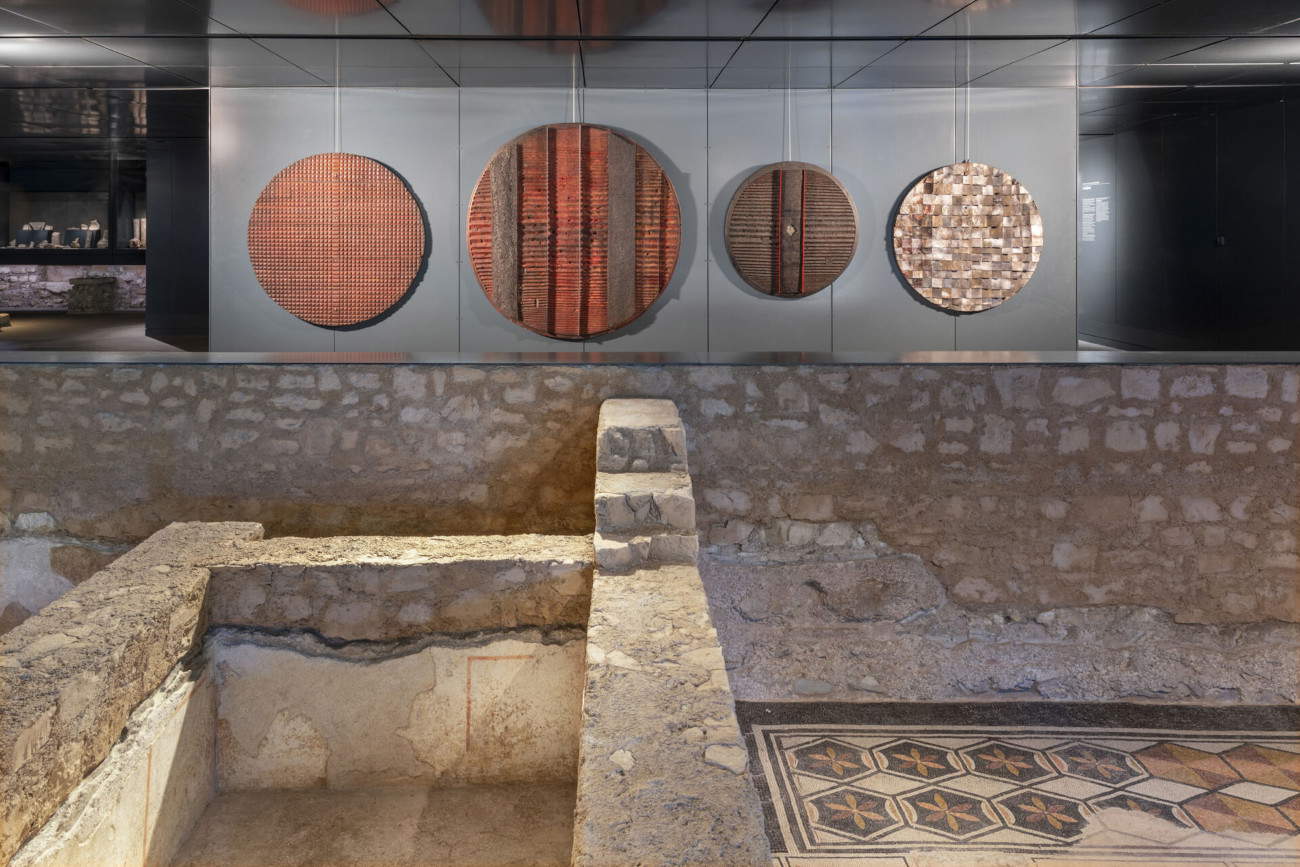
The tour then leads to the museum’s Roman section, among the remains of ancient domus decorated with mosaics and ornamental elements. On display here are the Tondi, created by repurposing the bottoms of large barrels. Through the circular form, Ghitti connects practical knowledge and symbolic thought, the memory of labor and the cultural dimension. These works take the form of true anthropological maps that recount daily gestures, conservation practices, and activities linked to community life. Also in the Roman section are the Pagine chiodate and the Porta del silenzio. The former arise from the assembly of ledgers, documents, and newspapers salvaged and transformed into surfaces dense with memory, traversed by a dual script composed of marks traced with chalk and old nails. The material itself, marked by time and wear, becomes the protagonist of a narrative that speaks of toil, suffering, and memory.
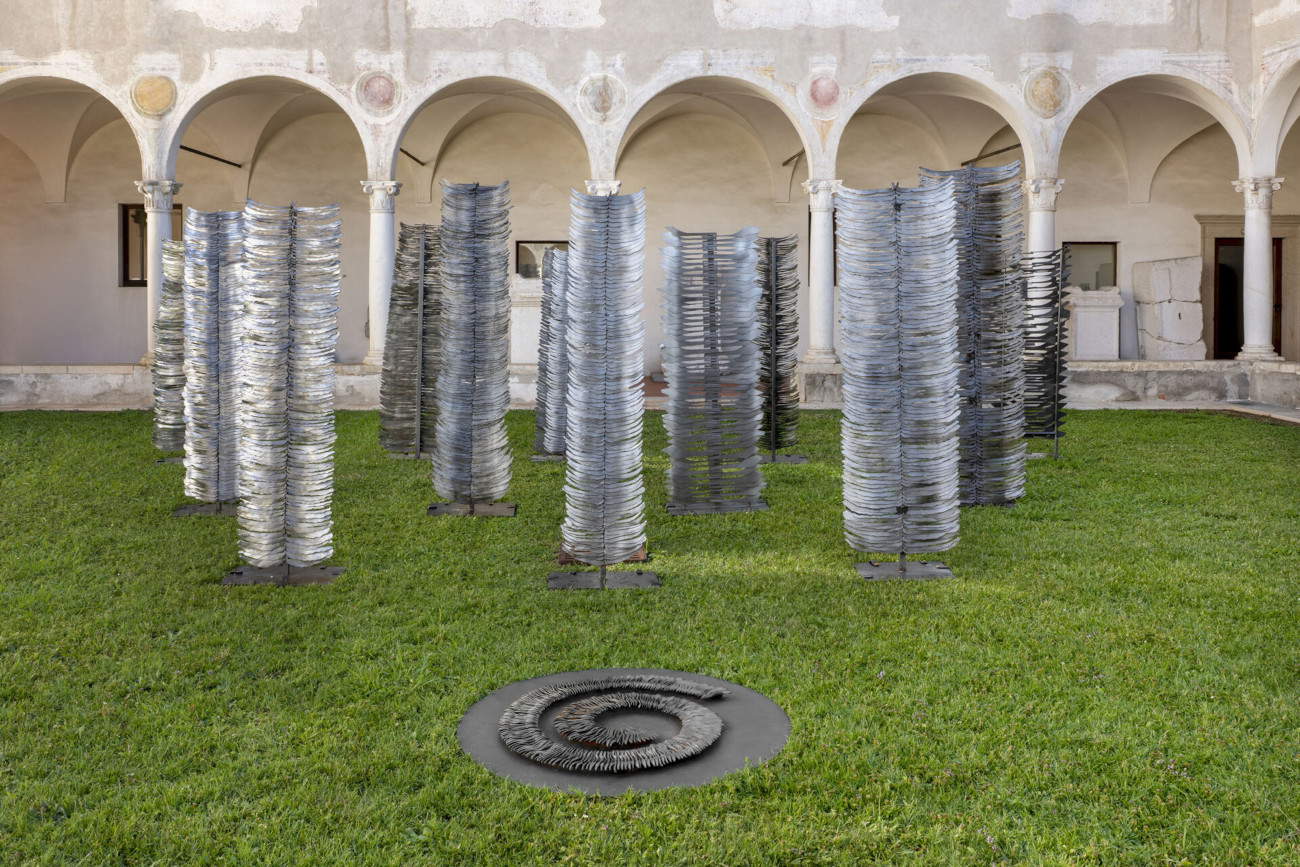
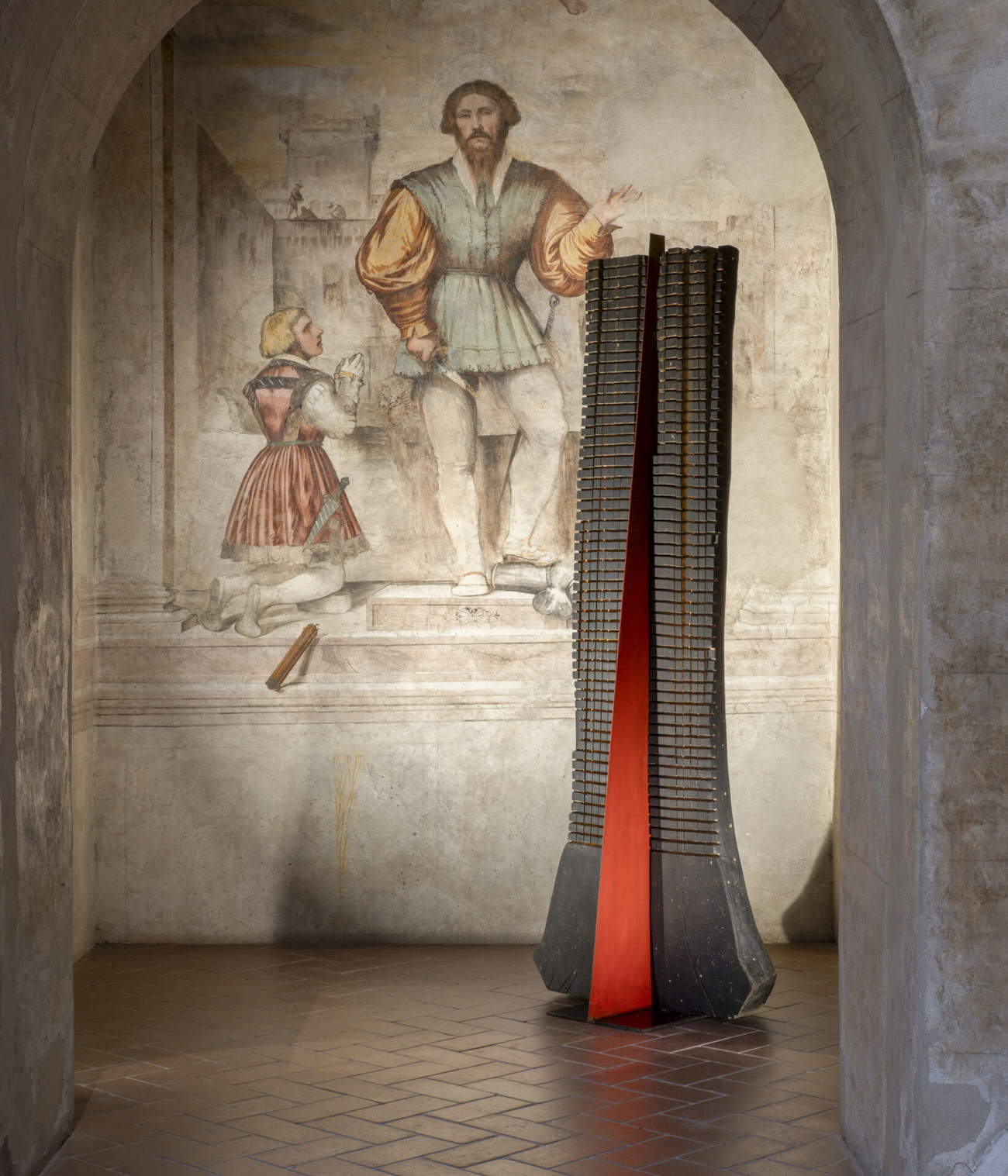
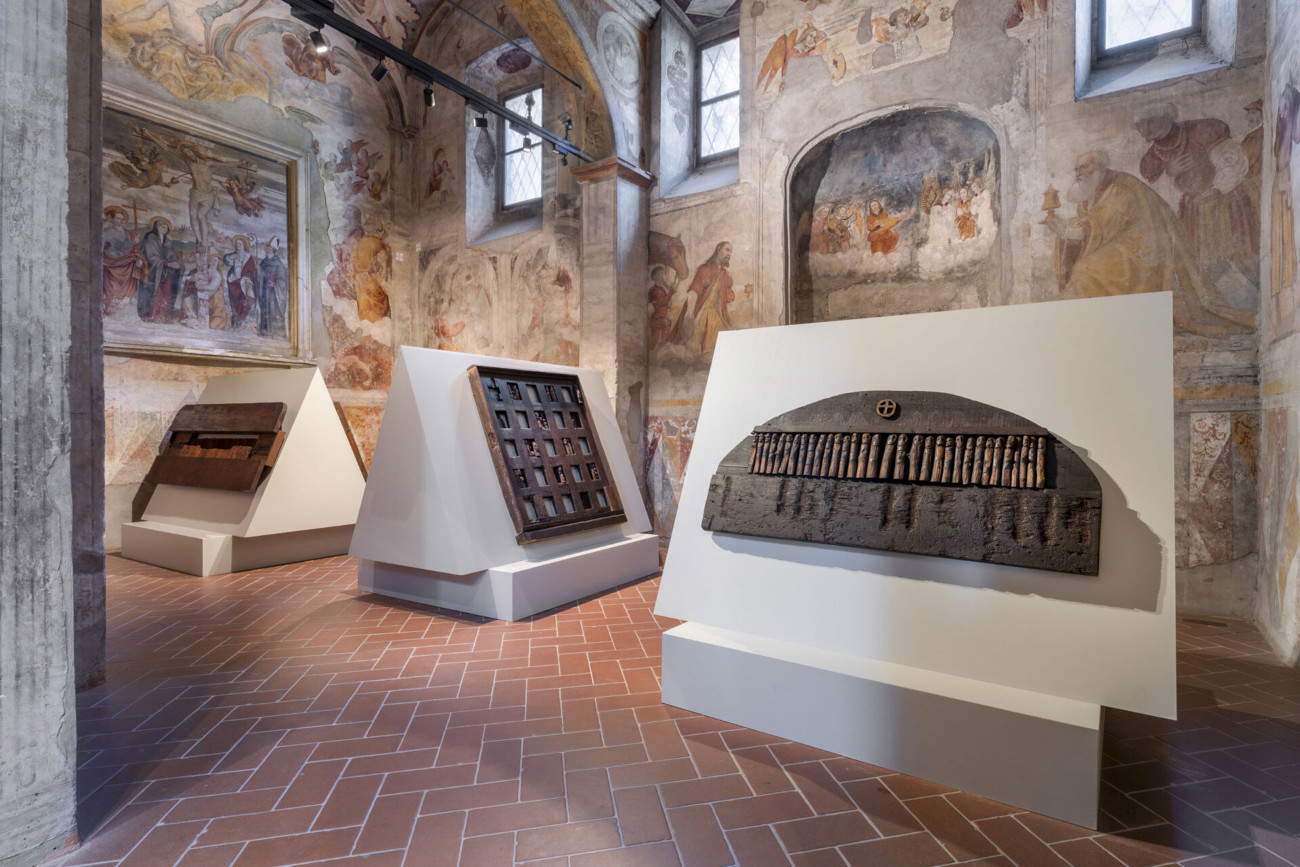
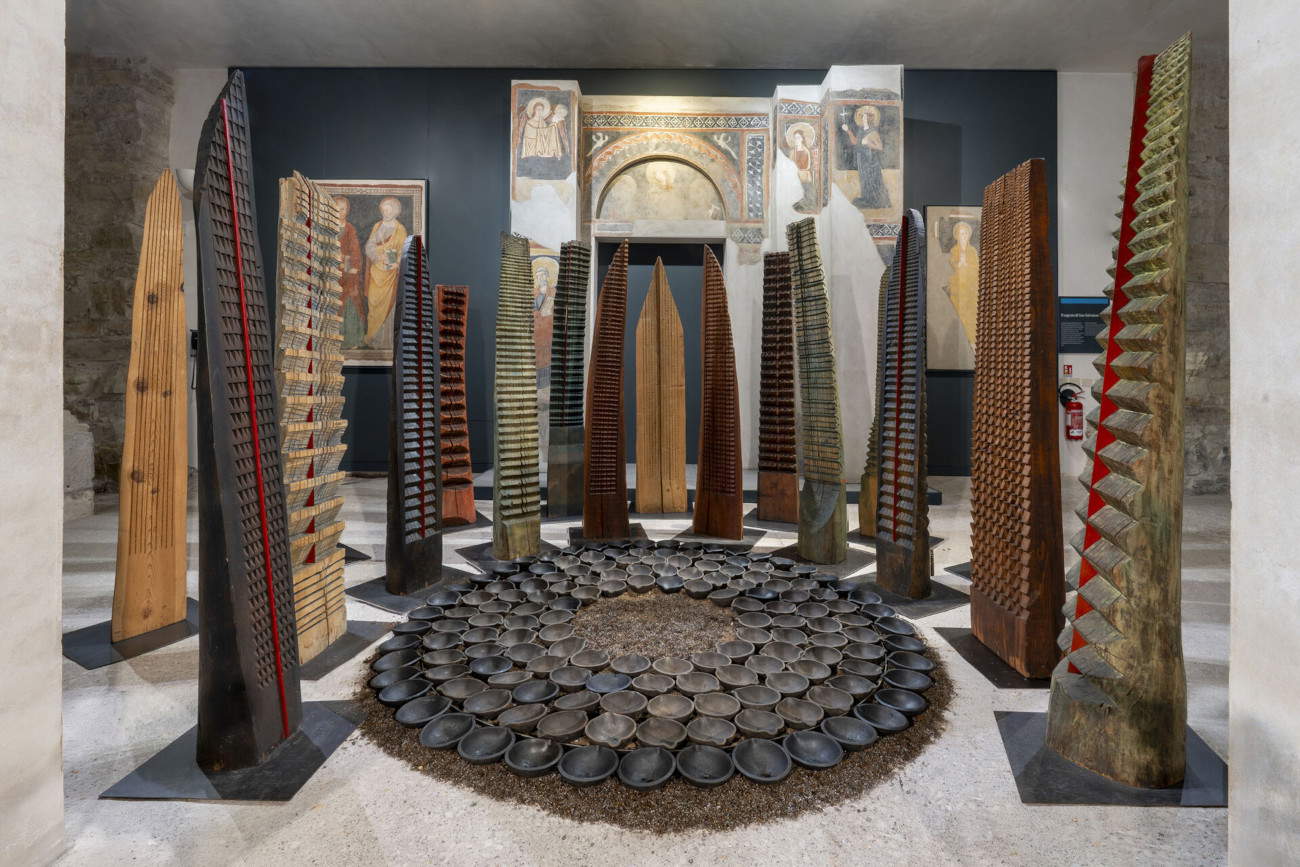
The exhibition continues in the section dedicated to the Age of the Communes and the Signorias, where wooden and glass-block works interact with capitals, frescoes, and Romanesque and Gothic artifacts. The sculptures evoke that “lesser Romanesque” style so dear to the artist and are ideally linked to the tradition of medieval stained-glass windows. The Basilica of San Salvatore brings together some of the most emblematic works from Ghitti’s oeuvre, united by a strong spiritual dimension. At the center of the ancient narthex stands a new Forest, formed by Book-Trees: wooden stelae that evoke the concept of knowledge preserved and passed down. Notches, engravings, and marks construct a silent script entrusted to the material itself. In this space, the forest becomes a metaphor for collective memory and the continuity of life beyond individual existence. Beside these works stands the circle of offerings, composed of ladle cups from ancient forges—objects that take on ritual and symbolic significance here, transforming into instruments of a secular liturgy dedicated to the community. In the chapel of Sant’Obizio stands Albero-ferito, a stele pierced by a deep gash highlighted by a red strip. The work engages in an ideal dialogue with the figure of the warrior saint depicted in Romanino’s frescoes and evokes the theme of vulnerability and resilience.
In the Chapel of the Virgin, on the other hand, several Vicinie are on display—panels composed of wood salvaged from antique domestic and artisanal furnishings. Their name evokes the historic community assemblies of the Camonica Valley and becomes a symbol of solidarity, belonging, and collective organization. Through these works, Ghitti revives the memory of mountain communities and their forms of cooperation. The nearby Chapel of St. John the Baptist houses the monumental Tondo di Wiligelmo. This tribute to the famous Romanesque sculptor serves as a reflection on the value of artisanal and community culture, set against the anonymity of industrial society. Here too, the circular form—inspired by the bottoms of barrels observed in Franciacorta—constitutes the starting point of the research. In the western cloister of the basilica, along the UNESCO Corridor, one encounters the Gate of Europe, a work that reflects on the themes of borders, passage, and European identity. Conceived as both a threshold and a barrier, the work addresses issues that remain relevant today, such as migration, integration, and inclusion. Finally, in the Viridarium—Sculpture Park —stands the Scala, created by repurposing scrap metal from ironworking. The structure rises upward like two hands joined in a gesture of invocation, encapsulating one of the fundamental tensions in Ghitti’s poetics: sculpture as a tool for engaging with reality and, at the same time, as an element capable of redefining and reinterpreting the landscape.
Accompanying the exhibition is a comprehensive program of activities aimed at audiences of all ages, featuring guided tours, workshops for families and students, initiatives dedicated to holders of the Abbonamento Musei Lombardia pass, and informational materials distributed free of charge to visitors. The project is complemented by a catalog published by Skira, enriched with photographs of the installations by Ela Bialkowska and critical essays by Bruno Corà, Ara Merjian, Fausto Lorenzi, and Elena Pontiggia.
"Franca Ghitti. A History of Other Alphabets isnot merely a significant retrospective exhibition of an artist who is deeply representative of the Brescia region and community, engaging for the first time in a comprehensive dialogue with the artistic, material, and demo-ethno-anthropological heritage represented in the Santa Giulia Museum, thanks to the exhibition counterpoints distributed throughout the monastery of San Salvatore and Santa Giulia," states Francesca Bazoli, President of the Brescia Museums Foundation. "For Fondazione Brescia Musei, it also marks the return, three years after the last installment—the one dedicated to Fabrizio Plessi—of one of the most defining formats of our approach to temporary art installations. The Archaeological Stages, which Vezzoli, Isgrò, and Plessi himself had already staged, are elevated by Franca Ghitti to a level of material and formal dialogue of rare completeness and succeed not only in illustrating the journey of a great artist in her development through the materials of her homeland’s work, but also to help us better understand the evolution of the history of material culture—as well as artistic culture—in the valleys of our Brescia region, which finds its full representation in the immense two-thousand-year-old artistic repertoire housed in the Monastery of Santa Giulia.”
“Fondazione Brescia Musei returns to the world of plastic arts and Brescian sculpture with the exhibition dedicated to Franca Ghitti: a major retrospective that follows, just two years later, the equally ambitious retrospective dedicated to the sculptor Giuseppe Bergomi,” says Stefano Karadjov, Director of Fondazione Brescia Musei. “These initiatives respond to the profound and nobly identity-defining objectives that illustrate Brescia Musei’s strategy: to promote Brescia’s culture, the great artistic events of both the past and the present, and, whenever possible—as in the Archaeological Stages—to achieve both objectives simultaneously, promoting the artistic journey of this region, including its contemporary art, at the national and international levels. This, too, is part of the management of the City Museum, Santa Giulia, the extraordinary institution that, from prehistory to the Roman era, from the Romanesque to the Renaissance, presents in an integrated manner the great artistic encyclopedia of this region and its communities. It is no coincidence that the two exhibition projects mentioned—just a fraction of the many dedicated to artists from our region—were supported by the initiative to promote the contemporary art fund established in the name of Bruno Romeda, another sculptor, this time from the Sebino area, who has brought worldwide recognition to the ability of the men and women of these lands to manipulate ancient materials—primarily, but not exclusively, bronze—to create contemporary totems of their homeland."
“Archeological Stages, the evocative exhibition project that creates a dialogue between contemporary artists and the spaces and times preserved in the Santa Giulia Museum in Brescia—spanning from prehistory to the 16th century—brings to life an exceptionally brilliant idea and, specifically, deeply in tune with the work of Franca Ghitti,” adds Maria Luisa Ardizzone, President of the Franca Ghitti Archive Foundation. “A 1987 letter sent by the Brescian artist to Enrico Crispolti (who later published it), and considered her aesthetic manifesto, documents how *Una Storia di Altri Alfabeti* embodies what is deeply inscribed from the very beginning and governs the artist’s work. I quote a fragment from the letter in which Franca lists the three ‘equally important’ components that contribute to motivating her sculpture, the third of which identifies—though only partially and without naming them—the Other Alphabets. Here are the three components 1. The Romanesque roots widely attested in my homeland and place of formation, Lombardy, and which I have researched in their European variants; 2. The essential nature of the geometry and symbols of the prehistoric and primitive world, which I have compared with the symbolism of certain African tribes. 3. The inventory of signs, notches, knots, cup marks that I chose to incorporate into my sculpture, aware that they represent a sort of specific language—almost an alternative to the alphabet (as it has been for centuries)—used by sawyers, blacksmiths, carpenters, smiths, millers, shepherds, and farmers. A language, therefore, capable of defining a non-metropolitan, marginal civilization, while also indicating a range of intercontinental connections.” ”Other Alphabets" will be the name Ghitti gives to the Universe she has sought and identified in her long journey of reflection and striving toward the essential, to which her creativity has guided her.
|
| Brescia is honoring Franca Ghitti with a major retrospective dedicated to her at the Santa Giulia Museum |

Warning: the translation into English of the original Italian article was created using automatic tools. We undertake to review all articles, but we do not guarantee the total absence of inaccuracies in the translation due to the program. You can find the original by clicking on the ITA button. If you find any mistake,please contact us.

















 IT
IT FR
FR DE
DE ES
ES CN
CN


