



by Redazione 10/04/2026



Categories: Exhibitions / Disclaimer
At the Capodimonte Museum, Emilio Isgrò's unprecedented exhibition celebrating Naples and Neapolitan song. For the occasion, the scores of twenty-five famous songs from the Neapolitan musical tradition are subjected to the operation of Erasing.
Canto Napoli is the exhibition project that Emilio Isgrò (Barcellona Pozzo di Gotto, 1937) dedicates to the city of Naples and the Neapolitan song: the unprecedented exhibition is curated by Eike Schmidt, director of the Museo e Real Bosco di Capodimonte, and can be visited from April 10 to September 29, 2026 in rooms 81, 83 and 84 on the second floor of the Neapolitan museum.
A central figure in international contemporary art, Emilio Isgrò is a conceptual artist, painter, but also a poet, writer, playwright and director. Since the 1960s he has devised his famous erasures, an artistic language that intervenes on text by erasing it only in part, transforming it into a visual and conceptual field in which memory, language and meaning emerge. This practice, which has become his stylistic signature, has been applied to fundamental texts of Western culture, from The Betrothed to the Bible, from theOdyssey to the Italian Constitution, to an evolving project on the encyclical Laudato si’, initiated with Pope Francis and continued with Leo XIV. For the first time, however, his intervention is measured against the repertoire of Neapolitan song.


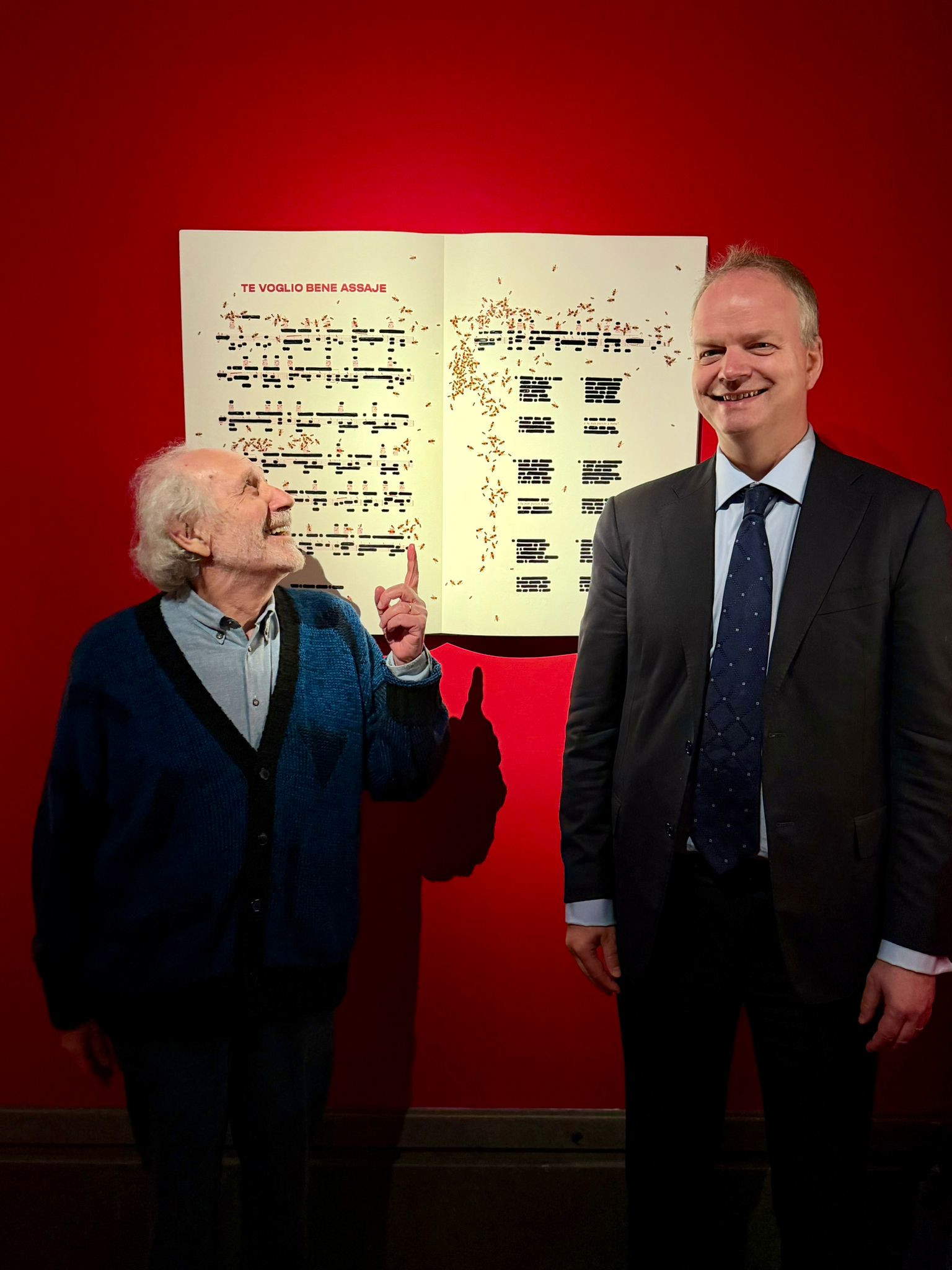
The scores of twenty-five famous songs of the Neapolitan musical tradition are for this occasion subjected to the operation of Erasing, which modifies their visual reading without completely annulling their content. Insects appear on the surfaces of the sheets, like presences attracted by the sweetness of melodies, verses and harmonies kept in the musical writing. The poetic structures of the songs, made of images, metaphors and collective memory, become visual matter on which Isgrò intervenes, generating a new layering of meaning. The result is a whole suspended between legibility and obscuration, close to a fragmented and almost hermetic text, capable of engaging the visitor.
The path traverses more than a century of Neapolitan song history, bringing together songs that have marked the collective imagination. They range from ’O sole mio (1898), in the double light and dark version, to Voce ’e notte (1904) and Reginella (1917), to Maruzzella (1954), Resta cu’ mme (1957), Tu si ’na cosa grande (1964) and Napul’è (1977).
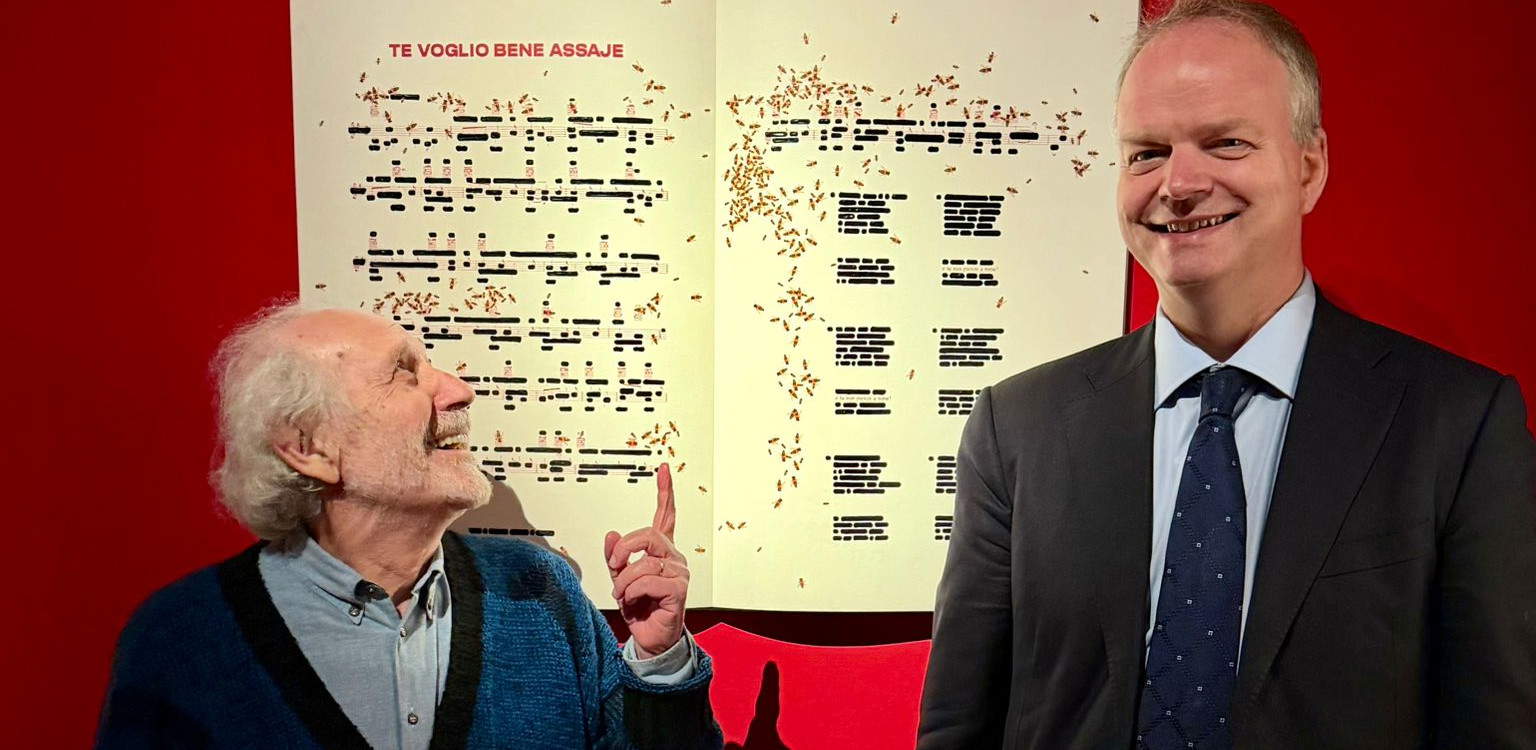
Alongside these, many other songs symbolic of Neapolitan culture find their place: from Te voglio bene assaje (1839) and Funiculì funiculà (1880), through Torna a Surriento (1894), I’ te vurria vasà (1900), Comme facette mammeta (1906), Ninì Tirabusciò (1911), ’O surdato ’nnammurato (1915), Santa Lucia and Santa Lucia luntana (1919), to Scalinatella (1948), Anema e core (1950), Luna Rossa (1950), Malafemmena (1951), Guaglione (1956), Nun è peccato (1960s) and A canzuncella (1977).
In parallel with the works on paper, the exhibition also presents three life-size sculptural works: two mandolins and a classical guitar. These instruments, too, are traversed by the same poetics of Erasing and inhabited by the presences of insects, visually linking them to Isgrò’s reworked scores.
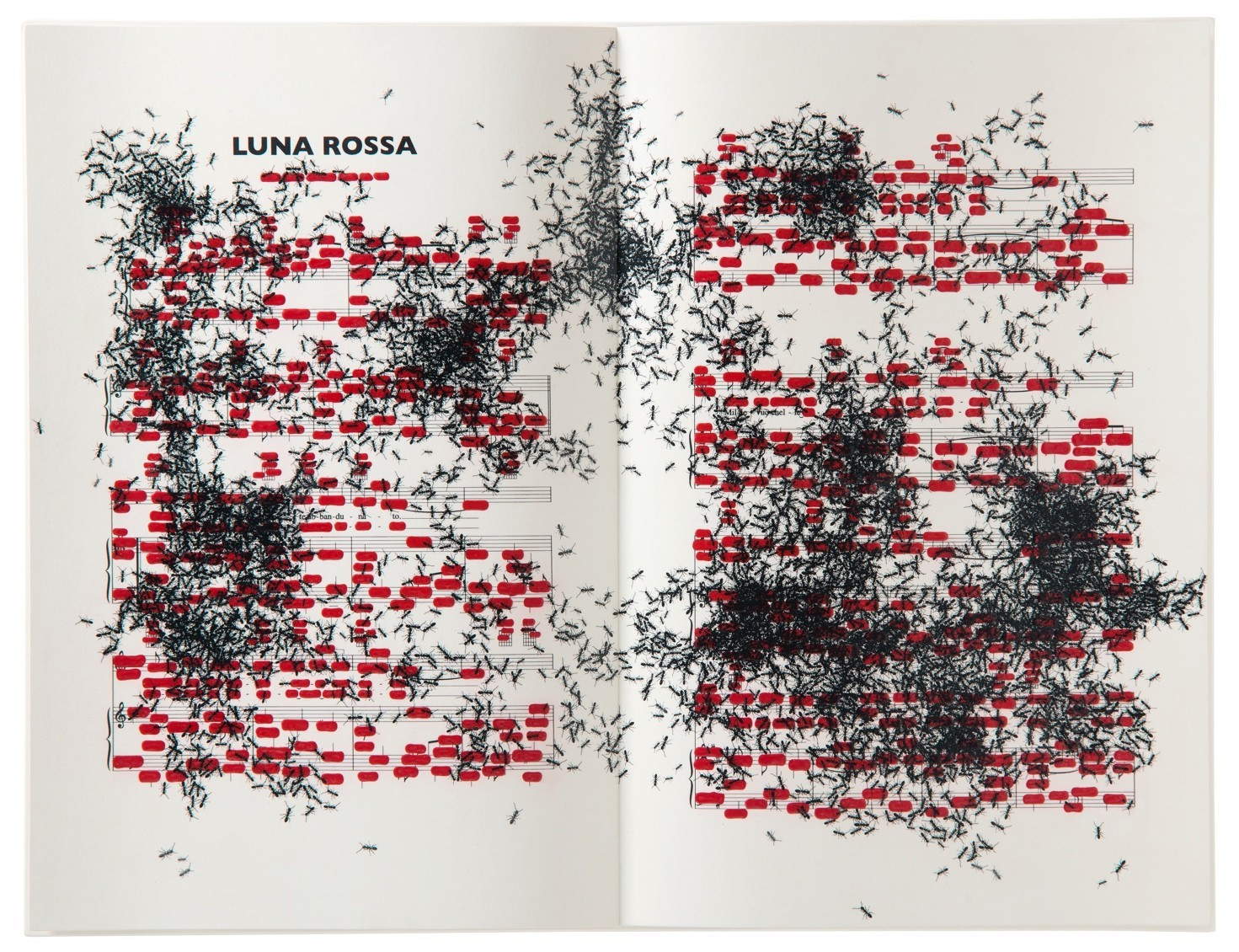
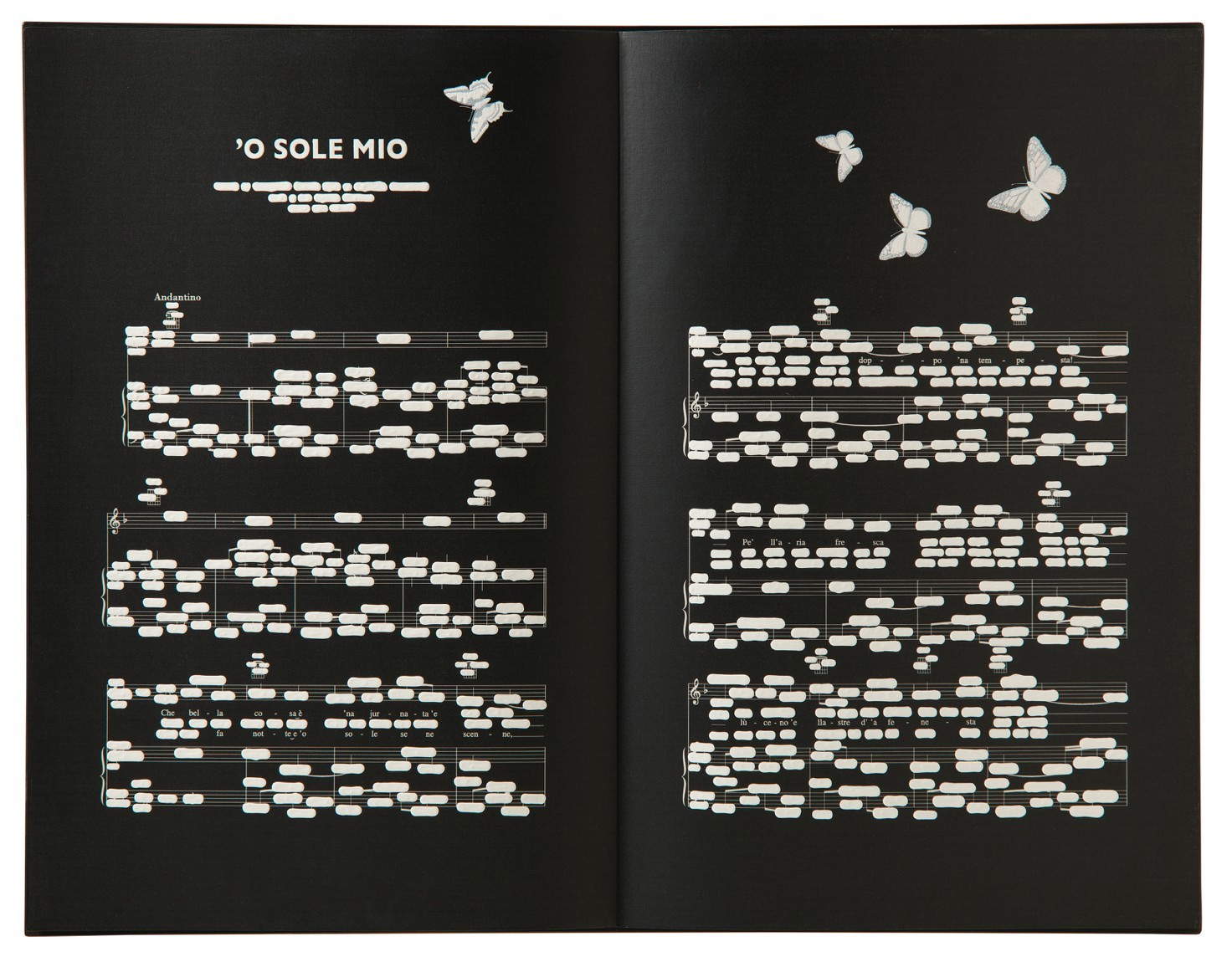
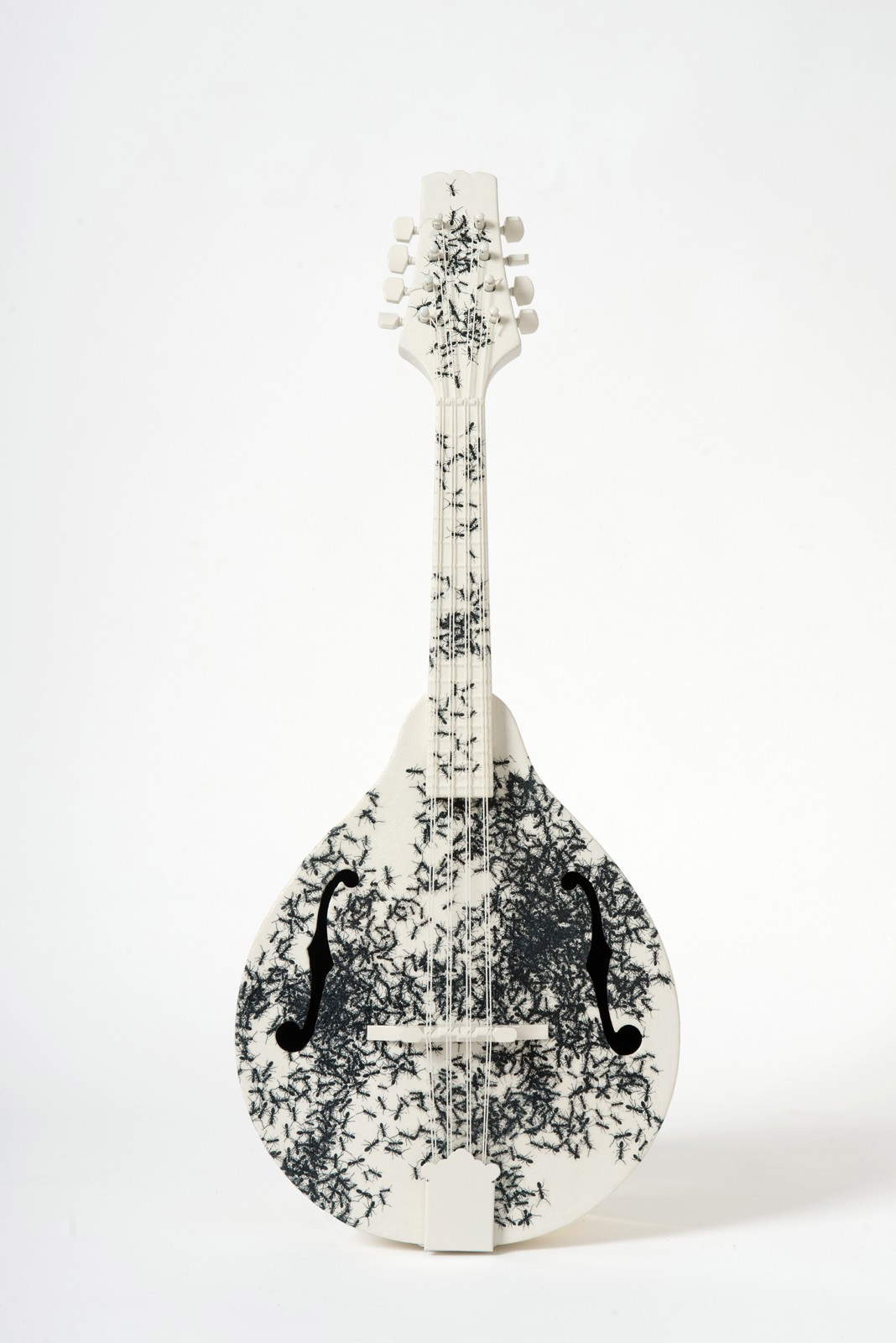
“Isgrò’s musical bees and ants are emanations of the artist’s mind,” writes Eike Schmidt in his curatorial essay, “nonpictographic signs, lacking precise semantic denotations; metasigns without grammatical function; hypersigns of multiple and mutually contradictory connotations, as indeed are the erasures themselves. If, however, the erasures highlight and conceal the text at the same time, covering the words to protect and preserve them, the processions and tangles of the insects introduce on the surface of the paper, a dynamic element. Their collective choreography makes evident the social dimension of the song and, in some cases, even seems to interpret its character: think of the large swarming lumps on the score of Black Tammurriata.”
The exhibition is set up near the room dedicated to the Neapolitan nativity scene, a typical expression of 18th-century figurative culture. The erased scores are made with mixed media on paper cloth mounted on wood. In this context, Isgrò’s intervention is placed in a tight dialogue between tradition and conceptual research.
“This new project stems, yes, from an ancient love for Neapolitan song, but also from something more stubborn: the desire to restore centrality to the historical dimension. European, and therefore Neapolitan, culture is based, in fact, on great traditions and art. I believe, it serves precisely to make those traditions not only acceptable but also necessary and vital for the future,” Isgrò explains.
The artist, who has always been attentive to music, a theme that has been very present in his 60 years of activity, defines Neapolitan song as “deeply democratic.” “In this time even Neapolitan artists can be exposed to the risk of homologation, but they hardly succumb to it, because here art can be breathed everywhere. When I hear a valet playing the mandolin, I don’t see subculture, I rather wonder where that music comes from. And the answer is clear, it comes from Pergolesi, from the great tradition of the San Carlo, from Paisiello. As a Sicilian, I cannot forget that those who wanted to study and make music, like Vincenzo Bellini himself, had to go to Naples, to San Pietro a Majella.”
On the subject of the Cancellatura, Isgrò adds, “For me, the Cancellatura is the direct daughter of the Siculo-Greek philosophy, a Greekness that also concerns Naples. It is the continuation of the positions on the one hand of the Sophists-nothing exists and even if it did exist it could not be known-and on the other of Socratic philosophy, the one that asks continuous questions. I place obstacles in front of Neapolitan song, or in front of texts and images, to suggest that the audience engage in a cognitive journey. To see, you have to lift the veil, making an effort, because art is never entirely easy, it always needs deciphering.”
The exhibition will be accompanied by a catalog published by Treccani, with a preface by President Massimo Bray, Eike Schmidt’s essay, The Dance of the Ants, and contributions by Bruno Corà, Emilio Isgrò: Songs Singing Cancellation; by Michele Bonuomo, The Silent Song of Emilio Isgrò; by Marco Bazzini, Isgrò and Music; by Laura Valente, Keeping the Traces; Stefano Causa, The Morse Alphabet of Neapolitan Song; Maria Laura Chiacchio, Beyond Cancellation, Poetry; by Luciana Berti, At the Margins of Notes. Interview with Emilio Isgrò.
 |
| Isgrò sings Naples in a brand new exhibition at the Capodimonte Museum |
Warning: the translation into English of the original Italian article was created using automatic tools. We undertake to review all articles, but we do not guarantee the total absence of inaccuracies in the translation due to the program. You can find the original by clicking on the ITA button. If you find any mistake,please contact us.