








From May 29, 2026, with opening scheduled for May 28, M77 Gallery in Milan is hosting Marco Petrus: in-motion, a solo exhibition dedicated to the painter known for his investigation ofurban architecture. The project, curated by Sharon Hecker and on view until September 12, 2026 in the spaces on Via Mecenate, presents about seventy new works and builds a reflection on the theme of movement, understood as a perceptual device through which to read and traverse images.
The starting point of the exhibition itinerary is identified in Giacomo Balla ’s Bambina che corre sul balcone (1912, Galleria d’Arte Moderna di Milano), a Futurist work that introduces a dynamic conception of reality and vision. From this reference, Petrus develops a series of progressive variations that lead the pictorial composition toward increasingly abstract outcomes, in which sequences of colored, rhythmic and sinuous lines progressively replace figuration.
The artist, already recognized for a reinterpretation of the urban landscape through synthetic geometries and a strong focus on the formal structure of architecture, shifts the axis of his research to the way images are observed and perceived today. The work fits into a contemporary visual condition marked by the overlap between physical space and digital logics, where perception appears fragmented and continuously reworked. In this context, the pictorial language takes on a fluid dimension, close to dynamics of decomposition and recomposition typical of digital visual experience.
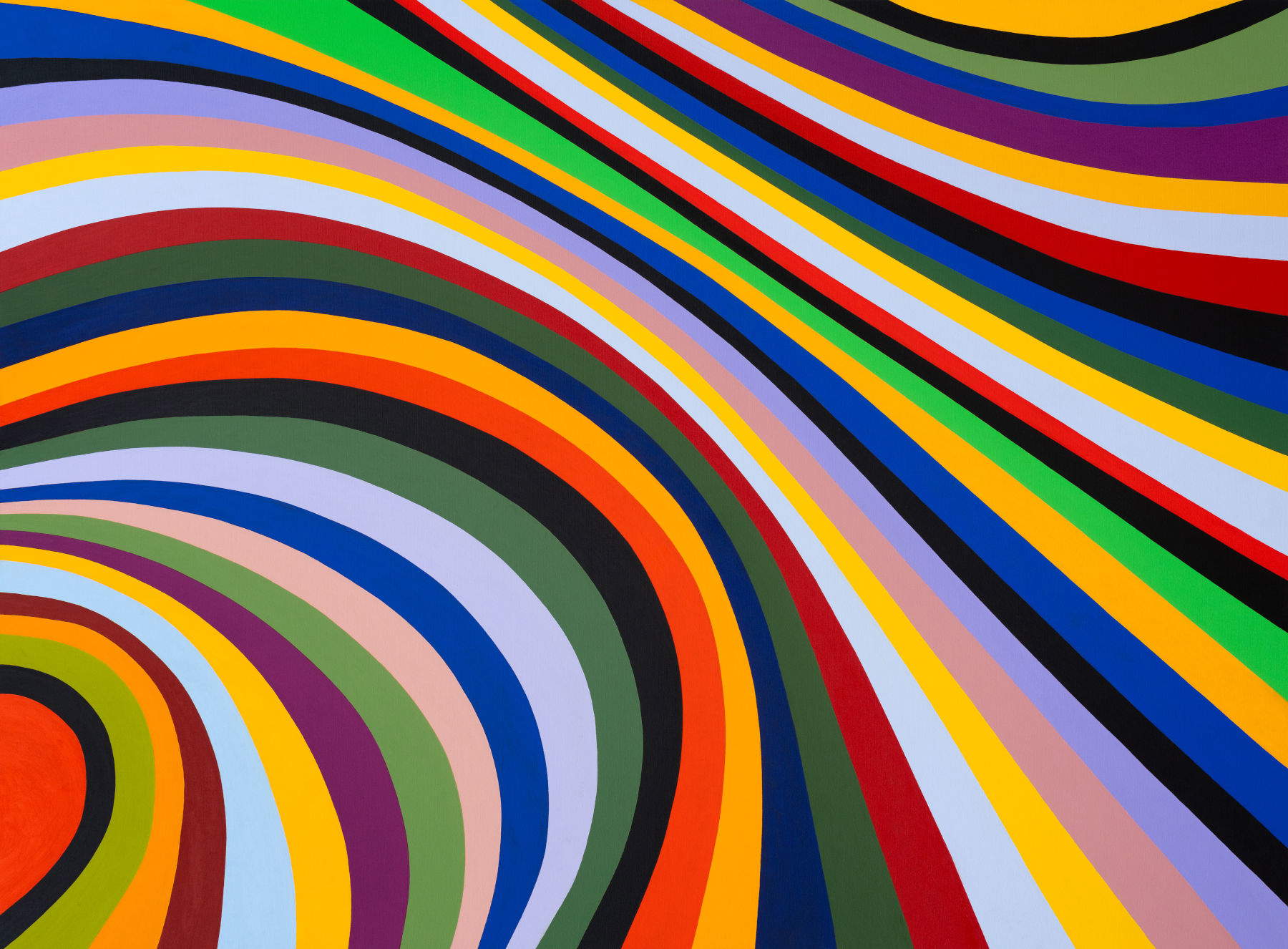
Central also in this phase of the research remains the relationship with architecture, which is reinterpreted in an engaging and dynamic key. In some works the viewer is involved in chromatic swirls of an almost pop matrix, which can recall narrative sequences and shared visual imagery, while in other works the vision shifts to an aerial perspective. The city is thus transformed into a pulsating geometric texture, traceable to the artist’s earlier cycles in which homages to Carla Accardi, Giuseppe Capogrossi and Afro Basaldella are reworked. In these works the urban reference approaches digital cartographic representation systems and zoom dynamics typical of contemporary mapping platforms.
More recent works further accentuate this perceptual tension. The images appear fragmented and, in some cases, likened to pixelation effects, with a tendency toward continuous expansion of the visual surface. Movement is thus defined as a perceptual condition, oscillating between immersion and distance, recognizability and dissolution of the image. A nucleus of works confronting the work of Giorgio Morandi also finds space within the exhibition itinerary. In these compositions, the dynamic tension gives way to a more rarefied dimension, built through muted tones and suspended chromatics, with attenuated grays, delicate blues and dusty hues. The section introduces a moment of pause within the overall rhythm of the exhibition and offers a slower, more contemplative counterpoint to the kinetic component of the other works.
“The exhibition presents an unprecedented body of projects made in the last decade and brought together here in a backward path that restores the conceptual unity of my work,” says Marco Petrus. “The different themes addressed can be traced back to an idea of visual perception represented through ’sequence plans’: movement, geometric compositions, volumes, infinite palettes, color, fantastic structures, illusion.”
 |
| Marco Petrus in Milan: the movement of the image in architecture and digital vision |

Warning: the translation into English of the original Italian article was created using automatic tools. We undertake to review all articles, but we do not guarantee the total absence of inaccuracies in the translation due to the program. You can find the original by clicking on the ITA button. If you find any mistake,please contact us.
























 IT
IT FR
FR DE
DE ES
ES CN
CN