





Venice is hosting the first solo exhibition in Italy by British artist Nigel Cooke (Manchester, 1973): On the occasion of the 61st International Art Exhibition of the Venice Biennale, the Fondazione Querini Stampalia presents Bad Habits, an exhibition curated by Evelyn C. Hankins and open to the public from May 5 to November 22, 2026. The initiative marks a significant milestone in the artist’s international career, as he is considered one of the most prominent figures in contemporary British painting. The exhibition stems from an artist residency specifically designed by the Querini Stampalia Foundation, which is hosting an artist-in-residence for the first time, thereby transforming the spaces of the Venetian palace into a place of creation, reflection, and direct engagement with the city.
During the spring of 2026, Cooke stayed in Venice to create a new series of large, atmospheric paintings inspired by the Foundation’s historical and cultural heritage and the vibrant fabric of the lagoon city. The residency, proposed by the museum, was conceived as an experience of total immersion in the Venetian environment—its waters, canals, lagoon, and the unique lighting conditions that have fascinated artists from around the world for centuries. The Querini Stampalia Foundation made the Portego della Biblioteca available to the artist, transforming it into a studio for the occasion. The space, located next to the Foundation’s historic library and directly above the ground-floor rooms designed by Carlo Scarpa, overlooks the waters of the Rio di Santa Maria Formosa and thus offers a privileged view of daily Venetian life.
The exhibition project is closely tied to the place where it takes shape. At the end of the residency, five paintings are thus exhibited in the very same space where they were created, a situation that creates a direct continuity between the creative process and the public experience of the works. Visitors can thus engage not only with the final result of the artist’s work but also with the physical and cultural context that influenced its creation.
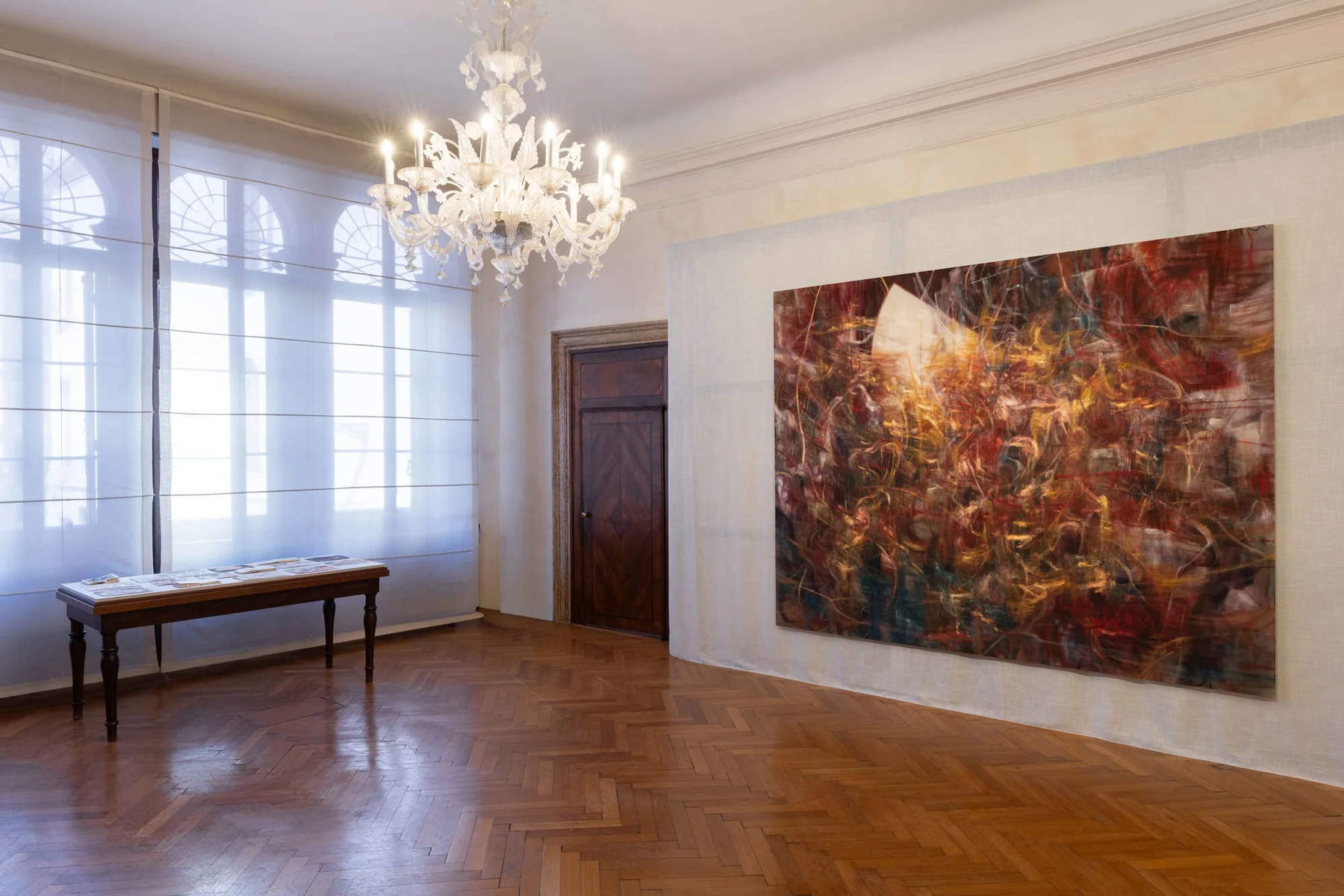
Nigel Cooke’s artistic practice has long been characterized by a strong connection to personal experience, the places he has visited, and the cultural contexts he has encountered. His works often emerge from the intersection of individual memory, direct observation, and historical reflection, giving rise to images that oscillate between figuration and abstraction, between narrative and atmospheric suggestion. The new works presented in Bad Habits have their roots in a trip the artist took to Athens. During his stay in the Greek capital, Cooke created studies of fragmentary statues housed in the city’s museums, developing a reflection on the ruins of antiquity and on the way time alters, transforms, and rewrites the meaning of forms.
Athens, a city that over the millennia has accumulated layers of history, culture, and architecture, has become for the artist a sort of living palimpsest, a surface upon which thousands of years of collective and individual experiences overlap. From this observation emerged a key word destined to guide the development of the new series of paintings: the Greek term “θραῦσμα” (thraûsma), which can be translated as ruin, trauma, or fragment.
The concept of thraûsma has become a foundational element of the research developed by Cooke for the Venetian exhibition. Fragments of the word appear in the early compositional stages of the paintings, taking on a dual function as text and image. These linguistic signs enter into dialogue with other modes of painterly intervention recently experimented with by the artist, generating visual and conceptual tensions that run through the entire series.
Venice, too, played a decisive role in shaping the project. The lagoon city, with its complex, layered history and its centuries-old role as an international crossroads, further fueled the artist’s reflection on the relationship between memory, ruin, and transformation. Like Athens, Venice has for centuries been a place for gathering and preserving the traces left by past civilizations, a heritage that has contributed to the development of important cultural, artistic, and scientific traditions.
In his engagement with Venice, however, Cooke does not limit himself to observing the city’s monumental charm. His attention also turns to the darker aspects of its history, as well as to the anxieties that characterize the present. The impressions evoked by contemporary events and the tensions sweeping the world find expression in the new works through a palette dominated by deep, nocturnal tones. Within these pictorial landscapes, fragments of human figures, animals, and objects emerge, seeming to surface from the darkness only to dissolve once more. The construction of the image proceeds through appearances and disappearances, in an unstable balance between recognizability and ambiguity. The paintings evoke situations of uncertainty and darkness, yet also offer glimpses of the possibility of change and signs of hope, described by the artist as fragments illuminated by moonlight.
The exhibition thus develops a reflection on the human condition, on individual and collective memory, and on art’s ability to interrogate the present through dialogue with the past. The works do not offer a linear narrative, but rather construct a web of references, suggestions, and associations that invite the public to engage with their own experiences and interpretations.
Deeply rooted in the history of painting, Nigel Cooke occupies a prominent position in the landscape of contemporary British painting. His work is part of a tradition that views the language of painting as a medium still capable of addressing existential, historical, and social issues, albeit through open and non-didactic forms. With Bad Habits, the artist ideally joins the long line of artists who have found in Venice a source of inspiration and creative renewal. For Cooke, the city becomes a place to rethink the relationship between the individual and history, between personal experience and collective memory, between the present and the past.
In the new paintings, as in the city that inspired them, the self appears as something that can be continually redefined. Through abstract marks, visual layers, and partially emerging images, the works trace circular paths in which different times overlap and reflect one another. The past resurfaces in the present, while individual experience enters into a relationship with broader, shared dimensions.
|
| Nigel Cooke makes his Italian debut with “Bad Habits” at the Fondazione Querini Stampalia |

Warning: the translation into English of the original Italian article was created using automatic tools. We undertake to review all articles, but we do not guarantee the total absence of inaccuracies in the translation due to the program. You can find the original by clicking on the ITA button. If you find any mistake,please contact us.




















 IT
IT FR
FR DE
DE ES
ES CN
CN


