





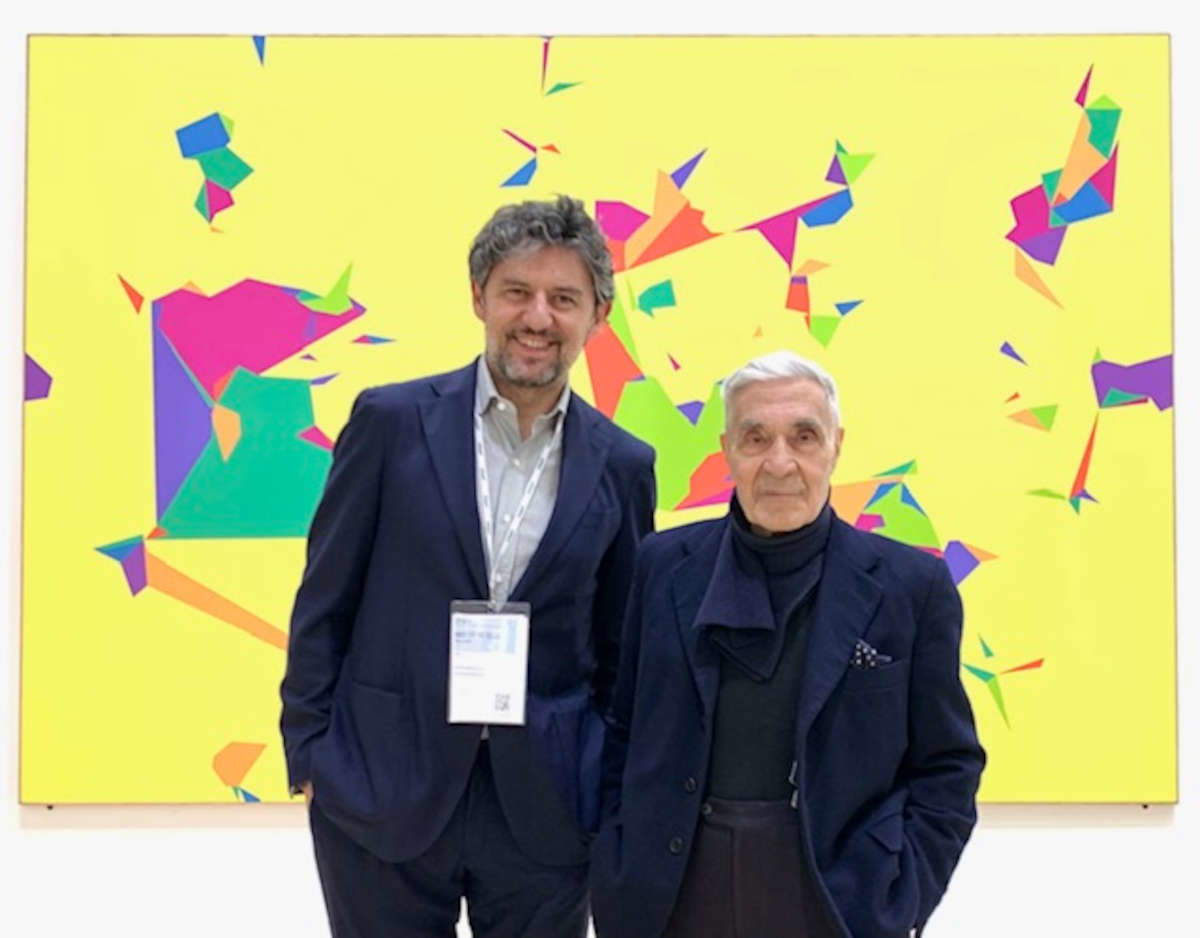
At the doorway of Sergio Lombardo’s Archive in Rome there is still a marble plaque designed now decades ago together with Palma Bucarelli and Cesare Pietroiusti where it is inscribed in red “Jartrakor, experimental space and center for the study of art problems.” When I first walked through that door in 2007, freshly graduated from the Academy of Fine Arts and in search of an artistic affiliation that would leave me free from indoctrination or stylistic constraints, Sergio Lombardo’s studio was not yet structured as an archive and it was not easy to evolve and collaborate in that environment without an official role among followers, assistants and other collaborators. But over the years, and with much perseverance, an intellectual exchange took shape in addition to esteem and affection that largely stimulated, in me as in many of various generations, an insatiable questioning of art. Very rare were and are the artists who speak with the same candor and knowledge of the changing and shifting dynamics of the art system. In Lombardo I have found the intellectual honesty of one who is not afraid of being contradicted, having precisely amply tested a laboratory that indeed puts divergences to good use.
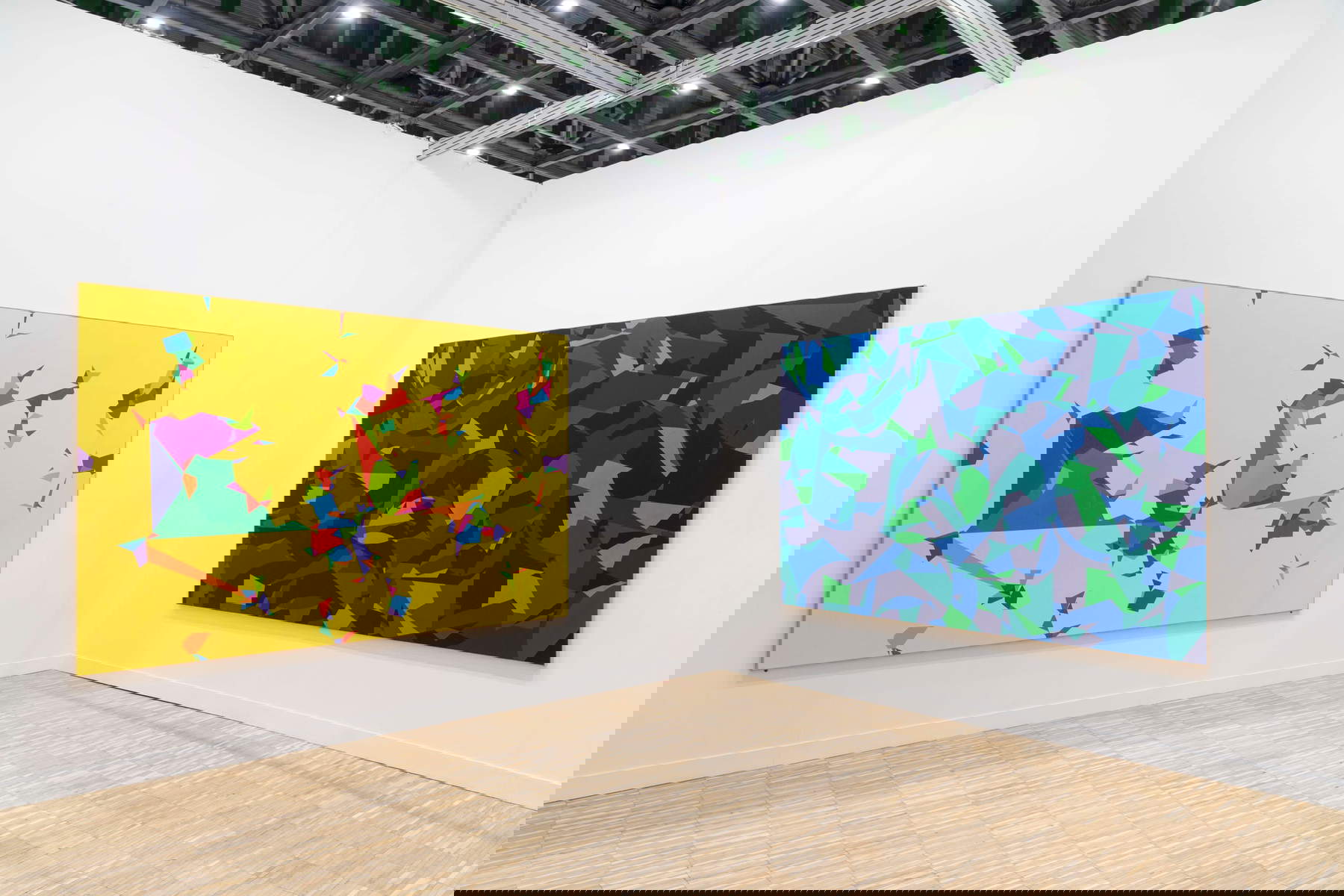
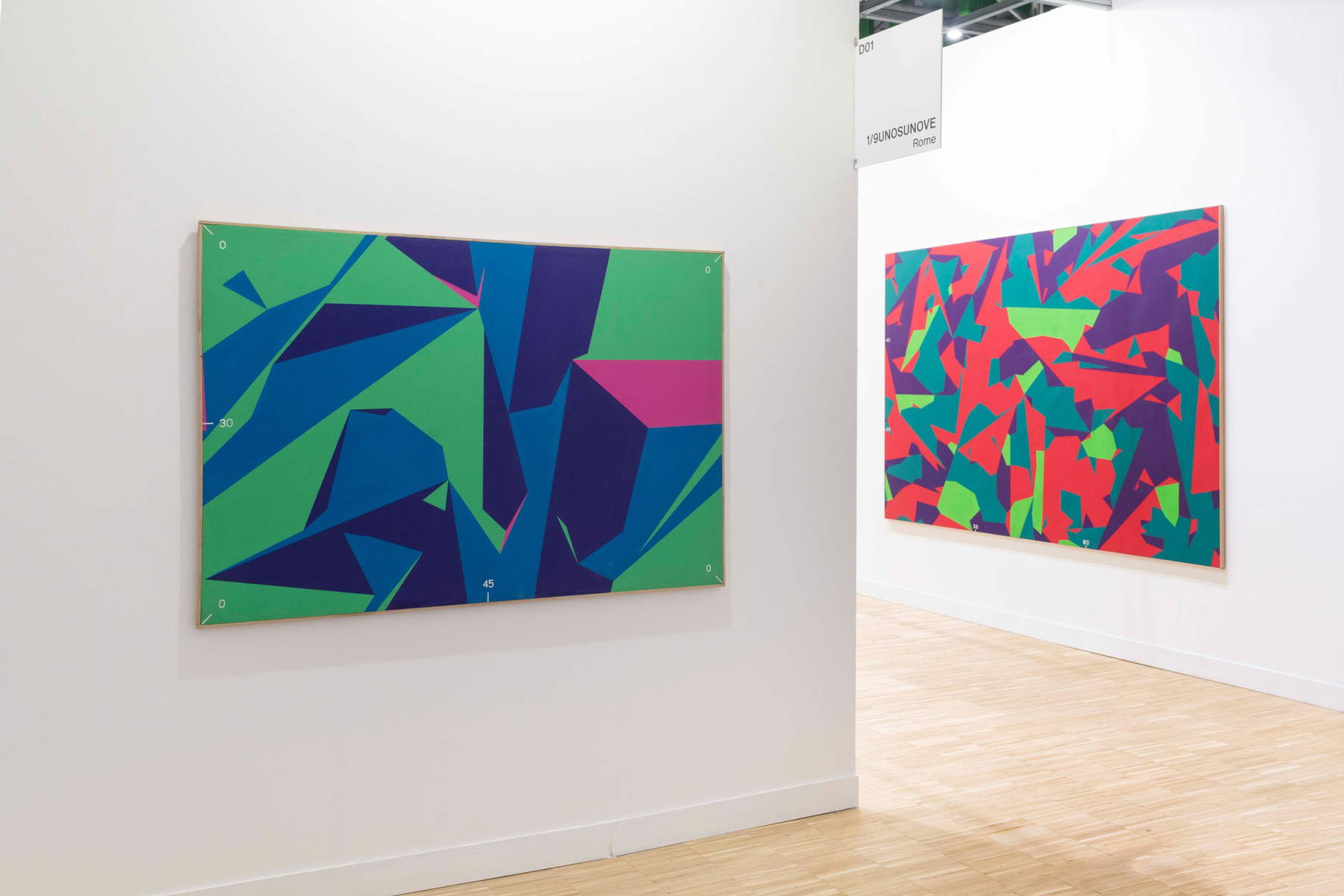
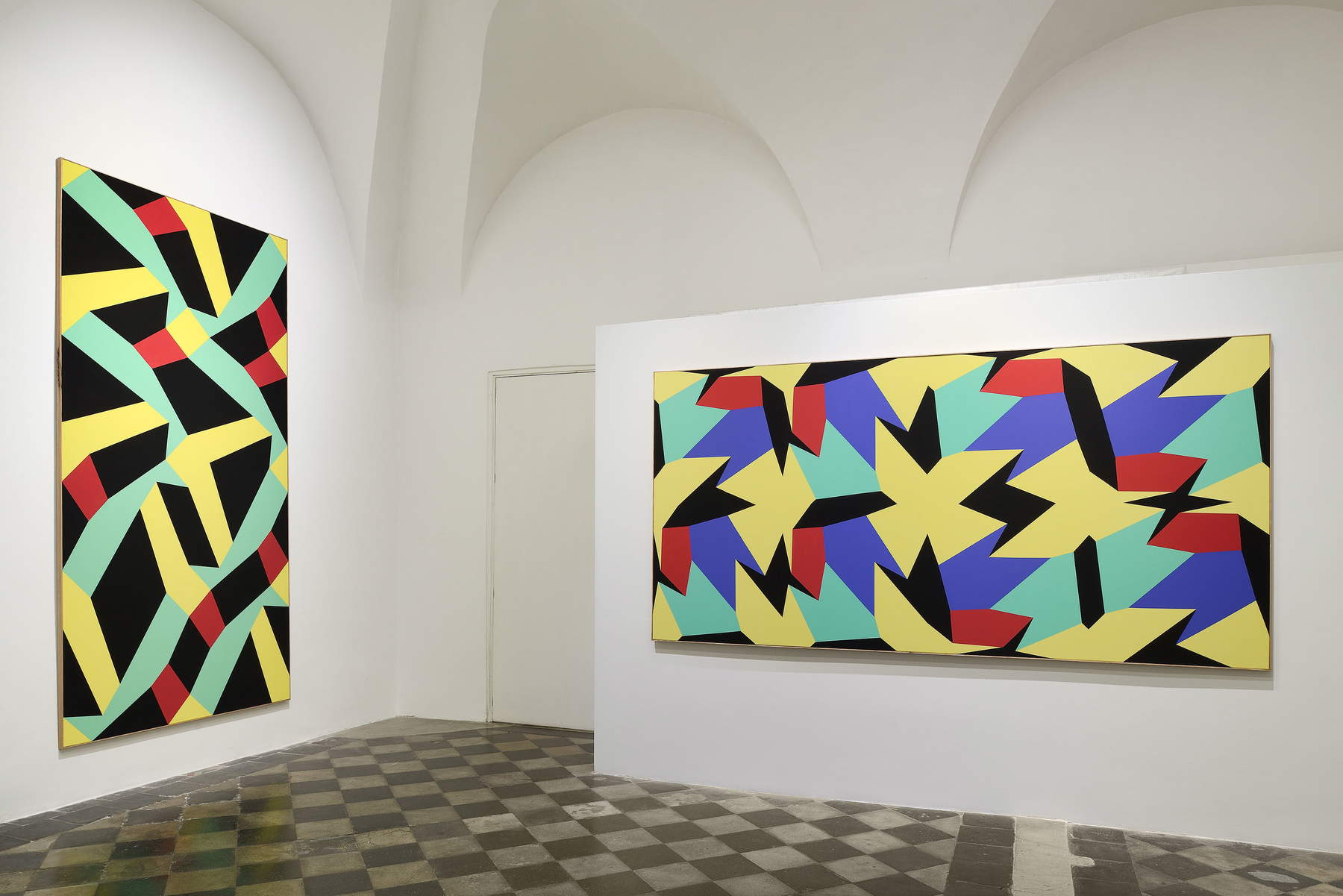
With the annual publication of his Journal of Art Psychology founded in 1979, Lombardo codifies and updates his eventualist theory scientifically with new experiments and collaborations. As he first did in the editorial of the 1983 issue, in 2026 Lombardo returns to place falling in love at the center of art, not only as an aesthetic transposition of Freudian transference but as the only parameter of beauty possible today. How does a work become art beyond all predictions, fashions, marketing and market contrivances? This is what Lombardo explains in this interview before presenting at Miart in Milan in the booth of gallery 1/9unosunove some of his early stochastic paintings from the 1980s. A few days after Miart, 1/9unosunove is also presenting Lombardo’s latest maps in a solo show with the same title Aesthetic Engineering at the gallery’s Rome location. A unique opportunity to be able to immerse oneself in his stimuli (mathematically conceived to surprise, disorient or astound) set up for the first time also in a vertical combination, thus on an almost monumental scale, and verify their psychological and spiritual effects. Next stop in June in Molise where one can experience the ecstasy of Lombardo’s stochastic stimuli directly in the church where the acrylic colors of his canvases will give way to the brilliance of ceramics on a large floor with tiles made by a Faenza-based manufacturer from 2012 stochastic maps.
REF. The name of your new series of paintings and the title of your new exhibition in Rome is Aesthetic Engineering. Why should we move from philosophy and phenomenology to engineering to define aesthetics today?
SL. Aesthetics lags behind science and technology. Aesthetics has remained tied to what is pleasing, to decoration. Or it has regressed, going backward in the evolutionary scale and going toward a fascination with the wild, the primitive. The Futurists idealized the machine, the airplane, admired the Futurist engineer, while in contrast the aestheticians, art critics, and philosophers disputed poetry in the abstract, never reaching a shared knowledge capable of being refuted and evolving. Today if we go around the moon, we do not owe it to philosophers, but to engineers. Aesthetics must change paradigm, must embrace the experimental method by turning it to the search for beauty in an operational, engineering sense.
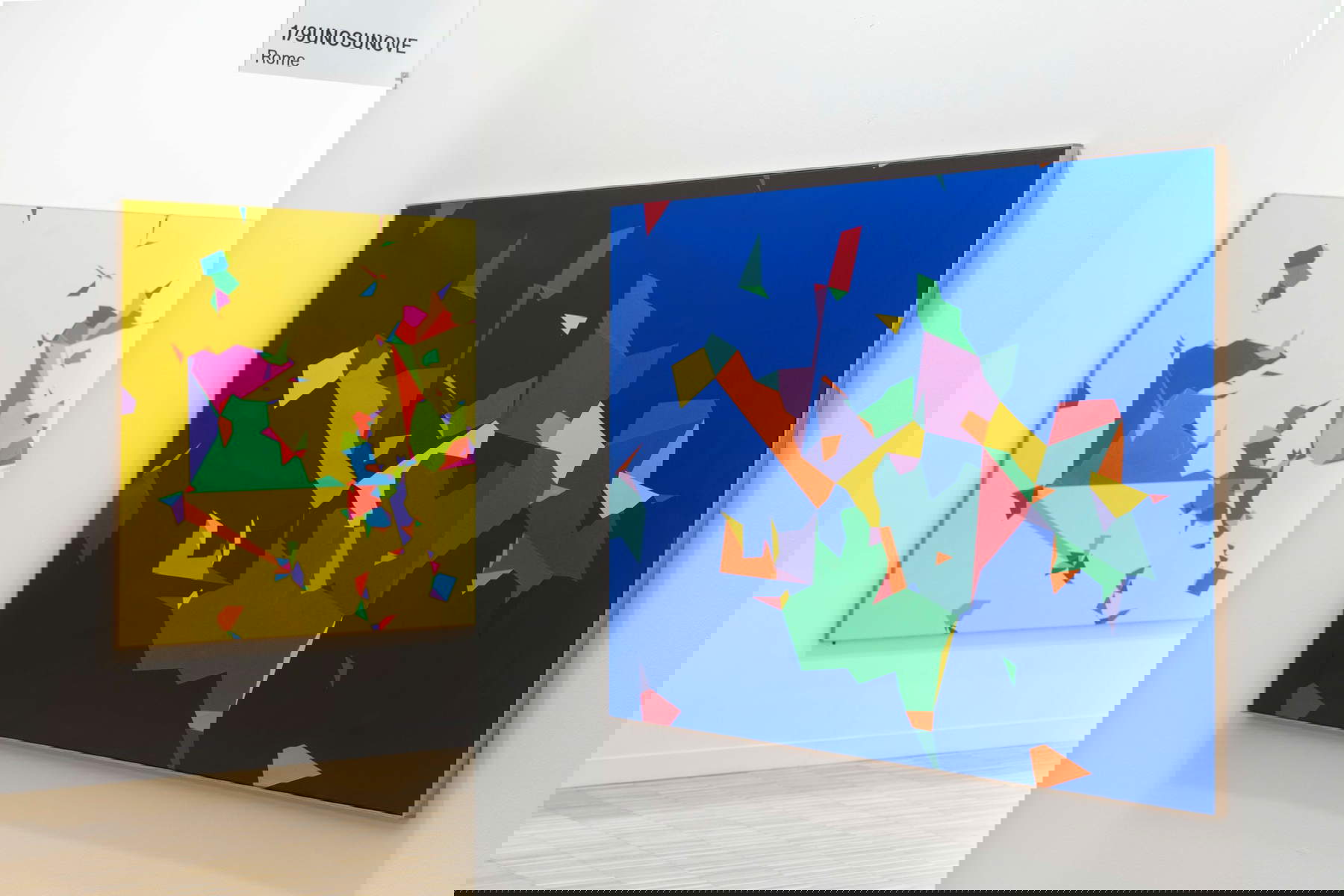
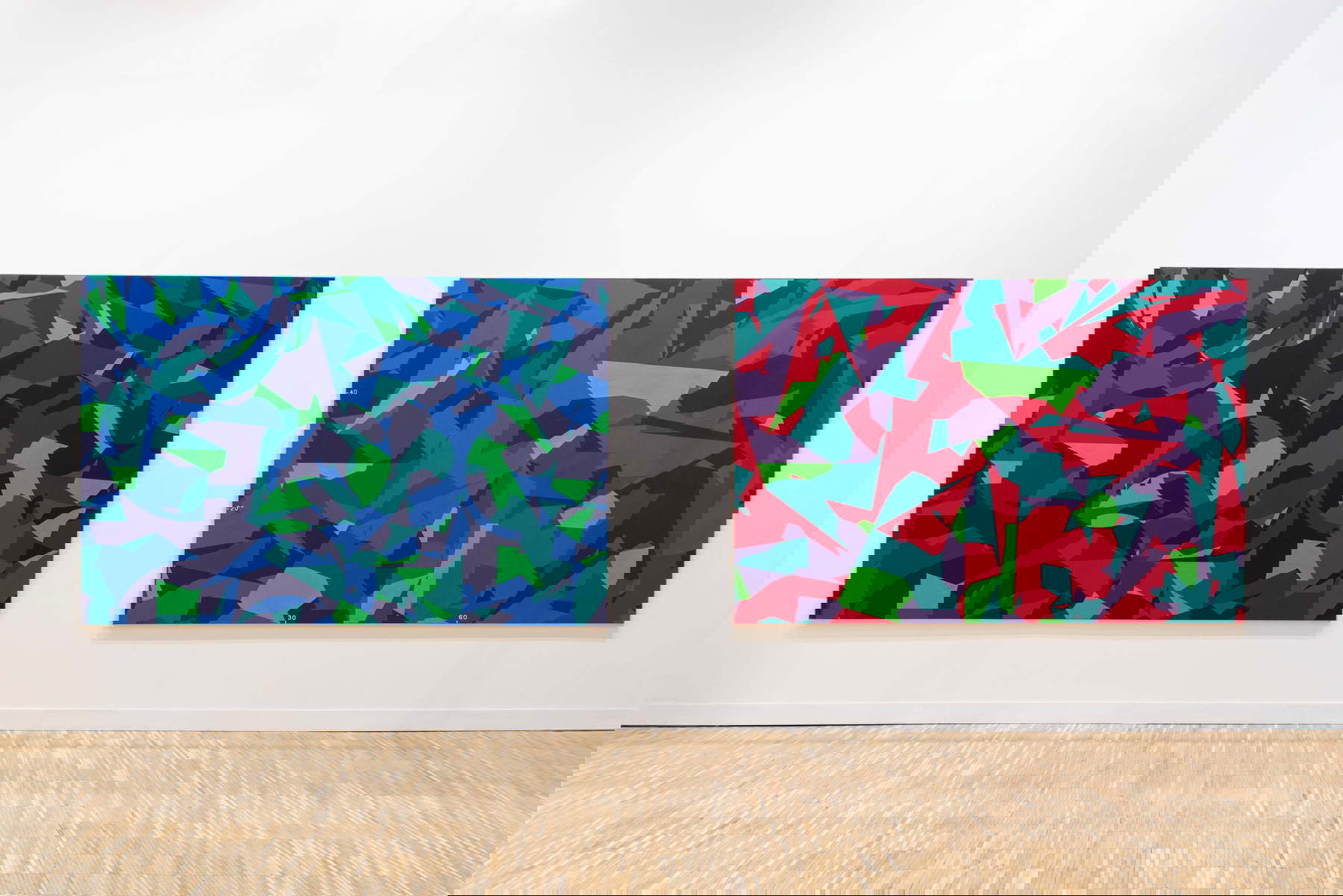
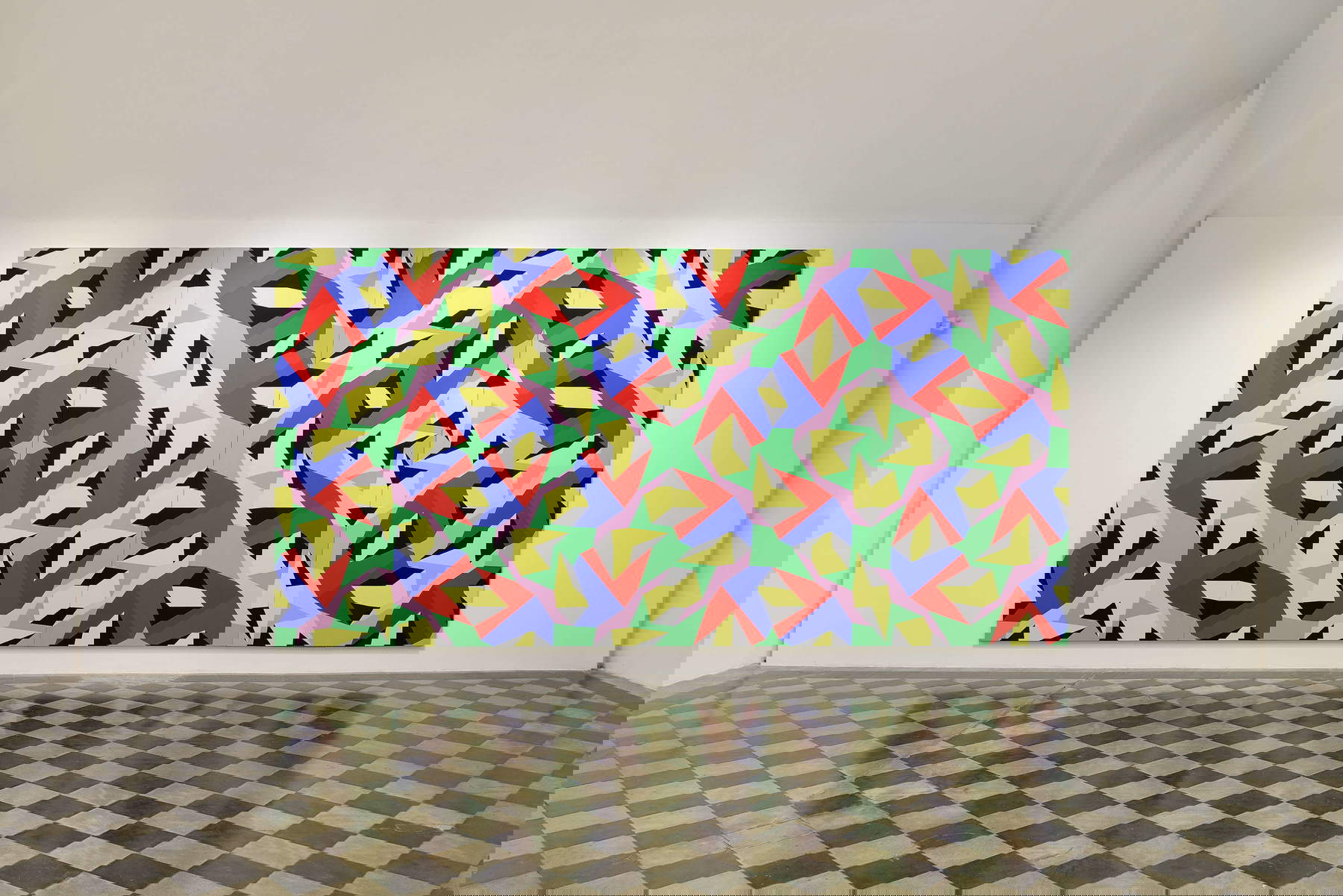
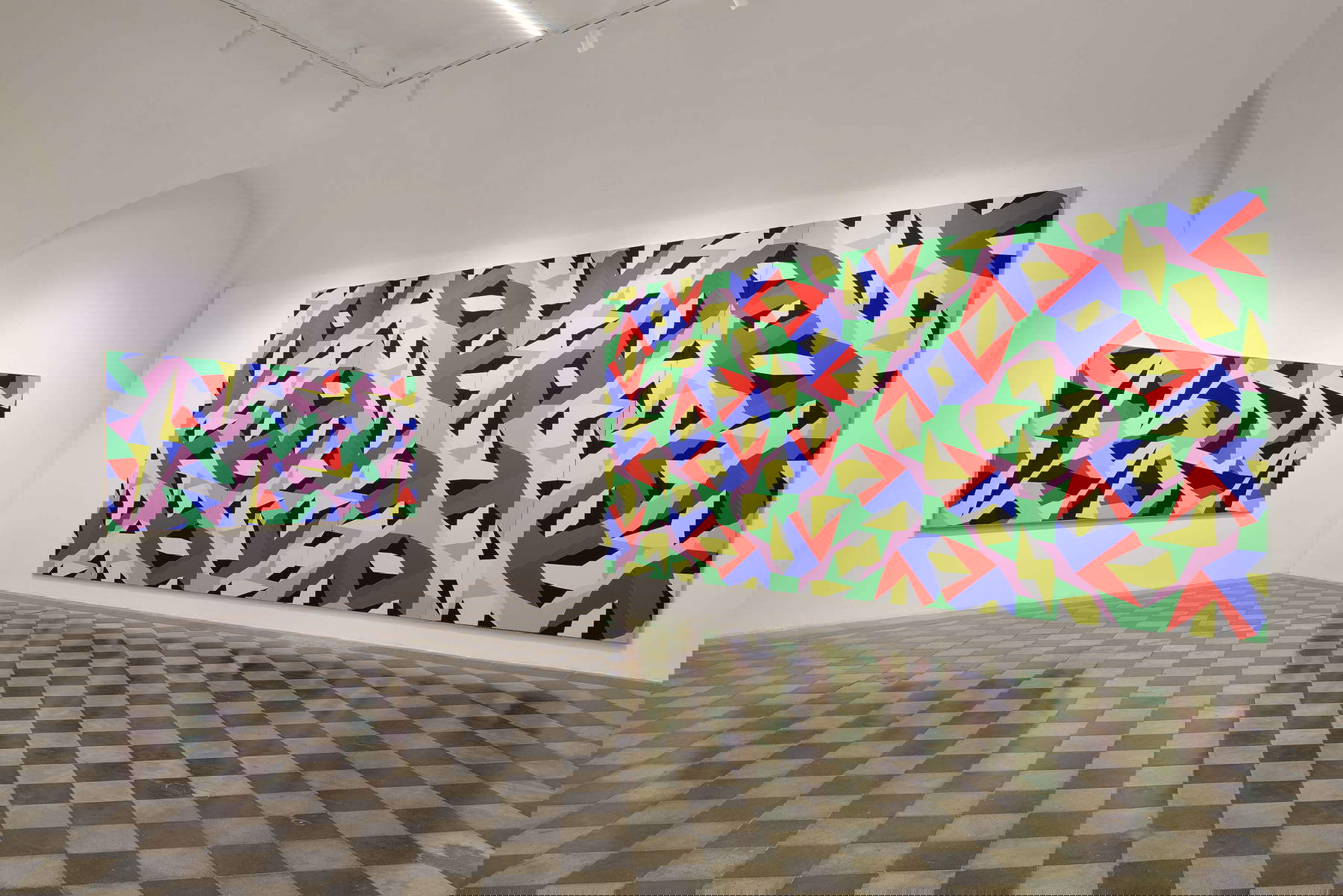
At your next solo exhibition opening April 28 at 1/9unosunove gallery in Rome, you are exhibiting a new series of tilings (tile floors, tessellations) and a 6-by-3-meter work that vertically combines four canvases. Is this the first time you are setting up your stochastic maps so immersively?
Size has always been an aesthetically important parameter of my paintings. When I exhibited Typical Gestures at La Tartaruga Gallery in 1963, the size of my paintings turned the exhibition into an event where the audience felt observed and threatened. Again I show stimuli to the audience.
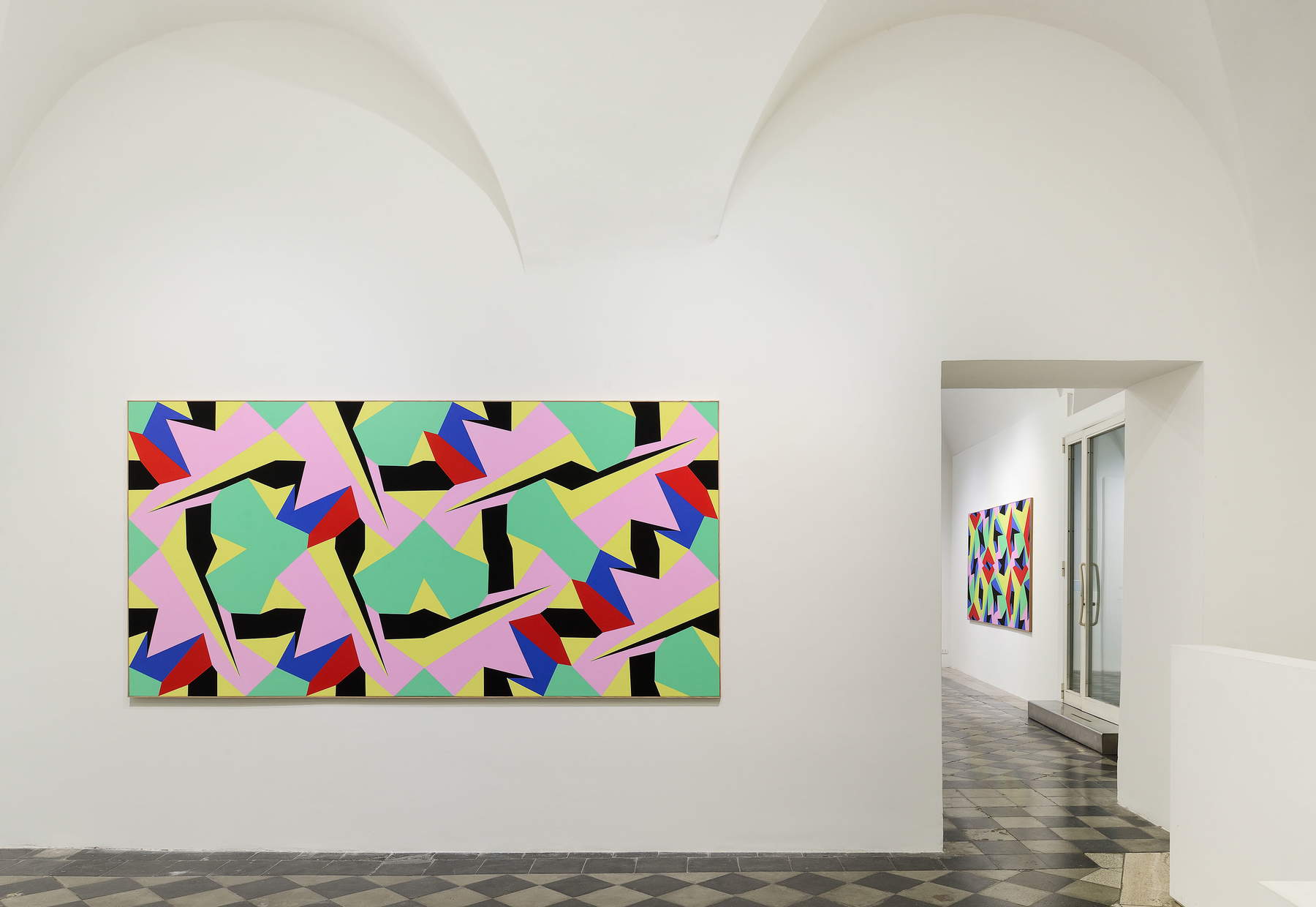
By rotating and combining the same tile a number of times, you get compositions with many different shapes.
Once I get all the shapes that can be combined with the same tile without repetition, I have an MCCT picture: minimal, complete, compact and toroidal. The observer can’t immediately understand what it looks like, gets involved for a long time, is almost enchanted. Even for me who knows them thoroughly, these paintings are not yet saturated, still drawing my gaze for a long time.
According to the theory that underlies your research, Eventualism, I understand that the artist must have control over the display of his or her works, balance their accessibility and precisely their saturation. In your creative process, exhibiting is still a central norm, despite the fact that you consider the ideal of beauty and criticism obsolete.
Certainly I prefer to look at pictorial art in a gallery as opposed to street graffiti art. That is a wild activity. The painting, on the other hand, contains a very advanced technology, the frame, the wedges, the canvases, the chemical colors, it lends itself to building extremely refined images, unattainable with other technologies. I work with digital methods, mine is digital art, however, then I paint the paintings. Digital printing is fugitive, it always tends to gray, it works on a small scale, on a large scale it is unwatchable. Then in the long run everything decays, art becomes saturated, the important thing is that the event happens, if it doesn’t happen the essential is missing. On the other hand, if the event happens, its saturation turns it into history, market, economic value.
It is somewhat the same difference between theater and happenings. Stage engineering promotes spectacle, and magic can operate over and over again on the audience.
Happening, on the other hand, has to succeed in one go; if you repeat it, it no longer has the same effect.
So your aesthetic must be repeatable, it is never random.
The algorithm is repeatable, even if it is stochastic. The stimulus generated by the stochastic algorithm is always different, but it is not random. The aesthetic stimulus to be effective must cause the event, which over time saturates. If it does not produce the event it is not art.
What conjuncture is needed for your eventualist theory to become an artistic movement?
A theory becomes a movement when artists decide not to submit to the dominant art system, but to follow different and more original aesthetic paradigms. When they challenge market-saturated parameters and propose new aesthetic criteria. Criteria that are always falsifiable and in conflict with each other. In the dominant system, on the other hand, artists queue up, hoping to be recognized by seniority, believing that publicity, putting themselves in view everywhere, obsessively, makes them famous. But in doing so they converge to the average, become conformists. Art, like science, is innovative when it diverges from the average, when it changes the dominant paradigm.
You paint toroidal maps, abstract and mathematical maps, proceeding stochastically. To demarcate between them the “countries” of infinite geometric shapes, the colors must be different or else the boundaries will merge. The chromatic number (which I envision as a kind of advanced palette in which the number of colors is no longer random but defined) is the minimum number of different colors used to delimit the boundaries of shapes. This concept of color number is also the name chosen by one of your disciples to form his art collective a few years ago.
To color any planar chart, or map, you need a maximum of four colors. If you have to color a toroidal map in some cases you may need up to seven. The minimum number of colors to color a map is the color number of that map. This is a topology theorem that has been well known among mathematicians for a couple of centuries, but only proved in the 1950s. In my painting, from monochromes to stochastic painting, I have always used the minimum possible number of colors. My former student Dionigi Mattia Gagliardi cleverly and originally used the name of this mathematical theorem to identify his artistic collective.
Imagine I am Michelangelo and I have to paint the Last Judgment: can I determine a priori the minimum number of colors on my palette?
It is difficult. The figurative has nuances, it has no boundaries. First you would have to turn it into a map, then you could color it with only four colors. The calculation of the color number is done from a map, we are in the field of topological geometry and particularly in graph theory.
Do you create a new algorithm for each new set of paintings? How many algorithms have you created to make your stochastic maps?
I have created several. The most important ones are the TAN, SAT, V-RAN, S-RAN methods, various Tiling and Quilting compositions. I can apply them serially, modify, modulate. They contain various modulable parameters and go to build the complex system of stochastic painting.
How does the definition of beauty change with your artistic process?
If I say that art is the pursuit of the Beautiful, then we have to define the Beautiful. Anciently, the Beautiful, in the line of Plato, Plotinus, Pseudo-Dionysius, was the ideal, the vision of God, ecstasy. The Beautiful, representing God, also had miraculous, therapeutic powers. It transformed man from a slave of biological drive to a lover. The mystical thunderbolt struck Dante at the sight of Beatrice and transformed him to the point where he saw Paradise in a dream. Philosophers have since defined Beauty in many ways, harmony, proportion, sublimity, spontaneity, complexity, perhaps more secular, but less precise. They forgot the experience of love, which was an event. They have simplified the Beautiful by reducing it to something that the majority likes, that everyone tends to like, like candy. So, if almost everyone likes it, it can be priced and can be traded. To me, on the other hand, beautiful is that which is loved, that which cannot be exchanged for anything else, that which is priceless and irrational, but for one person. While conformists converge on the same object and all desire what the majority desire, lovers love divergently among themselves.
A work is beautiful no longer according to an objective ideal but when the same work is loved in many different ways, all discordant and opposite. It is the collective falling in love with its subjectivity that sanctions the beauty of a work.
I look for the event, what produces divergence. Aesthetics, on the other hand, points you to what is pleasing to all. To give an example, the idea of a circle is perfect and therefore it is beautiful, but all concrete circles are ugly copies of the ideal circle. The closer the concrete circles get to the ideal circle, the more beautiful they become. Or, to be precise, it should be said: the closer concrete circles come to the ideal, the less ugly they are. However, it is a matter of the aesthetics of the least worst. Measuring proportions, studying balances and styles, art historians and critics look for the least worst and all converge on the same objects, like bees on honey.
The calculation of proportions was the basis of canons of beauty in ancient Greece.
Exactly, in this way a canon can be shared by a mass of people. In a given civilization, say Greek, a body or profile was considered beautiful if it had certain proportions. Phidias worked with canons. All the Greeks who looked at a sculpture by Polyclitus, which was also canonical, said that that was beautiful, because they shared the same theory of beauty. So they were talking about harmony, balance, proportion, measure.
Was the canon the aesthetic engineering of the past that served to make as many people as possible love a thing?
The canon was not about making people love something like a sculpture or a painting, that is impossible, it was about showing the ideal Beautiful. If I present to you the Discobolus of Polyclitus, you think it is perfect and therefore beautiful. In that culture what is perfect, proportionate, is art. In the vision I defend what is perfect is not beautiful; it is the least worst. In my aesthetic vision only what is loved is beautiful, but everyone has different objects of love, I love a humped person, you love another with a crooked nose. We love concrete objects, not abstract ideals. Conformity of the least worst is good for everyone, falling in love is good for only one.
The Renaissance is the continuation of ideal classical beauty. Perhaps the principle of perfection begins to enter a crisis as early as Mannerism, the proportions and balances offset and bodies twisted.
I don’t want to get into discussions more suitable for art historians, however, yes, in Mannerism there is a paradigm shift, the sublime, the marvelous is sought, the ascetic part, transcendence is lost.
Theoretically the eventualist artist with his works has to make many people fall in love. By putting love at the basis of aesthetic judgment, is it still possible to know when it is art?
I do aesthetic research, and my definition of Beauty rejects physical measurements, proportions, because they tend to a formal ideal external to the event. Without descending into idolatry, for me only what is loved is beautiful, but since each individual loves different objects of love, there can be no one measure of beauty that applies to all, just as there can be no eternal art that applies forever. The Latin adage: “De gustibus non est disputandum” is equivalent to Wittgenstein’s well-known statement referring to the event: “About what one cannot speak, one must be silent.” In fact, beauty is an event and as such cannot become language. Characteristic of the event is the fact that each individual experiences it in his or her own way, so when a stimulus produces very different responses in a human sample, when it produces a very broad evocative spectrum, then that stimulus is a work of art.
If we take for example the Venus de Milo, is it no longer art today? Is it art of the past?
Art of the past is art, but it is saturated. It was an event in the past. But the event is not stable; it decays and becomes saturated. Once saturated, the event becomes language, becomes History, can be measured, commercially evaluated, exhibited as art, preserved in museums.
So in your opinion, the more a work generates passions that are mutually inconsistent and contradictory, the greater the likelihood that it will be recognized as art?
People don’t just say I like it or I don’t like it. They project their own deep values onto that painting.
Instead of converging on one idea of Beautiful, they diverge with many different opinions.
I am not so much interested in opinions or judgments. Rather it is the evocations, especially preconscious and unconscious, that have a very wide spectrum.
In this way aesthetic judgment, which with the market and the commercial value of the work had become arbitrary, becomes possible again but through dispersion.
My theory is anti-idealist; I value that which diverges. The eventualist stimulus highlights divergences and stimulates diversities, it does not stimulate similarities.
Don’t you do anything for your paintings to be loved?
With my works, from the Sphere with Siren to the Death by Poisoning Project to the Tachistoscopic Mirrors with Stimulation to Dream, I have always tried to stimulate a deep relationship with people, not relationships of entertainment or pleasure. There is no dimension of pleasure in my works, in fact many times instead they repel, if there is pleasantness it is only on the surface.
In your art there is a certain iconoclasm, a search for abstractionism that connects you to Islamic art.
From this point of view perhaps there is a slight similarity, I like Islamic art very much, although I find it repetitive at times, even obsessive. Mine is not. My paintings are not abstract, they are not repetitive or even decorative.
Perhaps precisely in order to evolve, Islamic art should start from your research. In any case, you have repeatedly stated that your research excludes decoration, you call yourself an “aesthetic engineer” who goes beyond the ancient figure of the artist-craftsman.
I am an experimental scientist who designs the aesthetic event, I am not a craftsman.
So your art does not stop at the painting or the work but goes beyond it, investigates and studies reactions.
Yes, in a way it does, even Maurizio Calvesi said so when writing about my work many years ago. He spoke of “fortuita eventa” quoting Plutarch.
Since the 1960s, criticism has been replaced by advertising. You somehow restore it with direct users whose different and subjective reactions validate whether it is art or not.
This happens only for me in the research phase, then my works become saturated and follow the normal fates of art.
Going back to the divergent aesthetic concept, you also restore controversy: according to you, the work that collects the most diverse thoughts and conflicts is the most beautiful. The opposite of art competitions like the Venice Biennale in which a jury decides who the winners are, agreeing on the most beautiful work, more or less unanimously.
I don’t like juries; the only jury is History.
Do you also choose to whom you sell your paintings following the same logic?
I don’t control the market.
When does the saturation of a work begin?
Aesthetic value is determined by the event, economic value is determined by the market. The market is made up of saturated events. Saturation starts as soon as it is talked about, as soon as the impact with the work is transformed into language, as we do with this dialogue.

Warning: the translation into English of the original Italian article was created using automatic tools. We undertake to review all articles, but we do not guarantee the total absence of inaccuracies in the translation due to the program. You can find the original by clicking on the ITA button. If you find any mistake,please contact us.

























 IT
IT FR
FR DE
DE ES
ES CN
CN


