





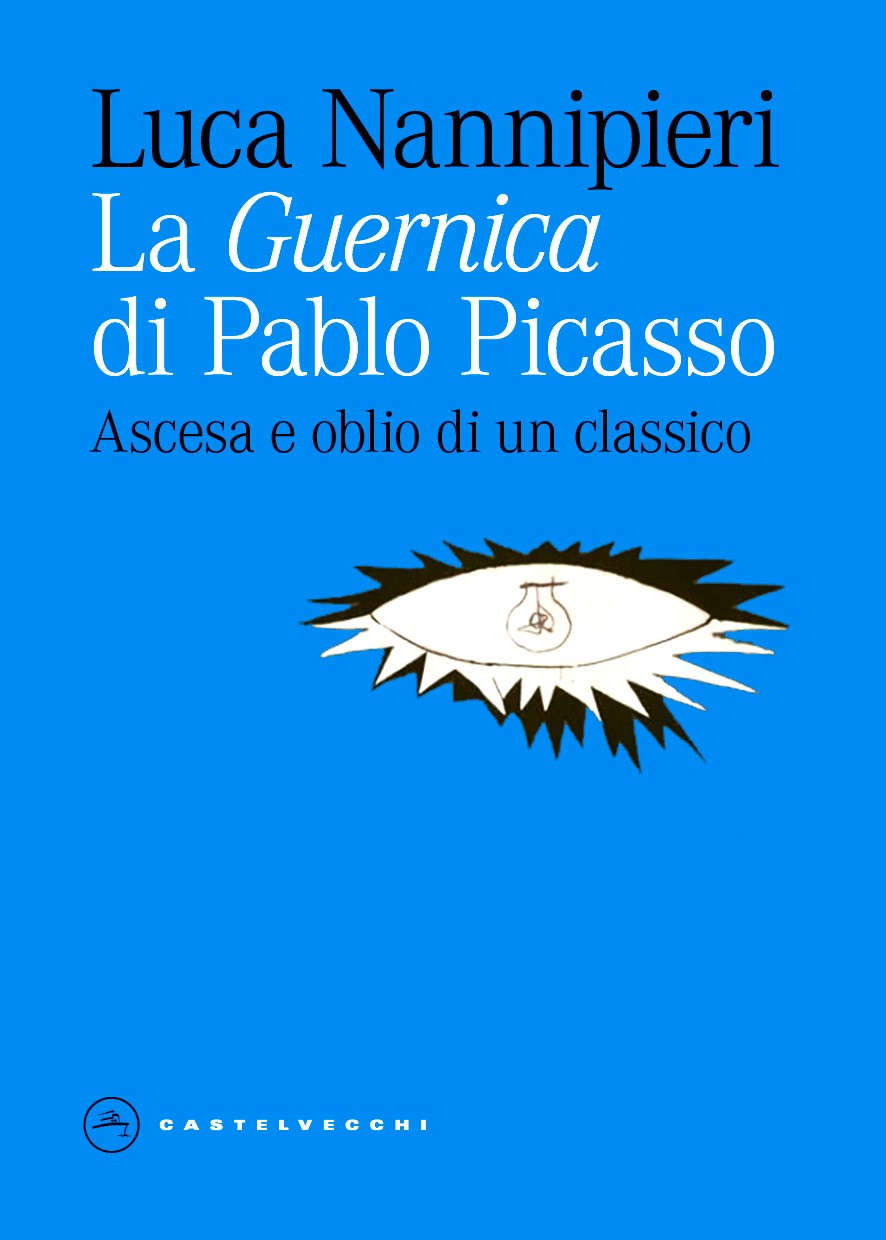
Pablo Picasso’s*Guernica* is one of the most recognizable symbols of 20th-century art. But what truly makes a work of art a classic? And how long can its fame endure throughout history? In his new book, *Pablo Picasso’s Guernica: The Rise and Fall of a Classic* ( Castelvecchi), Luca Nannipieri uses the famous painting as a starting point to explore the fate of works of art. Vandalism thus becomes a lens through which to understand the relationship between art, sacredness, and collective attention: even a destructive act, in fact, can enhance the symbolic power of the targeted work. Yet even the most celebrated masterpieces are destined, sooner or later, to face oblivion: their survival depends, in fact, on the attention, sensibilities, and cultural hegemony of each era. Thus, *Guernica* can regain its centrality when war once again takes on a dramatically relevant role and, conversely, can lose its centrality when the perspective through which a society interprets the world changes. In this interview with Ilaria Baratta, Nannipieri also reflects on the sacredness of art, the non-peaceful nature of artworks, and the role of museums. This exploration goes so far as to call into question the very idea of the eternity of cultural heritage.
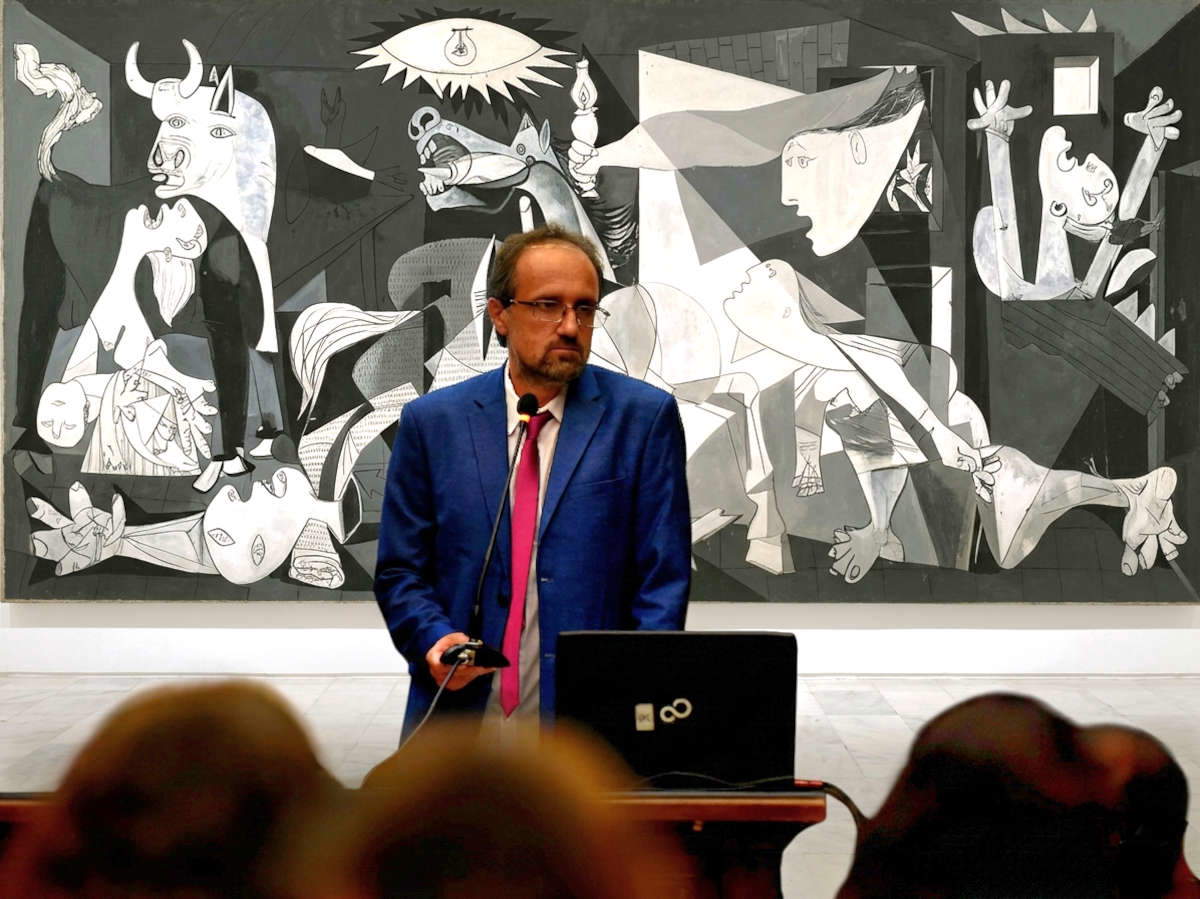
IB. Let’s start with the work that gives your new book its title: Pablo Picasso’s famous *Guernica*, which everyone knows. However, this is not a traditional monograph on *Guernica*; rather, the work serves as a springboard in your book for other highly topical issues, such as acts of vandalism against works of art. Why did you choose Guernica specifically as the central theme of your essay and not another work of art that has been vandalized—incidents of which, incidentally, you mention in a later chapter?
LN. Picasso’s *Guernica* is perhaps the most famous work of the twentieth century, alongside Andy Warhol’s *Marilyn Monroe *. My reflection on light and the oblivion of humanity’s milestones—a line of thought I have been pursuing for years—now touches on *Guernica*, just as it might touch on the Colosseum or the Sphinx. Its transformation into an icon—an industrialized image replicated in logos, trademarks, reproductions, variations, parodies, tourist souvenirs, and school curricula—has, over time, made it a symbol of orientation and collective meaning, and thus also the target of frequent acts of vandalism and protest. Vandals, through their actions, affirm the radiance of the works they target. A vandal does not attack the shadow—he attacks the light.
Your book opens precisely with the act of vandalism against *Guernica* at MoMA in 1974. Among the statements that struck me most on the subject of vandalism, you write in the chapter “The Vandal Strikes at What Is Considered Sacred” that “acts of vandalism amplify the almost prophetic magnetism of certain works of art. That is why we are writing about it: because the criminal act does not diminish the work’s significance—on the contrary, it amplifies it.” Can you explain what you mean by that?
The vandal’s act elevates to an absolute the very work he seeks to destroy or damage. The wound iconizes the work, casting a light upon it that ordinary life does not produce. It is the very act of sacrilege that, while appearing to diminish, actually multiplies. While appearing to annihilate, it in truth enthrones. The vandalized work of art is a work whose durability has been enhanced. Its “canon” emerges confirmed and augmented. For every Guernica vandalized for a single day, there are millions of images of the vandalized Guernica that are reproduced and disseminated in the days, months, and years that follow. The vandal is a social multiplier of the canon. The work’s prominence is thereby reinforced, compared to other works that, remaining in the shadows, do not receive the consecrating fanfare of defacement. A vandal, a protester, or a dissenter would never target a work in storage, a discarded piece, or one sitting in a warehouse. Their act targets a work in the spotlight, precisely because of its prominence, thereby validating its prominence.
This brings to mind, then, the incidents of recent years in which environmental activists have thrown soup or other filth at masterpieces, such as the tomato soup thrown at Van Gogh’s *Sunflowers* at the National Gallery in London as an anti-oil protest, or the black liquid sprayed on Gustav Klimt’s *Death and Life* at the Leopold Museum in Vienna. What do you think of these acts of protest? Do you think they’re truly effective in stirring people’s spirits in favor of a general shift toward a more environmentally conscious world?
Every struggle leads to a reconfiguration of the figurative languages we rely on and is driven by the sacrosanct desire to transform the guiding principles of a civilization. If a struggle were limited to a conservative “happy ending” for existing works of art, it would be nothing more than an aperitif, a Rotary Club cocktail party. The limitation of Ultima Generazione is that I’ve seen the demonstrative acts, but I haven’t seen the struggle: throwing a little washable paint on Van Gogh’s Sunflowers isn’t a struggle. Do you really want to shout that human civilization is rapidly going extinct because of climate change? Destroy the Louvre or the Uffizi. Don’t go wearing white gloves or without a bra.
Another point you reflect on in your book is the sacredness that surrounds works of art in museums. “The sacredness that surrounds works of art is profoundly different from the sacredness centered on places of worship,” you write, going on to define the sacredness of a work of art as “depersonalized sacredness.” What does that mean?
Religious sacredness tends to engage the whole person and tell them, “This is your full destiny.” Every person is driven, from birth to death, to embark on a journey toward the complete revelation of themselves. No one is excluded. One need only read anthropologists, philosophers, or historians of religion such as Julien Ries, Mircea Eliade, or Pavel Florensky. The sacredness of a work of art, on the other hand, does not depend on the direct involvement of all people. While Christianity says, “Repent, all of you. Yours is the Kingdom of Heaven,” works of art have no mission to fulfill toward all of humanity. If a priest sees a hungry homeless person, he feeds him. If a museum director sees the same hungry homeless person in front of the museum, he can call security to have the person removed. The sacredness surrounding art carries no moral or spiritual responsibility toward the evils of the world.
Referring to a brief chapter in your essay, what do you mean when you say that “works of art are not peaceful”? What did Pablo Picasso himself say on this subject?
Works of art are not docile objects whose meaning is fixed once and for all; nor is our attitude toward them fixed once and for all. Human testimonies—and art in particular—constantly call us to reevaluate what we have thought and said. The great art historian Alois Riegl said: “The meaning and significance of monuments [of works and artifacts, let’s say here, ed.] do not depend on their original purpose, but rather it is we, modern subjects, who attribute them to these objects.” Works of art are frequently altered or alterable, constantly open to manipulation and reinterpretation. Pablo Picasso, with his off-the-cuff remarks, is proof of this: in some years he claimed, like a Futurist, that museums should be closed and dismantled; while in other years he denounced the barbaric bombings of the Prado in Madrid. Here’s a truly curious fact: Picasso was the only person in the world (perhaps a one-of-a-kind case) who was arrested and suspected of the 1911 theft of the Mona Lisa from the Louvre in Paris, and then, decades later, in 1936, was appointed director of the Prado in Madrid. It is unthinkable that anyone (apart from Picasso!) could, on the one hand, be suspected of a high-profile theft at France’s leading museum and, on the other, be appointed director of Spain’s leading museum.
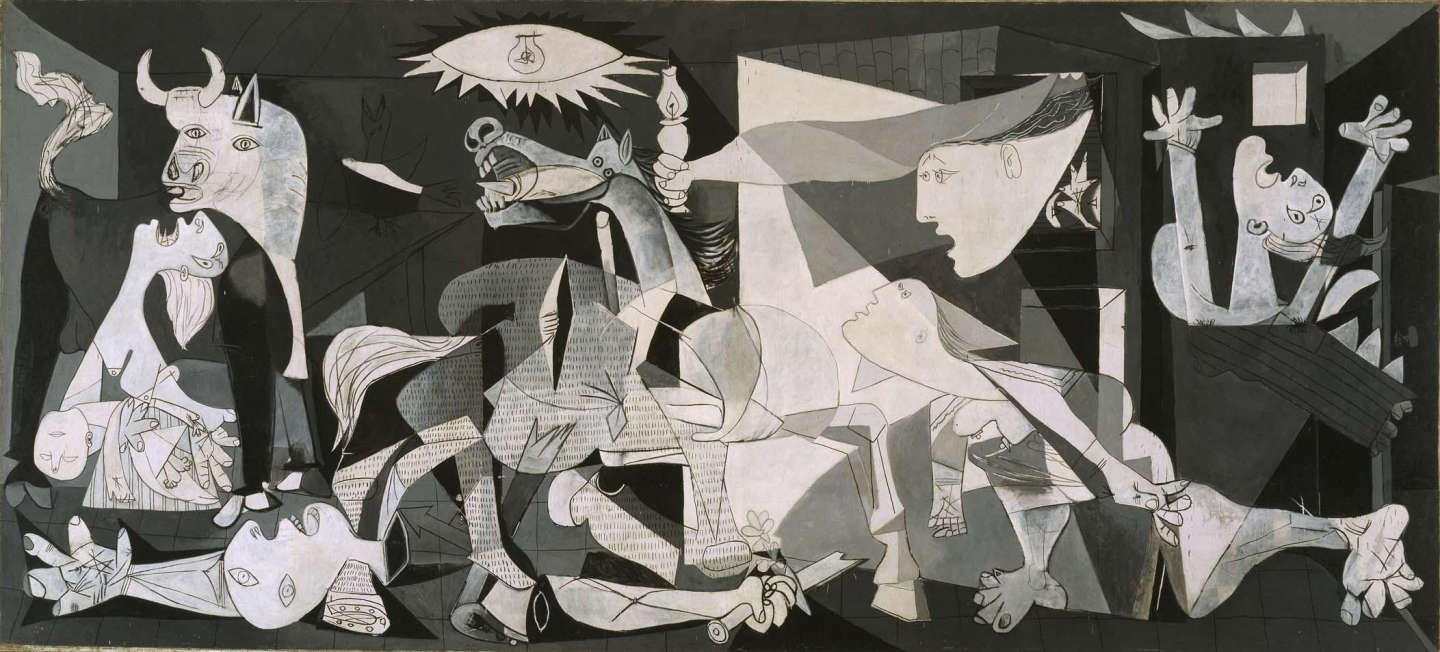
The subtitle of your book is “The Rise and Fall of a Classic.” You argue, in fact, that no classic is eternal and that it inevitably goes through cycles of prominence and obscurity due to a series of external factors, such as fashions, cultural hegemonies, and historical and political events. *Guernica* is a highly political work, born out of a specific historical event. How significant is this political-documentary component in determining the cycles of prominence and obscurity in the case of *Guernica*, compared to a work without explicit historical content?
The subject matter of *Guernica* (the cry of protest against violence) is actually of little relevance and has little impact on the long journey of prominence and oblivion that *Guernica* itself will undergo. In other words: today we are living through a dark period of wars and conflicts on the world stage, so we perceive that Picassian cry as a duty, an absolute. We reproduce Guernica to tell ourselves: never again war. But there have also been decades—even recent ones, such as the decades of “peaceful” globalization—when it was believed that every social and geographical conflict could be silenced by promoting dialogue, mutual tolerance, and the Western model that homogenized the planet, to the tune of Coca-Cola, Hollywood, and flower children. During those decades, which lasted until the 2001 attacks on the Twin Towers, *Guernica* was merely an artistic embellishment, a scenic backdrop with a noble name, to be displayed at UN headquarters. When war returned to knock on the doors of our cities—with attacks, bombs, and territorial claims— Guernica once again rose to become a symbol denouncing the barbarism of conflict.
So could even a masterpiece like *Guernica* be subject to oblivion? What do you think would have to happen for that to occur?
Time will pass, and, like all milestones, it will have to be confirmed or refuted by the free decisions of peoples who press forward with their desires, wills, hegemonic ambitions, and acts of abandonment. Around *Guernica* there will be omissions, inattentiveness, neglect, misalignments, then lulls, hibernations, and long periods of oblivion. The grass around the milestone will grow tall, then remain undisturbed. At some unspecified time, its oblivion will thus begin: Guernica will be absorbed into insignificance. Other landmarks will capture the attention of those future inhabitants. So what? Is this its end? Does its oblivion equate to its death? Does its descent into the shadows amount to its destruction? To its definitive departure from the world? No, history tells us. After oblivion, *Guernica* may return to civilization.
If every classic could slip into oblivion, what truly distinguishes an “eternal” work from one destined for a more rapid oblivion? I believe the central point lies, as you state, in the importance we ourselves attach to the classics—which is fundamental to keeping them alive. We are the essential element.
“We are the essential element” must be taken in all its radical significance: it is precisely we, as living beings, who determine whether works rise to prominence or sink into obscurity, together with traditions, hegemonic forces, conflicting forces, wars, and social demands. There are no eternal works. Cultural heritage is not a collection of works, but a collection of attentions.
In this view of the impermanence of the classics, you yourself admit a partial exception for sacred texts, such as the Gospels. Isn’t this a contradiction to the general principle?
It is not a contradiction. It is an open question. I love the Gospels and will do everything in my power to ensure that the word of Jesus lives on. But there are now billions of people in the world who do not consider his words to be central. When these billions of people also become culturally dominant, they may inevitably promote a worldview that will render Christianity a thing of the past, turning altarpieces, crucifixions, Pietàs, and scenes of mourning a set of increasingly empty, meaningless trappings to be consigned to oblivion. It will be the most difficult kind of oblivion for us, but the patterns of history tell us that it can happen, just as we no longer pray today to Osiris, Isis, and the other Egyptian deities, or to Ashur and the other Babylonian deities.
In the final chapter of your book, you propose this interpretive framework of alternating light and oblivion—which you applied to *Guernica*—as a method of study for a broader investigation leading to reflections, evaluations, analogies, correspondences, and a new capacity for understanding reality. Is this method applicable to all works of art? What, in your opinion, are the limitations of this method?
Thank you for this question. It is a persistent quest, a space of inquiry in which, every time I enter it, its entire unspoiled immensity reveals itself to me. Since there is no immensity that humankind has not, by desire and by nature, sought to navigate, I make my own the words that Stefan Zweig wrote in his defense of Sigmund Freud: “Wherever the human spirit senses an unexplored region or an unfathomable depth, it can find no rest.” There you have it: the epistemological limits of my method are, paradoxically, to set no limits for myself.


The author of this article: Ilaria Baratta
Giornalista, è co-fondatrice di Finestre sull'Arte con Federico Giannini. È nata a Carrara nel 1987 e si è laureata a Pisa. È responsabile della redazione di Finestre sull'Arte.
Warning: the translation into English of the original Italian article was created using automatic tools. We undertake to review all articles, but we do not guarantee the total absence of inaccuracies in the translation due to the program. You can find the original by clicking on the ITA button. If you find any mistake,please contact us.























 IT
IT FR
FR DE
DE ES
ES CN
CN


