





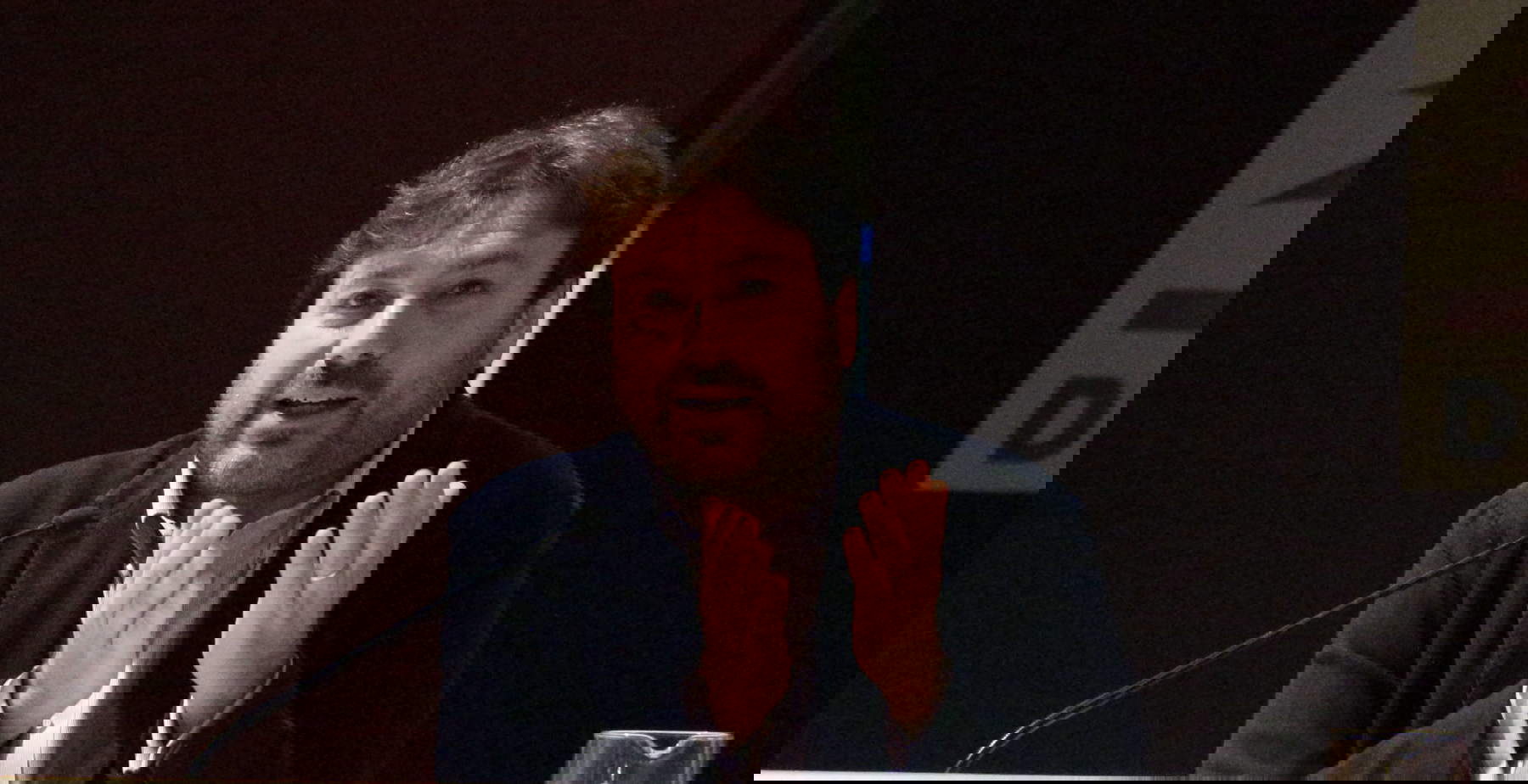
Harsh attack by Tomaso Montanari, Rector of the University for Foreigners of Siena, art historian and by now among the most followed political “influencers,” on Il Foglio, which published yesterday an article by Ginevra Leganza on his appointment to the technical-scientific committee for Archaeology, Fine Arts and Landscape. The exchange, initiated by the article and continued with a retort by Montanari from her very popular Instagram account, brought into focus the nature of advisory bodies, their relationship with political power and the role of intellectuals in the public space.
Ginevra Leganza, in her piece, anticipated that Montanari will be appointed to the cts, an advisory body that expresses opinions on protection issues but does not deliberate: it is an appointment without remuneration and Montanari was indicated to University Minister Anna Maria Bernini by the National University Council, as reported by the journalist, who while correctly reporting the passages did not spare a comment of her own: “The committee of the Meloni government-the same government that does not so much extol Tomaso-has in fact its own consistency. Its own weight. The face of La7 will now be able to advise on the protection and enhancement of the landscape, it will be able to define scientific criteria for restoration, maintenance and cataloguing interventions. It will then be able to have a say in projects, direct research, evaluate works and their possible transportability. In short, mica chatter. And certainly there is nothing undue, one will say, for a man whose science is not lacking. Nothing unfair. Except, perhaps, for the pro-chamber purism. That is, disdain for right-wing culture, for the fascist minister who appropriates Pasolini, for Giuli who does not renew him as president of the Museo Ginori, but who, therefore, willy-nilly, also favors Montanari. Without purism prevailing over legitimate aspirations.”
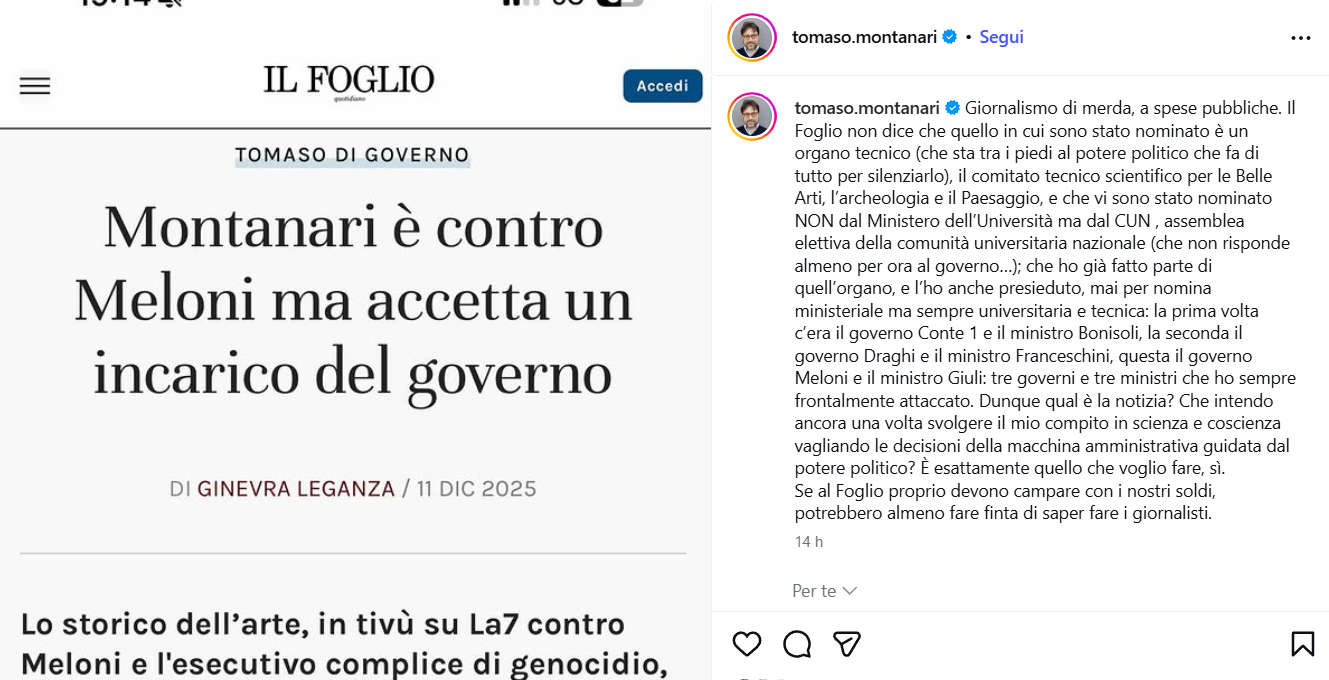
The text thus highlighted the contrast between the media exposure of Montanari, who has often been critical of the current executive and several times intervened on television with very harsh assessments, and his entry into the cts. Leganza concluded by reading Montanari’s appointment as evidence of the “transversality” attributed to Minister Bernini, pointing out how other figures from cultural circles distant from the Meloni government have recently been involved in technical positions in the University and Research sector. According to the interpretation proposed by Il Foglio, Montanari’s presence on the technical committee would represent further confirmation of the line adopted by the ministry, described as open to collaboration with experts from different political backgrounds. The article also notes how the art historian has in the past challenged cultural choices made by ministers close to the current majority, citing episodes and statements over the years that have helped define his public figure.
Montanari’s response came through a post published on his Instagram profile, which garnered significant attention online, with over 20 thousand likes and hundreds of comments and shares. “Shitty journalism, at public expense,” Montanari began. “The Foglio does not say that what I have been appointed to is a technical body (which stands in the way of the political power that does everything to silence it), the Scientific Technical Committee for Fine Arts, Archaeology and Landscape, and that I was appointed to it NOT by the Ministry of the University but by the CUN.” In fact, Leganza had written that “The intellectual, and rector of the University for Foreigners of Siena, who by virtue of unquestionable wisdom will be appointed to the technical-scientific committee for Archaeology, Fine Arts and Landscape. An inter-ministerial body, between University and Culture, where the man of concept as well as television face has been indicated to Bernini by the National University Council (Cun).”
In his reply, Montanari contextualized his participation in the technical body by recalling that he had already held similar positions under governments of different orientation: first during the Conte I executive, then during the period of the Draghi government. In both cases, he pointed out, his role did not result from a minister’s choice, but from internal procedures within the technical bodies. Such continuity, in his interpretation, would render unfounded the idea that the current appointment constitutes a contradiction to his critical positioning toward the Meloni government. Montanari finally defended the nature of his mandate: “So what is the news? That I intend once again to carry out my task in science and conscience by scrutinizing the decisions of the administrative machine driven by political power? That is exactly what I want to do, yes. If the Sheet really has to make a living on our money, they could at least pretend to know how to be journalists.” No replies followed at the moment, and the exchange remains confined to two speeches. It remains to be seen whether the affair will be limited to this exchange or whether it will become a new point of discussion about the role of technical expertise in decision-making processes and the often complex relationship between intellectuals and institutions.
|
| Tomaso Montanari attacks Il Foglio from Instagram: "Shitty journalism at public expense" |

Warning: the translation into English of the original Italian article was created using automatic tools. We undertake to review all articles, but we do not guarantee the total absence of inaccuracies in the translation due to the program. You can find the original by clicking on the ITA button. If you find any mistake,please contact us.



























 IT
IT FR
FR DE
DE ES
ES CN
CN