



by
Federico Giannini  @federicogiannini1
26/05/2026
@federicogiannini1
26/05/2026



Categories: Opinions / Disclaimer
Expansion of the Borghese Gallery. New spaces, services, exhibitions and events: the project, for now still at the feasibility project stage, reopens a question. Namely: to what extent can one intervene without breaking the historical balance between villa, garden and collection? Federico Giannini's editorial.


The discussion that has arisen around the future of the Borghese Gallery has so far produced an exciting, uplifting laboratory of nothingness, and let it be said in a positive sense, since at the moment it is necessary to fret about everything that is not: first of all, on an expansion that at present is just a larva, a hypothesis, a feasibility study, although the idea that someone is working on the possibility, we read in the papers, “of a new building to be constructed in a space conterminous to the building that houses the Gallery,” is enough to stir the passions of most. And then, on what the Borghese Gallery should not be, even though the direction imprinted by the notice of last November and, above all, by the memorandum approved by the Capitoline Council last May 5 (i.e., the element that triggered the discussion), would seem to be moving exactly, precisely and perhaps even ineluctably toward some form ofontological inaccuracy garnished with phrasing typical of a certain type of institutional conformism (“active and accessible cultural hub,” “improving the usability of public spaces,” “functional regeneration of one of the world’s most important cultural hubs,” “enhancing the city’s international attractiveness,” and so on).


Speaking of conformism: now that the hullabaloo of the first days has passed, it seems that the tribunes on both sides (and thus, on the one hand, the catastrophists who are screaming about preemptive havoc, about slaughter on trust, at a time when we still do not know what will be done, and on the other hand, the redevelopment jihadists who would like, with an attitude as overbearing as it is unrealistic, to hush up the other side by squawking about hysterical immobility: two forms of populism that appeal just to their respective claques, thus of little use), perhaps it is possible to get more into the merits of the issue, although for now nothing is known about what will be proposed by the company, Proger Spa, which has offered technical sponsorship for the preparation of the feasibility project. We can start from a statement, well summarized by Italia Nostra, which is careful to reiterate in its statement that the Borghese Gallery is a synthesis of a “balance between nature and culture that has remained unchanged for more than four centuries, which consolidate the place in the perspective of the future.” It is necessary, meanwhile, to make an initial distinction between a Villa Borghese that is the evolving fruit of a continuous stratification capable of making the park a kind of palimpsest uninterruptedly overwritten until almost the present day (the last structure, the Globe Theatre, today little more than a ruin due to the problems that have been than a ruin because of problems that there is no point in rereading here, is from the early 2000s, but think also only of the widening of the internal roads to meet the voracious and inescapable needs of the road system), and a Borghese Gallery that, at least in its exterior facies , has remained substantially unchanged since the end of the construction site.


The uniqueness of the Gallery lies in the almost perfect preservation of that balance that has been maintained and consolidated from the seventeenth century to the present day. It is natural, therefore, for someone to consider it desirable to safeguard a balance that would inevitably be jeopardized if the adjective “conterminous” were to be taken literally. Also delicate is the situation of Villa Borghese, which has been continually modified over time and even transformed, in the early twentieth century, into a public park, from the garden that it was (and it should not be forgotten that, again a hundred years ago, the Villa also lost its perimeter walls, a situation that caused the loss of its sense of boundary): nevertheless, Villa Borghese has come to the present day still substantially recognizable in its entangled harmony. And it is an observation that, it will be worth recalling, does not derive from a whim of Italia Nostra or anyone, but from a vast technical and scientific literature that has taken upon itself to read the place. Beata Di Gaddo, who has long studied the park, in her seminal 1985 essay, republished with a few variations in 1997, could write that Villa Borghese “has come down to us not certainly intact but still assessable among the city’s most remarkable parks,” "one of the few historical villas still remaining almost intact in its extension, but arrived today at a moment of impasse, at a limit point that may determine its complete destruction or on the contrary [...] its restoration and a revaluation appropriate to its historical and urban importance.“ It goes without saying that any intervention must be subject to ”an accurate reading of the places and historical knowledge of the evolution and changes that have occurred over time (whether positive or negative)." And if already, at the time of the restoration in the 1980s-1990s, the enlargement of the basement alone endangered the Gallery’s garden, let us imagine what could happen by raising a new structure close to the Borghese’s casino. In the best case scenario, we would end up turning Rome into a rowdy, reedy successor to Paris or Antwerp, and the Borghese Gallery into a caricature of what it is not, namely a museum.


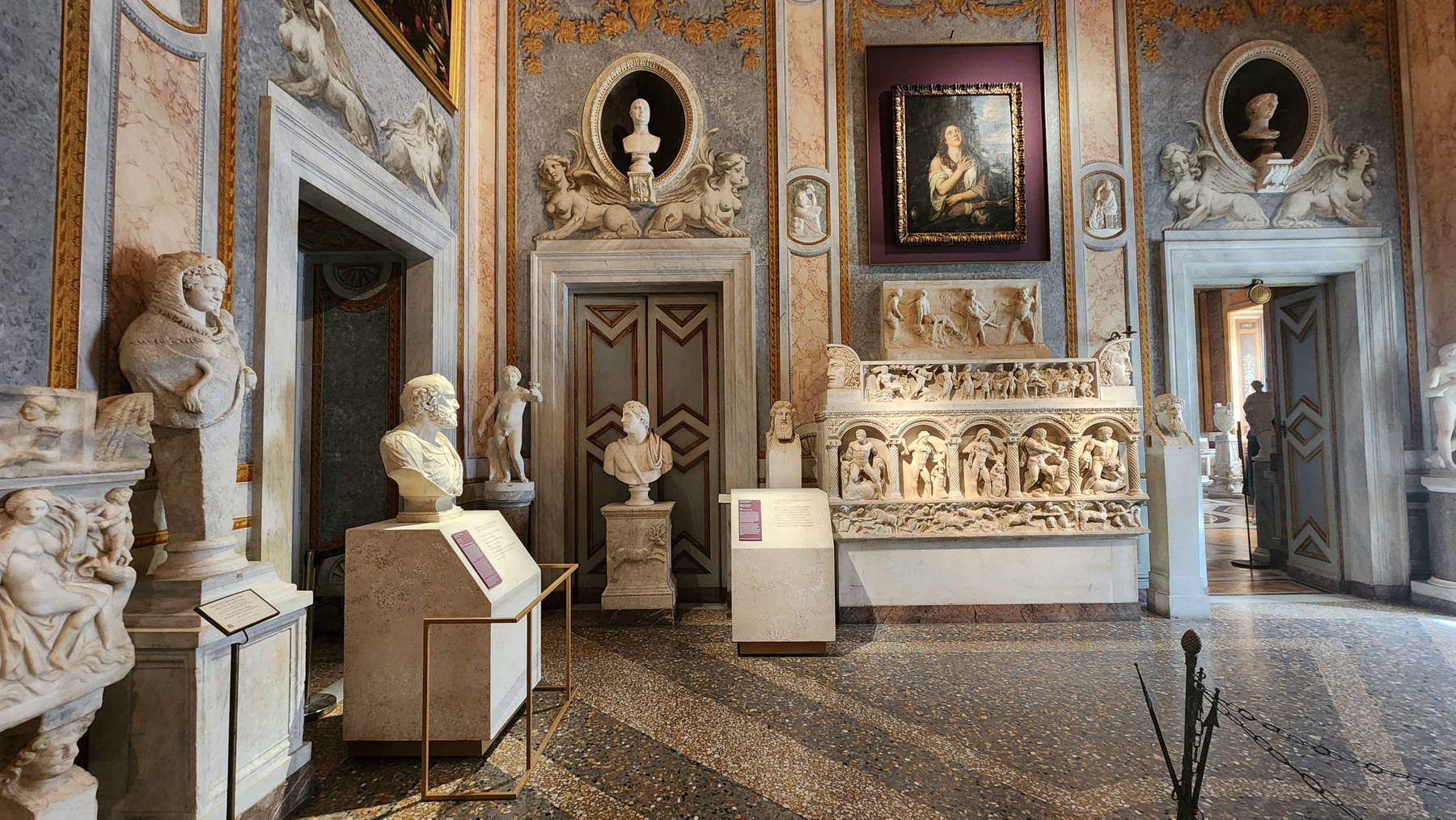
It may sound strange, but the Galleria Borghese is not a museum, except by misunderstanding of classification: it is, if anything, a habitat where paintings are not exhibited but stand quartered, where sculptures seem like motionless beasts proud of their reserve that appears so perfect as to seem still virgin, untouched. And according to this logic, then, the Borghese Gallery should be thought of. It is not then a useful argument to think about the almost interminable wait one has to undergo to enter this ecological niche: every year the Gallery is visited by almost six hundred thousand people, and it is hard to imagine an even greater pressure, given the nature, conformation and fragility of the place. Physics has boundaries that are impassable even to the most qualified of planners and the most talented of architects. The public will want to continue to see Bernini and Caravaggio, and unless it is improvisedly decided to move theApollo and Daphne or the David with the head of Goliath, a circumstance that is nevertheless impossible, it will be difficult to imagine any less light pressure: it is not then for the public anxious to explore the Borghese Gallery that a new building is imagined. It is, if anything, we are led to think, for a category of visitors for whom there are viable solutions, since what the management of the Borghese Gallery is pressing for is, we read again in the papers, “to increase the offer of exhibitions, of service areas, of technical and didactic areas, and of conference rooms by considering a new volume that can make the Gallery a more welcoming, usable and safe place.”
What you want to do, therefore, is to turn the Borghese Gallery into a museum. More exhibitions, then: but are they really necessary, to the point of justifying the construction of a “conterminous” volume? One struggles to recall, in recent times, truly indispensable exhibitions: the only high-level exhibition that comes to mind is the one on Giovan Battista Marino two years ago. For the rest, only small thematic lunges come to mind (such as the exhibition that accompanied the acquisition of Guido Reni’s Danza campestre ) or questionable operations such as the intrusion of contemporary works in the middle of the halls, starting with the recent exhibition of Wangechi Mutu, a forced and grotesque conversation, a noisy graft, a dull ornamental visit that was not felt to be necessary. Of course, one will say: it is necessary to turn the Borghese Gallery into a museum, and consequently it is necessary to put it on the exhibition circuit. But if only the exhibitions were the problem, then it would be a trifle, a matter of nothing: it would be enough not to do them, because there are too many of them, and the Borghese Gallery certainly does not need to compete on visitor numbers with other museums in Rome. There is more, however: we need service and educational areas, because today no one would dare deny the need for a restaurant inside a museum, a gesture of civility and welcome to the hungry, ailing and harried visitor, or for a workshop where to confine for a couple ofhours until the visit of the adults is over, and thus an opportunity to make the visit of each member of the family truly productive, or a conference room where the increasingly dense troop of book presenters can quarter and thus be useful in multiplying the opportunities for in-depth study.
Needs of a contemporary museum, of a structure that can no longer and should no longer guard but must produce traffic, flows, events. Needs that must be taken into due consideration, but one wonders whether it is really necessary to construct a new building, as if the renewed needs at the same time demand a translation into concrete, demand addition, demand a proliferation of spaces rather than the arrangement of what is already there. And there is no shortage of proposals, nor any shortage of spaces, to be refurbished probably at a lower cost than what a new building would cost: it has been said of the Casino delle Officine now occupied by a municipal kindergarten, Villino Pincherle, the Palazzina della Meridiana, and the Paviglione dell’Uccelliera, all buildings that already exist and where service areas, conference rooms, and refreshment areas could be accommodated without great difficulty (other than, of course, bucratic-administrative ones). Councillor Giulia Ghia, in charge of culture in the I Municipio, writes that Villino Pincherle “cannot be evoked as a magic solution” since it is necessary “to understand who owns it, what functions are compatible, what costs an eventual recovery would entail, what legal instruments could be used: acquisition, convention, public use, partnership, agreement between institutions,” and that “precisely for this reason it must be put into the reasoning.” No one denies that the Italian and Roman bureaucracy is as intricate as an equatorial jungle, but is it so impenetrable as to make a feasibility study for a new building more practical in lieu of perhaps a more sensible study of solutions for the existing one? It would lack, of course, the space for major exhibitions, the space to get works out of storage, the space where even more people could circulate who are itching to go see Bernini and Caravaggio (and which would become a waiting and accounting space, because the bulk of the public at the Borghese Gallery does not go there to see exhibitions). If that is the real goal, then the construction of a new volume seems the only plausible solution: it will then be appropriate to understand how far the contiguity should extend, and especially to what extent it is possible to build new buildings inside Villa Borghese without molesting it, to what extent it is possible to touch without destroying it, to what extent it is possible to intervene without ending up turning the Borghese Gallery into a parody of a Louvre.
Warning: the translation into English of the original Italian article was created using automatic tools. We undertake to review all articles, but we do not guarantee the total absence of inaccuracies in the translation due to the program. You can find the original by clicking on the ITA button. If you find any mistake,please contact us.