





The whole story of the thirteenth-century Madonna by the Master of the Baptistery of Parma that ended up abroad has become, in my view, a textbook case of misinformation, based in this case on a curious mixture of the two typical elements of misinformation, elements that in the scholarly literature on journalism some scholars have called “false connection” and “misleading content.” So, on the one hand, images and headlines that have no connection with the content and, on the other hand, use of misleading information to frame the issue. I think it all originated from the article by a colleague who was not an expert in the subject matter and who read the Council of State’s ruling, published 5 days ago, with the tools of a person unaccustomed to art history: the article was then picked up by many other newspapers who did not have the heart to feed their readers extraordinarily juicy news, as it turned out to be (again, because of another curious mix-up: a public servant’s alleged Fantozzi-like error, namely the exchange of an 8 for a 3 in an inscription on the back of the panel with the consequence of having deemed the painting a work of 1850 instead of 1350, and the explosive charge of indignation towards the public administration that the news presented in this way was capable of arousing). Finally, the newspapers were joined, last as usual, by the various influencers, charlatans, and barkers who point the camera in each other’s faces and who often gibber about things they do not know and do not know, ending up confusing the public even more.
In essence, the news was presented roughly like this: “A 14th-century work of art, a panel by the Master from 1302, ends up abroad because Ministry officials mistake a 3 for an 8, read 1850 the date 1350 written on the back, and write in the export authorization that the work is a modest 19th-century painting, interesting only for local devotion.” This levity provoked the flood of indignant and sarcastic comments mentioned above. There was even a video, viewed by thousands, shot by a person who turns out to be neither an art historian nor a registered journalist, who first mocks the official who made the mistake (of the series: “to distinguish a fourteenth-century Madonna from a nineteenth-century one, it is enough to have done the first year of the three-year degree in cultural heritage”), and then, with disarming naiveté, shows a roundup of images of two- and fourteenth-century Madonnas, some even famous ones, and then a series of classicist, neo-Raphaelite, early nineteenth-century Madonnas to show the difference.
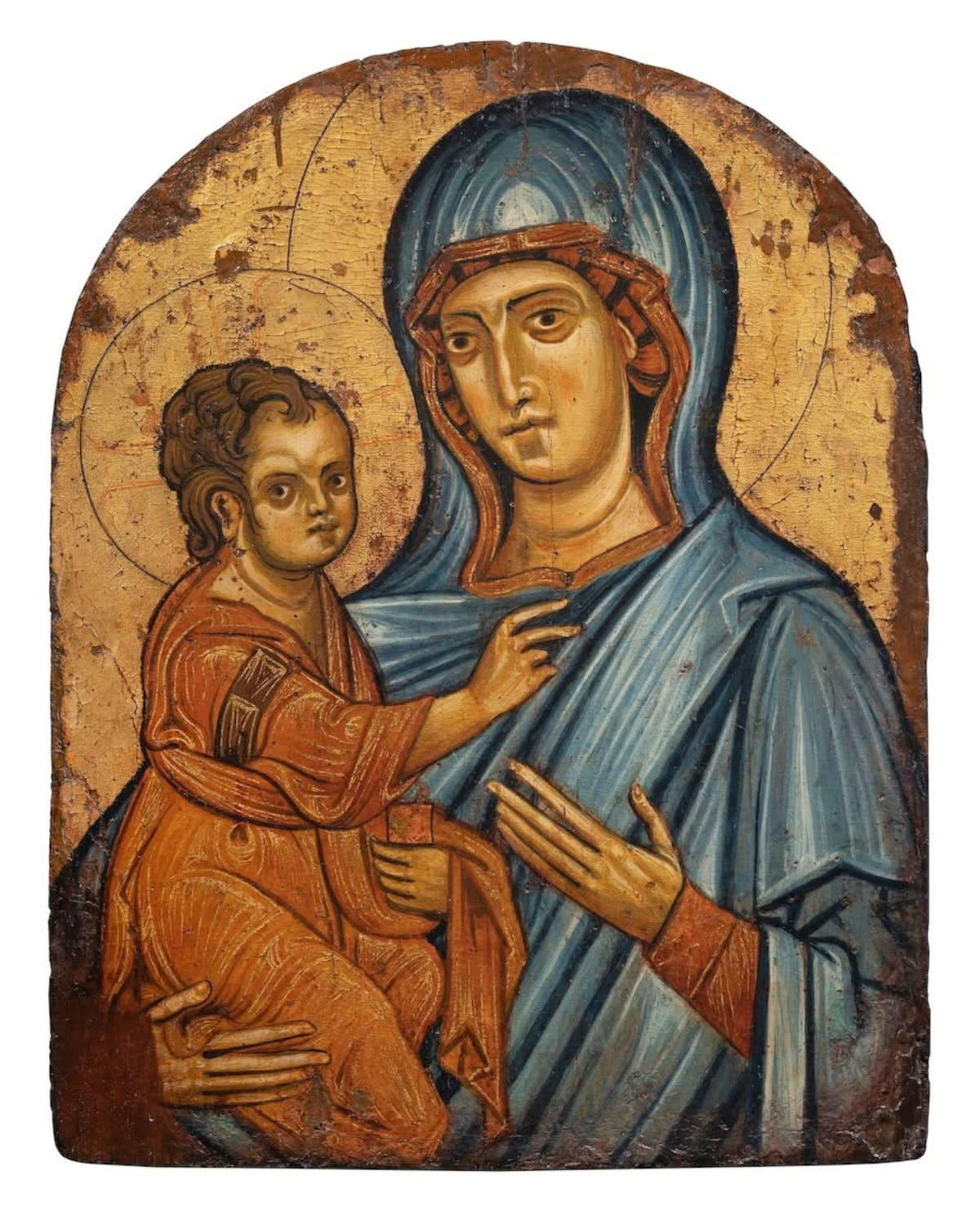
Now, as I see it, there was certainly a gross error on the part of the Genoa Export Office, but not so much in the formal assessment of the painting. Painting that, sure, had been published by Boskovits and is also supported by first-rate scholarly literature, so it should not have escaped notice. But let’s accept that the panel was unrecognizable, let’s accept the fact that, as someone notes, we are talking about the Covid period and libraries were inaccessible, let’s admit haste and exhausting working conditions, and let’s also admit the dose of human error in the formal analysis of the work. The grossest error in my opinion lies elsewhere: reading the Lazio Regional Administrative Court’s ruling, we learn that the certificate issued by the body found the declared value (38.000 euros), and in the report issuing the certificate it reiterated that it was a work “of some interest in relation to the local devotion to this venerated image; from the point of view of quality it is a modest work that can obtain the certificate of free circulation.” I continue to wonder how it was possible to consider that a value of 38,000 euros was congruous for a work judged to be a modest nineteenth-century panel in the Byzantine style, such as exist in cartloads of them, especially since it had been put up for sale by Pandolfini, the judgment again states, at open bid, which is usually the case when the auction house itself considers the work in question to be an object without real value (and the fact that it was sold at 38.000 euros from a base of zero means that there was at least some suspicion that it was not a trivial Byzantine crust). It seems to me that no one in the newspapers and on social media has pointed out this anomaly, but after all, if you don’t know the market, you don’t know what an auction looks like, you don’t know the scales of value of nineteenth-century works, it is normal to overlook that element, because of the art market you don’t know a damn thing and therefore you are not equipped with the tools to detect the inconsistency, whereas on the other hand we have all more or less gone to a museum and a little bit of art history in school we have all studied it, so you are surprised that a fourteenth-century Madonna (which was then from the thirteenth century: we’ll get to that) was mistaken for a nineteenth-century Madonna.
Actually, it is not that simple: in the nineteenth century, a flourishing market for Italian antiquities destined for foreign countries developed, and many Italian works, especially from the Middle Ages (the historical period toward which the taste of the buyers of the time was mainly directed, a taste that had been formed on the tail of Romanticism), ended up mainly in England and the United States. In this context, where there was a lack of laws regulating the exit of goods from the territory of a newly united Italy, it is normal that many forgers circulated, some of them very skilled (Alceo Dossena, Icilio Federico Joni, Umberto Giunti) and capable of deceiving even experts. In Pisa, at the Palazzo Blu, a genuine 14th-century polyptych by a painter named Cecco di Pietro and its 19th-century copy executed by Joni can be seen side by side. Here, for a non-expert it is practically impossible to notice the differences and figure out which is the ancient polyptych and which is the modern one. For an expert, if the forger is skilled (i.e., not only is he able to reproduce an ancient image, but he also knows the ancient materials, uses them, adopts the recipes from Cennini’s treatise on painting, and so on) it is very laborious and is something that can often be missed at a glance. So, other than a first-year mistake in a three-year degree in cultural heritage: it is possible for an expert to confuse a medieval table with a nineteenth-century table. This is not the main mistake. The consideration to be made is another one, in my opinion. Now, I have no idea what the work looked like when it was shown at the Export Office. But let’s admit that it was in a bad shape, to the point that it was unrecognizable (again, reading the judgments we learn that it was later restored): I think that the declared value and the quality of the image should have triggered in-depth investigations immediately. In-depth investigations that however, notes the Council of State, did not start “despite the noted uncertain tracing of the work back to the artist indicated as the author and the identification of elements of connection of the same to the miraculous image of the Madonna of St. Luke, a work of the mid-thirteenth century.” In short, there was a little too much levity on the part of the Export Office in Genoa, but that does not mean that there are not very competent people in the Ministry who work in difficult situations (let’s throw in the fact that we were at the beginning of the Covid period at the time), and if the Ministry ascertains that someone made a mistake, that someone will have to answer for it, since the work at the Export Office is a job of responsibility. Then I do not want to justify, of course, but situations have to be evaluated in all their complexity.
Returning instead to how the news was given in the newspapers, the sloppiness is not limited to its presentation, that is, making up the little story of the 3 being mistaken for an 8 and thus tracing back to a trivial misunderstanding the error of judgment of an official who obviously has paleographical knowledge a little more in-depth than that of the average social media user who at most buys Ikea prints, and therefore knows perfectly well that an apocryphal inscription (such as the one affixed to the back of the panel, which is nineteenth- or even eighteenth-century) is almost irrelevant to a correct dating of the painting (it may provide a clue, certainly, but it is not decisive). The sloppiness also relates to names and dates. I have no idea how the attribution to the “Master of 1302” emerged, who is a different artist, and about fifty years later, than the “Master of the Baptistery of Parma” mentioned in the papers, and to whom the work was attributed in Christie’s 2022 catalog. Especially since there was no need to even Google it: all the elements were already in the TAR ruling! Everything: name, measurements of the panel, even period of activity of the master in question, i.e. from 1240 to 1270. I assume that the error stems, again, from lack of expertise: in the present case, not knowing that, technically, “Master of the Baptistery of Parma” is a precise identification (one calls “Master X,” “Master of X” a painter who is still anonymous but well recognizable for stylistic reasons) and not the generic indication of an artist who worked in the Baptistery of Parma at the time. So I think the error stems from a sloppy and hasty Google search, where if you put “Master of the Baptistery of Parma” without quotation marks on June 5, mostly results related to Benedetto Antelami appeared (so much so that there was one journalist who even felt compelled to warn readers: be careful, because the artist in question is not Antelami!). In the case, no journalist pointed out in their story the inconsistency between a work that, in the media narrative, was granitically dated to 1350, and an artist active fifty years earlier (taking for granted the “Master of 1302” who is not the author of this work anyway). To get the correct name, however, one only had to read the rulings carefully.
As to why there is such carelessness in the newspapers, why such news is entrusted to colleagues who are certainly well versed in their subjects but not in art history (it happened, for example, and happens all the time, that the telling of similar cases was entrusted to, for example, very skilled political reporters, who however have not delved into art-historical subjects since their high school exams), as to why it then becomes very difficult to re-establish a minimum of order when by now, with such superficially given news, the cages have been opened, it will be convenient to talk about it again. For us, the same thing applies: those who were wrong to give this news should reconsider the idea of entrusting pieces of art history to those who show such approximation in the matter. And I reiterate that, in our case, one thing would be needed, which is training, which I think is the main way to prevent such situations from arising. Here it is: since by law we have to do so many refresher courses, maybe let’s organize a few more on art-history journalism. If they don’t do good, they certainly don’t hurt either.


The author of this article: Federico Giannini
Nato a Massa nel 1986, si è laureato nel 2010 in Informatica Umanistica all’Università di Pisa. Nel 2009 ha iniziato a lavorare nel settore della comunicazione su web, con particolare riferimento alla comunicazione per i beni culturali. Nel 2017 ha fondato con Ilaria Baratta la rivista Finestre sull’Arte. Dalla fondazione è direttore responsabile della rivista. Nel 2025 ha scritto il libro Vero, Falso, Fake. Credenze, errori e falsità nel mondo dell'arte (Giunti editore). Collabora e ha collaborato con diverse riviste, tra cui Art e Dossier e Left, e per la televisione è stato autore del documentario Le mani dell’arte (Rai 5) ed è stato tra i presentatori del programma Dorian – L’arte non invecchia (Rai 5). Al suo attivo anche docenze in materia di giornalismo culturale all'Università di Genova e all'Ordine dei Giornalisti, inoltre partecipa regolarmente come relatore e moderatore su temi di arte e cultura a numerosi convegni (tra gli altri: Lu.Bec. Lucca Beni Culturali, Ro.Me Exhibition, Con-Vivere Festival, TTG Travel Experience).
Warning: the translation into English of the original Italian article was created using automatic tools. We undertake to review all articles, but we do not guarantee the total absence of inaccuracies in the translation due to the program. You can find the original by clicking on the ITA button. If you find any mistake,please contact us.



























 IT
IT FR
FR DE
DE ES
ES CN
CN


