





I’ve been urged to write a commentary on the theft of Antonello da Messina’s paintings, yet whichever path one takes, it can only lead to some sort of rhetorical conclusion—especially now that everyone has already donned the customary mourning attire and I’m the last to weigh in. Add to this the fact that there are people far better equipped than I am with that whole arsenal of clichés and standard comments that have already been polished up for the occasion—and, above all, far more convincing— and it becomes clear that it’s impossible to add anything meaningful when others have already spoken of incalculable damage, to say that there are no words to describe the loss, to emphasize that the soul of the city has been stolen, and to remind us that this theft is a wound not only for Messina, but for Italy and the world. So, with comments this profound and meaningful, it becomes impossible to find anything original to say—especially since not even three or four hours have passed since the news broke, and the entire spectrum of possible positions has already been covered: there are those calling on the government to invest more in security for our museums (even though this is a regional museum—but it’s only right to refresh others’ memories every now and then), those surprised that the theft at the Regional Museum of Messina didn’t happen until now, some are calling for random resignations (from everyone: from the museum attendant all the way up to, probably, the President of the Republic), while others link the theft to the interest sparked by the Ministry’s recent acquisitionof Antonello’s *Ecce Homo* (in which case Minister Giuli will also have to be investigated for complicity in aggravated theft, guilty of having revealed the value of Antonello’s works to a gang of thieves and to any masterminds—whom we must imagine were completely ignorant of art until just the other day), some who trust in the authorities’ work and the prompt recovery of the stolen goods, and some who point out (a bit populistically, of course, but can we really say they’re wrong?) the rigid, obtuse inadequacy of a political class that hasn’t even commented on the theft (Our leaders must be understood, however: first, it’s Ferragosto, and second, they’re all busy with more important matters—some denouncing their opponents’ fake videos, others responding to those accusations by branding them as envious, still others wishing their followers happy holidays, some to support the initiative to award the Nobel Peace Prize to the children of Gaza—so it’s understandable that no one has yet managed to find the time to comment on the theft in Messina).
In short, everything that needed to be said has already been said, and a few reckless commentators have even gone so far as to suggest possible solutions, even though the problem isn’t yet entirely clear. At this point, the statements by Messina’s councilor for culture are helpful; he speaks of a “theft planned by professionals”: shouldn’t this lead us to conclude that, if the theft was successful, then the thieves are more professional than those who were supposed to protect Antonello’s works? Or, at the very least, that the museum’s antivirus systems are less up-to-date than the virus itself, one might say. The Sicilian Region should therefore consider the possibility of directly entrusting the security systems of its museums to a professional burglar, who will be enlisted into the ranks of regional officials exactly as certain cybersecurity firms do ( look up “Kevin David Mitnick”—known as “Condor”), and you’ll discover the enlightening story of a Californian computer expert who, as a young man—instead of going surfing and harassing female beachgoers like all his peers in the 1980s—enjoyed hacking into U.S. government computer systems, and was consequently arrested, spent a few years behind bars, after which he founded a cybersecurity firm and offered his consulting services to those who needed protection from his former colleagues). Alternatively, one could dust off the solution that Umberto Eco proposed in the aftermath of the theft of works by Piero della Francesca and Raphael from the National Gallery of Urbino in 1975: he suggested placing the masterpieces in bunkers and replacing them with photographic reproductions. And since there has been so much talk in recent days about the Magnani Rocca Foundation, it’s worth recalling how Luigi Magnani took him at his word when, a few years later, for an exhibition of his works in Reggio Emilia, he saw fit to send a photograph—albeit of poor quality— of Dürer’s *Madonna of the Patronage* , one of the most important pieces in his collection (it was said he had received threats that the masterpiece would be stolen); and yet, as the news reports recall, the exhibition was visited by nearly thirty thousand people. At the time, the prank—obviously carried out in good faith—was discovered (the ploy of hanging the work high up so it would be harder to spot the differences was to no avail), but now, with today’s reproduction techniques, no one would notice the difference. After all, that’s exactly what happened recently in Castelnuovo Magra when the municipal administration and the Carabinieri, having learned of the possibility of a theft, took the precaution of replacing the Brueghel in the village church with a reproduction—and in the end, the thieves made off with a photograph.
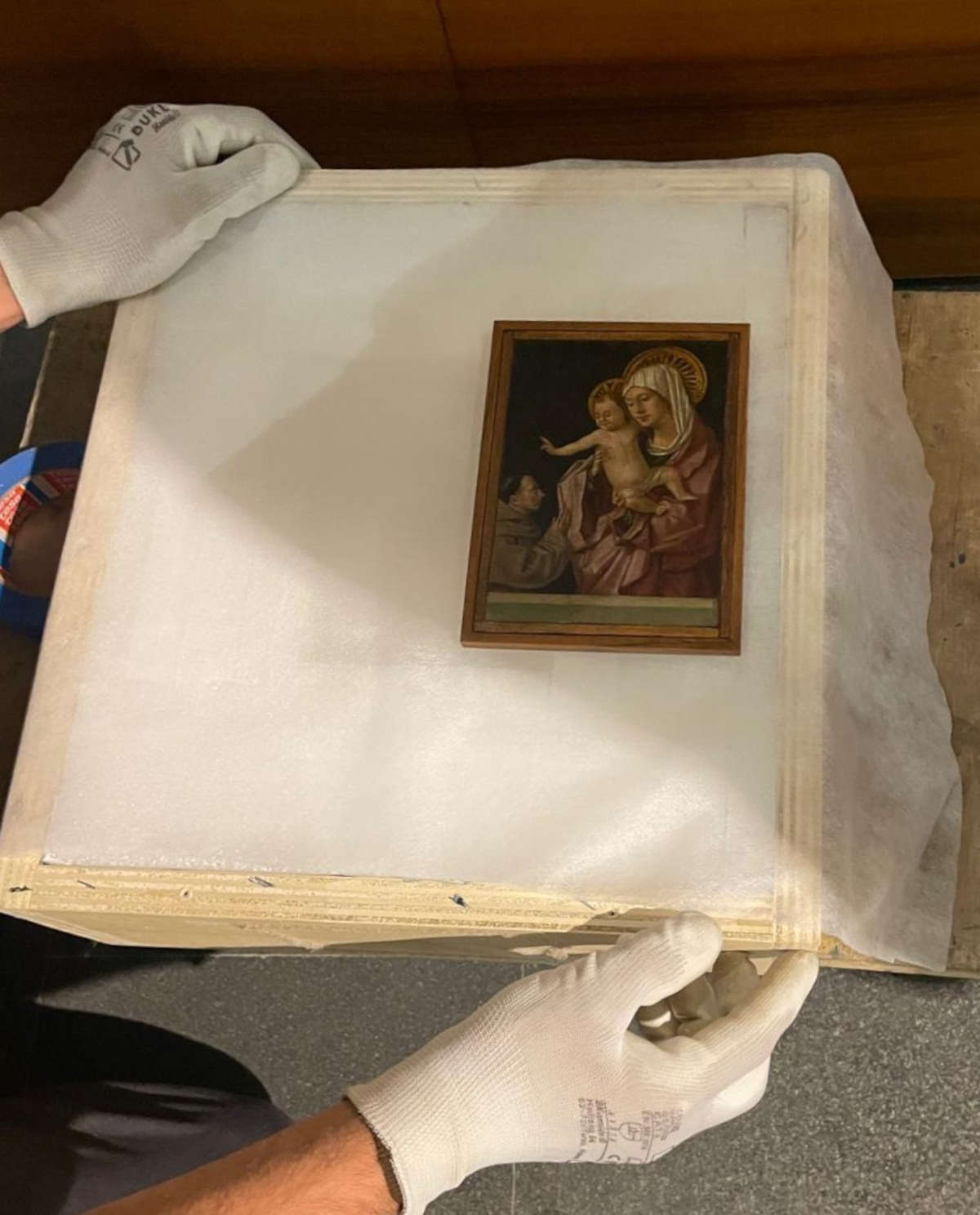
Of course, the fundamental premise remains that those responsible for security must be more professional than the thief, and it’s true that perhaps museums should spend more—and spend it more wisely—to protect themselves (and it probably wouldn’t even require massive spending sprees: what is certain is that if it has now become customary for every museum’s perceived priority to be changing the furnishings with every directorial transition, we will never achieve anything useful), but perhaps this isn’t even the central issue here, and in this regard one could say that thieves are extremely democratic, because in recent years they’ve stolen from everyone: from state museums (the National Art Gallery of Bologna in 2018, Pompeii in 2017), from municipal museums (we all remember the theft at the Castelvecchio Museum in Verona, which was perhaps the most serious until today’s incident), from private institutions (the Magnani Rocca Foundation, the Vittoriale), from diocesan museums (Nocera Inferiore, Pinerolo), and from churches (the Guercino in Modena). It does not, therefore, seem to be a problem of efficiency on the part of any single administration, although it might be desirable that, in the not-too-distant future—to return to today’s case— Sicily would finally abandon its anachronistic autonomy—at least when it comes to the protection of cultural heritage—and join the rest of the country, which is entrusted by the Constitution with the custody of what is found on the island, and which therefore requires, at the very least, an alignment with the standards of the rest of Italy. Let’s not even mention, for example, the difficulty of finding a decent photo online of the stolen works: the ones published on the museum’s website seem like relics from an era when you had to choose between going online or keeping your phone line free (anyone, therefore, will agree that it’s impossible to protect a work of art if you don’t even bother to display it properly for those who happen upon the museum’s website). And, above all, let’s not mention the fact that Sicily is currently—as we’ve widely reported on these pages in Silvia Mazza’s articles—the only Italian region without a Risk Map, the tool that’s supposed to identify operational priorities for assets considered at risk. Business as usual, of course, if the region continues to go its own way: not that this is the cause of the problem—far from it—but if Italy relied on a single protection system, would there be fewer administrative shortcomings? While we wait to find out, we can at least be certain that this is not a matter of individual responsibility. The director, the custodian, the council member, the alarm, the town festival that distracted everyone: if we focus solely on the mistakes, we’ll surely end up with a *Leopard*-esque conclusion. The real question is which system makes it possible for a masterpiece to be stolen. So how much does the risk increase if the system is mismanaged, if it lacks decent infrastructure, if it fails to meet standards? Perhaps we’d prefer to focus more on this than on incalculable damage and irreparable wounds.
The fact remains, however, that thefts are a constituent—and likely inescapable—part of art history. Absolute security belongs to the realm of dreams: it is predictable (indeed, certain) that there will always be someone who enters a museum and takes something away. Let’s accept this realistically and calmly. After that, it will be up to the wisdom of our politicians and officials to ensure that whatever is taken is at least not a masterpiece by Antonello da Messina. Alternatively, we’ll have to rely on the thieves’ lack of professionalism.

The author of this article: Federico Giannini
Nato a Massa nel 1986, si è laureato nel 2010 in Informatica Umanistica all’Università di Pisa. Nel 2009 ha iniziato a lavorare nel settore della comunicazione su web, con particolare riferimento alla comunicazione per i beni culturali. Nel 2017 ha fondato con Ilaria Baratta la rivista Finestre sull’Arte. Dalla fondazione è direttore responsabile della rivista. Nel 2025 ha scritto il libro Vero, Falso, Fake. Credenze, errori e falsità nel mondo dell'arte (Giunti editore). Collabora e ha collaborato con diverse riviste, tra cui Art e Dossier e Left, e per la televisione è stato autore del documentario Le mani dell’arte (Rai 5) ed è stato tra i presentatori del programma Dorian – L’arte non invecchia (Rai 5). Al suo attivo anche docenze in materia di giornalismo culturale all'Università di Genova e all'Ordine dei Giornalisti, inoltre partecipa regolarmente come relatore e moderatore su temi di arte e cultura a numerosi convegni (tra gli altri: Lu.Bec. Lucca Beni Culturali, Ro.Me Exhibition, Con-Vivere Festival, TTG Travel Experience).
Warning: the translation into English of the original Italian article was created using automatic tools. We undertake to review all articles, but we do not guarantee the total absence of inaccuracies in the translation due to the program. You can find the original by clicking on the ITA button. If you find any mistake,please contact us.























 IT
IT FR
FR DE
DE ES
ES CN
CN


