





In a measure signed by Culture Minister Alessandro Giuli, the Central Institute for Cultural Heritage Risk Management (ICRI), incardinated into the Department of Protection (DIT), was created. The garrison serves to give an ordinary structure to the functions carried out under an emergency regime by the Office of the Special Superintendent for the areas of Central Italy devastated by the August 24, 2016 earthquake. The new institution, in fact, is not really new... it is the latest reorganizational act of the Ministry to structurally strengthen the state’s capacity to prevent, monitor and deal with the risks that threaten the national cultural heritage, in light of the impact of climate change, calamitous events and the experience gained in managing earthquake emergencies in recent years.
The history of emergency prevention and management passes, in fact, through certain stages, which have their foundation in the concept of “preventive” restoration, already elaborated by Cesare Brandi. Its cornerstones are a thorough knowledge of the processes of degradation, the control of external stresses, such as environmental factors or pollutants, and the implementation of planned maintenance on the properties. The first attempt to concretize this strategy dates back to 1975, when Giovanni Urbani, then director of theCentral Institute for Restoration (ICR), drew up the “Pilot Plan for the Planned Conservation of Cultural Heritage in Umbria.” It was the same ICR that later developed “The Territorial Information System of the Cultural Heritage Risk Map” (CDR), which allows a particular way of applying scientific investigations, environmental microclimatic control and non-destructive testing, for the programmed conservation of cultural heritage. A working methodology that proposes to develop, through systematic interventions in the conservation and maintenance of property, a strategy based precisely on that prevention of damage of Brandian memory.
In 2020, the technical and administrative management of the Risk Map passed from the ICR to the then Directorate General (dg) Security of Cultural Heritage, which had been created the year before. Under this directorate was also the earthquake office created after the 2016 earthquake (now ICRI). Thus we arrive at thelatest ministerial reorganization by which dg Security was abolished and three departments were born under the new Department of Protection (DIT), of which II deals with emergency and reconstruction.
Today, therefore, the Risk Charter is managed between ICRI and Service II of DIT. In all these transitions to ensure continuity in the transmission of experience and expertise has been Carlo Cacace, head of the system, worthy heir of Brandi and Urbani, who today works as a volunteer to support the new head.
Let’s get a better understanding of the system. Everything revolves around the risk of loss of cultural heritage, taken by the Risk Map as a criterion for identifying operational priorities. From this perspective, knowledge of the geo-referenced distribution of assets on the territory is necessary to plan interventions for their protection, conservation and use. The cartographic representation of the level of risk allows a synthetic communication mode of data and is an operational tool for planning related conservation activities. Such visualization, which allows the production of different representations (“thematisms”), always updatable and superimposable, capable of defining the risk levels of the national heritage at different times and conditions, has been made possible by the development of Geographic Information Systems.
In a nutshell, risk expresses the probability that an undesirable event will damage a cultural property. It is considered as a function of two different quantities: hazard, i.e., the presence or probability of damaging events occurring in the area, and vulnerability, understood as the asset’s aptitude to be damaged (its fragility). This risk analysis and study activity is carried out in collaboration with many entities in charge of knowledge and protection of the territory, such as the Department of Civil Protection of the Presidency of the Council of Ministers, the Nucleo di Tutela del Patrimonio Culturaleof the Carabinieri, the Superior Institute for Environmental Protection and Research (ISPRA), the National Institute of Geophysics and Volcanology (INGV), the Basin Authority of the Eastern Alps, and the Basin Authority of the Apulia Region.
From this national scenario there is only one region to remain cut off: autonomous Sicily with exclusive competence in cultural heritage. And to say that until 2010 it had created its own version of the Risk Map in some ways more advanced than the same state model and more adherent to the specificities of the regional territory. A kind of medical record of monuments also useful to set a priority ranking to optimize the use of resources (means, men, money) in case of emergencies such as the recent disastrous landslide in Niscemi.
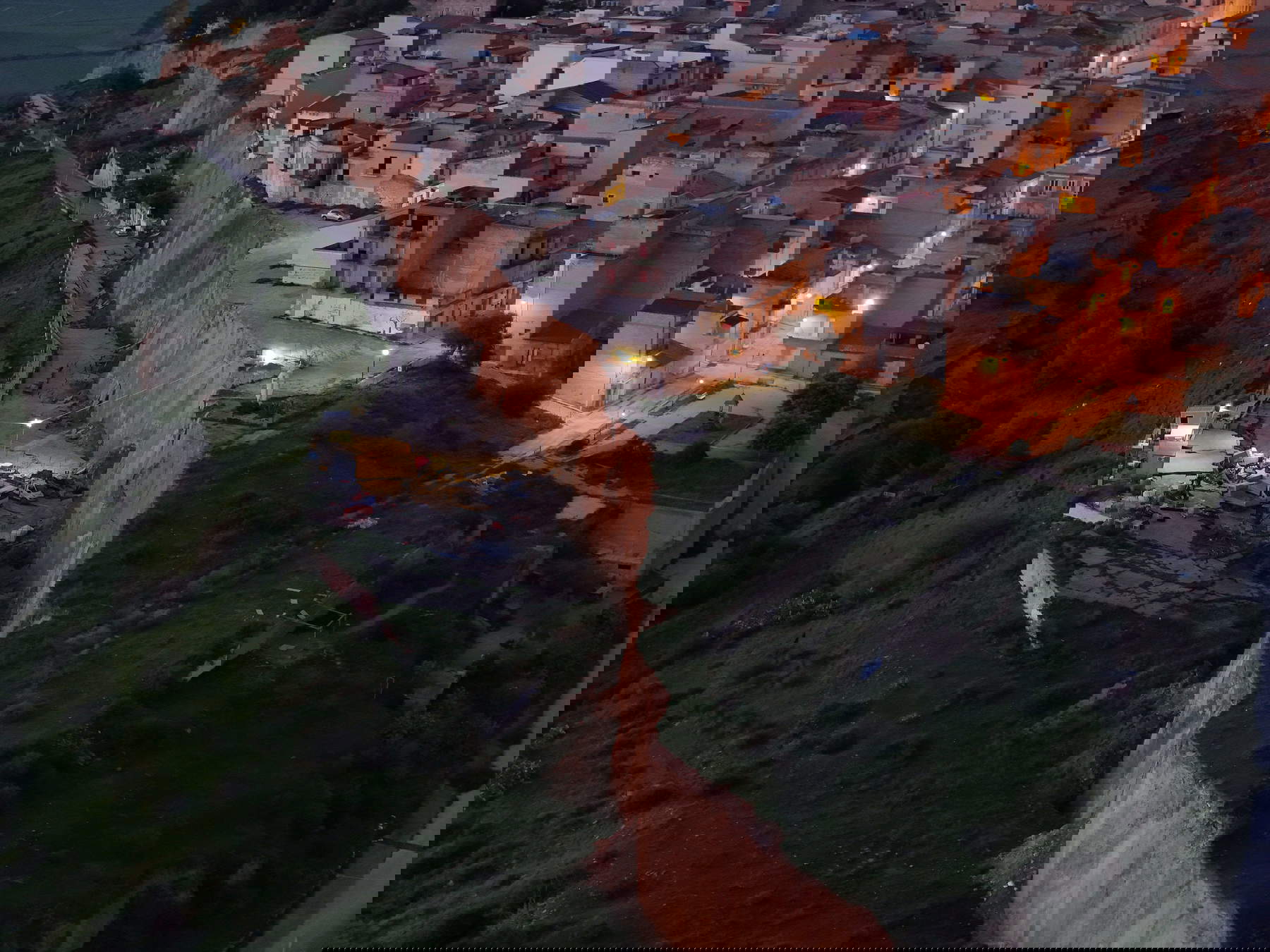
Here, on Feb. 2, the superintendent of Caltanissetta, Daniela Vullo, at the behest of the councillor of Cultural Heritage and Sicilian Identity Francesco Paolo Scarpinato, carried out an inspection to check the state of cultural assets, including the “Angelo Marsiano” Library, which holds about 5,000 volumes dedicated largely to the history of the city, which, however, being in the red zone is not accessible. Among the buildings of historical interest at risk, only one turns out to be fully listed, Palazzo Iacona di Castellana. While for the church of Maria Santissima delle Grazie, a list of paintings and statues to be transferred to other premises has been drawn up only on the spot. Had the cultural heritage affected been larger, the Region would not have had an emergency management tool, as it could have done in the distant past.
The Risk Map, in fact, had been activated in the early 2000s by the Regional Center for Planning and Restoration (CRPR) in Palermo, under the direction of Guido Meli, while the project manager was Roberto Garufi (both retired), in collaboration with the state-level project manager, Carlo Cacace (also retired, supporting as a volunteer the new Department of Protection).
But there is much more. In 2007, with the Palermo Resolution of October 21, in the context of the international conference promoted by the CRPR in Palermo, still under the direction of Meli, we had set ourselves the ambitious goal of initiating, in the presence of as many as 200 representatives from 27 countries, the construction, for peace and culture, of a network among Research Institutes applied to the preservation of cultural heritage in the Mediterranean capable of activating shared policies for the management and safeguarding of the latter in a highly unstable area. Because among the various risks to be weighed there is also the anthropogenic one, linked to terrorist acts. And Sicily in the Mediterranean is deeply immersed in it. It is not, of course, just a geographical issue.
The interregional coordination that was then intended to be woven for heritage at Sicily’s proposal was certainly a complex, long-term action dependent on the resources mobilized for cultural cooperation between countries.
But it was also the only project within the island’s borders that foundered. Of the Risk Charter today there is no trace either at the CRPR or at the level of the central services of the Department of Cultural Heritage and Sicilian Identity. The dismantling began in 2011, when the completion of the Territorial Information System, aimed more strictly at civil protection needs, was no longer funded (Po Fesr 2007-2013, for 639,980.00 euros). It was also intended to merge the other databases of the Department of Cultural Heritage into “Vincoli in rete,” the cooperative platform between the three Mibact systems (Risk Map, Protected Assets and SIGECweb). But already since 2010 there had been a total destructuring of the Palermo Center itself with the senseless transfer of highly qualified personnel to other institutes of the Department: a veritable diaspora of acquired skills. Thrown away 4 million European funds that the Center from 2001 to 2008 had managed, spent and concluded. This means that today in case of calamitous events such as the one in Niscemi, in an island where nine out of ten municipalities have areas at high risk of landslides (Ispra data cited by Minister for Civil Protection and Sea Policies Nello Musumeci), of an earthquake, operators, Superintendencies and Civil Protection can no longer access the online database. Today a landslide, tomorrow it could be an earthquake in a region with high seismicity. In this case, for example, clicking above the epicenter opened a spatial fan in which it was possible to immediately identify the assets included within the so-called “buffer zone” of seismic influence, thus enabling targeted intervention and prioritization.
The blindness of the policy leveraged technical reasons. The closure of the Sit was attributed, in fact, to alleged criticalities detected during operation, but also to the more trivial need to identify more suitable premises where to allocate the server. That everything worked until 2009 had, on the other hand, been confirmed by Cacace, for whom “the system implemented should have included expenses for evolutionary maintenance capable of correcting the normal criticalities that emerge during use.” As the country organizes itself, the question remains whether Sicily can really take the risk ... of being found unprepared for the next risky occasion.

The author of this article: Silvia Mazza
Storica dell’arte e giornalista, scrive su “Il Giornale dell’Arte”, “Il Giornale dell’Architettura” e “The Art Newspaper”. Le sue inchieste sono state citate dal “Corriere della Sera” e dal compianto Folco Quilici nel suo ultimo libro Tutt'attorno la Sicilia: Un'avventura di mare (Utet, Torino 2017). Come opinionista specializzata interviene spesso sulla stampa siciliana (“Gazzetta del Sud”, “Il Giornale di Sicilia”, “La Sicilia”, etc.). Dal 2006 al 2012 è stata corrispondente per il quotidiano “America Oggi” (New Jersey), titolare della rubrica di “Arte e Cultura” del magazine domenicale “Oggi 7”. Con un diploma di Specializzazione in Storia dell’Arte Medievale e Moderna, ha una formazione specifica nel campo della conservazione del patrimonio culturale (Carta del Rischio).Warning: the translation into English of the original Italian article was created using automatic tools. We undertake to review all articles, but we do not guarantee the total absence of inaccuracies in the translation due to the program. You can find the original by clicking on the ITA button. If you find any mistake,please contact us.


























 IT
IT FR
FR DE
DE ES
ES CN
CN


