





There was a day in the year when Venice stopped being a city and became a bride. It happened duringAscension Day: forty days after Easter, during the “Feast of the Sensa” (“Sensa” is Ascension in Venetian), the Serenissima donned her richest clothes, went down to the sea, and performed a gesture as old as her own greatness: she threw a ring blessed by the Patriarch of Venice into the waves of the Adriatic. Officiating this unique ceremony, known as the “Marriage of the Sea,” was the Doge, aboard a gilded and gleaming galley called the Bucintoro. And it was this event that Giovanni Antonio Canal, known as Canaletto (Venice, 1697 - 1768), stopped on canvas in a number of his paintings, the most famous of which is probably the one known as The Bucintoro at the Dock on Ascension Day, from 1740, now preserved at the Giovanni and Marella Agnelli Art Gallery in Turin.
The work, which Lionello Puppi, one of the foremost scholars of Venetian art, called “an excellent interpretation of one of Canaletto’s favorite themes,” is part of a series of six views attributed to the Venetian painter, which for a couple of centuries have been kept in the Buccleuch collection in Edinburgh. It is not an isolated work, but a piece within a larger project of documenting the civic and ceremonial life of Venice, at a time when the urban view was becoming a refined and ambitious genre, appreciated as much by local nobles as by foreign travelers, especially Englishmen, who stopped in the lagoon during the Grand Tour. The commissioner of this painting, in particular, was a nobleman of Spanish origin, Count Giuseppe Bolagnos (born José de Navia Bolaño y Castro), who had been appointed regent of the Council of Italy by Emperor Charles VI: a personage of weight, inserted in the circuits of European power, who was evidently seeking in those canvases not just a luxury souvenir, but an authoritative representation of Venetian magnificence.
The Feast of the Sensa, in fact, was not simply a religious celebration. It was the visible synthesis of at least a double historical memory. On the one hand, it commemorated one of the most important victories of the Venetian Republic on the sea, namely the one obtained by Doge Pietro II Orseolo over the Dalmatian pirates, achieved on Ascension Day in the year 1000 (or 998, according to other traditions), a victory that had moreover sanctioned the beginning of Venetian influence on the Dalmatian coast. On the other, a significant diplomatic event was remembered: the reconciliation between Pope Alexander III and Emperor Frederick Barbarossa, which took place in 1177 thanks to the mediation of Venice. According to legend, it was on that very occasion that the ceremony of the marriage to the sea was born, because at the time of what went down in history as the Peace of Venice, Alexander III is said to have granted Doge Sebastiano Zani and his successors the possibility to celebrate the marriage of the sea, as if to seal with a symbolic act the Venetian dominion over the Adriatic (we know, however, that Peter II Orseolo’s victory over the Dalmatians was already being commemorated on that date). Two stories therefore intertwine on that day, that of military might and that of diplomatic cunning, both converging in the image of the Doge who, on the Bucintoro, approached the Lido to perform the ritual gesture.
The Bucintoro was a floating manifesto of Venetian power. A small, richly decorated galley, entirely gilded and covered with red cloth, with the flag of St. Mark garroting on top, it represented the very essence of Doge ceremonial. Its history is long and troubled: the example depicted in Canaletto’s painting, designed by Stefano Conti in 1729, was the last version built before the fall of the Venetian Republic. The end of this sumptuous ship was inglorious: with the arrival of French troops in January 1798, the galley was demolished and its gold decorations removed. A deliberately symbolic gesture, as if to erase not only an object, but an entire civilization. And this is why the pictorial representations of the Bucintoro take on a value today that goes beyond the aesthetic one: they are visual documents. Of all these representations, Canaletto’s is considered by art historians to be one of the most accurate.
The boat’s very name has a complex history, layered with misinterpretations and misunderstandings that have accumulated over the centuries. The most suggestive (but also the most unfounded) version has it that the term derives from a mythological creature that is half man and half ox, a kind of bovine variant of the centaur, the bucentaurus. This reading has led some to imagine that the galley carried a bovine head as a figurehead. But medieval Venetian public acts tell a different and much more prosaic story: in those documents the vessel is called navis Bucinatoria, the ship of the bucinatori, that is, of the buccina players, the military wind instrument used to publicly signal the arrival of the Doge. In time, the buccina players were replaced by trumpeters, but the name remained, slowly morphing into Bucintoro and then bucintaurus, with that suffix that evoked the mythological world and ended up feeding the erudite fantasies of the Renaissance. The figurehead, after all, was not a bovine head at all: it depicted Venice in the guise of Justice, a majestic female figure, far more complex than a simple naval decoration.
The origin of the popular name bucintoro thus lies in Venetian civil ceremonies, on those occasions when the doge’s galley was employed to receive distinguished guests. In 1483, Doge Giovanni Mocenigo embarked on the Bucintoro to go to receive Renato, Duke of Lotharingia. The following year, the Maggior Consiglio resolved to send the same ship to greet Leone Sforza, son of Ludovico. Again, in 1492, the Senate ordered the Bucintoro to go to meet the cardinal patriarch of Venice, Maffio II Girardi, who was returning from Rome, where he had participated in the conclave that elected Rodrigo Borgia as Alexander VI. These episodes, handed down in public documents, show how the galley was not reserved only for the ceremony of the marriage of the sea, but was an all-round ceremonial instrument, the moving sign of Venetian sovereignty.
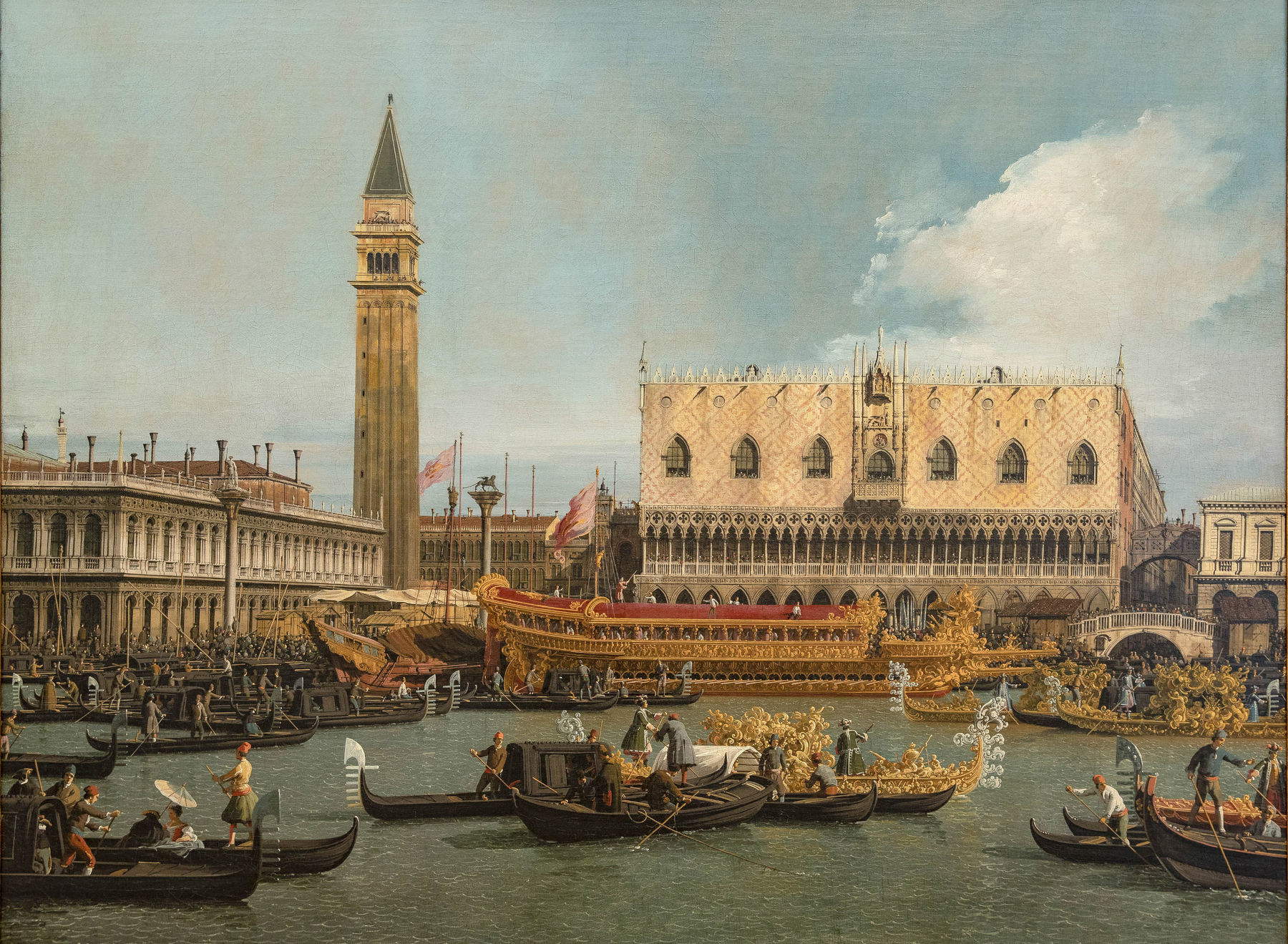
In front of all this historical and symbolic weight, Canaletto, one might say, posed as a chronicler. An extraordinarily precise chronicler, certainly, but also capable of transforming chronicle into painting. The point of view chosen is central, almost frontal, and allows the entire scene to be embraced at a single glance: the Bucintoro moored at the pier in front of the Doge’s Palace, the stretch of water that opens to the right increasingly crowded with boats, the square in the background with its iconic buildings. To the left, St. Mark’s bell tower soars above the building designed by Jacopo Sansovino and Vincenzo Scamozzi that now houses the Marciana Library. On either side of the entrance to the square the two columns with statues of St. Theodore and the Lion of St. Mark are very easily recognized. On the right, on the other hand, here is the facade of the Doge’s Palace, while further down, beyond the flags of the square, the outline of the facade of St. Mark’s can be recognized in passing. Finally, on the right, closing the view, one notices the Ponte della Paglia, as it was before the 19th-century reconstruction.
It is, however, the body of water that encapsulates all the visual energy of the painting. As it widens to the right, the number of boats increases, and they seem to be placed one on top of the other because of a refined and conscious perspective effect. The routes of the boats intersect and generate a continuous visual tension. The warm light that pervades the entire composition reflecting off the water and parade gondolas contributes to the sense of richness.
Note then, in the lower part of the painting, the figures wearing the bautta, the typical Venetian Carnival mask, with its hood and cloak, a presence is anything but incidental: in Venice, social distinctions blurred behind the masks, and the co-presence of the ritual that is associated with Carnival with the more official state ceremony adds a note of ambiguity to the scene. This is also because the audience attending the Marriage of the Sea is not an anonymous crowd: it is a society that shows itself, that stages itself, that actively participates in the construction of the collective spectacle.
Compared to the paintings of the first period of Canaletto’s career, characterized by deeper shadows and almost theatrical atmospheres in the scenographic sense of the term, this canvas belongs to a different, mature phase. It is a painting of light, the kind of painting most commonly associated with Canaletto’s flair. In particular, it is a golden light that envelops every surface and transforms the painting into a celebration of Venetian luminosity. The brushstroke is loose but precise, capable of rendering architectural details with the fidelity of a topographical relief and at the same time evoking the movement of water, the rustle of fabrics, and the vibration of air.
The perspective complexity of the painting deserves separate consideration. Each building seems to be constructed with its own vanishing point, which is never that of the others. It is probable, therefore, that Canaletto did not execute his work completely in his studio, but used, as indeed he was wont to do, an optical camera, that is, an instrument that, through a mirror, projected the scene onto a sheet of paper, and in this way the artist could trace the outlines of what he saw, to fix the composition. The result is a view that seems animated despite being still, and that captures the atmosphere of the place with an almost documentary truth.
The collecting history of this painting is also a small epic of European taste between the 18th and 20th centuries. By 1738 the work was in the hands of Francis Scott, Earl of Dalkeith, later Duke of Buccleuch and Queensberry, at Dalkeith Palace in Edinburgh, having come there by descent through the marriage of Caroline, daughter of John Campbell, 2nd Duke of Argyll. For more than two centuries the painting remained in that prestigious Scottish collection, along with the other five views in the series. In 1952 it passed to London dealer Edward Speelman, then to Marlborough Fine Art Ltd. in London. From there it entered the Giovanni and Marella Agnelli collection in Turin, and in 2002 it was destined for the Pinacoteca that the Agnelli family had founded in the Piedmontese city, where it is now preserved and accessible to the public.
This collecting trajectory also tells something of Canaletto’s critical fortunes over time. Purchased by a Scottish nobleman at the height of the eighteenth century, when Venetian views were in high demand by Grand Tour travelers as memories of an unforgettable journey, the painting traversed the art market and eventually landed in one of Italy’s most important private collections of the twentieth century. Its reputation has never wavered: Canaletto has remained one of the most recognizable and appreciated painters in the entire history of vedute, and this painting in particular represents one of the highest moments of his art.
One cannot close the discussion of this work without mentioning that his fortune was not only pictorial. Indeed, Canaletto’s views found a second life through the engravings of Antonio Visentini, who transposed them into prints destined for a much wider circulation. It was through this mechanism of reproduction, which today we could almost compare to the digital diffusion of an image, that the Venetian painter’s fame was consolidated nationally and internationally, reaching audiences that would never have been able to see the original canvases in person.
And so, looking at The Bucintoro at the pier on Ascension Day, one has the feeling of being in front of something more than a painting. One is in front of a historical document of exceptional value, the testimony of a vanished ceremony, the portrait of a city that no longer exists, and the technical summit of an artist capable of making precision a form of poetry. The gold of the Bucintoro, the reflections on the water, the masks in the crowd, the flag of St. Mark waving in the golden air of a May day, all this still lives on the canvas, intact, as if Venice had never stopped marrying the sea.

Warning: the translation into English of the original Italian article was created using automatic tools. We undertake to review all articles, but we do not guarantee the total absence of inaccuracies in the translation due to the program. You can find the original by clicking on the ITA button. If you find any mistake,please contact us.




























 IT
IT FR
FR DE
DE ES
ES CN
CN


