





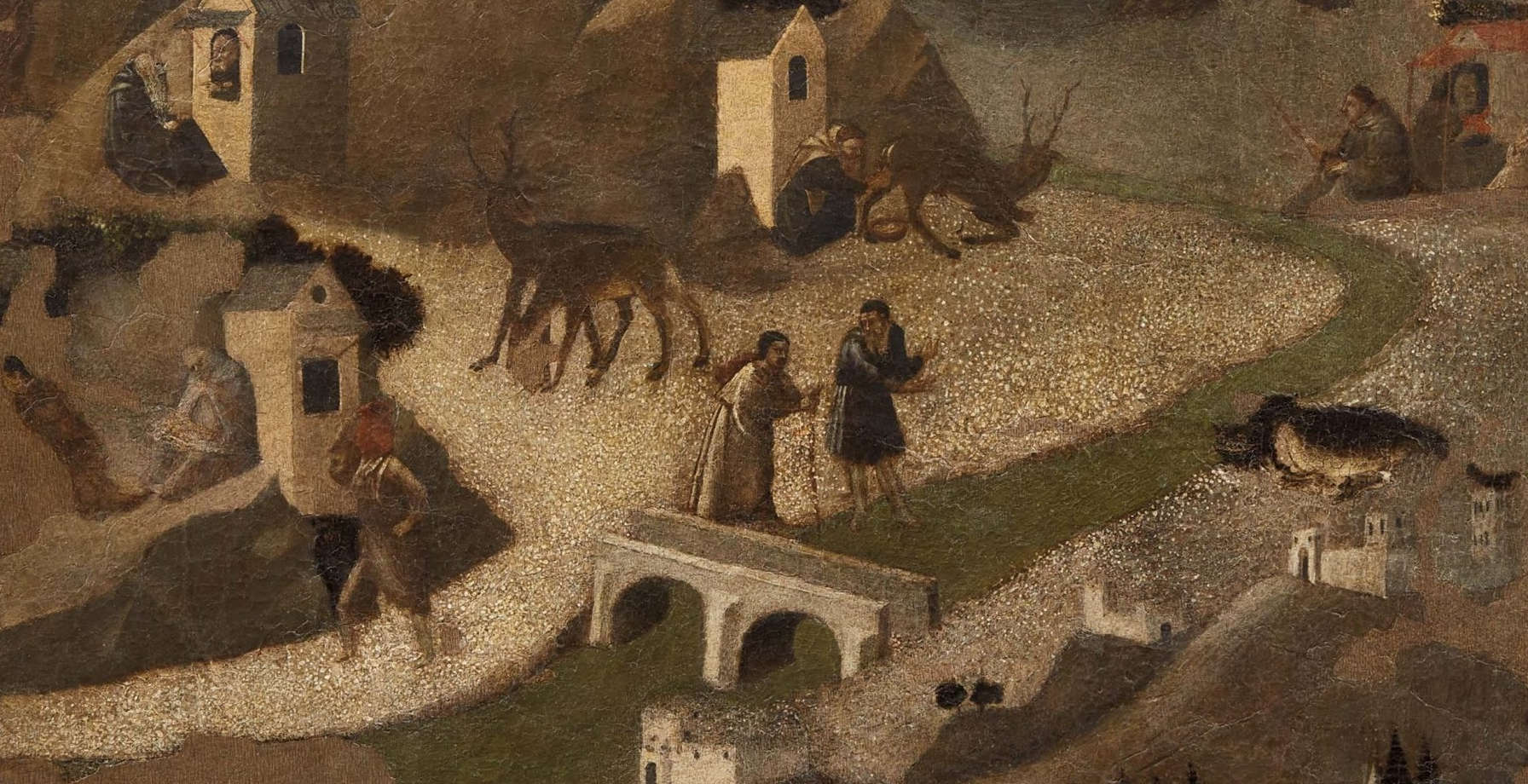
A work that disappeared from circulation for more than half a century, but was never forgotten by art history, suddenly returns to the center of international attention. In fact, the Thebaid attributed to Beato Angelico (Fra’ Giovanni da Fiesole, born Guido di Pietro; Vicchio, c. 1395 - Rome, 1455) re-emerges after fifty years of absence from the market and will be auctioned by Pandolfini next May 20 in Florence, as part of the sale dedicated to Old Master Paintings.
The work, which was alienated in 1970 during a sale held at the Palazzo Internazionale delle Aste ed Esposizioni in Florence and subsequently disappeared from circulation, had remained alive exclusively through black-and-white photographs and a long tradition of criticism that had always sustained its autograph authorship. Despite its untraceability, the painting has continued to occupy a significant place in studies devoted to the Dominican master, thanks in part to ongoing comparisons with another version of the same subject now in the Szépművészeti Múzeum in Budapest.
The reappearance of the panel therefore represents an event of particular significance not only for the antiquarian market, but also for art-historical research. In fact, works of this quality, especially when accompanied by a complex critical and attributive story, reemerge very rarely, and often change the framework of studies devoted to the artist and his cultural context.
The Thebaid on auction at Pandolfini’s is also related to the specimen kept at the Museum of San Marco, which came from the Uffizi Gallery and was recently exhibited in the major exhibition dedicated to Beato Angelico between Palazzo Strozzi and San Marco. According to scholars, the two works would be autograph and almost identical versions of a subject that was already extremely rare in early Renaissance figurative production. The image in fact depicts the life of hermits in the desert of Thebes, a theme taken from the Vitae Patrum, a collection of texts dedicated to the spiritual experiences of the Desert Fathers. It is a subject that enjoyed a fair amount of success between the 14th and 15th centuries, especially in monastic circles interested in ascetic and contemplative practices.
The painting attributed to Beato Angelico, made in tempera on panel then transferred to canvas, measures 68.5 by 56 centimeters and is estimated at between 150 thousand and 250 thousand euros. But economic value represents only one aspect of the transaction: what makes the appearance of the work particularly significant is its historical and critical weight.
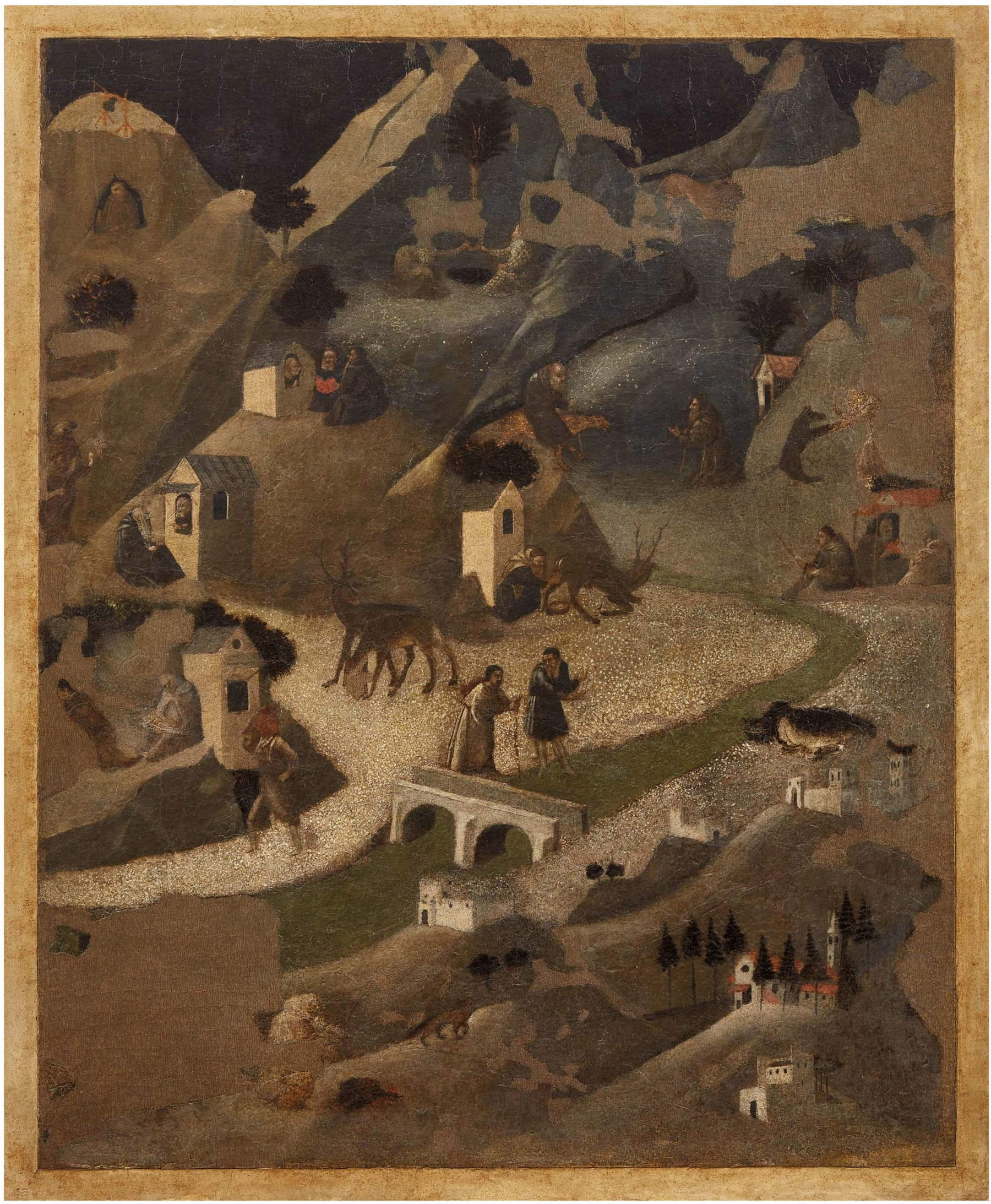
Indeed, the perfect (or near-perfect) correspondence between the different versions of the composition has over time fueled numerous studies of early 15th-century artistic practice. According to art historian Miklós Boskovits, in the early Renaissance the modern concept of artistic originality did not yet exist, and the production of copies or multiple versions of the same subject was an entirely common practice. In this context, the presence of two nearly identical Thebaids is not interpreted as an anomaly but as direct evidence of the operating methods of the artistic workshops of the time. Scholars consider it likely that both works derive from the same preparatory design and were intended for functionally similar contexts.
The question regarding the painting’s original destination, however, remains open. Several hypotheses formulated over the years try to identify the religious and cultural context within which the work would have been conceived. One of the most credited theories links the panel preserved in the Uffizi to the Vallombrosian milieu, pointing out how Hugford’s brother was a Vallombrosian monk and how the Bartolini Salimbeni family, from which the fragment now on auction comes, owned a chapel in the Florentine church of Santa Trinita, which was closely linked precisely to the Vallombrosian order.
In recent years, however, another interpretation has also emerged strongly, suggesting a possible Camaldolese origin for the work. This reading is linked to the figure of the monk Ambrogio Traversari, who in 1423 completed the first part of the translation from the Greek of the Vitae Patrum, contributing to the diffusion of the text in Italian religious and cultural circles in the early fifteenth century. The iconography of the Thebaid lends itself particularly well to this spiritual context. Indeed, the scenes devoted to hermits in the desert, ascetic practices and contemplation represented models of religious life deeply linked to both Vallombrosian and Camaldolese traditions. In both interpretations, the work appears closely connected to a monastic universe interested in meditation and spiritual quest.
The reappearance of the painting now makes it possible to reopen the direct comparison between the different versions of the work and to investigate technical, stylistic and conservation aspects that until now could only be studied through photographic material. The absence of the original had in fact limited the possibilities of analysis for decades, while at the same time fueling the fascination and mystery around the painting.
The quality of the panel and the complexity of its attributive story make it one of the most anticipated lots of the upcoming Italian auction season. For the international market of ancient paintings, the appearance of a work related to Beato Angelico represents an event of absolute importance, especially considering the rarity of autograph works available on the market.
The work comes from the historic Bartolini Salimbeni collection in Florence, one of the most important families in the Florentine aristocratic tradition. It subsequently went through the November 20, 1970 sale at the International Palace of Auctions and Exhibitions, where it was listed as lot 113, before entering a private collection and disappearing from the public scene altogether.
For more than fifty years, therefore, the Thebaid remained invisible, although it continued to be mentioned in the specialist literature and attributional discussions devoted to Beato Angelico. Its reappearance today makes it possible to directly verify many of the hypotheses developed by scholars over the decades and offers new elements for understanding the Florentine painter’s production in the context of early Renaissance spirituality.
A central figure in 15th-century art, Beato Angelico occupies a fundamental role in the transition between late Gothic culture and Renaissance sensibility. His works stand out for their intense spirituality, chromatic refinement, and ability to translate the mystical dimension into images of extraordinary formal elegance. The Thebaid fully belongs to this visual and cultural universe, in which landscape and religious narrative become instruments of meditation. For this reason, too, the return of the work takes on a significance that goes beyond the mere commercial event. In fact, the Pandolfini sale offers an opportunity to bring back to public attention an important piece of early 15th-century Italian painting and to reopen the debate on one of the most fascinating themes of Angelico’s production.
 |
| The Thebaid attributed to Fra Angelico found after 50 years: will go to auction in Florence |

Warning: the translation into English of the original Italian article was created using automatic tools. We undertake to review all articles, but we do not guarantee the total absence of inaccuracies in the translation due to the program. You can find the original by clicking on the ITA button. If you find any mistake,please contact us.



















 IT
IT FR
FR DE
DE ES
ES CN
CN


