





It is not a retrospective, nor a simple reconnaissance of works made at different moments in his career. Corollary, the solo exhibition of Michele Chiossi (Lucca, 1970) set up in the spaces of Villa Nigra in Miasino (Novara) from June 6 to 27, 2026, intends rather to present itself as an open system of connections, returns and deviations, capable of relating recent and historical works through a web of formal and conceptual correspondences that crosses time without losing coherence.
The exhibition brings together a significant selection of the artist’s production, constructing a path that does not follow a linear chronology but instead privileges the dialogue between materials, forms and intuitions developed over the years. In fact, Corollary was born as a project that investigates the lateral consequences of an established artistic research, highlighting how each work can be read as a derivation, variation or expansion of a language that continues to transform while maintaining its own recognizable identity. At the center of the exhibition emerges one of the most characteristic elements of Chiossi’s poetics: the zigzag. More than a simple formal motif, this sign becomes a generative principle capable of running through the entire exhibition. The broken line introduces rhythm, tension and discontinuity, constantly questioning the idea of linear development and opening the space to a multiplicity of interpretations.
The zigzag appears in the drawings, sculptures and works that punctuate the exhibition itinerary, turning into a true visual grammar. Such is the case with Europe, a work from 2025 conceived as a steel swirl suspended in space that takes on the characteristics of a three-dimensional drawing. The work ideally dialogues with Capogiro, made in 1999, a revolving skull built on a fractured and unstable trend that anticipates many of the reflections developed later by the artist. Although belonging to different historical moments, the two works reveal the persistence of the same design tension and testify to the zigzag’s ability to traverse different eras, techniques and materials.
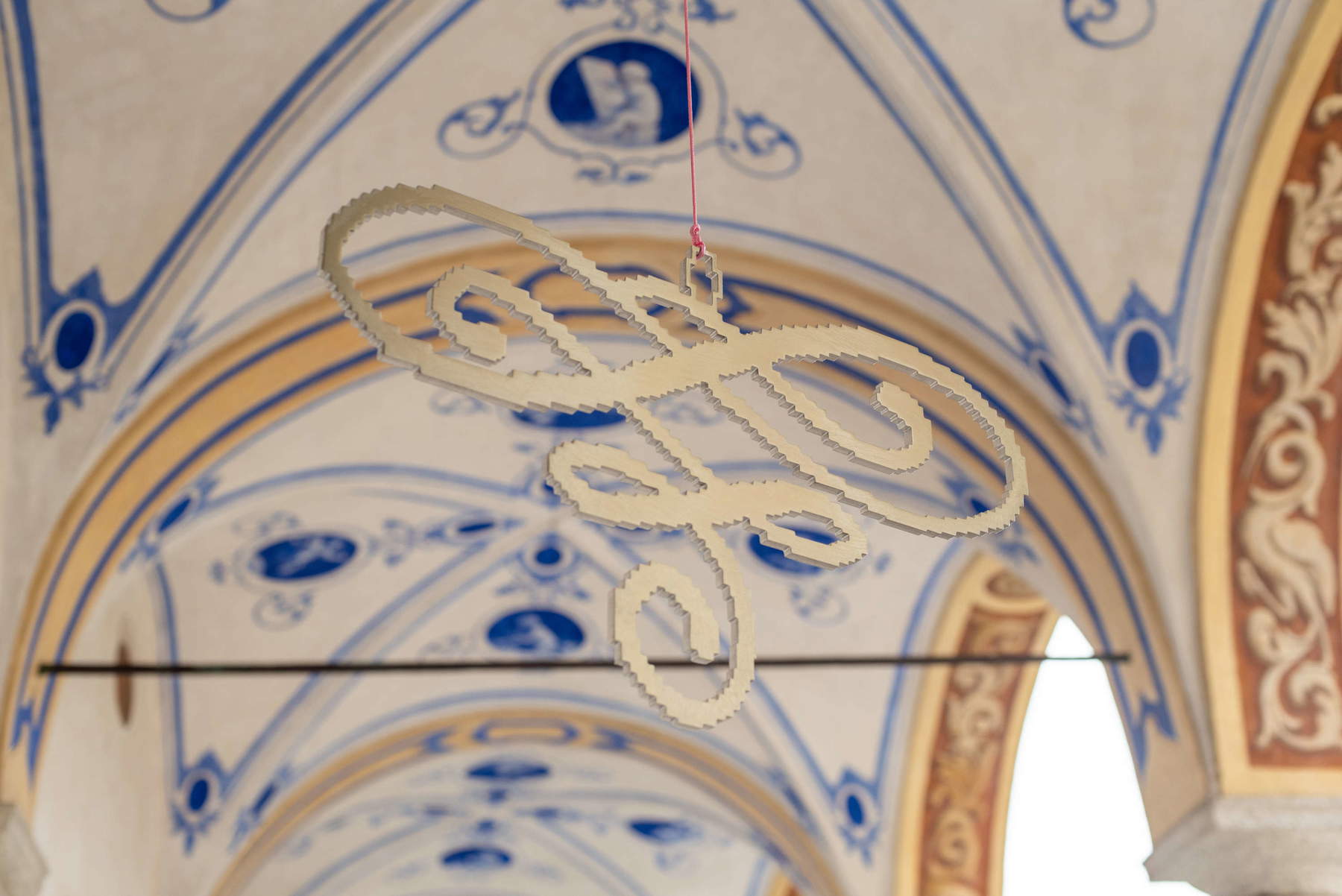
The exhibition highlights the wide variety of expressive media used by Chiossi. Steel sculptures coexist with brass castings, ceramics, paintings on marble, PVC canvases and silver interventions, delineating a path in which material experimentation is accompanied by a constant reflection on form. Each work seems to move along a line of precarious balance between order and deviation, control and loss, construction and disintegration. This dialectic represents one of the most significant aspects of the entire exhibition project. The forms arise from seemingly rigorous structures, from systems governed by precise compositional rules. However, it is precisely within these ordered devices that fractures and slippages open up, allowing the sign to emancipate itself from its initial control. The result is a language that does not seek to eliminate instability, but chooses to inhabit it, transforming it into an essential component of its expressiveness.
The exhibition’s cores also include a series of contemporary vanitas characterized by the presence of floral compositions. In these works, the artist rereads a centuries-old iconographic tradition, subtracting it from the purely symbolic dimension of transience to transform it into a broader reflection on time, transformation and permanence. Flowers thus become elements suspended between presence and dissolution, images that simultaneously evoke vitality and fragility.
The exhibition is developed in constant dialogue with the historical settings of Villa Nigra, one of the most significant places in the Lake Orta area. The architecture does not simply constitute the container of the works, but actively participates in the construction of the exhibition itinerary. The rooms of the villa become a field of resonance in which matter and memory confront each other, amplifying the tensions present in the works and encouraging a reading that goes beyond the exclusively plastic dimension to open up to a more contemplative sphere.
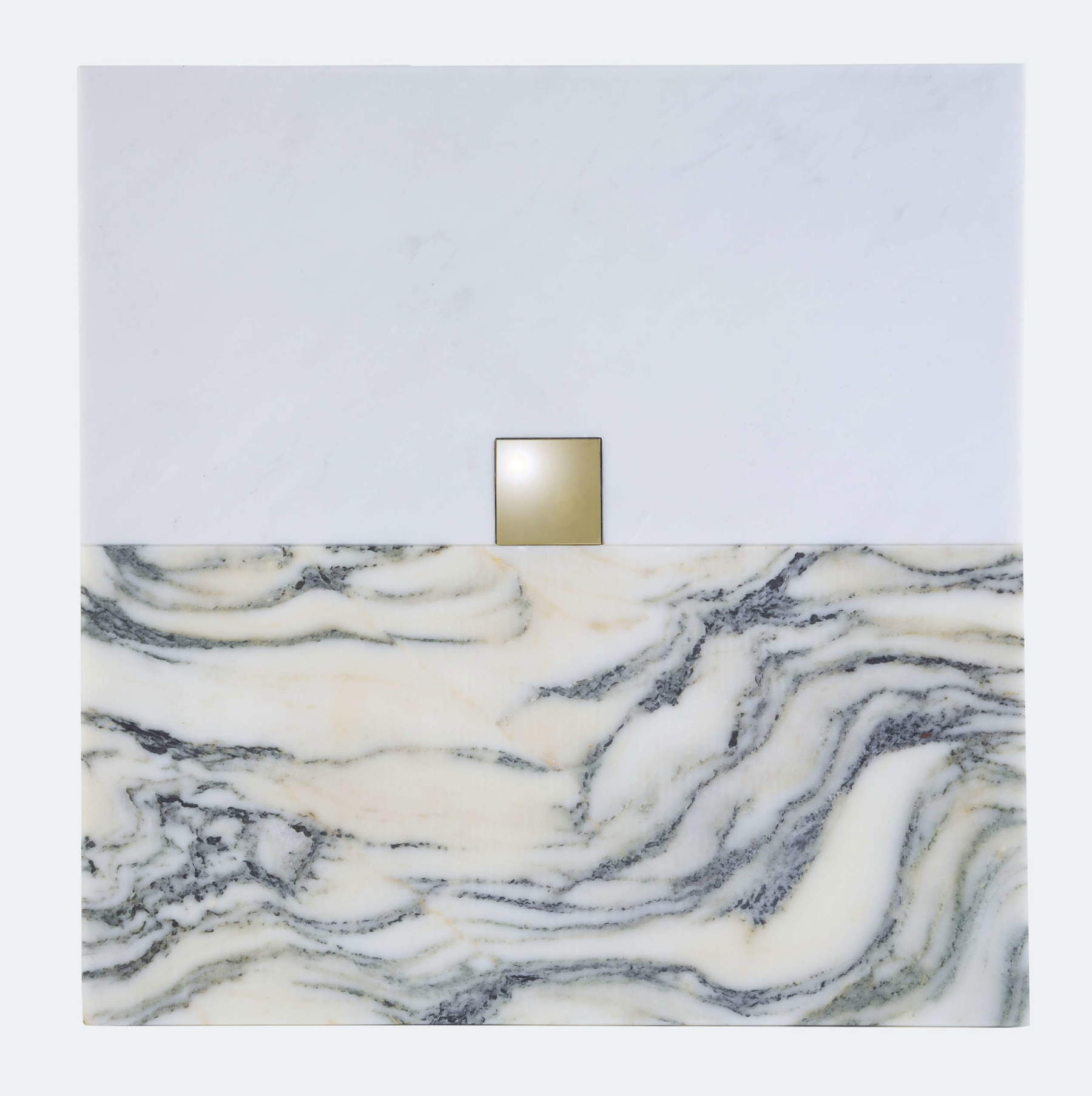
In this relationship with the place, a new work created especially for the occasion as a tribute to Antonio Calderara, a fundamental figure in twentieth-century Italian art and deeply linked to the territory of Lake Orta, takes on particular importance. The intervention combines marble and mirror metals in a reflection on the principles of order and balance, using light and abstraction as tools of perceptual investigation. The work establishes a subtle dialogue with Calderara’s research, without limiting itself to quotation or direct reference. Through the confrontation between reflective surfaces and stone materials, Chiossi aims to construct a visual device that relates formal rigor and perceptual instability, confirming one of the central themes of the entire exhibition: the possibility of finding balance precisely within complexity and continuous transformation.
The very title of the exhibition helps clarify the theoretical framework of the project. In logic and mathematics, a corollary is a consequence that follows naturally from a previous proposition. Chiossi uses this term to suggest the idea of a system of relationships in which each work represents a possible outcome of a larger research, but without exhausting its meaning. The works are thus not arranged according to a defined hierarchy, but are presented as elements of an open constellation, in which each work refers back to other works, generating unexpected connections.
Further emphasizing this approach will be the artist’s publication entitled Corollary. Derived System, which will be presented on the occasion of the exhibition. The volume, accompanied by a text by Martina Alemani, delves into the main theoretical cores of the project and offers a key to understanding the relationships that bind the works on display.
The publication is not configured as a simple catalog, but as an extension of the exhibition project, a tool through which to continue the reflection initiated in the rooms of Villa Nigra. Through Alemani’s critical contribution, the themes of deviation, derivation and the construction of open systems that characterize the artist’s research are analyzed.
|
| Michele Chiossi on display at Villa Nigra in Masino with Corollario |

Warning: the translation into English of the original Italian article was created using automatic tools. We undertake to review all articles, but we do not guarantee the total absence of inaccuracies in the translation due to the program. You can find the original by clicking on the ITA button. If you find any mistake,please contact us.




























 IT
IT FR
FR DE
DE ES
ES CN
CN


